
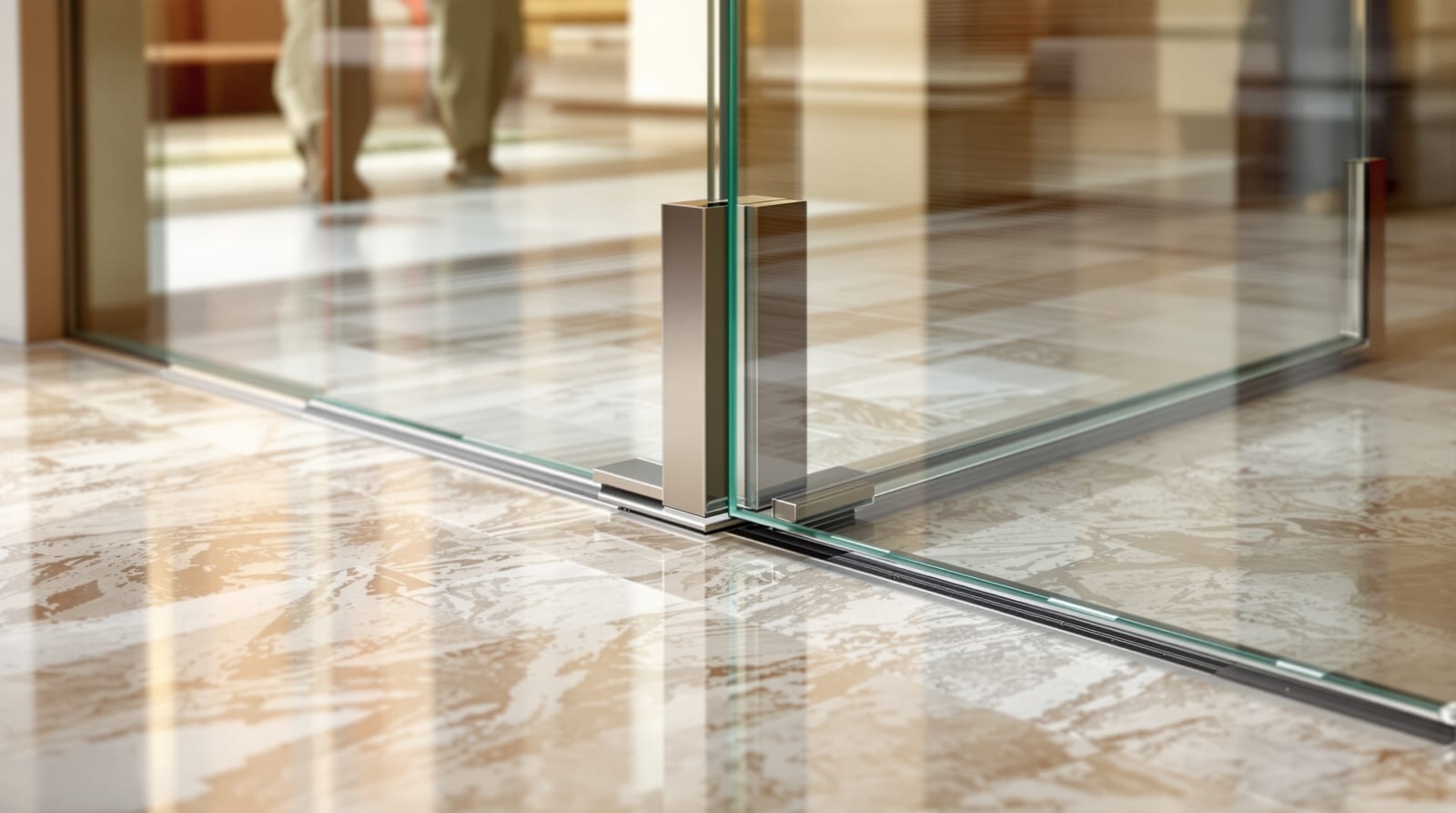
Floor Springs in India: The In-Floor Pivot for Heavy Glass & Wooden Doors (2026)
How a hydraulic floor spring works, how to pick the load rating for your glass or timber door, where it goes in the slab, and what it costs in India.
Walk into almost any showroom, café, clinic or upmarket Indian home with a heavy frameless glass entrance and you will see a door that has no visible hinge, no overhead closer, and yet swings open with one push, holds itself open, then glides shut without a slam. The mechanism doing all that work is hidden under your feet: a floor spring. It is the single component that makes a 60-80 kg sheet of toughened glass behave like a polite, self-closing door. Get its load rating or its slab pocket wrong, though, and you are looking at a door that sags, slams, or needs the floor broken open to fix. This guide explains how a floor spring actually works, how to size it for your door, and what it costs to do properly in India.
A floor spring is a specialist cousin of the overhead door closer. If you want the broader picture of self-closing devices, read our door closers guide first; this page goes deep on the in-floor pivot specifically. It is also the standard answer for frameless glass doors and glass doors, which usually cannot take a surface-mounted closer.
What a floor spring actually is
A floor spring is a sealed hydraulic mechanism set into a metal box (the "floor box" or "cement box") that is cast into the floor slab, directly under the pivot edge of the door. The door pivots on a spindle that pokes up through a flush cover plate. A matching top pivot, fixed to the lintel or frame above, keeps the door vertical. So the whole door hangs and turns on two points — bottom floor spring and top pivot — rather than on side hinges.
Inside the box, a strong coiled spring is compressed when you open the door. That stored energy is what closes the door again. The clever part is the hydraulic damping: the spring's push is bled through oil-filled chambers and adjustable valves, so the door closes at a controlled, smooth speed instead of snapping shut like a mousetrap. This is the same hydraulic principle as an overhead closer, simply turned 90 degrees and buried in the floor.
Single action vs double action
The big functional choice is which way the door swings.
- Single action: the door swings one way only (open inward or outward), then self-closes back to centre. Used for most main doors, office cabin doors and glass entrances where you do not want people walking into the door from the wrong side.
- Double action (two-way / both-way swing): the door swings open in both directions and self-centres to the closed position from either side. This is the classic café, restaurant, kitchen-service and showroom door — push it from inside or outside and it works. Double-action floor springs are also popular for partition and traffic doors.
Most quality floor springs are convertible: the same body can be set up single or double action during installation by adjusting a cam and the stop. Confirm this when buying, because it changes how the slab and threshold are detailed.
The three things a floor spring controls
A good floor spring gives you independent, screw-driver adjustment of three behaviours through valves on the body:
1. Closing speed (sweep) — how fast the door travels from fully open back to about 15 degrees. You slow this down so the door does not race shut.
2. Latching speed (final snap) — the last 15 degrees to closed. On a latching door you may want a slightly firmer final push so the latch engages; on a frameless glass door you usually want it gentle.
3. Hold-open — many models offer a "hold-open" position, typically at 90 degrees (sometimes 105 degrees), where the door stays parked open instead of closing. This is brilliant for shifting furniture or during loading hours, but must not be used on a fire-exit door, which has to self-close every time. If a door is on an escape route, specify a non-hold-open floor spring.
Some premium units also offer backcheck — a hydraulic cushion near the fully-open position that stops a gust of wind or an over-enthusiastic push from flinging the door against a wall. On heavy glass doors and breezy coastal or high-rise locations, backcheck is worth paying for.
Load rating: the number that matters most
Floor springs are rated by the maximum door weight and maximum door width (leaf width) they can carry. Both matter, because a wide door puts more leverage on the pivot than a narrow one of the same weight. Manufacturers publish a table; you pick the model whose limits comfortably exceed your actual door, never one you are scraping under.
To use it you need to know your door's weight. For a frameless toughened-glass door, weight is roughly 30 kg per square metre per 10 mm of glass thickness (12 mm glass is about 30 kg/m2). A typical 1000 x 2100 mm 12 mm glass leaf is around 2.1 m2, so roughly 60-65 kg — before you add the patch fittings, lock rail and handle. Always round up and add a margin.
| Floor spring class | Door weight (up to) | Leaf width (up to) | Typical use | Indicative ₹ (unit only) |
|---|---|---|---|---|
| Light / single-action | 80-90 kg | ~800 mm | Light glass cabin door, internal timber door | ₹2,000-3,500 |
| Medium (most common) | 120-130 kg | ~950-1000 mm | Standard frameless glass main door, office door | ₹3,000-5,000 |
| Heavy double-action | 150 kg | ~1100 mm | Café/two-way doors, showroom entrance, wide glass | ₹4,500-6,500 |
| Extra-heavy / commercial | 180-300 kg | 1100-1300 mm | Mall, large glass façade door, heavy hardwood | ₹6,000-15,000+ |
Prices are unit-only, indicative and vary by city, brand and patch fittings; add roughly 18% GST and fitting labour. Heavy hardwood and double doors push you up a class. When in doubt, ask the dealer for the manufacturer's load chart and match it to your measured/calculated door weight — do not guess. Our door cost calculator and door size calculator help you scope the door itself.
How the floor spring sits in the door — a diagram
The floor spring is only one of three coordinated parts. Here is how they stack up on a frameless glass door.
The door's weight bears down on the floor spring's spindle; the top pivot only steadies it. That is why the floor box must sit on solid, level structure and be perfectly aligned with the top pivot — any misalignment and the door will not self-centre or will rub.
Installation: plan it before the flooring goes down
This is the part homeowners discover too late. The floor box has to be cast into the slab and set to the finished floor level, which means it must be planned and positioned before your final flooring (tile, marble, vitrified, wood) is laid. Retro-fitting a floor spring into a finished marble floor means cutting and breaking a neat pocket, which is messy, expensive and rarely flush.
A correct sequence:
1. Mark the pivot point precisely, from the door schedule, plumbed against the top pivot location.
2. Form the pocket in the slab/screed at the marked point, deep enough for the box plus a bed of concrete.
3. Set the box in cement, dead level, with the cover plate at exactly the finished floor height — not the rough slab height. Get this wrong by even a few millimetres and the door drags or there is a gap.
4. Lay flooring around it, leaving a clean margin for the cover plate.
5. Fit the door and top pivot last, then adjust the speed and latch valves.
Because the box is buried, service access is from the top: the spindle and adjustment screws are reachable through the cover plate. Choose a model whose closing-speed and hold-open valves adjust from the top, so you never have to open the floor again.
Waterproofing — non-negotiable in India
A floor spring sits in a pocket in your floor, often near an entrance that sees rain, mopping water, monsoon splash, or — for a shower or wet-area glass door — constant moisture. Water that collects in the box rusts the spring and rots the hydraulic seals, and the box becomes a small reservoir. Protect it:
- Slope the surrounding floor away from the cover plate so water does not pool over it.
- Use a box with a drainage provision and seal the cover-plate edge.
- For coastal homes (Mumbai, Chennai, Kochi, Goa), specify stainless-steel internals or a galvanised box to fight salt corrosion.
- Never place a non-rated floor spring in a constantly-wet shower threshold — use a marine/wet-area rated unit, or a top-mounted pivot system instead.
Floor spring vs overhead door closer
Why bury a closer in the floor at all? Two reasons: looks and the type of door.
| Aspect | Floor spring | Overhead door closer |
|---|---|---|
| Appearance | Hidden in floor — clean, premium | Visible arm/body on top of door |
| Best for | Frameless glass, heavy/wide doors, two-way swing | Most timber/flush/metal doors |
| Door weight handled | High (up to 150-300 kg) | Moderate (sized by EN power, IS 3564) |
| Installation timing | Must be planned before flooring | Fits any time, surface-mounted |
| Two-way swing | Native (double action) | Not its strength |
| Service/repair | Floor access, harder | Easy — unscrew from door |
| Cost (unit + fitting) | Higher | Lower |
For a normal wooden bedroom or main door, an overhead or concealed closer (covered in our door closers guide) is simpler and cheaper. Reach for a floor spring when the door is frameless glass, very heavy, very wide, needs to swing both ways, or when a visible closer would spoil a minimalist look. For ordinary swing doors the choice is usually a surface closer; for glass it is usually a floor spring.
Where floor springs are used in Indian homes and shops
- Frameless glass main doors — the most common residential use, on villa and bungalow entrances and apartment lobbies.
- Café, restaurant and kitchen two-way doors — double-action floor springs for high-traffic, both-direction swing.
- Showrooms, clinics, salons, offices — heavy glass entrances and glass cabin doors.
- Glass partition and conference-room doors — where a clean, hingeless look is wanted.
- Heavy carved hardwood doors — occasionally, where a designer wants the door to pivot without bulky side hinges.
Brands and what to expect in India
You will mainly meet three tiers in the Indian market. Dorma (now dormakaba) is the long-standing premium reference for floor springs, with well-regarded load charts, backcheck and durability; expect to pay the most. Ozone is the popular mid-market choice, widely stocked, with a broad range of single/double-action units and patch fittings to match. Hardwyn and similar Indian brands (along with Godrej and Hettich in the closer/architectural-hardware space) cover the value-and-mid segment. Cheap unbranded floor springs from hardware bazaars are a false economy — they leak oil, lose closing control within a year or two, and replacing a buried unit is far more painful than buying a good one first time.
When ordering for a glass door, buy the floor spring, the top pivot, and the patch fittings (top and bottom clamps, lock patch) as a matched set, ideally same brand, so the geometry lines up. Mismatched parts are the usual reason a glass door will not self-centre.
Costs to budget in India (2026)
For a frameless glass main door, think in terms of a system, not just the spring:
- Floor spring unit: ₹2,000-7,000 for residential classes (heavy/commercial higher), indicative and varying by brand/city.
- Top pivot + patch fittings set: roughly ₹2,500-8,000 depending on brand and finish.
- Toughened glass leaf (12 mm): about ₹450-1,200 per sq ft, so a single leaf often ₹6,000-15,000+.
- Fitting labour and slab pocket work: typically ₹1,500-5,000, more if flooring is already laid.
- Add about 18% GST on materials and branded fittings.
So a complete done-properly frameless glass entrance on a floor spring commonly lands in the ₹18,000-40,000+ range for the door, glass, fittings and fitting — versus a fraction of that for a flush timber door on a surface closer. You are paying for the look and the engineering.
Common mistakes to avoid
- Under-rating the spring to save ₹1,000 — it sags, slams, and dies early. Always size up.
- Fitting it after the marble is laid — plan the box before flooring.
- Skipping waterproofing at an entrance or wet area — the buried unit rusts.
- Using a hold-open floor spring on an exit door — fire-exit and escape doors must self-close; pick a non-hold-open model there.
- Mixing brands of spring, top pivot and patch — the door will not self-centre.
- Ignoring the top pivot alignment — both pivots must be plumb in the same vertical line.
For the broader hardware picture, see our door hardware guide; for entrance placement tradition, the main door Vastu guide and entrance Vastu.
Frequently asked questions
Can I put a floor spring under an existing finished floor?
Yes, but it means cutting a neat pocket into your laid tile or marble, setting the box in cement at the exact finished-floor level, and re-laying the margin — messy and rarely as flush as planning it in from the start. If at all possible, position the box before the flooring goes down.
What load rating do I need for a glass door?
Calculate the glass weight first — a 1000 x 2100 mm 12 mm toughened leaf is roughly 60-65 kg before fittings. Pick a floor spring whose chart allows comfortably more weight and more leaf width than your door, with margin. Most standard frameless glass main doors use a medium-class spring rated to about 120-130 kg and ~1000 mm width.
Why does my floor-spring door slam or not close fully?
Usually the closing-speed or latching valve needs adjusting (a small screwdriver tweak from the top), or the spring is under-rated for the door's weight, or the top pivot is out of alignment so the door does not self-centre. A worn-out cheap unit that has lost its oil will also stop closing properly — that one needs replacement.
Floor spring or door closer — which is better for my main door?
For a normal timber or flush main door, an overhead or concealed door closer is simpler, cheaper and easy to service. Choose a floor spring when the door is frameless glass, very heavy or wide, needs to swing both ways, or when you want a hidden, minimalist look with no arm on top of the door.
Do floor springs work for two-way (café) doors?
Yes — that is a classic use. A double-action (both-way) floor spring lets the door swing open in both directions and self-centre to closed from either side, ideal for café, restaurant-service and high-traffic doors. Confirm the unit is set to double action at installation.
Export this guide
Related Guides — Deep-dive reading
Door Closers in India: Overhead, Concealed & Floor Spring Guide (2026)
How hydraulic door closers work, how to size them by door width and weight to IS 3564, and what they cost for Indian homes.
Home Doors & EntrancesFitting Door Closers: New Install Guide (India 2026)
Fit an overhead door closer from new — choose the mounting, template and drill the fixings, mount body and arm, set closing and latching speed.
Home Doors & EntrancesSwing Doors in India: Double-Action Café Doors, Self-Closing & How to Read Door Handing
Two-way swinging pass-through doors, self-closing AC-room doors, and a plain-English guide to door handing — left/right hand, inswing/outswing — so you order the right swing the first time.
Home Doors & EntrancesRelated Tools — Try Free
Door Cost Calculator
Estimate the all-in cost of a door — leaf, frame, hardware, fitting and GST — by type, material and size.
Door CalculatorDouble Door Planner
Decide single vs double from your opening width and get leaf sizes, hardware and a Vastu even-leaf note.
Door PlannerDoor Hardware Cost Estimator
Estimate the all-in hardware cost for a door — hinges, lock, handle, closer, bolts, stopper and fitting — with GST.
Door Calculator