
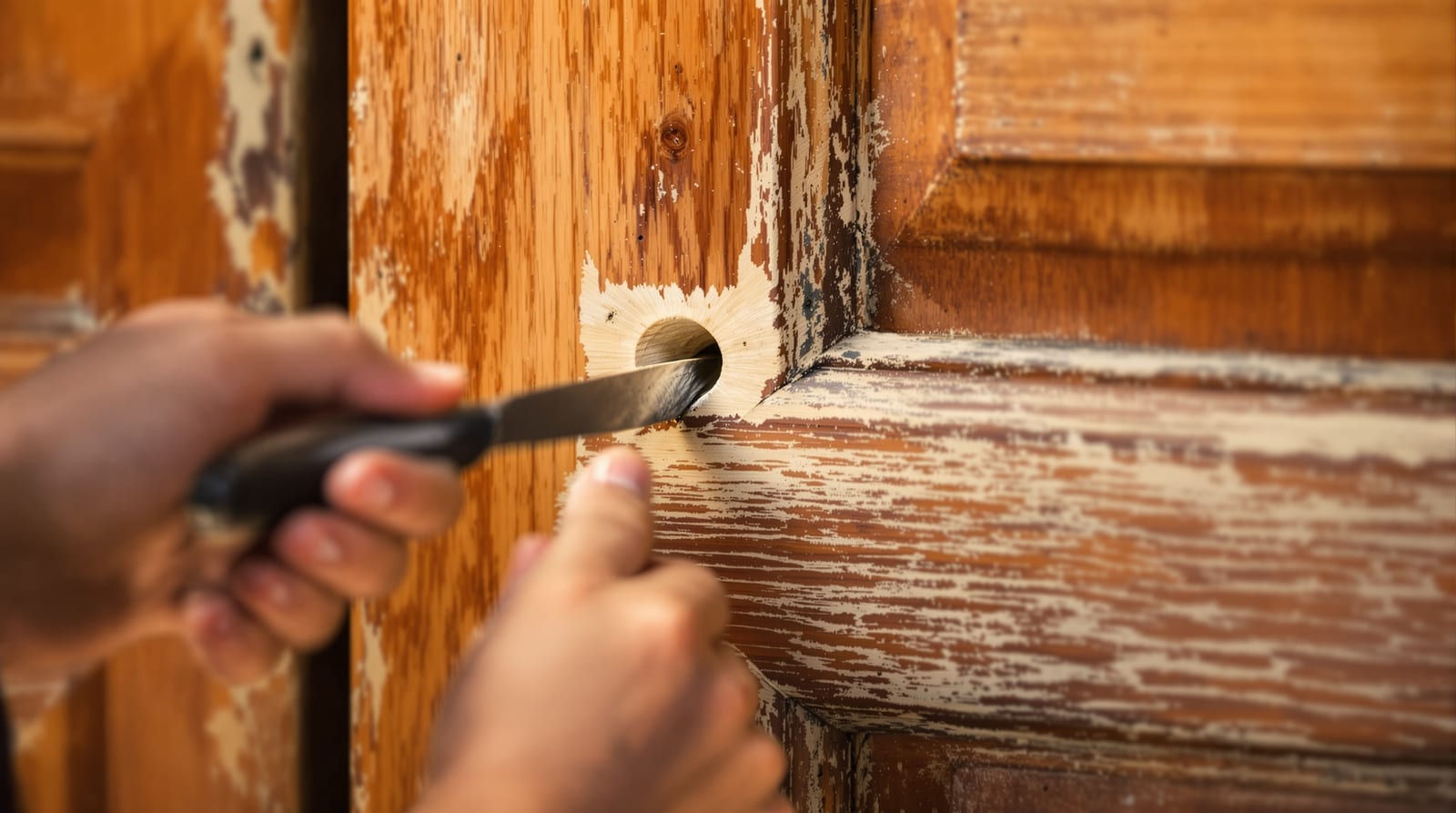
How to Fill Door Holes and Dents: DIY (India 2026)
Patch screw holes, dents and punched hollow-core damage with filler or epoxy, then sand, prime and paint so it disappears.
A door collects scars over the years — a dent where a chair back hit it, the four old screw holes left when you moved a tower bolt, the punched dimple in a hollow flush door after a knock. The good news: you can fill door holes and dents yourself in a weekend, and once you sand, prime and paint, nobody will ever spot the repair. This guide walks through every common case — solid-wood holes, deep gouges, raised dents, and the tricky hollow-core punch — with the right filler for each, honest cost ranges, and the point at which you should stop and call a carpenter.
Difficulty: easy to moderate. Time: 30 minutes of work spread over a day (filler needs drying time). Cost: ₹150–600 in consumables for DIY, versus ₹500–2,000 if a carpenter does a veneer or laminate patch.
Before you fill door holes and dents, identify the damage
The fix depends on the damage and on whether the door is solid (timber, teak, engineered) or hollow-core flush (a thin plywood/HDF skin over a honeycomb or batten frame). Tap the door: a hollow ring across most of the leaf means hollow-core, and that changes the method for anything bigger than a screw hole.
| Damage | Door type | Best fix | Difficulty |
|---|---|---|---|
| Old screw / hardware holes | Any | Wood filler or matchstick-and-glue plug, then sand | Easy |
| Shallow dent (no broken fibres) | Solid wood | Wet-cloth + iron to raise the grain | Easy |
| Dent with broken/torn fibres | Solid wood | Sand, fill with wood putty, sand level | Easy |
| Deep hole or gouge (>5 mm) | Solid wood | Two-part epoxy wood filler | Moderate |
| Punched / pushed-in hole | Hollow-core | Backing material + filler, build in layers | Moderate |
| Crack along the grain | Solid wood | See repair a cracked wooden door | Moderate |
| Water-swollen, soft, crumbling | Any | Often replacement — see below | Pro |
If the area is soft, spongy or dark, that's likely rot or water damage, not a simple dent — read fix a water-damaged door and door bottom rot repair before you fill, because filler over rotten timber just falls out again.
Tools & materials you'll need
- Wood filler / putty (water-based or solvent) for shallow holes — ₹100–300 a tub
- Two-part epoxy wood filler for deep holes and edges — ₹250–600 a pack
- Putty knife / filling blade (flexible) — ₹50–150
- Sandpaper: 120-grit and 220-grit — ₹20–60 per sheet
- Sanding block (or an offcut of wood)
- Clean cotton cloth, a household iron, a little water (for the dent trick)
- Wood primer / sealer and matching paint, PU/melamine polish or a touch-up marker
- For hollow-core: backing material — a wad of newspaper, a piece of fibreglass mesh, expanding foam, or a thin plywood strip
- Optional: matchsticks/toothpicks + wood glue for screw-hole plugs; masking tape; dust mask
A dust mask is worth it — sanding old paint and filler is messy, and some older doors carry lead-based paint.
Fixing old screw and hardware holes
The most common job: you've shifted a hinge, lock or tower bolt and left empty holes.
1. Clear any loose splinters or old plug from the hole.
2. For holes you'll re-screw into later (a new hinge nearby), don't just fill — fillers hold screws poorly. Dip wooden matchsticks or toothpicks in wood glue, pack them tightly into the hole, snap them flush when dry, and drive the new screw into solid wood. See fix loose door hinges and stripped hinge-screw fix for the same trick on hinge screws.
3. For holes you only need to hide, press wood filler in firmly with the putty knife, slightly proud of the surface (it shrinks as it dries).
4. Let it dry per the pack (usually 1–4 hours; epoxy faster).
5. Sand flush with 120-grit, then smooth with 220-grit.
6. Prime and paint or polish to match.
Fixing dents in solid wood
A dent where the wood is compressed but not torn can often be raised back — no filler needed.
1. Sand off any polish or paint directly over the dent (the trick needs to reach bare wood).
2. Lay a damp — not soaking — cotton cloth over the dent.
3. Set a household iron to medium-high and press it on the cloth for 10–30 seconds, moving it a little so you don't scorch the wood. The steam swells the crushed fibres back up.
4. Lift, check, and repeat. Most shallow dents lift level over a few passes.
5. Let it dry fully, sand lightly with 220-grit, then re-polish or paint.
If the fibres are broken or torn, steam won't help — sand the area, press wood putty in, let it dry, and sand flush. Light surface scratches are a different job: see scratched-door repair.
Deep holes in solid wood
For anything deeper than about 5 mm, or on an edge that takes knocks, ordinary filler is too weak — use two-part epoxy wood filler. It bonds hard, doesn't shrink much, and you can drill or screw into it.
1. Clean out loose debris; the cavity must be dry.
2. Mix the two parts on a scrap of card per the ratio on the pack — only as much as you'll use in the working time (often 5–10 minutes).
3. Press it in with the blade, overfilling slightly. For very deep holes, build in two layers, letting the first set.
4. Once hard (15–60 minutes), sand back: 120-grit to shape, 220-grit to finish.
5. Prime and finish.
Patching a hollow-core (flush) door
The punched-in hole in a flush door is the one DIYers get wrong — there's nothing solid behind the skin, so filler just disappears into the void. The fix is to create a backing first, then build up filler in layers.
1. Trim ragged edges of the hole back to clean skin with a sharp blade. Don't enlarge it more than you must.
2. Create a backing. Options: push a loose wad of newspaper into the cavity to act as a base; or feed in a strip of thin plywood/card and hold it against the back of the skin with glue; or squirt a little expanding foam, let it cure, and trim it flush — this makes the strongest base.
3. Over the backing, press in the first thin layer of filler to bridge the hole. Don't fill it all at once — deep filler cracks and sinks.
4. Let it set, then add a second and third layer, each slightly proud, until you're level with the surface.
5. Sand flush with 120-grit, finish with 220-grit.
6. Prime and paint the whole panel area so the patch blends.
A hollow-core door is thin and light, so a knuckle-sized patch is fine — but a fist-sized hole near a hinge or lock may have weakened the leaf. If it flexes or the skin is delaminating widely, a patch is cosmetic only; budget for a replacement leaf (₹3,000–6,000 for the leaf) and see door replacement guide.
Finishing so the repair vanishes
A filled hole that's left raw or painted carelessly is more obvious than the damage was. The finishing is what sells it.
1. Sand level — the patch must be flush with no ridge you can feel with a fingertip.
2. Prime the bare filler; raw filler soaks up paint differently and shows as a dull spot.
3. Match the finish. On a painted door, feather paint outward and, ideally, recoat the whole panel or stile so there's no halo. On a polished teak or veneer door, a melamine/PU touch-up and a colour-matched marker work better — see door polishing & refinishing and the door painting guide.
4. On veneer or laminate doors, filler shows badly because you can't reproduce the grain — a proper door veneer repair or laminate peeling fix gives a cleaner result.
India reality: in humid and monsoon months, filler and primer dry slowly and water-based fillers can stay tacky. Work on a dry day, give each coat extra time, and keep a fan on the area. If your door keeps denting because it swells and rubs, you may be chasing the wrong problem — see fix a swollen door in monsoon.
Cost: DIY vs carpenter
| Job | DIY cost | Carpenter cost |
|---|---|---|
| Fill a few screw/hardware holes | ₹150–300 (filler + sandpaper) | ₹300–800 (visit) |
| Raise / fill a dent + repaint area | ₹200–500 | ₹500–1,200 |
| Deep hole, epoxy fill | ₹300–600 | ₹600–1,500 |
| Hollow-core punch patch | ₹300–600 | ₹800–2,000 |
| Veneer / laminate patch | — (tricky DIY) | ₹500–2,000 |
| Replace a flush leaf | — | ₹3,000–6,000 (leaf) + labour |
GST at 18% applies to the materials you buy. Want a quick estimate for your door before you start? Try the door repair cost estimator, and if the damage looks borderline, the repair vs replace door calculator helps you decide whether filling is even worth it.
When to stop and call a carpenter
Filling is for cosmetic and small structural damage. Stop and get a professional in if:
- The wood is soft, dark or crumbling — that's rot, and filler won't hold.
- The leaf is warped or sagging — fix the warped door or sagging door cause, not the symptom.
- A hollow-core door has a large hole near the lock or hinge that's weakened the leaf.
- It's a glass, toughened-glass or automatic/sensor door — don't DIY these.
- The damage is widespread veneer/laminate failure rather than a single hole.
For the bigger picture on keeping doors sound, see the complete door guide and the door repair guide.
Frequently asked questions
What's the difference between wood filler and two-part epoxy filler?
Ordinary wood filler/putty is fine for shallow holes and dents and is cheap and easy. Two-part epoxy is stronger, shrinks less and can be drilled or screwed into — use it for deep holes, edges, and anywhere that takes a knock. For most household door dents, plain filler is enough.
Can I really raise a dent with just an iron and a cloth?
Yes, on solid wood where the fibres are compressed but not torn. The steam swells the crushed wood back up. It does nothing for broken fibres, veneer, laminate or hollow-core skins — those need filling or patching instead.
Why does filler keep falling out of my hollow-core door?
Because there's an empty honeycomb cavity behind the thin skin and the filler has nothing to grip. You must put a backing in first — newspaper, a plywood/card strip, or cured expanding foam — then build filler up in thin layers over it.
Will the repair be invisible?
On a painted door, yes — if you sand flush, prime, and repaint the whole panel so there's no halo. On polished teak or a veneer/laminate door it's harder, because you can't recreate the grain; a colour-matched touch-up or a proper veneer/laminate repair looks better than filler.
Can I fill a hole and screw new hardware into the same spot?
Not reliably into filler alone. Pack the hole with glue-coated matchsticks or toothpicks, let it set, then drive the screw into that solid plug. Plain filler doesn't grip screw threads well.
My door is soft and dark around the dent — can I just fill it?
No. Soft, dark, spongy wood is rot or water damage. Filler over it won't hold and the rot keeps spreading. Treat the water/rot first — and if the timber is gone, the door may need replacing rather than repairing.
Export this guide
Related Guides — Deep-dive reading
Door Repair Guide India: Fix Holes, Dents, Swelling, Hinges & Locks (2026)
A fix-it reference for Indian homes: every common door problem with a quick fix, a proper repair, a replace verdict, the materials needed, and indicative rupee costs.
Home Doors & EntrancesRepair a Cracked Wooden Door: DIY Guide (India 2026)
Hairline crack, deep split or panel separation? Match the right glue, clamp and filler method to the fault and refinish like new.
Home Doors & EntrancesDoor Troubleshooting Guide: Fix Any Door Fault (India 2026)
Symptom to cause to fix for every common door problem in Indian homes, with difficulty, time, cost and when to call a carpenter.
Home Doors & EntrancesRelated Tools — Try Free
Door Paint Calculator
Estimate paint and primer litres and cost to paint your doors by size, number of doors, coats and paint type.
Door CalculatorMaterial Comparison Sheet
India's interior material cheatsheet — plywood, finishes, hardware, countertops, paints, waterproofing.
Reference GuideDoor Cost Calculator
Estimate the all-in cost of a door — leaf, frame, hardware, fitting and GST — by type, material and size.
Door Calculator