
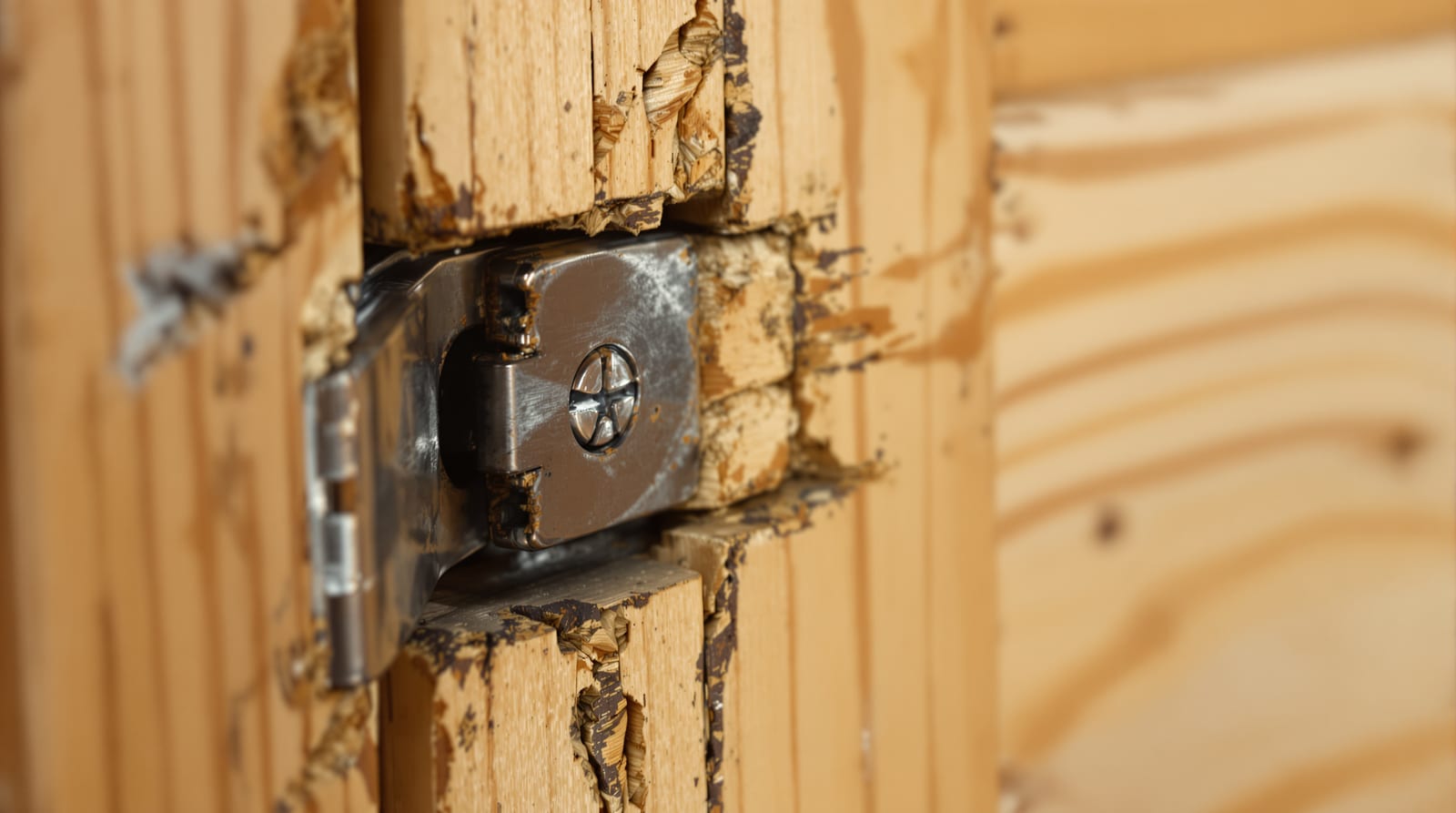
Stripped Hinge Screw Fix: 5 Proven Methods (India 2026)
Your hinge screw spins without biting and the door has dropped? Here are five ranked fixes, from a longer screw to a glued dowel plug.
You tighten the screwdriver, it spins forever, and the screw never bites. That endless turning is the classic sign you need a stripped hinge screw fix: the wood inside the hole has crumbled or compacted, so the threads have nothing to grip. It is one of the most common reasons a door starts to sag, scrape the frame or refuse to latch, and the good news is that almost every case is a genuine DIY job. You rarely need a new door, a new hinge, or even a carpenter. You need to give that screw fresh material to bite into.
This guide ranks the five proven fixes from quickest to most thorough, tells you which to pick for solid wood, flush or hollow-core, and frame-into-wall situations, and is honest about the point where you should stop and call a carpenter. For the wider picture, see the complete door guide and the phase pillar on door troubleshooting.
Why a hinge screw strips in the first place
A hinge carries the door's full weight on a few small screws. Over years of swinging, that load works the screws loose. Once a screw is even slightly loose the door drops a fraction, which levers the screw harder every time you use it, which loosens it more. In India there are extra culprits: monsoon swelling and drying cycles enlarge the hole, termite or borer activity hollows the wood behind the frame, and the soft pine or rubberwood used in many budget frames simply does not hold threads well. A door that drops and rubs is usually telling you the top hinge screws have stripped, the spot that carries the most pull. If yours is sagging, pair this fix with fix a sagging door and fix loose door hinges.
First, work out where the hole is
The right fix depends entirely on what is behind the screw. Pop the screw out and look (and feel with a toothpick).
| Hole location | What is behind it | Best fixes |
|---|---|---|
| Hinge into a solid wood frame or door edge | Solid timber | Longer screw, matchsticks, dowel plug |
| Hinge into a flush / hollow-core leaf | Thin face veneer + hollow or chipboard core | Dowel plug or epoxy rebuild (NOT a longer screw) |
| Hinge into a frame fixed against a masonry wall | Thin timber frame, brick/concrete behind | Wall plug into the masonry, longer screw |
| Strike plate on the frame side | Same as frame above | Identical fixes; see strike-plate note below |
The same methods fix a loose strike plate screw, since a strike plate is just another piece of hardware screwed into the frame. If your latch misses because the plate has shifted, also read door strike plate alignment.
The five fixes, ranked
Fix 1 - A longer or thicker screw (easy, 5 minutes)
The fastest fix. If the screw stripped its hole, a longer screw can reach past the damaged wood into fresh timber deeper down, and a slightly thicker-gauge screw bites wider, undamaged walls of the hole.
Use this when the hinge goes into solid wood or into a frame backed by masonry (a long screw can reach the wall). Do not use a longer screw on a flush/hollow-core leaf, there is nothing solid deeper in to grab. Keep the head the same size and shape so it still sits flush in the hinge's countersink. A common trick on the top hinge of a sagging door is to swap two short screws for 60-75 mm screws that bite into the wall stud behind the frame, this also lifts the door.
Fix 2 - Matchsticks or toothpicks + wood glue (easy, 20 min + drying)
The classic budget fix, and genuinely reliable in solid wood. You pack the hole with slivers of wood and glue so the screw has fresh fibre to thread into.
Best for solid wood frames and door edges where the hole is only mildly enlarged. It is cheap, costing the price of a matchbox and a bottle of Fevicol, but you must let the glue cure (4-6 hours, ideally overnight) before you drive the screw, or you simply re-strip it.
Fix 3 - A wooden dowel plug (moderate, 30 min + drying)
The strongest and most permanent of the wood fixes. You drill the ragged hole out clean, glue in a hardwood dowel, let it set, then drill a fresh pilot and drive the screw into solid new wood.
This is the fix for a flush/hollow-core leaf (it gives the screw real material where there was none), for a badly chewed-up hole, or anywhere you want a once-and-done repair. It needs a drill and a matching dowel but rewards you with a hole as good as new.
Fix 4 - A plastic wall plug (moderate, 15 min)
When the hinge frame is screwed against a brick or concrete wall, the real holding power is in the masonry. Drill through the stripped timber into the wall with a masonry bit, tap in a plastic wall plug (rawl plug), and drive the screw into that. This is often the only thing that truly holds a heavy main-door frame.
Fix 5 - Epoxy or wood-filler rebuild (moderate, 30 min + cure)
When the hole has crumbled into a cavity, or the surrounding wood is soft from old water damage, rebuild it. Pack the hole with two-part epoxy or a structural wood filler, let it cure fully, then drill a fresh pilot. This works almost anywhere, including hollow leaves and damp-softened frames, but cures slowly and is the messiest option. If the wood is soft because it is rotting or borer-eaten, treat the cause first, see fix water-damaged door and door borer and fungus treatment.
Pick the right fix
Step-by-step: the matchstick fix (most common)
This is the fix most homeowners will use, so here it is in full. Difficulty easy, total time about 20 minutes of work plus overnight drying.
1. Support the door. Wedge a folded cloth or a thin wooden shim under the outer (latch) edge of the door so the leaf is held level and the hinge is not under load while you work.
2. Remove the stripped screw(s). Back out only the screws from the affected hinge leaf. If the whole hinge is loose, you can take all of them out, but leave the other hinges holding the door.
3. Clean the hole. Blow out dust and any loose crumbs of wood. If the hole is greasy or polished inside, scrape it lightly so glue will stick.
4. Coat slivers in glue. Take wooden matchsticks (snap off the chemical head) or flat toothpicks. Dip them in white wood glue (Fevicol or similar).
5. Pack the hole. Push in glued slivers until the hole is tightly filled, snug, not bulging. Snap or trim them flush with the surface using a sharp blade.
6. Wipe and wait. Wipe off squeezed-out glue with a damp cloth. Let it cure 4-6 hours, ideally overnight. Skipping this step is the number one reason this fix fails.
7. Make a pilot hole. Once hard, drill or push an awl through the centre to make a small pilot. This stops the new screw splitting the plug.
8. Drive the screw home. Rehang the hinge and drive the screw by hand with a screwdriver (not a power driver, which over-spins and can re-strip). It should now bite firmly. Remove the shim and test the swing.
For the dowel-plug version, replace steps 4-6 with: drill the hole out to your dowel size with a wood bit, glue and tap in a hardwood dowel, trim flush, then continue from step 6.
Tools & materials you'll need
- Screwdriver set (matching the hinge screw head; Phillips for most Indian hinges)
- Hand drill or cordless drill + small wood bit and a masonry bit (for the wall-plug fix)
- Wooden matchsticks or flat toothpicks, OR a hardwood dowel, OR plastic wall plugs
- White wood glue (Fevicol) or two-part epoxy / wood filler
- A wooden wedge or shim, a cloth, a sharp blade or chisel
- Replacement screws: a few longer (50-75 mm) and thicker-gauge options
Costs and what each fix is worth
| Fix | Difficulty | Time | DIY parts cost | If a carpenter does it |
|---|---|---|---|---|
| Longer/thicker screw | Easy | 5 min | ₹10-50 (screws) | Part of a ₹400-800 visit |
| Matchsticks + glue | Easy | 20 min + dry | ₹20-80 | ₹400-800 visit |
| Wooden dowel plug | Moderate | 30 min + dry | ₹50-150 | ₹400-800 visit |
| Plastic wall plug | Moderate | 15 min | ₹20-80 | ₹400-800 visit |
| Epoxy / filler rebuild | Moderate | 30 min + cure | ₹150-400 | ₹500-1,000 |
| New hinge (if hinge itself bent) | Moderate | 30 min | ₹150-700/hinge | + half-day labour ₹400-800 |
Note that GST of 18% applies on the goods. Nearly every fix above costs less than ₹400 in parts, which is why this is such a satisfying DIY job, a stripped screw almost never justifies a service call on its own. If the hinge plate itself is bent or the knuckle is worn, the screw fix won't help; replace the hinge, see door hinge replacement.
When to stop and call a carpenter
Most stripped screws are DIY, but stop if:
- The frame wood crumbles when you touch it, soft, dark or powdery wood means rot or borer, not just a stripped hole. The frame may need a section replaced; see door frame repair.
- The door is heavy hardwood or teak and badly sagging, the load may have split the frame; a pro can reset the hinge mortise. See teak wood doors.
- It is an automatic, sensor or glass door, isolate the power first, and call the installer; never DIY-drill toughened glass or auto-operator mountings.
- Every screw on the frame side strips, the whole frame fixing is failing, often a job for replacement, see door replacement guide.
Not sure whether to repair or replace the whole door? Run the repair vs replace door calculator, or get a parts-and-labour figure from the door repair cost estimator.
Frequently asked questions
Why does my hinge screw just spin and never tighten?
The threads in the wood have been chewed away or compacted, so the screw has nothing to grip. This is a stripped hole. Give it fresh material to bite into, longer screw, glued matchsticks, a dowel plug or epoxy, and it will hold again.
Do matchsticks and glue really hold a door long-term?
Yes, in solid wood, provided you pack the hole tightly and let the glue cure fully before driving the screw. For a hollow flush leaf or a badly enlarged hole, step up to a glued hardwood dowel, which is stronger and just as permanent.
Can I just use a bigger screw?
Often, yes, a thicker or longer screw bites undamaged wood. But it only works where there is solid timber (or a masonry wall) behind the hole. On a hollow-core flush door there is nothing for a longer screw to reach, so use a dowel plug or epoxy instead.
My hinge is on a frame fixed to a brick wall, what should I use?
A plastic wall plug. Drill through the soft frame timber into the masonry with a masonry bit, tap in a rawl plug and screw into that. For heavy main doors, this is usually the only fix that truly holds.
The wood around the hole is soft and dark, is it still fixable?
Maybe not by screw fix alone. Soft, dark, powdery wood signals water damage, rot or borer. Treat or cut out the bad wood first, see fix water-damaged door, or you will simply re-strip the repair.
Should I use a power drill to drive the new screw?
No, finish by hand. A power driver over-spins and can strip your fresh repair in seconds. Drill a small pilot hole, then turn the screw home with a hand screwdriver until it is snug, not over-tight.
Export this guide
Related Guides — Deep-dive reading
Fix Loose Door Hinges: Easy DIY Repair Guide India 2026
Tighten, re-anchor or replace sagging hinges with the matchstick trick and longer screws — the #1 cure for most door faults.
Home Doors & EntrancesDoor Frame Repair: Fix a Damaged Chowkat (India 2026)
Split jambs, kicked-in frames, loose chowkats, rotted feet and out-of-square frames — a clear DIY repair guide for Indian homes.
Home Doors & EntrancesDoor Hinge Replacement: DIY Step-by-Step Guide (India 2026)
Match the size, type and finish, then swap a worn or rusted hinge yourself without taking the whole door off its frame.
Home Doors & EntrancesRelated Tools — Try Free
Door Cost Calculator
Estimate the all-in cost of a door — leaf, frame, hardware, fitting and GST — by type, material and size.
Door CalculatorDoor Hardware Cost Estimator
Estimate the all-in hardware cost for a door — hinges, lock, handle, closer, bolts, stopper and fitting — with GST.
Door CalculatorWindow Hardware Cost Calculator
Estimate window hardware cost — hinges, handles, locks, rollers and multipoint gears.
Window Calculator