
Warped Door Fix: Bowed Door Repair Guide (India 2026)
How to measure a bow, the realistic fixes that actually work, and the honest point where a warped door needs replacing.
A warped door fix is one of those repairs where honesty matters more than enthusiasm. A door that no longer sits flat against its frame — bowing out at one corner, refusing to latch, letting in a draught — is a frustrating thing, and the internet is full of confident promises. The truth is gentler: some warps are easy to live with or correct in an afternoon, and some mean the leaf is finished. This guide from Studio Matrx walks you through measuring the bow, the genuinely useful fixes, and the point where spending more money is throwing it after a door that will never come straight again.
Why doors warp in the first place
A warp is the timber (or core) moving unequally. One face takes on or loses moisture faster than the other, the two faces change dimension at different rates, and the leaf curves towards the drier, more shrunken side. Understanding the cause tells you whether a fix will hold.
| Cause | What's happening | Will a fix hold? |
|---|---|---|
| Moisture imbalance | One face sealed/polished, the other bare — bare face swells in monsoon | Often, if you seal both faces |
| One-side sun or heat | West-facing or beside a stove; that face dries and shrinks | Sometimes, with shading + sealing |
| Cheap hollow-core leaf | Thin skins over honeycomb; little structure to resist bowing | Rarely — usually replace |
| Stored or hung flat-side down | Leaned against a wall for weeks before fitting | Sometimes self-corrects, or clamp |
| Green/unseasoned timber | Wood was never properly dried before milling | No — it will keep moving |
| Water damage at the bottom | Bottom rail soaked, swelled, then dried twisted | No if rotted — repair or replace |
The single most common Indian culprit is moisture imbalance: a door polished beautifully on the room side, left raw on the bathroom or balcony side, then put through a monsoon. The raw face drinks humidity, swells, and bows the leaf. That one is genuinely fixable. A bowed hollow-core flush door, sadly, usually is not.
Measure the bow before you decide anything
Never guess how bad a warp is — measure it. A 2–3 mm bow is cosmetic and often fixable with a hardware tweak. A 10 mm-plus bow on a solid door is a serious case; on a hollow-core leaf it is usually terminal.
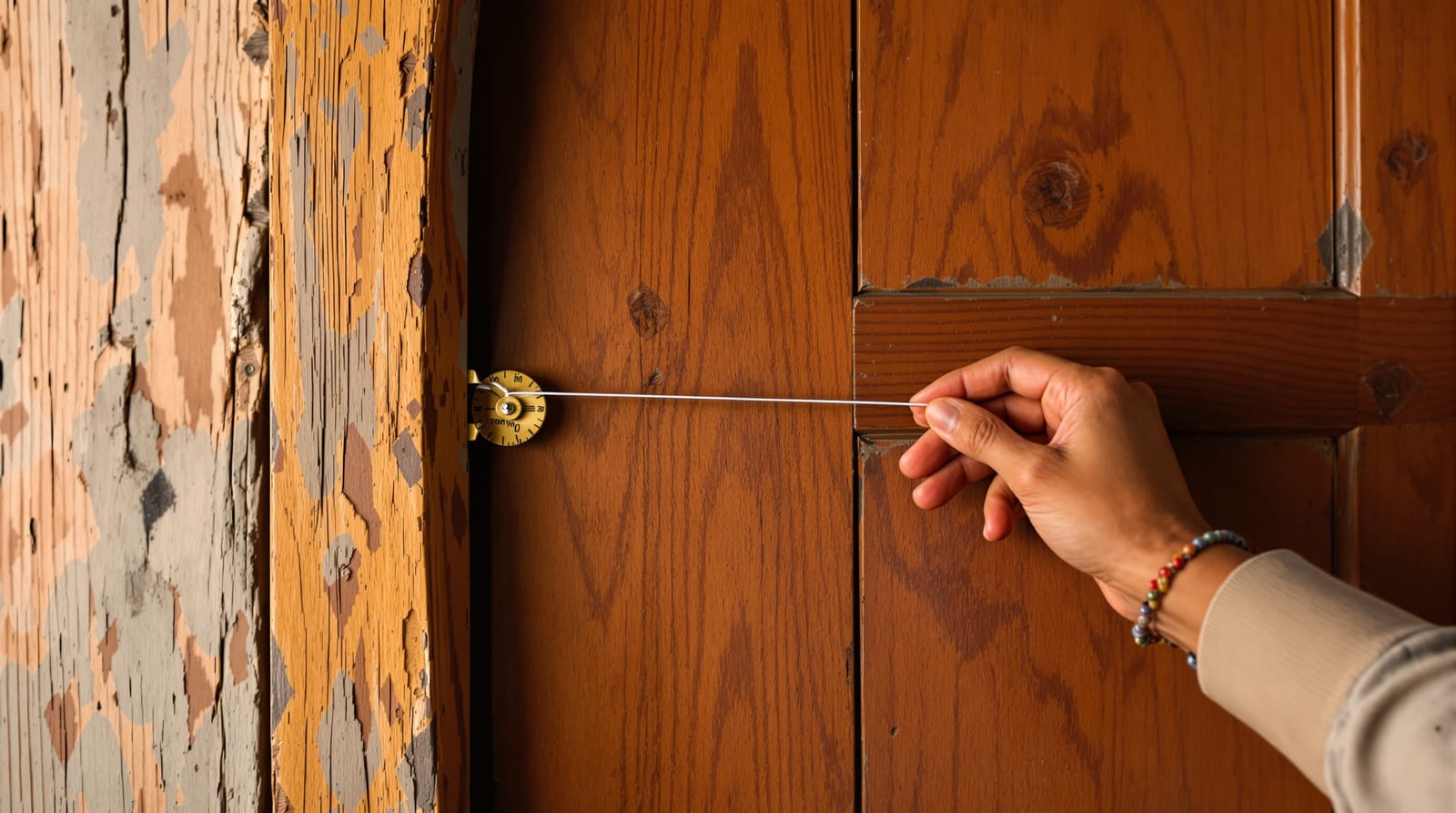
The string test
1. Take the door off its hinges if you can, or work on it in place.
2. Stretch a taut string (or fishing line) diagonally corner-to-corner, and then edge-to-edge top-to-bottom along the bowing face.
3. At the middle, measure the gap between the string and the door face with a ruler. That gap is your bow depth.
4. Repeat on both diagonals — this tells you whether it is a simple bow (curve in one direction) or a twist/cup (different corners off, harder to fix).
| Bow depth | Door type | Verdict |
|---|---|---|
| Up to 3 mm | Any | Cosmetic — adjust hardware, often no real fix needed |
| 3–6 mm | Solid / engineered | Worth trying the fixes below |
| 6–10 mm | Solid timber | Clamp + humidity may help; manage expectations |
| Over 10 mm | Solid timber | Usually replace the leaf |
| Any visible bow | Hollow-core flush | Replace — no reliable fix |
Tools and materials you'll need
- String or fishing line, a steel ruler/measuring tape
- A spare third hinge (₹150–700) and matching screws, a chisel, and a screwdriver
- A few sash clamps or G-clamps, or heavy weights (bricks, water cans)
- Sealer for both faces: PU/melamine polish, primer-paint, or exterior varnish (₹200–500)
- Sandpaper, wood filler, a damp cloth
- For the stop-bead method: a small pry bar/chisel, panel pins, a hammer
The realistic fixes
Fix 1 — Add a third (or fourth) hinge — easy, 1 hour
If the door bows outward in the middle of the latch edge, a third hinge placed at the centre of the bow pulls that point back towards the frame. This is the lowest-risk fix and often enough for a 3–6 mm bow.
1. Close the door and mark the point of maximum bow on the hinge stile.
2. Chisel a shallow mortise for the new hinge at that point.
3. Fit the hinge, screwing it tight into both leaf and frame so it draws the bow in.
4. Test: the door should now sit closer to the frame at the middle.
Difficulty: easy. Time: ~1 hour. Cost: ₹150–700 part, or ₹400–800 if a carpenter does it.
Fix 2 — Reposition the stop bead to meet the bow — easy, 1 hour
If the door latches and is structurally fine but looks gappy or rattles because it no longer touches the door stop, move the stop instead of the door. Prise off the planted stop bead, close the door, and re-pin the bead so it sits snug against the bowed leaf. The door now closes flush even though it is still slightly curved. This hides a bow rather than removing it — perfectly acceptable for an internal door.
Difficulty: easy. Time: ~1 hour. Cost: consumables only.
Fix 3 — Weight/clamp plus humidity — moderate, several days
Timber that warped from uneven moisture can sometimes be coaxed back. The idea: re-introduce moisture to the shrunken side, then clamp the leaf flat while it re-equalises and dries straight.
1. Lay the door bow-side up across two trestles or supports.
2. Lightly dampen the concave (shorter) face with a wet cloth — damp, never soaking.
3. Place sash clamps across the bow, or stack heavy weights along the high points, with a flat board to spread the load.
4. Leave it clamped in a shaded, airy spot for 3–7 days, checking daily.
5. When it reads flat on the string test, seal both faces immediately (see Fix 4) so it stays put.
This works best on solid timber with a modest bow, and results vary. It will do nothing for a hollow-core door.
Difficulty: moderate. Time: 3–7 days. Cost: consumables; clamps if you don't own them.
Fix 4 — Re-seal both faces — moderate, half a day
This is the cure for the most common cause and the essential follow-up to any straightening. An unsealed face keeps drinking humidity and the door re-warps. Sand both faces lightly, clean off dust, and apply the same sealer (polish, primer+paint, or varnish) to both faces and all four edges, including the top and bottom edges people always forget. Equal sealing means equal moisture movement, which means a flat door. See our door painting guide and door polishing and refinishing for technique.
Difficulty: moderate. Time: half a day plus drying. Cost: ₹200–500 materials.
The honest verdict: when to replace
A badly warped solid door with a bow over 10 mm, a door that has cupped or twisted (different corners off), or any hollow-core flush door that has bowed, is usually beyond an economical fix. You can spend a weekend and a carpenter's fee chasing it, and it will move again with the next monsoon. A new flush leaf is ₹3,000–6,000; a quality solid leaf more — and that money buys a door that closes. Don't sentimentally re-fix a leaf that keeps failing. See the door replacement guide and door cost guide for 2026, and use our repair vs replace door calculator to weigh it honestly.
When to stop and call a carpenter: if the door is structurally sagging (that's a hinge/frame problem, not a warp — see fix sagging door), if the bottom is rotted or water-damaged, if it's a heavy main door, or if it's a glass or automatic door — never try to straighten those yourself.
A quick guard against re-warping
- Seal every face and edge equally — the commonest mistake is a polished front and raw back.
- Shade west-facing doors and keep them away from direct heat.
- During monsoon, run a fan or keep rooms ventilated so humidity doesn't sit against one face. Our fix swollen door in monsoon guide covers the seasonal version of this problem, and water-damaged door repair handles soaked bottoms before they twist.
- For the full picture of door faults, see the complete door guide and the door troubleshooting hub.
Frequently asked questions
Can a warped door be straightened permanently?
A solid timber door with a modest bow can often be coaxed flat with the clamp-and-humidity method and kept flat by sealing both faces equally. A hollow-core flush door, or any bow over about 10 mm, rarely stays straight — replacement is the honest answer.
Why does my new polished door keep bowing?
Almost always because only the visible face was sealed and the back left raw. The raw face absorbs humidity and swells, bowing the leaf. Sand and seal both faces and all edges with the same finish.
Will adding a third hinge fix a warped door?
It can fix the symptom — a 3–6 mm bow that stops the door touching the frame at the middle — by pulling that point back. It doesn't un-warp the timber, but for an internal door it's often all you need.
How much does it cost to fix a warped door in India?
DIY is mostly consumables (₹200–500) plus maybe a hinge (₹150–700). A carpenter visit runs ₹400–800 for a half-day adjustment. A new flush leaf, if it can't be saved, is ₹3,000–6,000 plus fitting.
Is it the warp or the hinges making my door stick?
Do the string test. If the leaf is curved, it's a warp. If the leaf is flat but drooping at the latch corner, it's a hinge/frame sag — a different repair. Confirm before spending money.
Export this guide
Related Guides — Deep-dive reading
Door Not Closing Properly? Fix It Step-by-Step (India 2026)
A clear decision tree for a door that won't shut — latch, hinge-bind, swelling, sag, warp or a moved frame — with DIY fixes and ₹ costs.
Home Doors & EntrancesDoor Repair Guide India: Fix Holes, Dents, Swelling, Hinges & Locks (2026)
A fix-it reference for Indian homes: every common door problem with a quick fix, a proper repair, a replace verdict, the materials needed, and indicative rupee costs.
Home Doors & EntrancesFix a Water-Damaged Door: Repair Guide (India 2026)
Dry it, assess swelling vs delamination vs rot, sand and fill, re-glue veneer, seal every edge, and know when to switch to WPC or uPVC.
Home Doors & EntrancesRelated Tools — Try Free
Door Cost Calculator
Estimate the all-in cost of a door — leaf, frame, hardware, fitting and GST — by type, material and size.
Door CalculatorDoor Paint Calculator
Estimate paint and primer litres and cost to paint your doors by size, number of doors, coats and paint type.
Door CalculatorWindow Hardware Cost Calculator
Estimate window hardware cost — hinges, handles, locks, rollers and multipoint gears.
Window Calculator