
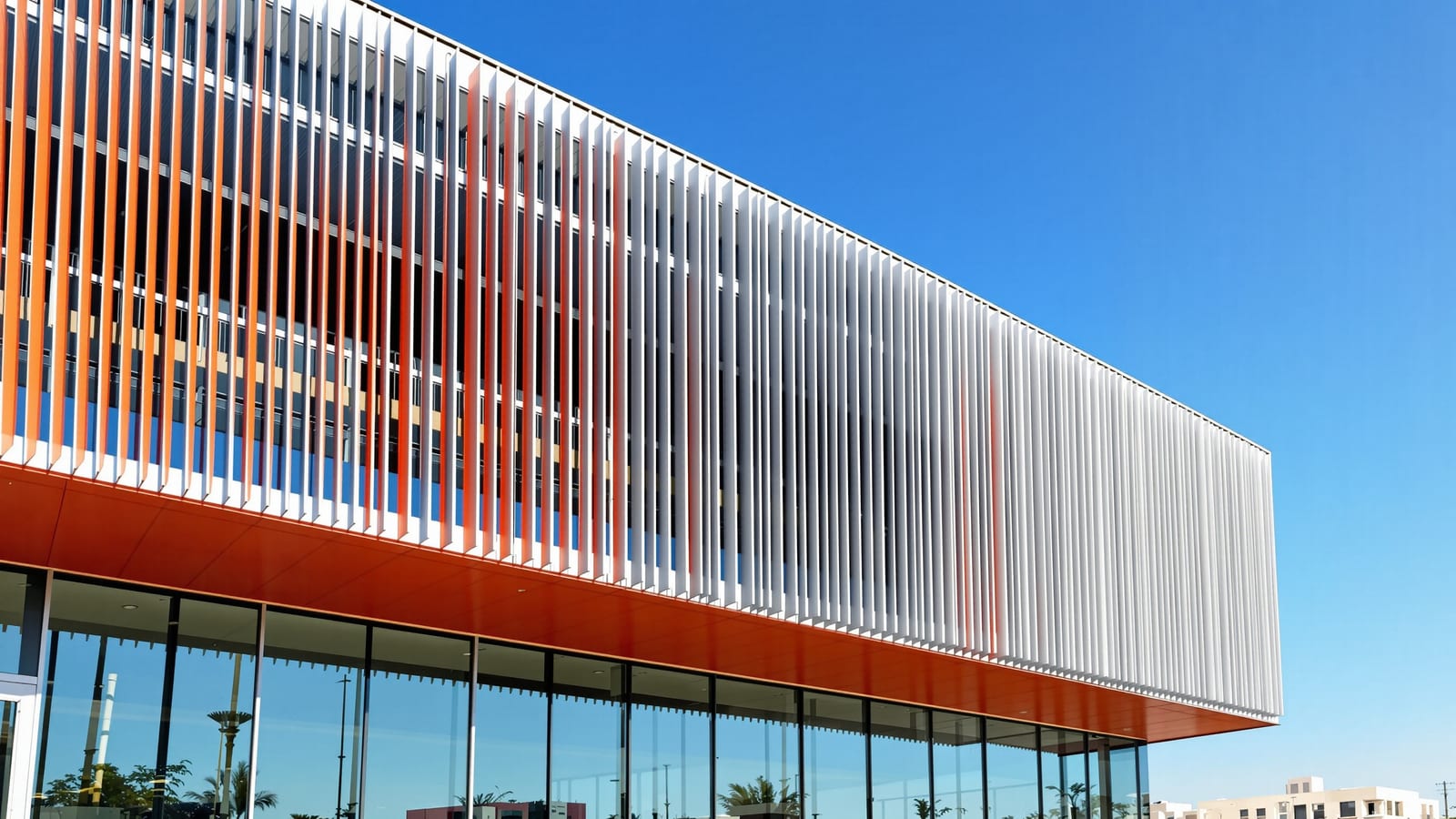
Brise-Soleil, Louvre and Fin Facades in India: Fixed External Sun-Shading That Beats the Heat
A plain-English guide to fixed external shading — horizontal louvres, vertical fins, eggcrate, baguettes and chajjas — and how to size and orient them by facade direction so they actually stop the sun before it hits your glass.
There is a deceptively simple idea at the heart of building in a hot country: it is far easier to stop the sun before it touches the glass than to fight the heat after it is already inside. A pane of clear glass behaves like a one-way valve for heat — it lets short-wave sunlight pour in, that sunlight strikes your floor and furniture, re-radiates as long-wave heat, and the glass traps it. By the time you reach for the blinds, the energy is already in the room. The only move that truly works is to intercept the sunlight outside the building. That is what a brise-soleil does.
Brise-soleil is French for "sun-breaker", and the term was coined and made famous by Le Corbusier. When he came to India in the 1950s to build the Mill Owners' Association Building in Ahmedabad and the great civic complex at Chandigarh, he turned the sun-breaker from a detail into the entire architectural language of the facade — deep concrete fins and grids that you can read from a kilometre away. He sized them to Ahmedabad's latitude and the path of the sun, and they still keep those buildings habitable seventy years later, with no motors, no sensors and no maintenance contract. That endurance is the whole point of this guide.
This is part of our Building Facades series, and it is specifically about fixed external shading — the static, passive cousin of the moving stuff. If you want shading that opens and closes on a sensor, read our guide to smart, kinetic and parametric facades. For the wider strategy of reading climate into a skin, see climate-responsive facades and energy-efficient facades. And because a perforated stone or terracotta screen is really a shading device too, our guide to the jaali is a close cousin to everything below. Here we stay with the louvre, the fin and the baguette — the hardware — and, most importantly, with how to size and orient it so it actually works.
1. What "fixed external shading" actually means
Let us define the family precisely, because the words get used loosely on site.
Fixed shading means the shading element does not move — it is built once at a calculated angle and stays there for the life of the building. Operable (or adjustable) shading moves: a blind, a motorised louvre, a folding shutter. Fixed shading is the subject of this guide; we cover the moving kind in the kinetic facades guide.
External shading sits outside the glass; internal shading (curtains, roller blinds) sits inside. This distinction is the single most important physical fact in the whole topic. External shading stops the sunlight before it enters and reflects or re-radiates that heat back out to the open air. Internal blinds only intercept the light after it has already passed through the glass — the heat is already in the room, and the best a blind can do is manage glare. As a rule of thumb, an external shade can block the large majority of solar heat gain, while an internal blind on the same window blocks only a fraction of it. In India, external wins, every time.
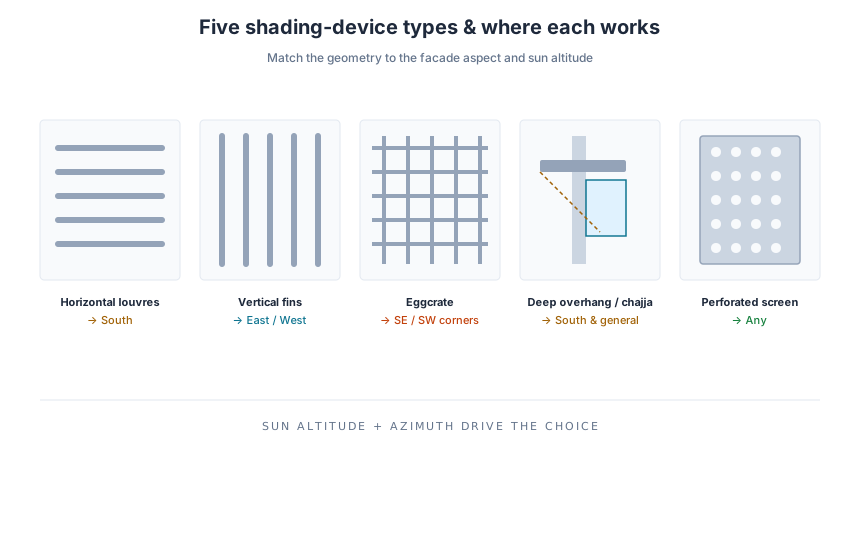
A brise-soleil is any built sun-breaker on the facade. A louvre or fin is a single shading blade. We call them horizontal louvres when the blades run side to side (like a venetian blind, but architectural and fixed) and vertical fins when the blades stand up like a comb. An eggcrate (or grid) shade combines both into a waffle of horizontal and vertical members. A baguette is the trade name for a slender extruded shading rod — usually aluminium or terracotta — that does the same job with a finer, more decorative grain. A deep overhang or, in Indian terms, a chajja (the projecting ledge over a window or door) is the oldest fixed horizontal shade of all.
2. Why external beats internal — the physics in one paragraph
When sunlight hits clear glass, roughly four-fifths of its energy passes straight through. An interior blind catching that light then warms up and releases the heat inside the conditioned space, so your air-conditioner still has to remove it. An exterior device intercepts the same sunlight in the open air; whatever heat it absorbs is carried away by the breeze and convection outside the building line. The technical shorthand for "how much solar heat gets through, glass plus shade together" is the shading coefficient (or in modern codes, the solar heat gain coefficient, SHGC) — lower is better in a hot climate. External fixed shading is the cheapest, most durable way to drive that number down without resorting to dark tinted glass that also kills your daylight. This is why every serious passive design in India treats external shading as the first line of defence and glazing tint as the last.
3. The orientation rule — the technical heart of this guide
Here is the part that, if you get wrong, makes expensive fins useless. The correct shape of a fixed shade depends entirely on where the sun is in the sky when it threatens that facade. And the sun is in very different places depending on which way the wall faces.
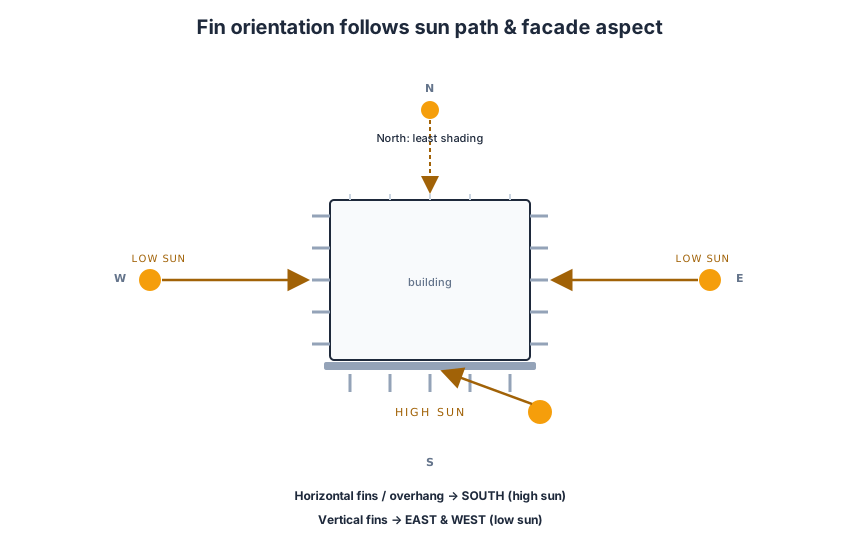
South facades want horizontal shading. Across India (we sit in the northern hemisphere), the south sun at midday is high in the sky — it climbs steeply overhead and shines down onto a south wall at a steep angle. A horizontal blade, overhang or chajja projecting outward intercepts that high, top-down light beautifully while barely interrupting the view straight out. This is why the south is the easiest facade to shade and why a simple deep horizontal projection often does the whole job.
East and west facades want vertical shading. The morning sun on the east and the evening sun on the west are low — they rise and set near the horizon, so the light comes in almost horizontally, straight at the glass. A horizontal overhang is nearly useless against a sun that is level with the window; the rays slide right underneath it. What you need is vertical fins standing in front of the glass like a comb, angled to block that low side-on sun. East and west are the hardest, most punishing facades in India precisely because that low sun carries a lot of heat and there is no cheap horizontal fix for it. Angling the vertical fins toward the south (toward the equator) sharpens their bite.
In-between angles want an eggcrate. South-east and south-west facades catch sun that is both fairly high and coming from the side, so they need both — a grid that combines horizontal and vertical members. That is what an eggcrate is for, and it is also why Corbusier's deep concrete grids look the way they do.
North facades need the least. A north wall in India catches direct sun only for short spells around the summer solstice, low and from the side, early and late in the day. Mostly it receives soft, even, indirect light — which is why north light is prized for studios and why the north facade can usually carry the most glass with the least shading. Where summer north sun does intrude, modest vertical fins at the edges handle it.
The honest takeaway: the same fin, put on the wrong facade, does almost nothing. Horizontal louvres on a west wall are an expensive mistake; vertical fins on a south wall block your view without blocking much sun. Match the geometry to the orientation, or do not bother.
4. Sizing an overhang — the cut-off angle
Once you know which device a facade wants, the next question is how deep it has to be. For a horizontal overhang or fin, the governing geometry is the cut-off angle (architects also call it the vertical shadow angle).
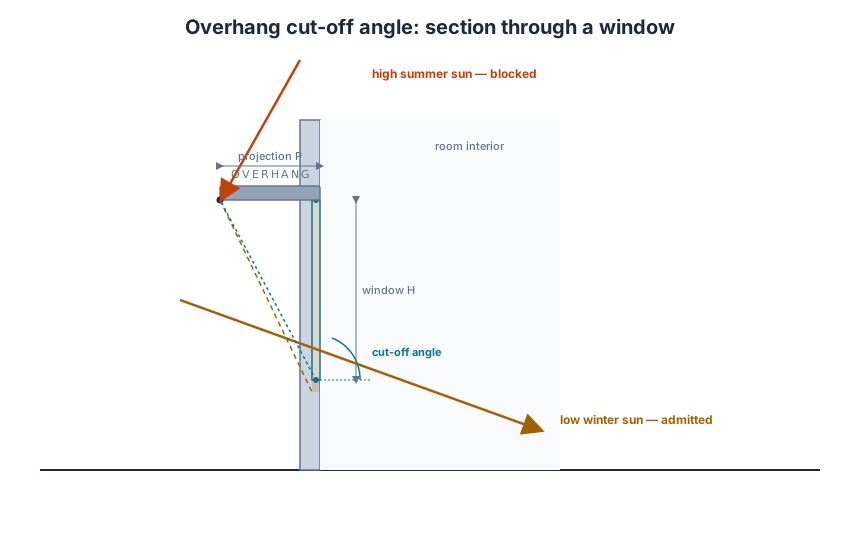
Picture a section cut through a window with a horizontal ledge above it. Draw a line from the bottom edge of the window up to the outer tip of the ledge. The angle that line makes with the horizontal is the cut-off angle: any sun higher than that angle is blocked and throws shade across the whole window; any sun lower slips underneath and lands inside. So the design move is to set the projection deep enough that the cut-off angle sits just below the noon summer sun altitude for your latitude — high summer sun is excluded, while the lower winter sun (which you may actually want for warmth in north India) is allowed in. This is the same physics that lets a fixed overhang shade in June and welcome sun in December without moving a single part.
The practical version of all this in Indian codes is the projection factor — simply the depth of the projection divided by the height of window below it. A bigger projection factor means a deeper, more effective shade. India's residential energy code, the Eco-Niwas Samhita (the residential ECBC), gives explicit credit for external shading through "projection factor, overhang" and "projection factor, side fin" terms: shade your windows well and you are allowed more or larger glazing while still complying. In other words, the code rewards exactly the move this guide is about. (We deliberately avoid quoting a single magic number — required projection depends on your latitude, the facade direction and the window height, and should be checked against a sun-path diagram for your city.)
5. The device family, compared honestly
| Device | Best orientation | What it blocks | India fit | Material options | Key risk |
|---|---|---|---|---|---|
| Horizontal louvres / overhang | South (also SE/SW upper sun) | High overhead midday and summer sun | Excellent — cheapest effective move; chajja is the vernacular form | RCC, aluminium, timber, terracotta baguette, steel | Useless on east/west; collects dust and bird droppings on every top surface |
| Vertical fins | East and West | Low morning/evening side-on sun | Essential for E/W — nothing else works there | Aluminium, terracotta, precast concrete, timber | Block the view sideways; must be angled correctly or they do little |
| Eggcrate / grid | South-East, South-West, deep sun | Both high and side-on sun together | Very good for harsh corners; the Corbusier look | RCC, precast, aluminium frame | Heavy, costly, lots of surfaces to clean; can darken interiors |
| Fixed perforated / expanded-metal screen | Any, especially E/W and full skins | Diffuses and cuts a fixed fraction of all sun | Good — see our jaali guide for the stone/terracotta cousin | Perforated aluminium/steel, GFRC, terracotta jaali | Fixed perforation ratio is a compromise; cuts daylight even when you want it |
| Deep overhang / chajja / verandah | South and general | High sun, glare, and monsoon rain | Outstanding value — does several jobs at once | RCC, stone, steel-and-sheet | Limited reach on low E/W sun; deep ones darken the room behind |
| Operable louvres (for contrast) | Any | Tunable, follows the sun | Better performance, but motors fail | Aluminium, glass | Cost, maintenance, electronics — see our kinetic guide |
The perforation ratio in that table — the open area of a perforated screen as a fraction of its total area — is worth defining: a 30 percent perforation lets through roughly a third of the light and view and blocks the rest, fixed, all day. It is the same idea as a jaali, just in metal.
6. Real buildings, not renders
The Indian canon of fixed shading is unusually rich, which makes this an easy topic to ground in verifiable fact rather than glossy CGI.
Mill Owners' Association Building, Ahmedabad (Le Corbusier, completed 1954). This is the textbook brise-soleil. Corbusier placed deep concrete sun-breakers on the east and west facades — the hard orientations — and kept the north and south walls almost blind. On the east face, overlooking the Sabarmati, the fins are set roughly perpendicular to admit river breeze and morning light; on the west, they are angled diagonally to block the harsh evening sun and the street view at once. It is a built lesson in orientation-specific shading, calculated to Ahmedabad's latitude.
The Secretariat and Capitol Complex, Chandigarh (Le Corbusier, 1950s; UNESCO World Heritage since 2016). The Secretariat is a long concrete slab whose entire facade is brise-soleil — deep cast-in-place concrete louvers and eggcrate grids that shade the offices behind while letting air move through. Built in raw "béton brut" concrete, it has needed no shading machinery in seventy years; the shade is the structure. The Palace of Assembly and High Court carry the same vocabulary of sun-breakers over their glazing.
Terracotta and aluminium baguette towers. Across contemporary Indian offices, campuses and apartments you now see the modern industrialised version of the same idea: extruded terracotta baguettes and aluminium fin systems hung off a curtain wall as a sun-screen. They do exactly what Corbusier's concrete did — intercept sun before the glass — but lighter, faster to install and with a finer rhythm. The terracotta versions also weather the Indian sun and monsoon without fading, which is why they recur on institutional facades.
Perforated screens and jaalis as shading. Buildings such as the Pearl Academy of Fashion in Jaipur use a perforated screen as an outer skin — a contemporary jaali — held off the building to shade the glass and create a cooled cavity. That is a fixed perforated sun-screen in the truest sense; we cover the stone-and-terracotta lineage in depth in the jaali guide.
7. Materials — what the fins are actually made of
The blade can be almost anything, and the choice is a trade-off of cost, weight, lifespan and look.
Reinforced concrete (RCC) is the Corbusier original and the cheapest for a deep, structural brise-soleil cast with the building — but it is heavy, hard to alter, and shows water streaks unless detailed well. Aluminium extrusions are the workhorse of the modern industry: light, rust-proof, powder-coated in any colour, easy to hang as louvres or baguettes, and recyclable — but they conduct heat and dent. Terracotta baguettes are fired clay rods that keep their colour for decades, sit comfortably in the Indian palette, and shrug off sun and rain — at a higher cost and weight than aluminium. Timber louvres look warm and are genuinely sustainable, but in Indian sun and monsoon they need a durable species and regular re-finishing or they grey and warp. Steel and expanded/perforated metal make light, airy screens for east and west skins. The right answer is usually a mix: a deep RCC chajja where the structure can carry it, lighter aluminium or terracotta fins where it cannot.
8. The honest case: cost, cleaning and when simpler wins
Fixed external shading is, in our honest view, one of the highest-value and most climate-smart moves you can make on an Indian facade — but it is not free of downsides, and a candid guide must say so.
It costs more than a bare wall. You are adding a whole secondary layer of facade — blades, sub-frame, brackets, fixings — to the glazing you were going to buy anyway. The pay-off is lower running cost (a smaller, less-burdened air-conditioner) for the life of the building, which usually justifies it in our climate, but the up-front number is real.
Louvres collect dirt. Every horizontal blade is a little shelf that gathers dust, leaves, bird droppings and, near the coast, salt. Vertical fins fare better but still soil. You must design cleaning access from day one — a maintenance walkway, a gondola anchor, a hose reach, or fins you can reach from a window. Beautiful louvres that cannot be cleaned become grey louvres within two monsoons.
Sometimes simpler genuinely wins. Before you specify a fancy parametric fin array, ask whether a deep chajja, a verandah or a jaali does the same job for less. In a great many Indian homes it does: a generous projecting chajja shades the window, throws off the monsoon rain, and costs a fraction of a bespoke louvre system — and a verandah or balcony shades the whole wall while giving you usable outdoor space. The vernacular answers are vernacular because they work.
Shading and glazing must be co-designed. This is the deepest point. Lots of glass behind good external shading is perfectly fine — the shade does its job and you get your view and daylight. Lots of glass with no shading cooks the room no matter how the brochure describes the "high-performance" coating. So decide the window-wall ratio and the shading together, not in sequence. Get the orientation right (horizontal for south, vertical for east-west), size the projection to the cut-off angle, and only then choose how much glass you can afford to expose.
What this means for you
If you are building or renovating anywhere in hot India, fixed external shading should be near the top of your facade budget, not an afterthought. Start with orientation: put your big glass on the north and south where it is easy to shade, and be ruthless about the east and especially the west. Shade the south with horizontal louvres, a deep overhang or a chajja; shade the east and west with vertical fins; use an eggcrate on the harsh corners. Size the depth to the cut-off angle for your city's sun, and let the Eco-Niwas Samhita projection-factor credit reward you for it. Choose a material you can clean — and design the access to clean it. Reach for moving, motorised shading only when a fixed device truly cannot do the job, because fixed shading has no motors to fail and lasts the life of the building. And before any of it, ask the honest question: would a deep chajja or a verandah do this more cheaply? Often, in India, it would.
Sources
- Bureau of Energy Efficiency, Government of India — Eco-Niwas Samhita (Energy Conservation Building Code for Residential Buildings), Part I: Building Envelope — for window-wall ratio, RETV and the projection-factor (overhang and side-fin) shading provisions.
- Energy Conservation Building Code (ECBC), Bureau of Energy Efficiency — external shading and solar heat gain provisions for commercial envelopes.
- Fondation Le Corbusier and ArchDaily AD Classics — Mill Owners' Association Building, Ahmedabad (1951–54): documentation of the east/west brise-soleil and its orientation logic.
- ArchDaily AD Classics and UNESCO World Heritage listing — Chandigarh Capitol Complex (Secretariat, Palace of Assembly, High Court): concrete brise-soleil as facade system.
- Victor Olgyay, Design with Climate: Bioclimatic Approach to Architectural Regionalism — solar geometry, shading-mask and cut-off (shadow) angle method for sizing fixed devices.
- Standard solar-geometry references on vertical shadow angle / cut-off angle and sun-path diagrams for sizing overhangs and fins by latitude and orientation.
- General passive-design guidance on horizontal-versus-vertical shading by facade orientation (south = horizontal, east/west = vertical).
Export this guide
Related Guides — Deep-dive reading
Energy-Efficient Facades in India: How the Building Skin Cuts Your Cooling, Heating & Lighting Bills
How a building facade drives cooling, heating and lighting energy in India, the three levers of solar-heat-gain control, insulation and daylighting, U-value, SHGC, VLT and WWR in plain terms, ECBC and Eco-Niwas expectations, and real Indian green buildings.
Building FacadesSmart, Kinetic & Parametric Facades in India: Skins That Move, Tint and Respond (And When They Are Worth It)
Plain-English guide to parametric, kinetic and smart-glass facades: how moving louvers, electrochromic glass and AI-driven envelopes work, real examples like Al Bahar Towers, and the honest India verdict on cost, maintenance and when fixed shading wins.
Building FacadesWindow Shading Strategies for Indian Homes
The external shading device catalogue and overhang geometry, by orientation
Windows & GlazingRelated Tools — Try Free
Brise-Soleil Visualizer
Interactive horizontal-louvre cut-off angle calculator — sun altitude, louvre depth, and spacing inputs with a live shadow preview. Computes θ = arctan(spacing/depth) for façade shading, ECBC envelope compliance, hospital daylight design, and tropical sun-control detailing.
Sun Shading ToolCross-Ventilation Analyzer
Estimate airflow and air changes per hour (ACH) from room size, window areas, layout, and local wind — with NBC 2016 Part 8 compliance check.
Ventilation CalculatorWindow Orientation Planner
Pick the best window type, glass and shading by wall direction — north, east, south and west.
Window Tool