
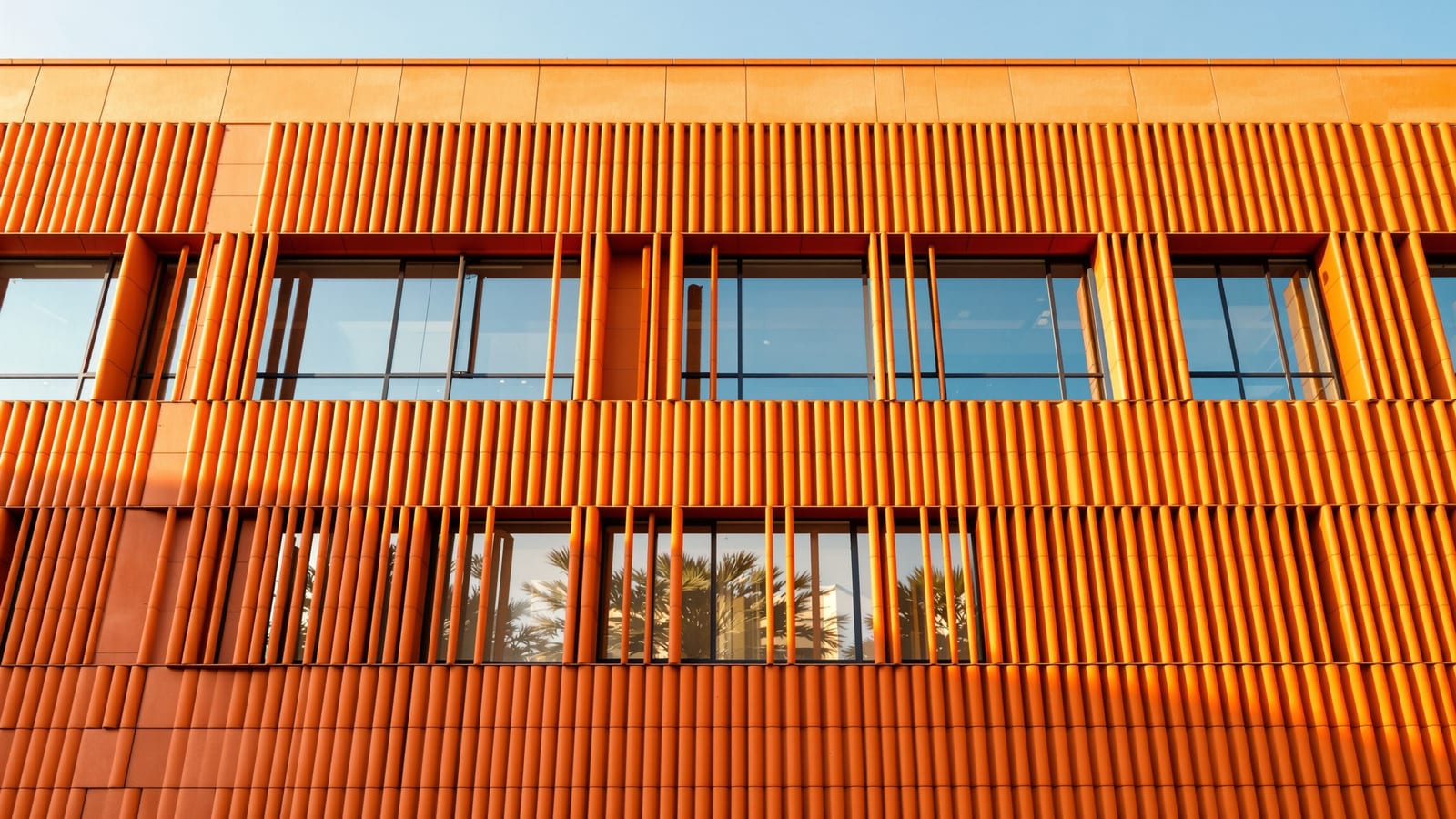
Terracotta & Ventilated Rainscreen Facades in India — Baked Clay That Keeps Walls Dry
How fired-clay panels and baguettes, hung on a drained, ventilated cavity, use the rainscreen principle to beat the Indian monsoon — the material, the science, the real buildings and what it means for your project.
A building skin made of baked earth
There is something quietly reassuring about a wall made of fired clay. It is the same material as the pot your grandmother stored water in, the same earth that becomes a roof tile in a Mangalore village or a brick in a Kolkata terrace house. Terracotta — literally "baked earth" in Italian, but a material India has fired for at least five thousand years — has come back into contemporary architecture in a very modern form: thin, precise, factory-extruded clay panels and rod-like "baguettes" that hang off the outside of a building like a second skin.
What makes this comeback interesting is not just the look, though the look is part of it. It is that terracotta is almost always installed as part of a system called a ventilated rainscreen. This is one of the most important ideas in modern facade engineering, and it is genuinely useful to understand if you are building or renovating anything in India, because it directly answers our oldest building problem: how do you stop a wall from getting wet and staying wet through a four-month monsoon?
This guide explains both halves — the material (terracotta) and the principle (the rainscreen) — in plain language, with the jargon unpacked as we go. It is a companion in our building facades series, and it builds on the case made in why building facades matter.
1. What a terracotta facade actually is
Strip away the marketing and a terracotta facade is clay that has been mixed with water, pushed through a die (extruded), cut to length, dried slowly, and fired in a kiln at around 1,000 to 1,150 degrees Celsius until it becomes hard, dimensionally stable and weather-resistant ceramic. Modern panels are usually hollow — a twin-wall, ribbed cross-section — which keeps them light, lets them dry evenly during firing, and gives the clips something to grip.
You will meet terracotta cladding in roughly three forms:
- Flat tiles or panels — rectangular plates, commonly 300 to 600 mm tall and up to about 1,500 mm long, fixed in horizontal bands. This is the classic "ceramic wall" look.
- Baguettes — extruded clay rods or batons, round, square or aerofoil in section, run horizontally or vertically as a louvre screen. They shade the glass behind, filter light and read almost like a contemporary jaali.
- Custom shapes and glazes — folded profiles, perforated tiles, and surfaces ranging from raw matte earth-red through sandy buffs and greys to bright ceramic glazes in almost any colour.
The colour, crucially, is not paint. It is either the natural colour of the clay body (which is why most terracotta is some shade of warm orange, ochre or buff) or a fired ceramic glaze fused into the surface. Either way the colour is baked in. It does not fade in UV the way a painted or coated facade does, and it does not need repainting — a real advantage in India's high-sun, high-rain climate where painted exteriors often need redoing every five to seven years.
2. India's deep terracotta tradition
It would be a mistake to treat terracotta cladding as a foreign import. India has one of the world's richest terracotta cultures. The temple towns of Bishnupur and the broader Bengal countryside are famous for entire temple facades — Madanmohan, Shyamrai, Jor Bangla — covered in intricate fired-clay relief panels narrating the epics, because good building stone was scarce in the alluvial delta and clay was everywhere. Mangalore tiles roofed half of coastal and southern India. Gujarat and Tamil Nadu have living traditions of terracotta tile, pot and figurine making, and the giant terracotta horses of Aiyanar shrines are an art form in themselves.
So when a contemporary Indian architect specifies a terracotta facade, there is a genuine cultural continuity, not just a catalogue choice. The CEPT University campus in Ahmedabad, designed by B. V. Doshi in load-bearing exposed brick, sits in exactly this lineage of honest fired-earth surfaces — and CEPT-trained architects have carried that earth-material sensibility into many modern brick and terracotta projects across the country. The material says "India" in a way a glass curtain wall never can.
3. The rainscreen principle, explained simply
Here is the single most useful idea in this guide. Most people imagine a wall keeps water out by being a solid, perfectly sealed barrier — one continuous waterproof skin. The problem is that no outer skin, anywhere, stays perfectly sealed forever. Joints move, sealants age, hairline cracks open, and wind drives rain through tiny gaps you cannot see. A "perfect barrier" wall fails the day its weakest joint fails.
A rainscreen works on a smarter assumption: accept that a little water will get past the outer cladding, and design the wall to handle it. A ventilated rainscreen has four layers, working from outside in:
1. The outer cladding — the terracotta panels or baguettes. This is the rain screen. Its job is to take the brunt of the weather, not to be perfectly watertight.
2. A ventilated, drained air cavity — a continuous open gap, typically 25 to 50 mm, directly behind the cladding, open to the outside air at top and bottom. This is the heart of the system.
3. Insulation — a board of mineral wool or similar fixed to the structural wall, adding the thermal performance.
4. An airtight, water-resistant backing wall — the real weather line: blockwork or concrete with a breather membrane, plus the bracket framing the cladding hangs from.
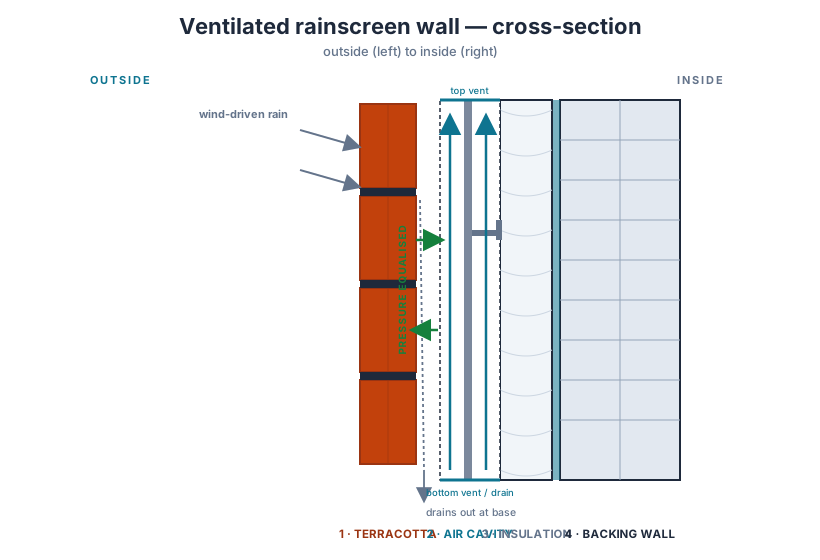
The clever bit is pressure equalisation. Rain is driven into a wall mainly by an air-pressure difference: when wind pushes against the building, the air pressure on the outer face is higher than inside the wall, and that pressure difference forces water through any gap. In a rainscreen, the open cavity behind the cladding is connected to the outside air, so the air pressure inside the cavity quickly rises to match the pressure outside. With little or no pressure difference across the cladding joints, there is almost no force pushing water through them. The small amount of water that does get past simply runs down the back of the cladding, into the drained cavity, and out at the bottom. The structural wall behind stays dry.
In one line: a barrier wall tries to win by sealing every gap; a rainscreen wins by removing the pressure that pushes water through gaps in the first place.
4. Why this suits the Indian monsoon
If the rainscreen idea was invented anywhere, it was invented for places with wind-driven rain — and the Indian monsoon is wind-driven rain at industrial scale. Mumbai, Mangalore, the Konkan and the Northeast can see 2,000 to 3,000 mm of rain in a few months, much of it slamming horizontally into facades on the windward side. This is exactly the loading that defeats a plaster-and-paint barrier wall, and exactly what a rainscreen is built for.
The ventilated cavity gives a second, climate-specific benefit: heat. Across India's hot-dry and warm-humid zones, the outer cladding takes the solar hammering and gets hot, but the continuous air gap behind it lets that heat rise and escape out the top of the cavity (a chimney effect) instead of conducting straight into the building. Combined with the insulation board, this measurably reduces the cooling load. A ventilated terracotta facade is, in effect, a permanent shaded jacket with its own airflow — the modern engineering cousin of the traditional double wall and jaali.
It also handles humidity intelligently. The breather membrane on the backing wall lets any moisture inside the construction escape outward into the ventilated cavity — the wall can "breathe" and dry out — rather than trapping it the way a fully sealed cement-and-paint skin does. In a country where trapped damp, efflorescence and peeling paint are near-universal complaints, a wall that can dry itself is a genuine upgrade. (For the broader fight against water in Indian buildings, see our waterproofing guide.)
5. How terracotta is actually hung — the rail and clip system
A terracotta facade is not glued or plastered on. It is hung on an engineered sub-structure, and understanding it helps you judge a contractor's quote.
- Brackets are fixed back to the structural wall or slab edge with anchors. These set the cavity depth and carry every kilogram of cladding load back into the building.
- Vertical rails (mullions) and sometimes horizontal rails of aluminium are clamped to the brackets, forming a grid. The brackets often have slotted holes so the installers can adjust the rails dead-level on an imperfect Indian site wall.
- Clips engage the panels. Flat tiles usually have grooves on their top and bottom edges; a clip on the rail hooks into the groove so the panel hangs and locates without any fastener showing on the face. The joints between tiles are left as deliberate open gaps — that is what makes it a ventilated rainscreen and not a sealed wall.
- Baguettes clip or bolt into end brackets and clamp collars on the rails, spanning between mullions like the rungs of a horizontal ladder.
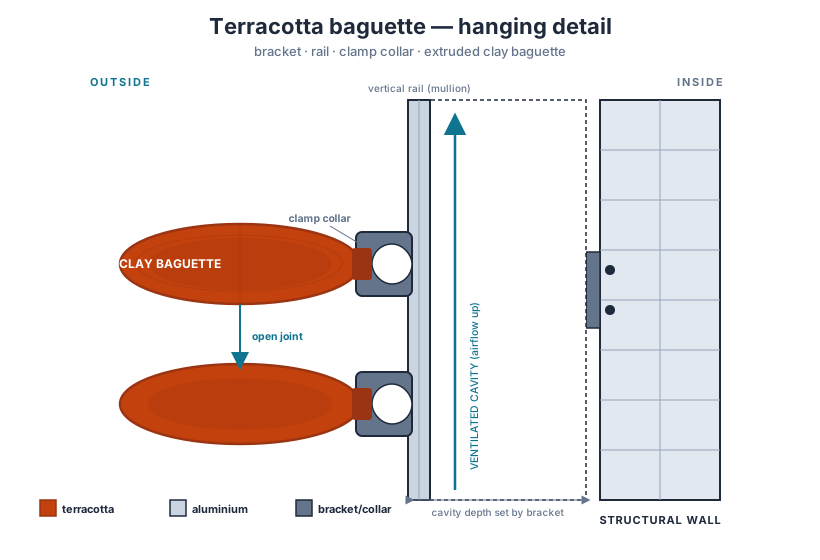
Because the system is dry-fixed and clip-engaged, a single damaged panel can later be unclipped and swapped without disturbing its neighbours — a real maintenance advantage over bonded stone or monolithic plaster. It also means the whole performance of the wall depends on the sub-structure being designed and installed correctly: this is a system, not a finish. (We return to upkeep in facade maintenance and durability.)
6. Pros, caveats and where it fits
No facade is free of trade-offs. Here is the honest balance for terracotta rainscreen in Indian conditions.
| Factor | Terracotta ventilated rainscreen | Plaster + paint (typical Indian barrier wall) |
|---|---|---|
| Water management | Excellent — pressure-equalised, drained, self-draining cavity | Relies on a single sealed skin; fails at cracks and joints |
| Wall drying / breathability | High — backing wall ventilates and dries out | Low — moisture often trapped, leading to damp and peeling |
| Colour life | Fired-in clay/glaze; effectively does not fade | Paint fades; repaint every ~5–7 years |
| Thermal performance | High — insulation + ventilated cavity cuts heat gain | Low unless insulation added separately |
| Lifespan of cladding | 50+ years for the clay itself | Surface life measured in years between repaints |
| Repairability | Single panels unclip and replace | Patch repairs, but cracks recur |
| Upfront cost | High (clay + aluminium sub-frame + skilled install) | Low |
| System dependence | High — needs correct engineering and detailing | Low — forgiving, familiar to any mason |
The caveats deserve weight. Terracotta rainscreen is expensive upfront — you are paying for the clay, a full aluminium sub-structure, insulation, a membrane and skilled installation, not just a sack of cement. It is detail-sensitive: corners, window reveals, parapet tops and the cavity's top and bottom openings must be designed properly or the rainscreen advantage is thrown away. And it is system-dependent — a good panel on a badly engineered frame is a liability, especially for wind loads on tall coastal buildings. This is not a finish to improvise on site; it needs a designer and a vetted installer.
That is why its natural home is educational, cultural, institutional and better-quality commercial and residential work — buildings meant to last, where the lower lifetime cost (no repainting, fewer leaks, lower cooling bills) and the warm, durable, distinctly Indian character justify the higher first cost.
7. Real buildings worth knowing
A few real, verifiable examples — terracotta and rainscreen, Indian and global — to ground the idea (we never invent buildings):
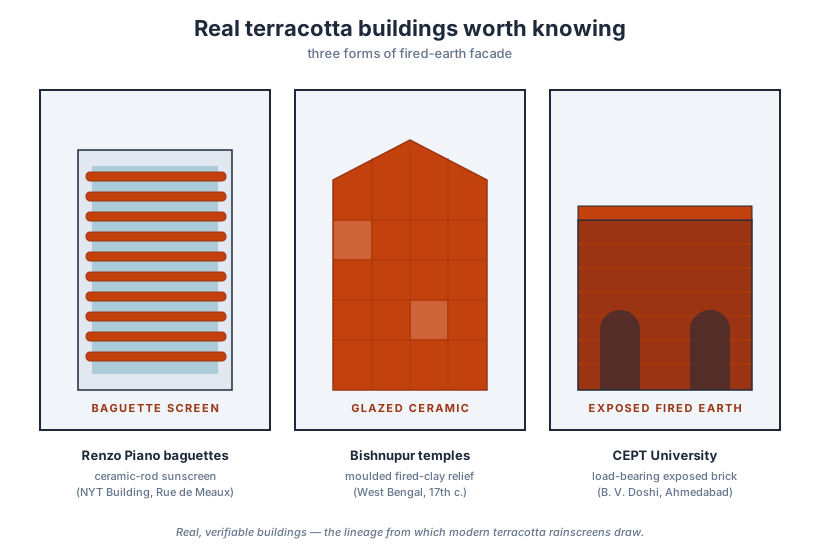
- CEPT University, Ahmedabad (B. V. Doshi, 1960s onward) — the touchstone of honest exposed fired-earth architecture in India; load-bearing brick rather than hung panels, but the lineage of expressed clay that contemporary terracotta facades draw on.
- Bishnupur terracotta temples, West Bengal (17th century) — entire temple facades in moulded fired-clay relief, India's most celebrated demonstration that clay can carry an entire building's expression.
- Renzo Piano's terracotta-baguette buildings — the architect who effectively pioneered the modern terracotta rainscreen, from the Rue de Meaux housing in Paris to the New York Times Building's ceramic-rod sunscreen; the global reference for the baguette louvre.
- Modern Indian institutional and IT campuses — terracotta rainscreen panels and baguette screens now appear on numerous university blocks, offices and cultural buildings across cities including Ahmedabad, Bengaluru and Pune, as architects pair the material's Indian warmth with its monsoon-suited performance.
If you are evaluating a specific building's facade, ask the architect to name the cladding system and manufacturer — reputable terracotta is a documented, tested product, not an anonymous tile.
What this means for you
If you are a homeowner, you almost certainly will not clad a single house in terracotta rainscreen — the system cost rarely makes sense at that scale. But the principle should change how you think about every wall you build. Stop asking "is this wall sealed?" and start asking "if water gets in, can this wall drain and dry?" That mindset — a drained cavity, a breather membrane, weep holes, ventilation — is the difference between a wall that survives the monsoon and one that grows mould behind the paint. You can apply rainscreen thinking to a stone-clad compound wall, a timber feature wall or a tile-clad facade band at a fraction of the cost.
If you are a developer, architect or builder working on an institution, office, school or premium residence, terracotta rainscreen deserves a serious look. Yes, it costs more upfront. But over a building's life you stop repainting, you stop chasing leaks, you cut cooling bills, and you get a facade that ages with dignity and reads as unmistakably Indian. The two non-negotiables: engage a designer who details the corners, parapets and cavity openings properly, and use a vetted installer — because a rainscreen is only as good as its sub-structure and its detailing.
Either way, the lesson of baked earth is the same one Indian builders learned millennia ago and modern engineering has now formalised: the smartest wall is not the one that pretends water will never reach it, but the one that lets the water leave.
Continue with the types of building facades overview, the pillar on why building facades matter, and the practical companion on facade maintenance and durability.
Sources
- B. V. Doshi and CEPT University, Ahmedabad — Vastushilpa Foundation / CEPT University archives, on exposed-brick and fired-earth campus architecture.
- Bishnupur terracotta temples — Archaeological Survey of India listings for the Bishnupur group (Madanmohan, Shyamrai, Jor Bangla temples), West Bengal.
- Renzo Piano Building Workshop project records — Rue de Meaux Housing (Paris) and The New York Times Building (New York), on terracotta-baguette rainscreen facades.
- Building science references on rainscreen and pressure-equalised cladding — Building Science Corporation technical papers on the rainscreen principle and drained-cavity wall design.
- National Building Code of India (NBC 2016) and relevant BIS standards on cladding, wind loads and weatherproofing of external walls.
- Manufacturer technical literature on extruded terracotta cladding systems (panel sizing, firing, twin-wall sections and rail-and-clip fixing), used for general system description only.
Export this guide
Related Guides — Deep-dive reading
Porcelain, Ceramic & Sintered-Stone Facade Cladding in India: A Practical Guide
Thin large-format porcelain and sintered-stone slabs can clad a building with the look of marble, concrete or weathered steel at a fraction of stone's weight — but on a facade, the fixing system is a life-safety decision, not a finish choice.
Building FacadesDouble-Skin & Ventilated Facades in India: The Layered Envelope That Buffers Heat, Noise & Glare
What a double-skin facade is, how the ventilated cavity cuts solar gain, noise and glare, the four cavity types, how it differs from a rainscreen, honest India cost and monsoon caveats, plus real examples.
Building FacadesEnergy-Efficient Facades in India: How the Building Skin Cuts Your Cooling, Heating & Lighting Bills
How a building facade drives cooling, heating and lighting energy in India, the three levers of solar-heat-gain control, insulation and daylighting, U-value, SHGC, VLT and WWR in plain terms, ECBC and Eco-Niwas expectations, and real Indian green buildings.
Building FacadesRelated Tools — Try Free
Cross-Ventilation Analyzer
Estimate airflow and air changes per hour (ACH) from room size, window areas, layout, and local wind — with NBC 2016 Part 8 compliance check.
Ventilation CalculatorBrise-Soleil Visualizer
Interactive horizontal-louvre cut-off angle calculator — sun altitude, louvre depth, and spacing inputs with a live shadow preview. Computes θ = arctan(spacing/depth) for façade shading, ECBC envelope compliance, hospital daylight design, and tropical sun-control detailing.
Sun Shading ToolMonsoon-Readiness Checklist
Pre-rain home audit across 9 categories — terrace, drains, waterproofing, electrical, HVAC, pest, vehicles, documents.
Seasonal Audit