
Porcelain, Ceramic & Sintered-Stone Facade Cladding in India: A Practical Guide
Thin large-format porcelain and sintered-stone slabs can clad a building with the look of marble, concrete or weathered steel at a fraction of stone's weight — but on a facade, the fixing system is a life-safety decision, not a finish choice.
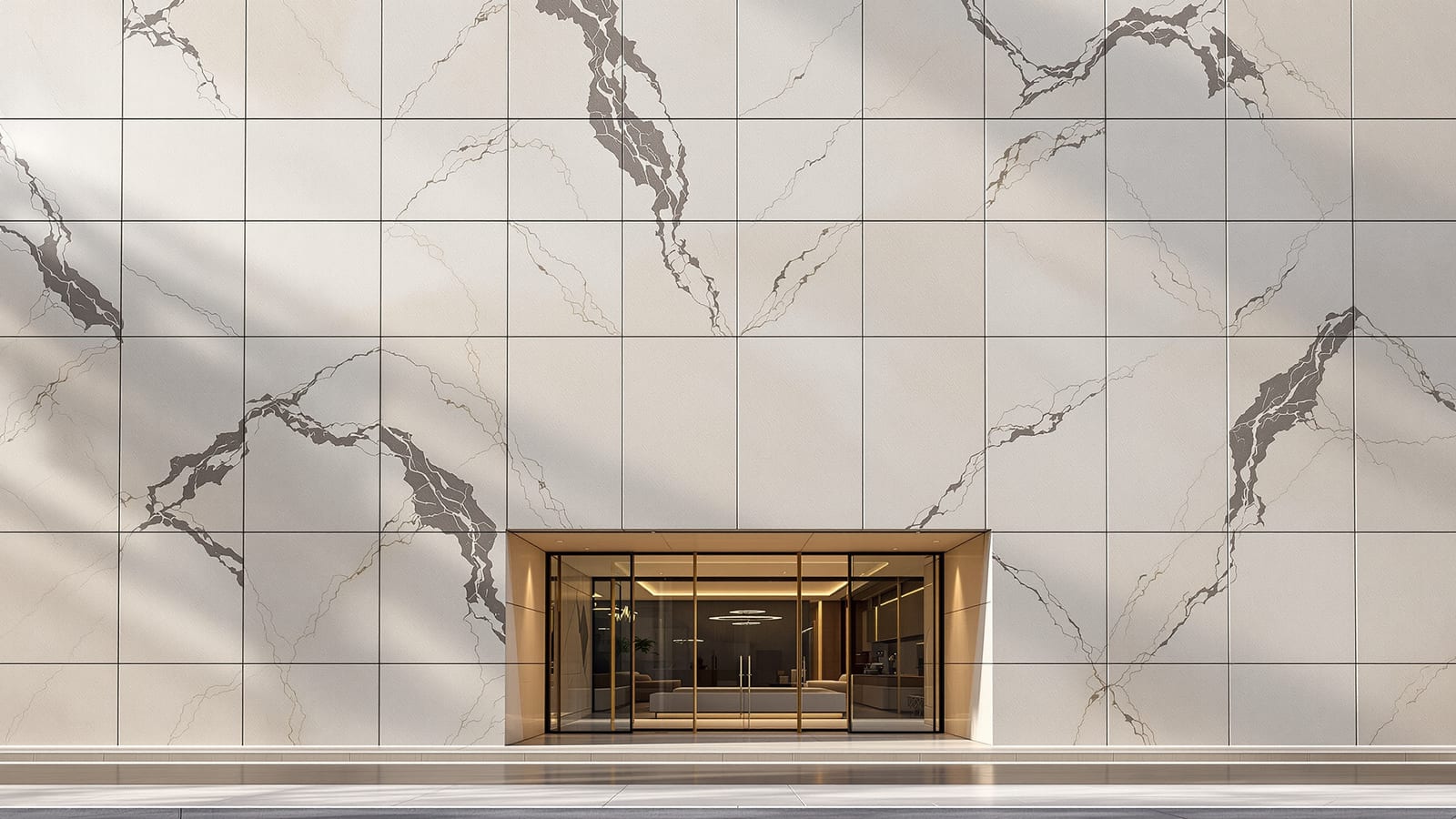
From the road it reads as a tower sheathed in book-matched Carrara marble — the same cool grey veining flowing across panel after panel, three metres tall, impossibly consistent. Walk up and touch it and the illusion holds: it is hard, cold, flawless. But it is not marble. It is not stone at all. It is fired clay — porcelain — a few millimetres thick, printed with a digital photograph of marble and baked at over 1,200°C into a slab harder than the rock it imitates. Across Indian cities, this material is quietly replacing granite, marble and concrete on facades, because it gives you the look of premium stone at a fraction of the weight, with none of the quarry lottery and almost none of the staining.
That is the seductive half of the story. The other half is physics. A thin, brittle ceramic slab hung on the side of a building is, by definition, a heavy sharp object held up against gravity, wind and the brutal thermal swings of an Indian summer. Get the fixing right and it outlives the paint, the sealant and probably the owner. Get it wrong — glue it to a wall like a bathroom tile and hope — and it becomes a guillotine waiting for the bond to fail. Porcelain facades fail rarely, but when they fail they fall, and falling cladding kills.
This is part of our Building Facades series, where we work through every common cladding family honestly. This guide is specifically about engineered ceramic slab cladding — porcelain, large-format ceramic and sintered stone — the fired material that imitates natural stone rather than being quarried from it. If you are weighing the real thing, read stone & masonry facades. For the metal cousins see metal & ACP facades; for fired-clay rainscreen see terracotta rainscreen facades; and the fibre-cement & HPL cladding guide shares almost identical rainscreen-fixing logic — porcelain just adds weight and brittleness to the same problem. If you want the all-glass look instead, see glass curtain wall facades.
1. What porcelain actually is — and why "tile" undersells it
Start with the chemistry, because it explains everything that follows. Porcelain stoneware is a ceramic made from refined clays, feldspar and fine sands, dry-pressed under enormous pressure and fired so hot that the body partially melts and fuses — a process called vitrification. The result is a dense, glass-like material with almost no internal pores.
The single number that defines porcelain is water absorption. Under the international tile standard ISO 13006 (and its European twin EN 14411), dry-pressed tiles are sorted into groups by how much water they soak up. True porcelain stoneware sits in Group BIa — water absorption ≤ 0.5% by weight. That near-zero porosity is the source of nearly every good property porcelain has: because water can barely get in, it cannot freeze and spall the material (frost-proof), it cannot carry stains deep into the body (stain-resistant), and it cannot wick efflorescence or breed the algae and black streaking that plague cheaper claddings.
Two construction terms matter for facades. A large-format slab is simply a very big porcelain panel — common Indian and global sizes run 1200×2400 mm, 1200×3200 mm and up to 1600×3200 mm — usually 6 mm to 12 mm thick, sometimes 20 mm (2 cm) for heavy-duty use. Gauged porcelain tile panels/slabs (GPTP) is the formal name (from the American standards ANSI A137.3 / A108.19) for these thin, precisely-calibrated big panels larger than one metre square; "gauged" means the thickness is tightly controlled so the panel behaves predictably. The decoration is applied by digital inkjet decoration — high-resolution printheads spray ceramic pigments onto the body before firing, which is why a porcelain slab can carry a photographically convincing image of marble, travertine, oxidised steel, raw concrete or weathered oak. After firing that image is locked under a vitrified surface and is UV-stable: it will not fade, chalk or yellow the way paint and many coatings do in Indian sun.
2. Through-body, glazed and the sintered-stone cousin
Not all porcelain is equal, and three distinctions change how a slab behaves on a facade.
Glazed porcelain carries its colour and pattern in a thin printed-and-glazed surface layer over a plain body. The face is beautiful; a deep chip exposes the different-coloured body underneath. Through-body (full-body) porcelain has the colour and aggregate running all the way through the thickness, so a chip or an exposed cut edge looks the same as the face. For a facade — where panels are cut on site, edges are sometimes visible at reveals, and impacts happen — through-body or at least a well-matched body is the safer, more honest choice.
Sintered stone is the premium relative, sold under brands like Laminam, Neolith, Dekton and Lapitec. It is made by the same broad route — minerals compacted and fired — but the recipe and process differ: Dekton, for instance, blends porcelain raw materials with quartz and glass and applies extreme particle-compaction technology, aiming for even higher hardness, scratch resistance and acid resistance than ordinary porcelain. In practice the line between "large-format porcelain slab" and "sintered stone" is more marketing than mineralogy for most facade purposes — both are vitrified ceramic, both are mechanically fixed the same way — but sintered-stone brands generally sit at the top of the quality and price ladder, with the most convincing aesthetics and the tightest tolerances. Globally you will also see Florim, Iris (FMG/Ariostea) and Cosentino (Dekton); in India the volume players are Kajaria, Simpolo (and Simpolo Slabs), AGL, Somany, Johnson Endura and slab specialists like Lioli.
One more property worth banking: porcelain and sintered stone are non-combustible, achieving the top fire classification (A1 / Euroclass A1 under EN 13501-1). On a facade — after the cladding-fire tragedies of the last decade — a non-combustible skin is a genuine, code-relevant advantage that ACP and HPL cannot always match.
3. The fixing decision is the whole game
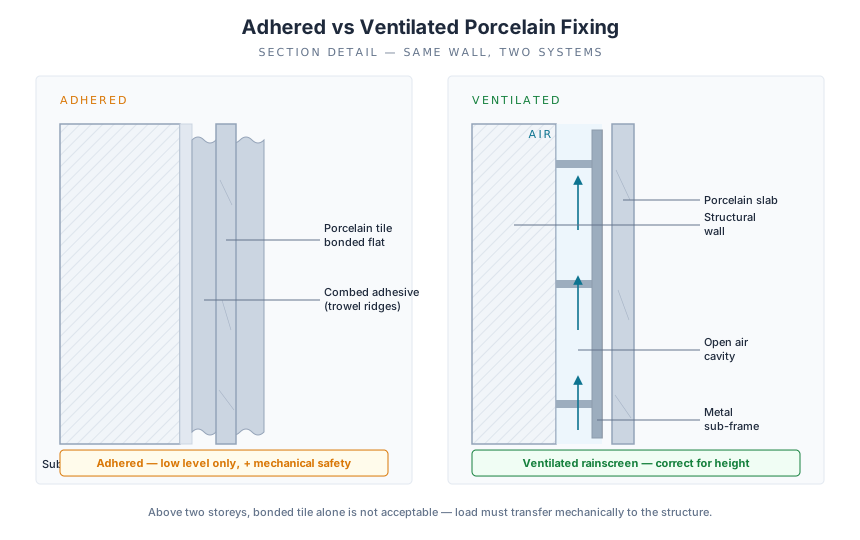
Here is the sentence that should govern every porcelain facade decision in India: above pedestrian level, the slab must be mechanically fixed or back-anchored to a structural sub-frame — adhesive alone is not acceptable. Understand why, and you understand the material.
There are two fundamentally different ways to put porcelain on a wall.
Adhered (bonded) cladding sticks the slab flat against a solid substrate using a tile adhesive. For a low-porosity material like porcelain this must be a high-performance, polymer-modified, deformable adhesive — at least a C2 class (and often an S1/S2 deformable grade) under EN 12004 — because ordinary cement mortar is too rigid and too weak to grip a glassy back face. Adhered work is fast and cheap and looks seamless, and for a porcelain slab it demands extra discipline: full back-buttering (adhesive combed onto both the substrate and the back of the slab) to eliminate voids, because any hollow behind a slab is a stress concentrator and a crack waiting to start.
Ventilated (mechanically-fixed) cladding does not glue the slab to anything. It hangs each slab on a metal sub-frame — aluminium or stainless rails fixed back to the structure — leaving a continuous air cavity between the slab and the wall behind. This is a ventilated rainscreen facade: the porcelain sheds rain, the cavity drains and ventilates any moisture that gets past the joints, and the slab is held by metal hardware, not by a bond that can fail. This is the correct system for any significant height.
The reason this distinction is not negotiable is consequence. When an adhesive bond fails on a horizontal floor, a tile lifts and you trip on it. When an adhesive bond fails three storeys up, a several-kilogram sheet of brittle ceramic falls onto whoever is below. International facade research is blunt on this point: interfacial debonding is the most common failure mode of adhesively-bonded tiling, and tile delamination is one of the most frequent falling hazards on tall buildings worldwide. A ventilated, mechanically-fixed slab cannot simply let go, because metal hardware is carrying it, not glue. That is why the rule everywhere serious is: adhesive at low level only, on a sound flat substrate, usually still with mechanical safety fixings as a backup; mechanical fixing or back-anchoring for height.
4. How mechanical fixing actually works
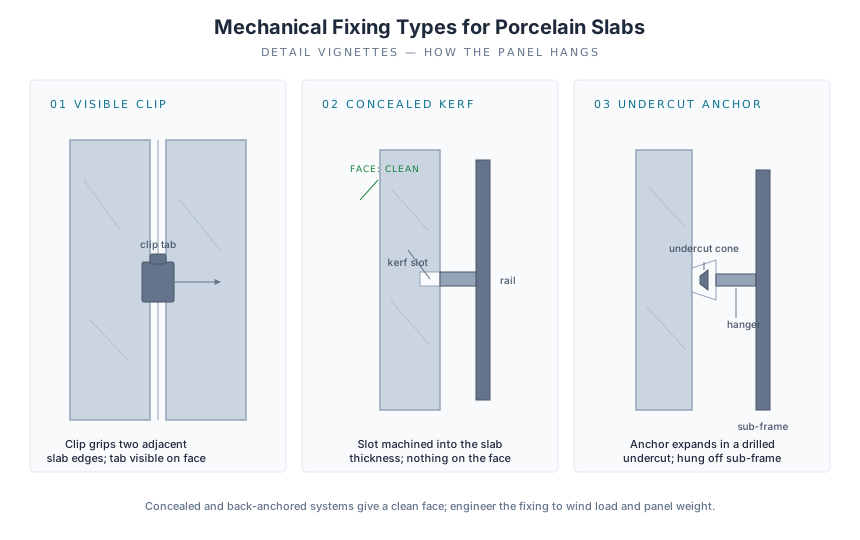
There are three main ways to mechanically hold a porcelain slab, in rising order of refinement and cost.
Visible clip / clamp fixing uses small metal clips that grip the slab at its edges or corners, exposed on the face as little tabs (often colour-matched). It is the cheapest mechanical system, robust and easy to inspect, but the clips are visible and interrupt the clean stone illusion.
Concealed kerf fixing cuts a horizontal slot — a kerf — into the thickness of the slab's top and bottom edges; a bracket or rail engages that slot so the slab hangs from its own machined edge with nothing showing on the face. It needs a slab thick enough (typically 10–20 mm) to take the slot without weakening the edge, and very precise factory or workshop cutting.
Undercut back-anchor fixing is the premium method and the workhorse of sintered-stone facades. A conical, undercut hole is precision-drilled into the back of the slab (not all the way through), and an expanding anchor — from specialists like fischer or KEIL — locks into that cone. Metal hangers then carry the slab off the sub-frame, completely concealed, with no edge grouping and no face penetration. Done right, an undercut anchor distributes load across the panel and can reduce panel bending stress dramatically compared with crude edge fixings. This is how thin large-format slabs are safely flown at height.
All three share the same logic: the load path runs slab → anchor/clip → sub-frame → structural fixing → building. Each link must be designed by an engineer for the actual wind loads, and — critically for India — the metalwork must be stainless steel or properly treated aluminium, because mild-steel brackets will rust, streak the facade and eventually drop the slab they were meant to hold.
5. Porcelain versus the alternatives — an honest comparison
| Material | What it is | Look | Weight & thickness | India fit | Cost band | Key risk |
|---|---|---|---|---|---|---|
| Porcelain / large-format slab | Fired vitrified clay, inkjet-printed | Convincing marble, stone, concrete, wood, metal | Light: ~15–28 kg/m², 6–12 mm | Excellent for the look at low weight; frost/UV/stain-proof | Mid; far below premium marble | Brittle; falls if adhesive-fixed at height; installer skill |
| Natural stone | Quarried marble/granite/sandstone | The real thing, with natural variation | Heavy: 60–120+ kg/m², 20–40 mm | Proven, but heavy, porous, quarry-variable | Mid–very high | Weight, staining, supply variation, anchor corrosion |
| Sintered stone | Compacted, sintered minerals (Dekton/Neolith/Laminam) | The most convincing stone/concrete look | Light, often 12–20 mm | Premium engineered ceramic; hardest, most scratch/acid-proof | High–very high | Cost; same fall risk if mis-fixed |
| Terracotta (ref.) | Extruded fired clay baguettes/tiles | Warm earthy clay, ribbed | Moderate | Strong rainscreen pedigree (see terracotta guide) | Mid–high | Joint detailing, breakage |
| HPL (ref.) | Resin-bonded laminate panels | Flat colour, wood, stone print | Very light | Light rainscreen (see fibre-cement & HPL guide) | Mid | Combustibility grade, impact |
The headline: porcelain and sintered stone give you the look of natural stone at roughly a quarter to a third of its weight, with better stain and frost resistance and consistent factory supply — no quarry block lottery, no batch that arrives the wrong colour. What they give up is the irreplaceable authenticity (and resale cachet) of real stone, and they add brittleness that real stone, at its thickness, does not share.
6. Real-world performance, not the brochure
In a showroom, on a chrome stand, a porcelain slab looks invincible. On a real Indian site it meets three enemies the brochure skips.
Point loads and impact. A thin slab is enormously strong in compression but weak against a sharp point load or an edge knock. A dropped scaffold pole, a careless trolley, a stone flung up by a strimmer at ground level — any of these can star-crack a panel that would shrug off a flat blow. This is why the bottom courses near pavements and parking take the most damage, and why through-body slabs (where a chip is less visible) and impact-rated thicknesses matter at low level.
Thermal cycling and debonding. An Indian facade can swing from a cool monsoon morning to a 60°C+ surface temperature in afternoon sun, day after day. Every material on the wall expands and contracts at a different rate — slab, adhesive, substrate — and that differential movement loads the bond line. On adhesive-fixed work, this is the slow killer: cycle after cycle, the weakest interface fatigues, water creeps into any void, and one day a hollow-sounding tile lets go. The international literature is consistent that thermal and moisture cycling at the tile-mortar interface is where exterior tiling fails first. Ventilated mechanical fixing sidesteps this entirely by letting each slab move freely on its hardware.
Expansion joints and substrate flatness. Adhered porcelain needs movement joints at regular intervals and at every structural break — skip them and thermal stress has nowhere to go but into cracked slabs or a debonded field. And because the panels are big and rigid, the substrate must be genuinely flat; bond a 3-metre slab to a wavy plastered wall and you build voids and stress points into it from day one.
The skill gap. This is the single biggest variable in India. Handling a 1.6×3.2-metre, 12 mm slab without cracking it requires vacuum-lifter frames, two or more trained installers, specialised scoring-and-snapping or waterjet cutting, and a real understanding of back-buttering and fixing systems. The slab is fine; the average crew is not yet trained for it. A premium imported sintered-stone slab fitted by a tiling gang that learned on bathroom walls is a liability, not a feature.
The honest case: cost, weight, fixing and safety
Let us be fair to porcelain, because its strengths are real. It is lighter than natural stone, which means a lighter sub-structure and lower dead load. Its water absorption below 0.5% makes it genuinely frost-proof, stain-proof and self-cleaning in a way porous stone and painted render never manage in monsoon India. Its colour is UV-stable and will not fade like paint or chalk like cheaper claddings. It is non-combustible (A1) — a serious post-Grenfell advantage. It mimics Carrara marble, oxidised Corten steel, board-formed concrete or weathered teak so well that most people never know, and it does so at a price well below premium marble, with consistent factory supply instead of quarry variation. For the architectural look-per-rupee, it is hard to beat.
And then the unforgiving truth: on a facade, none of that matters if the fixing is wrong. A porcelain slab is a brittle sheet, and a brittle sheet at height held only by adhesive is a falling hazard, full stop. The correct specification is unambiguous:
- Above pedestrian level: mechanically fix or undercut back-anchor, ideally as a ventilated rainscreen, with engineered stainless or treated-aluminium hardware sized for local wind loads.
- At low level only, over a sound, flat, structurally stable substrate, adhered porcelain with a deformable C2-class polymer adhesive, full back-buttering and proper movement joints is acceptable — and even there, prudent practice adds mechanical safety fixings so a debond cannot become a fall.
- Never the bathroom-tile approach of dabs of adhesive on a tall wall and hope.
The Indian risk is not the material — Kajaria, Simpolo, AGL and the global brands make excellent slabs. The risk is the gap between a world-class slab and a world-class installation. Specify the fixing system explicitly, insist on an engineered sub-frame for any height, demand corrosion-proof metalwork, and hire a crew that can prove it has flown large-format slabs before. Treat the installer's competence as the most important line item in the quote, because it is.
What this means for you
If you love the look of marble, travertine, concrete or weathered metal and you want it to stay beautiful through monsoons and decades of sun without staining or fading, porcelain and sintered stone deserve a place on your shortlist — they are lighter, cleaner and more colour-stable than the natural materials they imitate, and non-combustible into the bargain.
But buy the system, not just the slab. For anything above the ground floor, write ventilated, mechanically-fixed or undercut-back-anchored into your specification and refuse adhesive-only at height. Demand an engineer's design for the sub-frame and the wind loads, stainless or treated-aluminium hardware, and an installer who can show you a finished large-format facade they actually fixed. Reserve adhered porcelain for low, flat, solid surfaces, with deformable adhesive, movement joints and safety fixings. Do that, and a thin sheet of fired clay will outlast almost everything else on your building. Skip it, and you have hung a hazard on your wall. The beauty is genuine; the engineering is non-negotiable.
Sources
- ISO 13006 and EN 14411 — Ceramic tiles: definitions, classification and characteristics; Group BIa porcelain stoneware, water absorption ≤ 0.5%.
- ANSI A137.3 / A108.19 — material and installation standards for Gauged Porcelain Tile and Gauged Porcelain Tile Panels/Slabs (GPTP).
- EN 13501-1 — Euroclass fire classification; porcelain/ceramic A1 non-combustible.
- EN 12004 — classification of tile adhesives (C2 polymer-modified, S1/S2 deformability).
- Manufacturer technical literature: Laminam, Neolith, Cosentino (Dekton), Florim, Iris, and Indian producers Kajaria, Simpolo / Simpolo Slabs, AGL, Somany, Johnson Endura, Lioli.
- Undercut-anchor and ventilated-facade system documentation: fischer undercut anchors and KEIL concealed facade anchor systems.
- Peer-reviewed research on exterior tiling failure: studies on tile delamination on tall-building facades and long-term failure mechanisms of exterior applied tilings (debonding as the primary falling hazard; thermal/moisture cycling at the tile-mortar interface).
- National Building Code of India (NBC 2016) and relevant IS provisions on cladding fixing and wind loads (IS 875 Part 3).
Export this guide
Related Guides — Deep-dive reading
Facade Cost in India: A Per-Sq-Ft Cost & Specification Guide (2025-2026)
A candid, system-by-system breakdown of what every facade material actually costs per square foot in India — from ₹40 painted render to ₹2,500+ structural glazing — plus what drives the price and how to compare quotes fairly.
Building FacadesMetal & ACP Facades in India — Appeal, Core Types, and the Fire Lesson
Aluminium composite panels and metal cladding are India's favourite modern facade after glass. Here is how ACP is built, why the PE vs FR vs A2 core decides whether it is a finish or a fuel, what NBC 2016 and IS 17682 require, and the real cladding-fire lessons India must heed.
Building FacadesPlaster, Render and Texture-Paint Facades in India: The Honest Guide to the Country's Default Wall Finish
A building-physics guide to cement and lime render, exterior emulsion and weatherproof paints, and textured coatings — how these everyday facades are built, why they crack, streak and grow algae, and what actually keeps them looking good in the Indian monsoon.
Building FacadesRelated Tools — Try Free
Material Compare — Side by Side
Compare materials side-by-side: granite vs quartz vs marble, laminate vs acrylic vs PU, and more.
ComparisonMaterial Comparison Sheet
India's interior material cheatsheet — plywood, finishes, hardware, countertops, paints, waterproofing.
Reference GuideWindow Material Comparison Tool
Compare uPVC, aluminium, wood, steel and composite windows on cost, life, upkeep and insulation.
Compare