
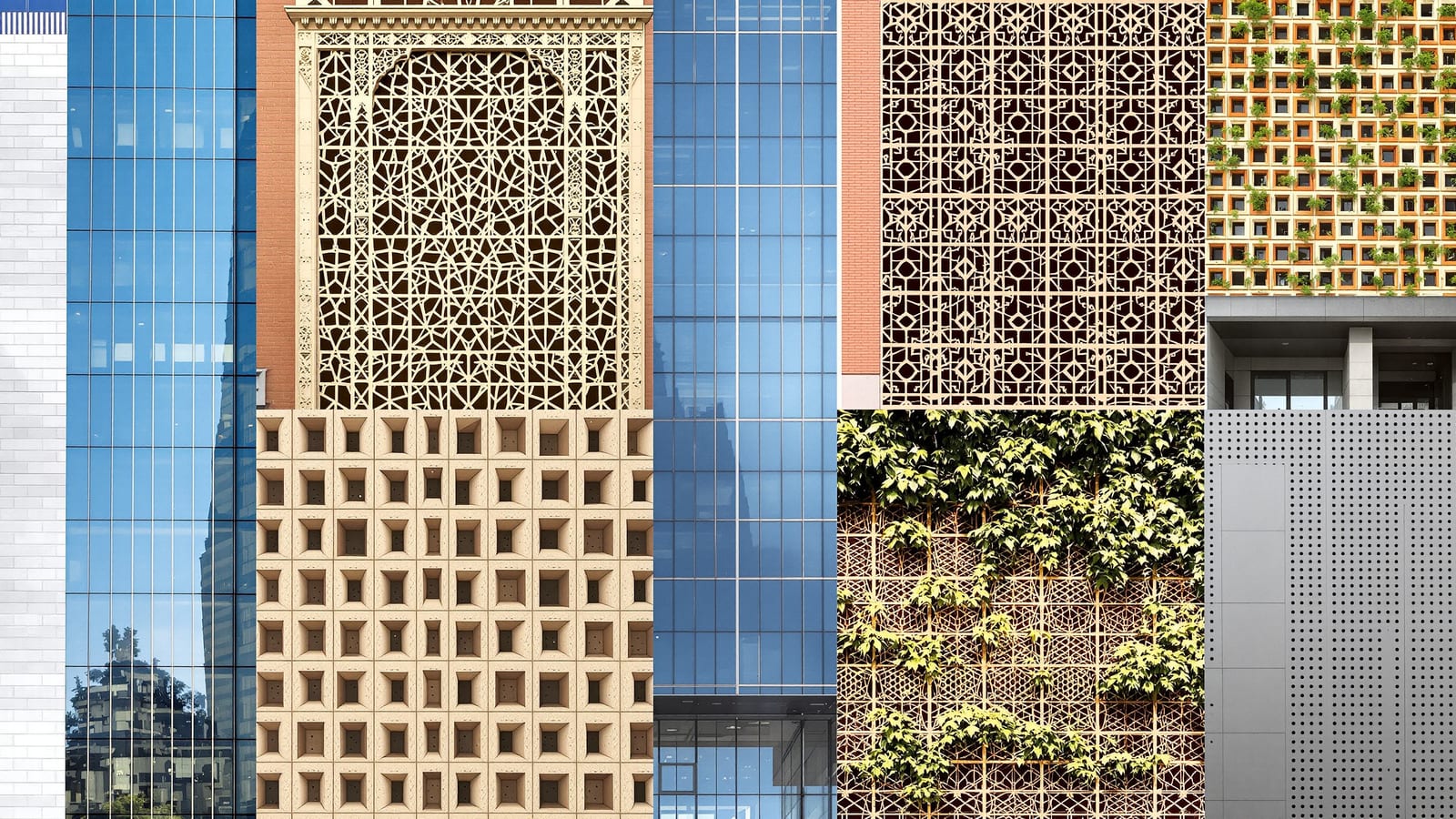
Types of Building Facades — A Complete Guide (India)
The full taxonomy of facade types by material, construction system and performance — masonry, glass, metal, terracotta, timber, jaali, green and BIPV — with real Indian examples and what is popular here today.
A facade is simply the outward-facing skin of a building — the wall you see from the street. But "the wall you see" hides an enormous amount of variety. A facade can be a solid brick mass that stores the day's heat, a sheet of mirror glass that bounces it back, a clay screen that breathes, or a panel that quietly makes electricity. Each of those is a different type of facade, with its own cost, its own behaviour in the Indian sun, and its own maintenance bill.
This guide is the map. It walks through every major facade type you are likely to meet in India — grouped by material and by how it is built — names real buildings you can go and look at, and then ranks what is actually popular here today and where the field is heading by 2035. Where a type deserves a full treatment, we point you to a dedicated deep-dive. If you want the bigger "why does any of this matter" picture first, start with the pillar guide on why building facades matter.
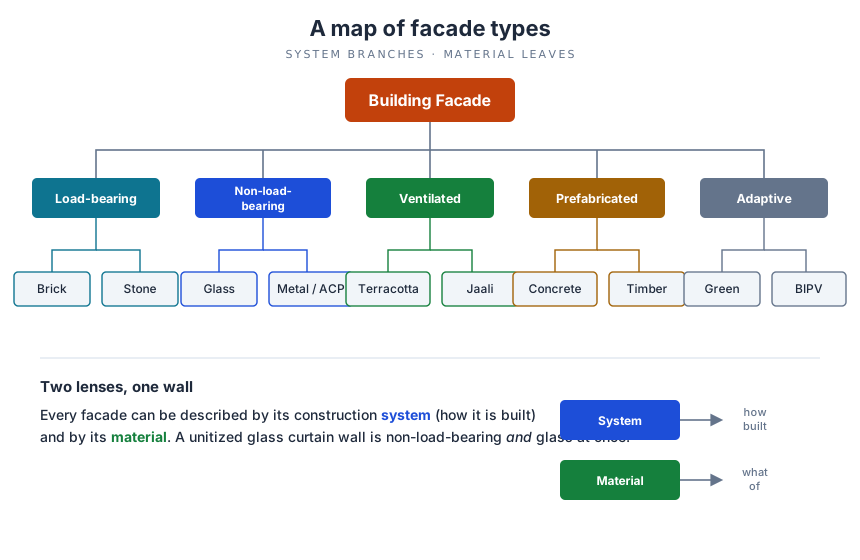
A quick orientation before we begin. Architects classify facades in two ways at once. By construction system — does the wall hold up the building, or just hang off it? And by material — brick, stone, glass, metal, and so on. The same building can be described both ways: a unitized glass curtain wall is "non-load-bearing" (system) and "glass" (material). Keep both lenses in mind; they answer different questions.
1. Masonry facades — brick, stone and block
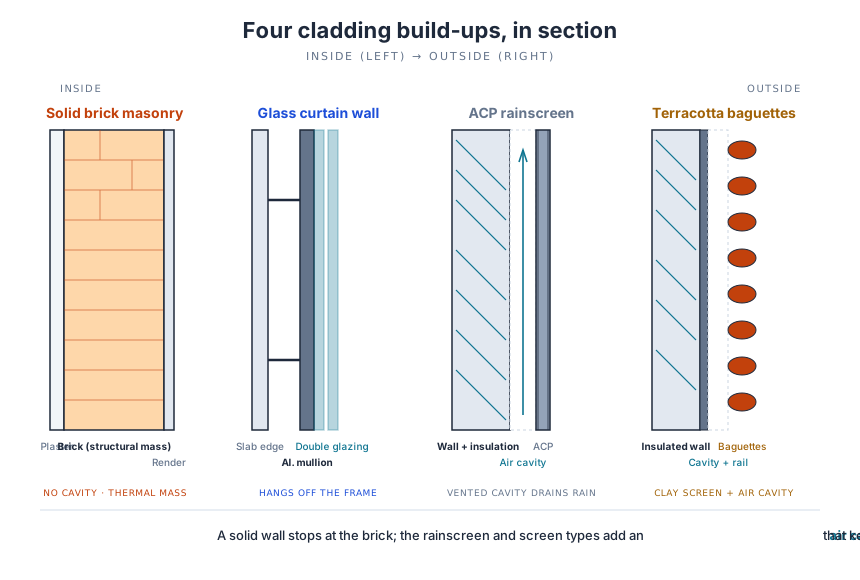
Masonry is the oldest facade family and still the backbone of Indian construction. The wall is built up from small units — fired clay brick, fly-ash brick, concrete block, or cut stone — bonded with mortar. In its purest form the masonry is the structure (load-bearing); in modern frame buildings it is often a veneer or infill that simply encloses the column-and-beam skeleton behind it.
Brick gives a building warmth and texture that little else matches. Exposed brickwork, brick veneer over a frame, and decorative perforated brick screens all fall here. Brick has good thermal mass — it soaks up heat slowly, which suits hot-dry climates — and lasts for generations. India's modern brick legacy runs deep: Louis Kahn's Indian Institute of Management, Ahmedabad is a global landmark of exposed-brick architecture, and the architect B.V. Doshi used brick masterfully across Ahmedabad. Studio Mumbai and many contemporary practices have revived exposed brick for homes and boutique hotels.
Stone — granite, sandstone, limestone, marble, slate — reads as premium and ages beautifully. It appears two ways: as thin cladding panels dry-fixed to a wall, or as full structural masonry. India's stone tradition is unrivalled, from the red sandstone and white marble of Mughal Delhi and Agra to the carved sandstone of Rajasthan. Modern examples include the marble-clad Akshardham temple complexes and countless granite-faced corporate and government buildings.
Masonry's trade-offs: it is heavy, slower to build, and less flexible for dramatic shapes — but durable, fire-resistant and low-maintenance. Read the full treatment in stone and masonry facades.
2. Glass facades — curtain walls and structural glazing
Glass is the signature of the modern Indian office. A curtain wall is a non-structural skin — aluminium framing carrying glass panels — hung off the building's frame like a curtain on a rail. It comes as a stick system (mullions and glass assembled piece by piece on site, cheaper, slower) or a unitized system (factory-built storey-height panels craned into place, faster and higher-quality, used on tall towers).
Structural glazing goes a step further: the glass is bonded to the frame with structural silicone so no aluminium shows from outside, giving a seamless mirror-smooth wall. It reads as the most expensive, high-end option.
Glass delivers daylight, views, a lightweight skin for high-rises, and an unmistakably contemporary image. Its problems in India are real, though: untreated glass turns offices into greenhouses, spiking air-conditioning loads, and large mirror facades cause glare. The fix is high-performance coated and double-glazed units, plus shading. Real Indian examples are everywhere in IT corridors — Cyber City Gurugram, Hyderabad's HITEC City, and Bengaluru's tech parks — and at modern airport terminals. The full guide is glass curtain-wall facades.
3. Metal facades — ACP, aluminium, zinc and steel
Metal cladding is fast, light, and endlessly customisable. The dominant type in India is ACP — Aluminium Composite Panel — two thin aluminium skins sandwiching a core. It is cheap, comes in hundreds of colours and finishes (including faux-wood and faux-stone), and goes up quickly, which is why it covers a huge share of Indian malls, showrooms and hospitals.
ACP carries one serious caveat. Panels with a plain polyethylene (PE) core are combustible, and PE-core cladding has fuelled deadly tower fires worldwide. For any building of height, India's National Building Code direction is toward fire-retardant (FR) or non-combustible A2 cores. Treat the core specification as a safety decision, not a cost line.
Beyond ACP sit premium metals — zinc, copper, weathering (Corten) steel, and stainless steel — which patina and age into character. Other metal facades and the ACP fire question are covered in metal and ACP facades.
4. Terracotta and rainscreen facades
Terracotta — fired clay panels and tubular baguettes — is masonry reborn as a modern engineered cladding. Hung on rails as a ventilated screen, it pairs the earthy character of clay with the speed of a panel system, and the air cavity behind it improves thermal performance. It suits India's climate and culture well, and appears on educational, cultural and sustainability-minded buildings.
The cavity idea generalises into the ventilated rainscreen — any outer cladding (terracotta, fibre-cement, metal, stone) separated from the structural wall by an air gap. Rain that gets past the outer skin drains and dries in the cavity instead of soaking the wall, and the gap adds insulation. It is one of the most reliable ways to keep a wall dry and cool in the Indian monsoon. See terracotta and rainscreen facades.
5. Concrete facades — exposed and precast
Exposed (architectural) concrete leaves the structural material itself as the finish — the board-marked, raw look of brutalism and much institutional architecture. Le Corbusier's Chandigarh Capitol Complex is the defining Indian example, alongside many university and government buildings of the mid-twentieth century. Concrete is durable, fire-resistant and almost maintenance-free, though it can stain in the monsoon if detailed poorly.
Precast concrete moves the casting off-site: facade panels are made in a factory to tight tolerances, then craned into place. This speeds up residential towers, hospitals and hotels, and improves quality control. Precast is increasingly common on India's large fast-track housing and infrastructure projects.
6. Timber and natural facades
Timber cladding — teak, cedar, the modified-wood Accoya, bamboo, and engineered timber — brings warmth no synthetic finish can fake. It is renewable and beautiful, and India has a living tradition of timber facades in Kerala, the Himalayan belt and the North-East. The cost is maintenance: wood needs protection from sun, rain and termites, all of which India supplies in abundance, so detailing and species choice matter enormously. Best suited to villas, resorts and eco-buildings. Full guide: timber and natural facades.
7. Performance skins — double-skin and ventilated facades
A double-skin facade wraps the building in two layers — usually an outer glass skin, a ventilated cavity, and an inner wall — so the cavity acts as a thermal and acoustic buffer. Air moving through the gap carries away solar heat before it reaches the occupied space, cutting cooling loads and traffic noise. It is a hallmark of high-performance green offices and is the natural answer to the "all-glass building cooks in the Indian sun" problem. Explored in double-skin and ventilated facades.
8. Screens and jaali — India's own climate technology
The perforated screen — a wall pierced with a repeating pattern to filter light and air — is a global type, but in India it has a name, a history and a deep cultural meaning: the jaali. For centuries, carved stone jaalis cooled palaces, mosques and havelis by speeding up breeze (the Venturi effect) while cutting glare, dust and direct sun, all while giving privacy. The white marble jaalis of the Taj Mahal and Fatehpur Sikri are world heritage; Rajasthan's Hawa Mahal is essentially one giant jaali facade.
Modern architects have updated the idea in concrete, terracotta, GFRC and laser-cut metal. Pearl Academy, Jaipur (Morphogenesis) wraps a contemporary jaali around the whole building as a passive cooling layer — a textbook revival. Perforated metal and concrete screens also tame parking structures and commercial frontages. The full story is in jaali and traditional Indian facades.
9. Green and living facades
A green facade brings plants onto the wall. Two distinct types hide under the name: green walls (living-wall systems where plants grow in panels or pockets fixed to the wall) and living facades (climbers rooted at the base, growing up a cable or mesh support). Both shade the wall, cool it through evapotranspiration, clean the air and soften a building's image — valuable in India's hot, polluted cities. They demand irrigation and upkeep, so they reward owners who plan for maintenance. More in green and living facades.
10. Advanced and adaptive facades — parametric, kinetic, ETFE, BIPV
This is the frontier, where the facade does more than enclose.
Parametric facades use algorithms to generate complex, performance-tuned geometry — flowing or faceted skins seen on museums, airports and landmark towers.
Kinetic facades physically move: louvres or panels that open and close to track the sun and shade the building automatically. The celebrated international benchmark is Al Bahar Towers, Abu Dhabi, whose jaali-inspired panels fold like flowers against the desert sun — a striking proof that a Mughal idea can become high technology.
ETFE is a lightweight transparent polymer formed into inflated cushions — a fraction of the weight of glass, used for stadiums and exhibition roofs and walls.
BIPV — Building-Integrated Photovoltaics — makes the facade generate electricity, with solar cells built into glass, spandrels or cladding rather than bolted on as an afterthought. For India's net-zero ambitions and abundant sunshine, this is one of the most consequential trends. See smart and kinetic facades and solar / BIPV facades.
Two ways to classify any facade
Architects sort facades by system and by material. The same wall sits in both tables.
Classification by construction system
| System | What it means | Typical types | Where you see it |
|---|---|---|---|
| Load-bearing | The facade carries the building's weight | Brick and stone masonry | Homes, heritage, low-rise institutional |
| Non-load-bearing | The facade only encloses; the frame holds the building | Curtain wall, structural glazing, ACP cladding | Offices, towers, malls |
| Ventilated | An air cavity sits behind the cladding | Rainscreen, double-skin, terracotta screens | High-rise, green buildings |
| Prefabricated | Built off-site, assembled on-site | Unitized curtain walls, precast concrete panels | Fast-track towers, hospitals |
| Adaptive | The facade changes with conditions | Kinetic louvres, electrochromic glass, smart skins | Signature and research buildings |
Classification by material
| Material | Facade types | Character |
|---|---|---|
| Brick | Exposed, veneer, perforated screen | Warm, thermal mass, durable |
| Stone | Cladding panels, full masonry | Premium, weather-resistant |
| Glass | Curtain wall, structural glazing | Modern, daylit, high cooling load |
| Metal | ACP, aluminium, zinc, copper, steel | Light, fast, customisable |
| Timber | Cladding, screens | Natural, warm, maintenance-heavy |
| Concrete | Exposed, precast | Robust, low-maintenance |
| Terracotta | Panels, baguettes | Earthy, breathable, sustainable |
| Vegetation | Green walls, living facades | Cooling, air-cleaning |
| Solar | BIPV glass and panels | Energy-generating |
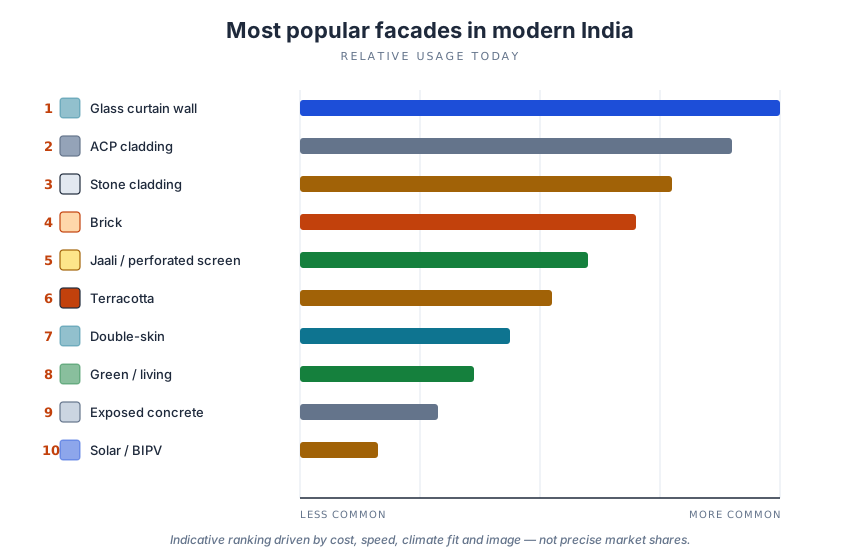
Most popular facades in modern India
Across India's current building stock and pipeline, popularity roughly stacks up like this — driven by cost, speed, climate fit and image.
| Rank | Facade type | Why it leads here |
|---|---|---|
| 1 | Glass curtain wall | Default for offices, IT parks, airports; modern image |
| 2 | ACP cladding | Cheapest fast skin for malls, retail, hospitals (watch fire-rated cores) |
| 3 | Stone cladding | Premium homes, hotels, government buildings; deep local tradition |
| 4 | Brick | Homes, schools, boutique hospitality; warmth and thermal mass |
| 5 | Jaali / perforated screen | Passive cooling with cultural identity |
| 6 | Terracotta | Sustainable institutional and cultural buildings |
| 7 | Double-skin | High-performance green offices |
| 8 | Green / living | Hospitality and corporate campuses chasing cooling and image |
| 9 | Exposed concrete | Institutional and design-led architecture |
| 10 | Solar / BIPV | Emerging on net-zero campuses and smart cities |
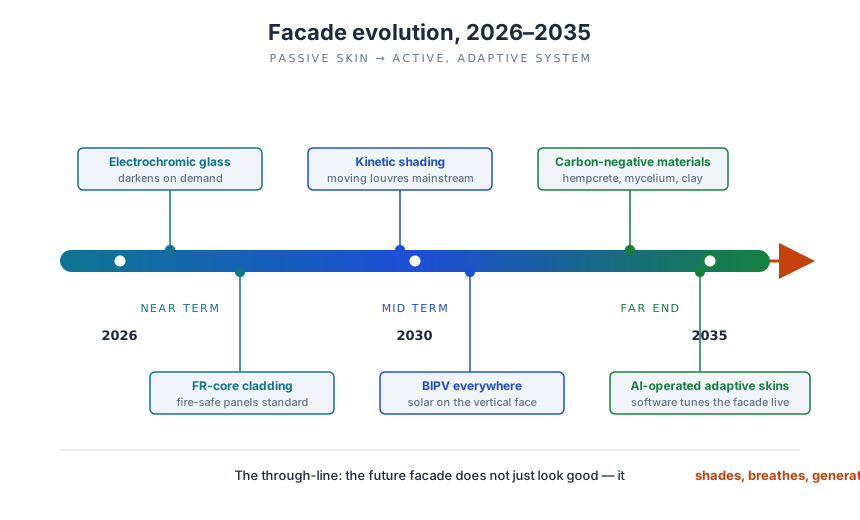
Future trends, 2026-2035
The next decade pushes facades from passive skins toward active, intelligent and regenerative systems. Expect to see:
- Climate-responsive and AI-optimised facades — skins designed and even operated by software that tunes shading, ventilation and glazing to local sun and weather, increasingly relevant as Indian cities heat up.
- Smart electrochromic glass — glazing that darkens on demand to cut glare and cooling load without blinds.
- BIPV everywhere — solar moving from rooftops into the vertical facade, helping buildings approach net-zero in India's sun-rich climate.
- Kinetic and adaptive shading — moving louvres becoming mainstream rather than showpiece, often reviving jaali geometry.
- Carbon-negative and bio-based materials — hempcrete, mycelium, low-carbon clay and timber replacing carbon-heavy options.
- Living green walls at scale as a heat-island and air-quality response.
- Digital and media facades for retail and civic landmarks.
- Biomimetic facades that copy nature's own cooling and ventilation strategies.
The through-line is unmistakable: the future facade does more than look good — it shades, breathes, generates and adapts. For how all of this lands in our specific climate, see the companion guide on facade design for Indian climates.
What this means for you
You do not need to memorise twenty facade types. You need to ask three questions in the right order. What is the building? A home, an office and a mall pull toward different families — brick and stone for homes, glass and ACP for commercial, terracotta and jaali for anything that wants to breathe. What does the climate demand? In most of India that means controlling heat and glare, which favours ventilated, shaded and screened skins over bare glass. What can you maintain? Glass needs cleaning, timber and green walls need care, concrete and stone largely look after themselves — be honest about who will keep the facade alive in year ten.
Then go deeper on the one or two families that fit. Each type linked above has its own guide with detailing, costs and Indian examples. Treat this page as the index you return to — and if you are still deciding whether the facade deserves your attention at all, the pillar on why building facades matter makes the case.
Sources
- National Building Code of India (NBC 2016) — provisions on cladding fire safety and combustible facade materials.
- Energy Conservation Building Code (ECBC), Bureau of Energy Efficiency — facade and glazing performance requirements for Indian commercial buildings.
- Morphogenesis, project documentation for Pearl Academy, Jaipur — contemporary jaali as a passive-cooling double facade.
- Indian Institute of Management Ahmedabad — Louis Kahn's exposed-brick campus, widely documented architectural reference.
- Chandigarh Capitol Complex — Le Corbusier, exposed architectural concrete (UNESCO World Heritage listing).
- Taj Mahal, Fatehpur Sikri and Hawa Mahal — historic marble and sandstone jaali facades (Archaeological Survey of India).
- Aedas / Al Bahar Towers, Abu Dhabi — published case study of a contemporary kinetic, jaali-inspired adaptive facade.
- Council on Tall Buildings and Urban Habitat (CTBUH) — technical references on curtain-wall systems (stick vs unitized) and double-skin facades.
Export this guide
Related Guides — Deep-dive reading
Jaali & Traditional Indian Façades: India's Original Climate-Smart Screen
Guide to the jaali and traditional Indian façades: history from Mughal and Rajasthani stone screens to Hawa Mahal and Sidi Saiyyed, the building physics of daylight, heat, privacy and breeze, materials from sandstone to GRC and metal, the parametric revival at Pearl Academy Jaipur, and how a homeowner can use a jaali.
Building FacadesLimberlost Place: How a Beamless Timber Floor Made a Net-Zero Tower Possible
Moriyama Teshima and Acton Ostry's ten-storey mass-timber building for George Brown College in Toronto pairs a Canadian-first exposed-wood structure with two solar chimneys that ventilate the building on no energy at all — a working prototype for how a decarbonised, low-tech-passive architecture might actually be built at scale.
The Future of ArchitectureDouble-Skin & Ventilated Facades in India: The Layered Envelope That Buffers Heat, Noise & Glare
What a double-skin facade is, how the ventilated cavity cuts solar gain, noise and glare, the four cavity types, how it differs from a rainscreen, honest India cost and monsoon caveats, plus real examples.
Building FacadesRelated Tools — Try Free
Brise-Soleil Visualizer
Interactive horizontal-louvre cut-off angle calculator — sun altitude, louvre depth, and spacing inputs with a live shadow preview. Computes θ = arctan(spacing/depth) for façade shading, ECBC envelope compliance, hospital daylight design, and tropical sun-control detailing.
Sun Shading ToolCross-Ventilation Analyzer
Estimate airflow and air changes per hour (ACH) from room size, window areas, layout, and local wind — with NBC 2016 Part 8 compliance check.
Ventilation CalculatorAcoustic Privacy (STC) Visualizer
Indian healthcare acoustic visualizer — compare wall assemblies and noise sources, see received SPL after STC attenuation, and check FGI 2018 / IS 1950 / NABH speech-privacy compliance with live dual-canvas waveform.
Acoustic Tool