
Why Building Facades Matter: The Face, Engine, and Identity of Your Home
A homeowner's guide to the single layer of your building that decides comfort, energy bills, durability, and first impressions
Stand on any street in India and look up. Before you read a single signboard, you already know things. You know whether a building is a bank or a boutique, a government office or a family home, a place that wants you to feel welcome or one that wants you to keep walking. You know this in less than a second, and you know it almost entirely from the facade — the face the building turns to the world.
A facade is far more than decoration or a coat of paint. It is the building's skin, weather shield, energy engine, and identity all at once. Architects call it the "third skin" — your own skin is the first, your clothes the second, and the facade mediates between the people inside and the sun, rain, dust, and noise outside. Get it right and the building stays cool in a Nagpur summer, dry through a Mumbai monsoon, quiet beside a busy road. Get it wrong and you pay for the mistake every month — in electricity bills, seepage stains, repainting, and a home that never feels right. This guide is the foundation of our Building Facades series, explaining in plain language why this single layer deserves far more attention than it usually gets.
1. What a facade actually is
In everyday speech, "facade" usually means the front of a building — the principal elevation you see from the road. In architecture it means more: every exterior surface that separates inside from outside. That includes external walls, windows and glazing, the main entrance and doors, balconies and railings, any cladding (the outer layer fixed over the structure — stone, tile, metal, fibre-cement board), sunshades and louvers, decorative screens, and even shop or office signage.
Think of it as an interface — where the interior meets the exterior, the occupant meets the climate, one building meets the street, and the practical job of keeping weather out meets the human wish to express something. A wall does all of this at once, which is why a facade is harder to design well than it looks.
A useful way to hold the idea: a good facade does three jobs together — it is a face (identity and first impression), a filter (it lets in light, air, and views while keeping out heat, glare, rain, and noise), and a shield (it protects the structure and the people inside). The rest of this guide walks through each of those jobs.
2. First impressions and identity
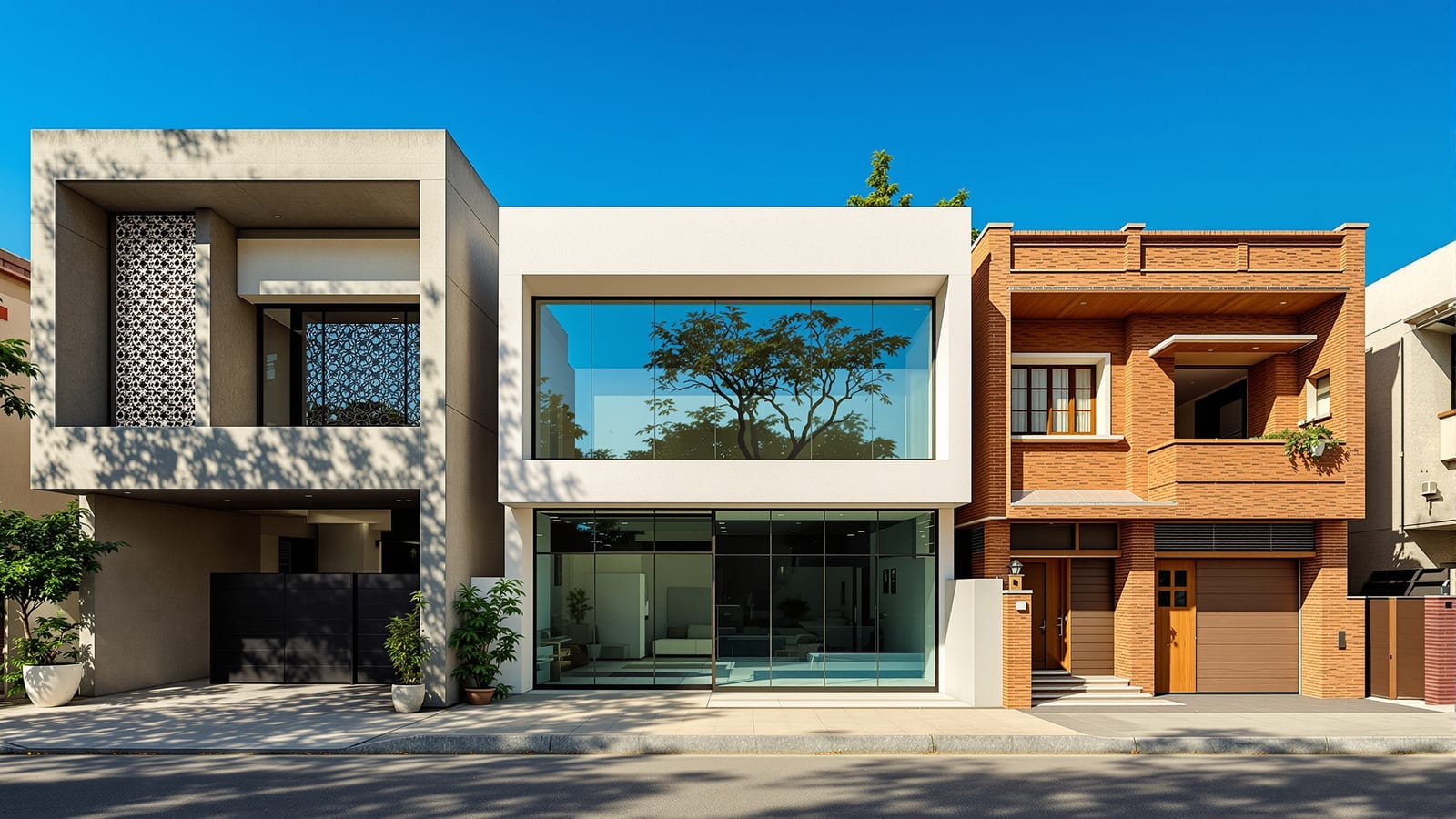
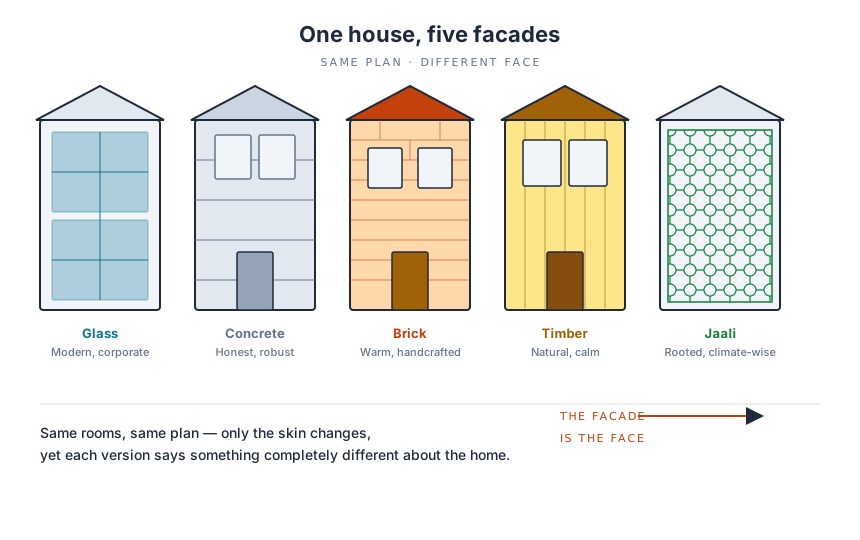
The facade is the public identity of a building — the part everyone sees and almost no one questions, which is why it carries so much weight. A grand stone-clad entrance signals permanence and prestige; a sleek glass front says corporate and contemporary; a warm brick-and-timber front says home. None of this is written down anywhere, yet we all read it fluently.
Different materials carry different meanings, and it helps to know the shorthand:
| Facade language | Typical reading | Common Indian use |
|---|---|---|
| Glass curtain wall | Modern, corporate, transparent | IT parks, corporate HQs in Bengaluru, Gurugram, Hyderabad |
| Exposed concrete | Honest, robust, brutalist | Institutions, some bold homes |
| Stone (Dholpur, Kota, granite) | Timeless, monumental, premium | Civic buildings, temples, luxury homes |
| Exposed brick | Warm, contextual, handcrafted | Homes, boutique offices, cafes |
| Timber / wood-look | Natural, calm, sustainable | Hill-station homes, resorts |
| Jaali / perforated screen | Rooted, climate-wise, elegant | Homes, institutions, cultural buildings |
For a homeowner this matters in a very direct way. Your front elevation is how your house introduces itself — to guests, to neighbours, and one day to a buyer or tenant. You do not need it to shout. You need it to say clearly and honestly what kind of home this is.
3. The climate engine: one country, many weathers
India is not one climate; it is at least five. A facade that works beautifully in Kochi can fail completely in Jaipur, and this is where most homeowners go wrong — they copy a photograph from a magazine or a different city without asking whether it suits their own sky.
The facade is your first and biggest line of climate defence. Here is the short version of how good facades respond across India's zones:
| Climate zone | Where (examples) | What the facade should do |
|---|---|---|
| Hot and dry | Jaipur, Ahmedabad, Bikaner | Thick walls, small openings, deep shading, high thermal mass, light colours |
| Warm and humid | Kochi, Mangaluru, Chennai coast | Large shaded openings, cross ventilation, moisture-resistant finishes, generous overhangs |
| Composite | Delhi, Lucknow, Nagpur | Adaptive, seasonal — shade in summer, let low winter sun in, balanced glazing |
| Temperate / moderate | Bengaluru, Pune | Balanced glazing, comfortable most of the year, modest shading |
| Cold | Shimla, Leh, Gangtok | Insulation, smaller openings, capture solar warmth, sealed against cold winds |
The lesson is simple: the right facade is the one that answers your local weather, not someone else's. We go far deeper into this in our companion guide on facade design for Indian climates.
4. Energy: the bill you pay every month
This is the part that hits your wallet. In an Indian home or office, the single largest electricity cost is usually cooling — and the facade decides how hard your air conditioner has to work. Sunlight striking an unshaded wall or a large unprotected window pours heat straight into your rooms (this is "solar heat gain"), and your AC then spends money fighting it.
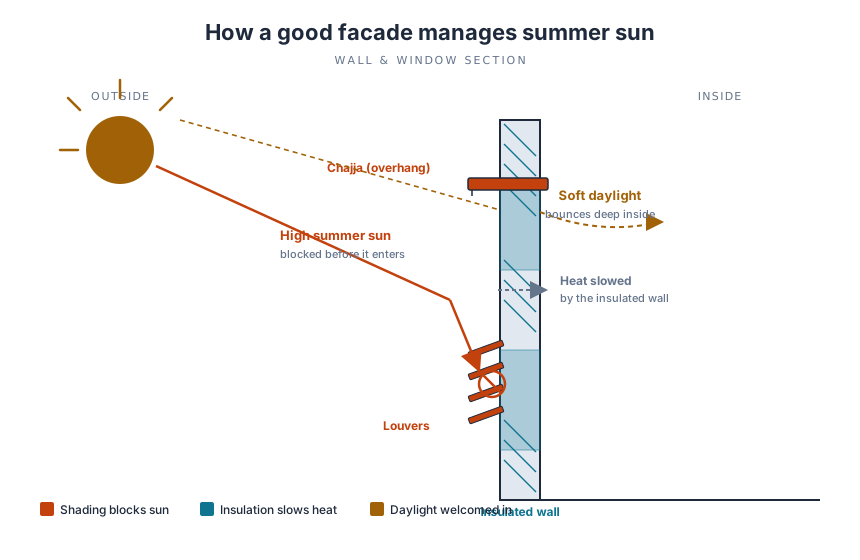
A high-performance facade controls this in three ways. It blocks unwanted sun before it enters, using external shading — chajjas, louvers, deep reveals, jaali screens, and reflective or double glazing where glass is used. It slows heat coming through the walls themselves, using insulation, cavity walls, or insulated panels. And it lets in good daylight so you do not need to switch on lights during the day, while keeping out the harsh glare that forces you to draw the curtains and turn on the AC anyway.
The numbers are not small. Studies and green-building experience consistently show that a well-designed facade can cut a building's energy demand by roughly 20 to 40 percent compared with a careless one. Over the twenty- or thirty-year life of a home, that is a genuinely large amount of money — and a large amount of carbon.
5. Comfort you can feel — heat, light, and sound
Energy savings are the measurable benefit. Comfort is the one you live with every day, and it has three parts.
Thermal comfort is whether rooms feel pleasant without a fight. A poor facade gives you afternoon rooms that overheat, walls that radiate stored heat into the evening, and uncomfortable temperature swings between morning and night. A good facade gives steadier indoor temperatures, less heat radiating off the walls, and comfort across the seasons — which is also better for health, sleep, and the simple pleasure of being at home.
Visual comfort is about light. Daylight is wonderful; glare is not. A large west-facing window with no shading floods a room with hard afternoon light that makes screens unreadable and forces you to shut everything out. Well-designed openings bring in soft, even daylight that lifts the mood, supports the body's natural day-night rhythm, and reduces eye strain — without the glare and without the heat.
Acoustic comfort is the one most people forget until they cannot sleep. Beside a busy Indian road, a railway line, or under a flight path, the facade is your main barrier against noise. Double glazing, laminated glass, insulated walls, and well-sealed window joints make the difference between a peaceful bedroom and a constant drone. A gap you could slide a coin through will undo a lot of expensive glass, so detailing matters as much as material.
6. The weather shield: monsoon, dust, sun, and pollution
India is hard on buildings. Three or four months of driving monsoon rain, months of fierce ultraviolet sun, fine dust on every surface, and urban pollution that eats into finishes — the facade takes all of it, every year, so the people inside do not.
A robust facade keeps wind-driven rain out of the walls, sheds water away from openings, resists fading from UV, and stays cleanable rather than streaky. When it fails, the symptoms are familiar to every Indian homeowner: damp patches, peeling paint, white efflorescence salts on the wall, black algae streaks below sills, and the smell of trapped moisture. Good detailing — drip grooves under chajjas, sloped sills, sealed joints, weather-resistant finishes — is unglamorous but it is what keeps a building looking new for years instead of months.
7. Protecting the bones of the building
Behind the visible finish, your building has a structure — usually a reinforced cement concrete (RCC) frame, sometimes steel, with waterproofing layers and internal finishes. The facade is the first line of defence for all of it.
This is where neglect becomes expensive. When a facade lets water in, that water reaches the steel reinforcement inside the concrete. The steel rusts, expands, and cracks the concrete from within — a slow failure called spalling that you may not notice until chunks start falling and repairs run into lakhs. Trapped moisture also breeds mould and rots finishes. A facade is the raincoat that keeps the structure alive, and money spent on good detailing is the cheapest structural insurance you can buy.
8. Property value, branding, and the market
A quality facade is one of the strongest drivers of property value in India. It is often the first thing a buyer or tenant judges, and it is hard to fake — anyone can repaint a room, but a well-resolved exterior signals the whole building was built with care. In premium and rental markets, the facade is frequently the single biggest differentiator between two otherwise similar properties, and it shows up directly in resale price and rental yield.
For commercial buildings the facade does more — it is branding made of glass and stone. An office, hotel, hospital, or showroom uses its facade to communicate professionalism, trust, and prestige before a customer steps inside. This is why corporations spend so heavily on their exteriors: the building is an advertisement that works twenty-four hours a day.
9. Sustainability and a building that gives back
A facade is usually the largest single contributor to how sustainable a building is, because it controls the two biggest levers — how much energy the building wastes, and how much it can harvest. Good facade design does several green things at once: orientation and shading for passive solar control, operable windows and louvers for natural ventilation, light shelves and good glazing for daylight, and increasingly vertical gardens and living walls that cool the air and soften the street. The most advanced facades even generate power, with solar cells built into the glass or cladding (building-integrated photovoltaics, or BIPV).
A clear Indian example is the CII–Sohrabji Godrej Green Business Centre in Hyderabad, designed by Karan Grover and Associates. In 2004 it became the first building outside the United States to earn the LEED Platinum rating, and it did so by leaning on facade-led ideas — jaali screens, courtyards, a wind tower, green roofs, and lightweight aerated-concrete walls that cut the cooling load substantially. It is proof that climate-wise facades are not a sacrifice; they are an advantage.
10. Urban and cultural identity — and a deep Indian inheritance
Every facade also speaks to the street. Buildings together create the character of a neighbourhood, a skyline, a sense of place. A facade that respects its context strengthens the streetscape; one that ignores it can cheapen everything around it.
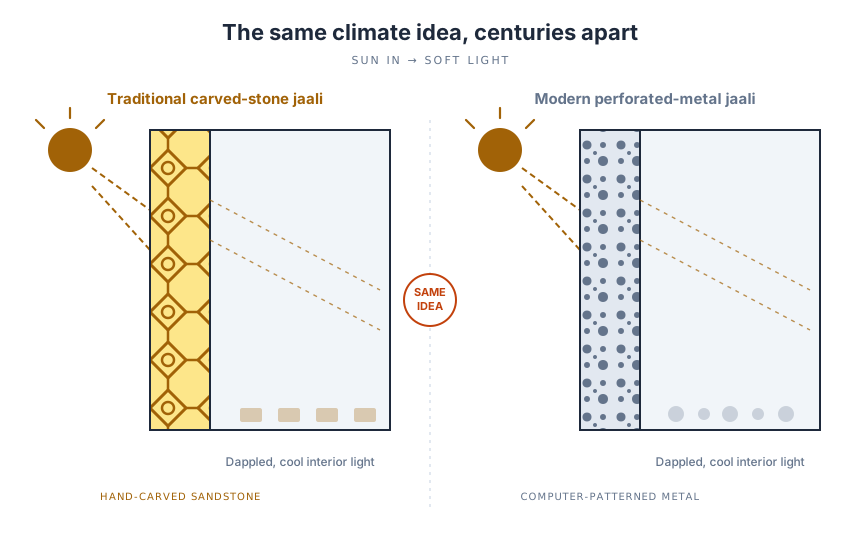
India has one of the richest facade traditions in the world, developed over centuries to handle exactly the climate problems we still face. The jaali — a carved stone or lattice screen — filters harsh sun into soft light, allows breeze through while creating privacy, and turns a wall into a piece of art. The chajja (the projecting horizontal shade over windows and doors) keeps sun and rain off openings. Verandahs and courtyards create shaded, ventilated buffer zones. These were not decoration; they were brilliant, low-tech climate engineering.
The exciting part is that modern Indian architects are reinventing this inheritance, not abandoning it. The clearest example is Pearl Academy in Jaipur, designed by Morphogenesis. It wraps the building in a contemporary double-skin jaali set about four feet away from the inner wall. The perforation pattern was worked out with computer shadow analysis so the screen blocks direct desert heat while letting diffused daylight in — a centuries-old Rajasthani idea, re-engineered. For a heritage counterpoint, the Chhatrapati Shivaji Maharaj Vastu Sangrahalaya (CSMVS) in Mumbai, designed by George Wittet in the Indo-Saracenic style, shows the same instincts a century earlier — domes, arched pavilions, and small jaalis for light and wind, woven into a civic face that still defines its part of the city. We explore this lineage fully in our guide to jaali and traditional Indian facades.
11. Fire safety — the lesson the world learned the hard way
A facade is also a fire system, and ignoring this can be fatal. Some modern cladding materials — especially certain composite panels with combustible cores — can let fire race up the outside of a building far faster than anyone expects. International tragedies have made this brutally clear, and India has seen its own high-rise facade fires. A safe facade uses non-combustible or fire-rated cladding, includes fire-stops at every floor level to break the path of flame inside the wall cavity, and is detailed so that the skin protects rather than endangers the people inside. If you are using any panel cladding, this is not a corner to cut — we cover it in detail in facade fire safety and cladding.
12. Intelligent and future facades
The frontier of facade design is a skin that responds. Instead of a fixed wall, an "intelligent" facade adjusts itself through the day — louvers that rotate to track the sun, glass that darkens automatically to cut glare (electrochromic glazing), and shading systems driven by sensors and software. The most famous example is the Al Bahar Towers in Abu Dhabi, designed by Aedas, whose facade is a giant computer-controlled reinterpretation of the Arab mashrabiya screen — over two thousand triangular panels that open and close with the sun and cut solar heat gain by more than half. It is, in spirit, a high-tech cousin of the Indian jaali.
For most homeowners today these systems are still costly, but the direction is clear, and simpler versions — operable louvers, smart blinds, switchable glass — are steadily becoming affordable. The principle behind them is one any homeowner can apply now: the best facade adapts to the weather rather than ignoring it.
What this means for you
Strip away the jargon and a few simple principles remain. A good facade is climate-responsive (it suits your sky, not a magazine's), energy-efficient (it shades and insulates so your bills stay low), comfortable (steady temperatures, soft light, quiet rooms), durable and maintainable (it shrugs off monsoon, dust, and sun for years), safe (especially regarding fire and water), contextually appropriate (it belongs on its street), and economically sensible (good value over its whole life, not just the cheapest quote).
As a homeowner, here is the practical takeaway. Treat the facade as a system, not as a final coat of paint chosen at the end. Decide it early, alongside the plan and the orientation, because shading and openings are hard to add later. Spend on the things you cannot see — detailing, drip grooves, sealing, the right shading — not only on the things you can. And resist the urge to copy a striking front from a different climate; the most beautiful facade you can own is the one that keeps your home cool, dry, quiet, and unmistakably yours.
From here, explore the rest of the series: the types of building facades you can choose from, how to tune a facade to Indian climates, real Indian house front elevation ideas, the heritage of jaali and traditional Indian facades, modern glass curtain-wall facades, and the critical subject of facade fire safety and cladding.
Sources
- Morphogenesis, "Pearl Academy of Fashion, Jaipur" — project documentation on the double-skin jaali and passive cooling strategy.
- Dezeen, "Pearl Academy of Fashion by Morphogenesis" (2009).
- Chhatrapati Shivaji Maharaj Vastu Sangrahalaya (CSMVS), official and Google Arts and Culture project pages — Indo-Saracenic design by George Wittet.
- Re-Thinking The Future, "CII–Sohrabji Godrej Green Business Centre by Karan Grover and Associates — First LEED Platinum Certified Building in India."
- U.S. Green Building Council, LEED rating system documentation (LEED Platinum, 2004 award to CII GBC).
- Aedas, "Al Bahar Towers, Abu Dhabi" — responsive mashrabiya facade case study; Council on Tall Buildings and Urban Habitat (CTBUH) Tall Building Innovation Award 2012.
- Bureau of Energy Efficiency (BEE), Energy Conservation Building Code (ECBC) — building envelope and facade performance provisions for India.
- National Building Code of India (NBC) 2016, Bureau of Indian Standards — provisions on fire safety, cladding, and building envelope.
Export this guide
Related Guides — Deep-dive reading
Energy-Efficient Facades in India: How the Building Skin Cuts Your Cooling, Heating & Lighting Bills
How a building facade drives cooling, heating and lighting energy in India, the three levers of solar-heat-gain control, insulation and daylighting, U-value, SHGC, VLT and WWR in plain terms, ECBC and Eco-Niwas expectations, and real Indian green buildings.
Building FacadesClimate-Responsive Facades for India: Designing Your Home's Skin for Your Weather
A homeowner's plain-language guide to the facade strategy for every Indian climate zone — what your walls, windows, shading, and colours should actually do where you live
Building FacadesDesigning a Naturally Energy-Efficient Indian Home
Comfort first, gadgets last — passive design, orientation, insulation, ventilation and the climate wisdom that cuts Indian energy bills
SustainabilityRelated Tools — Try Free
Brise-Soleil Visualizer
Interactive horizontal-louvre cut-off angle calculator — sun altitude, louvre depth, and spacing inputs with a live shadow preview. Computes θ = arctan(spacing/depth) for façade shading, ECBC envelope compliance, hospital daylight design, and tropical sun-control detailing.
Sun Shading ToolCross-Ventilation Analyzer
Estimate airflow and air changes per hour (ACH) from room size, window areas, layout, and local wind — with NBC 2016 Part 8 compliance check.
Ventilation CalculatorFuture Home Comfort Score
Score your home 0 to 100 on daylight, ventilation, thermal and acoustic comfort and find the weak link.
Window Tool