
Facade Maintenance, Durability & Property Value in India — Keeping the Building's Face Working for Decades
What attacks a facade in India, how each material ages and its realistic upkeep cycle, the failure chain from a missed detail to spalling concrete, inspection and access regimes, and how facade condition quietly drives resale, rent and value.
The face of a building is a working part, not a finish
Most people think of a facade the way they think of a coat of paint — something you put on once and admire. In reality the outside face of your building is a working part, and every day it is being attacked. Rain hammers it for four months, the sun bakes it for eight, dust settles on it constantly, pollution etches it, and at the coast salt eats at it around the clock. The facade is the only thing between all of that and the concrete, steel and money inside your walls. Whether it does that job for fifty years or quietly fails in eight comes down to one unglamorous thing: maintenance.
This guide is about keeping the building's face working and valuable over decades — what attacks a facade in India, how each material ages and what its upkeep cycle and cost look like, the failure chain that turns a tiny detailing mistake into a structural problem, how you inspect and reach a facade safely, and how facade condition quietly drives what your property is worth and whether it rents or sells. It is the practical companion to our pillar on why building facades matter and the overview of facade types.
1. What actually attacks a facade in India
A facade in India faces a harsher combination of forces than almost anywhere in the temperate West, and they work together rather than separately. Understanding the enemy is the first step to defending against it.
Monsoon rain. The big one. Wind-driven rain in Mumbai, the Konkan, coastal Karnataka, Kerala and the Northeast can deliver 2,000 to 3,000 mm in a few months, much of it slamming horizontally into the windward face. Water does not need a hole — it needs a hairline crack and a pressure difference, and it finds both.
Ultraviolet (UV) radiation. India's solar load is brutal. UV breaks down the chemical bonds in paints, sealants, plastics and the surface of timber — which is why a south or west facade fades, chalks and cracks years before a shaded north face, and why a sealant that lasts twenty years in Europe may last well under that here.
Dust and pollution staining. Indian city dust is sticky with vehicle soot and industrial particulates. It settles on every ledge and rough surface, then the first rain washes it down in dark streaks — the grimy "tear stains" under window sills and projecting bands on almost every unmaintained urban building.
Salt at the coast. Within a few kilometres of the sea — Mumbai, Chennai, Kochi, Visakhapatnam, Goa — airborne chloride salt settles on the facade and accelerates corrosion of steel railings, fixings and any reinforcement near the surface. Coastal buildings age visibly faster.
Thermal movement. Materials expand when hot and shrink when cool. A dark metal panel on a Delhi summer afternoon can swing through 40 to 50 degrees Celsius between night and day, every cycle. This constant movement fatigues joints, opens cracks and is the slow killer of sealants and rigid finishes.
Biological growth. Warmth plus moisture plus organic dust equals algae, mould, lichen and moss — the green and black films that colonise damp, shaded and poorly drained surfaces. It is not just ugly; it holds moisture against the wall and accelerates breakdown of the finish underneath.
2. How each facade material ages — a comparison
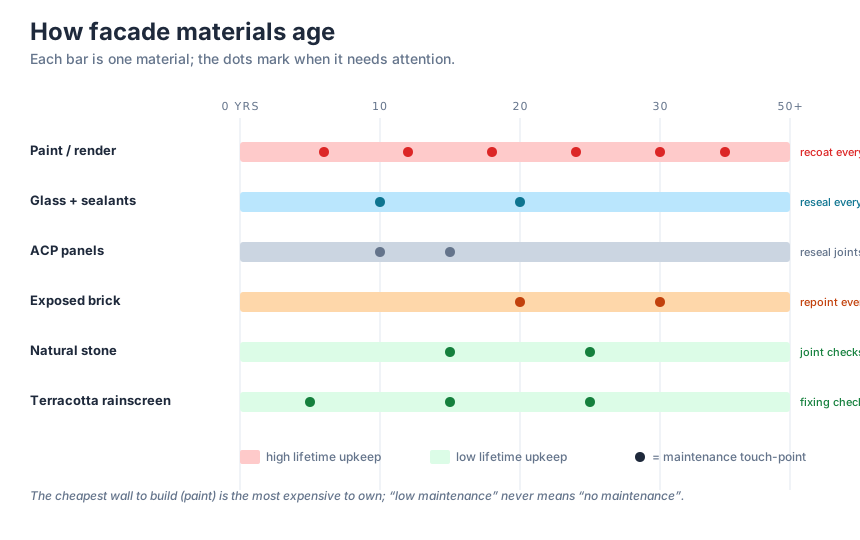
No material is maintenance-free; they simply fail in different ways and on different timescales. The honest comparison below is what should drive a facade choice, because the cheapest wall to build is rarely the cheapest to own.
| Material | How it ages in India | Main failure mode | Realistic maintenance cycle | Relative lifetime upkeep |
|---|---|---|---|---|
| Paint / cement render | Fades, chalks, hairline-cracks; streaks with dust; algae on damp faces | Cracking and peeling letting water in | Wash yearly; recoat every 5–7 years (3–5 yrs on exposed/coastal faces) | High — recurring repaint forever |
| Exposed brick | Weathers gracefully; efflorescence (white salt bloom); mortar joints erode | Mortar joint decay and water ingress | Inspect joints; repoint every 20–30 years; clean as needed | Low |
| Natural stone | Very durable; can stain, develop biological growth; some stones spall at the coast | Joint/sealant failure, staining | Clean every 3–5 years; reseal joints ~10–15 years | Low to moderate |
| ACP (aluminium composite panel) | Coating holds colour well; sealed joints degrade; panels can oil-can/dent | Sealant joint failure; (fire risk if non-FR core) | Wash 1–2 times a year; reseal joints ~10–15 years | Moderate |
| Glass + sealants | Glass is inert; the sealants and gaskets around it are the weak link | Sealant ageing, seal failure, leaks | Clean 2–4 times a year; reseal/regasket every 10–20 years | Moderate to high (access cost) |
| Terracotta rainscreen | Fired clay colour is permanent; clips and sub-frame are the parts to watch | Fixing/sub-frame corrosion; cracked panel | Inspect fixings ~5 years; clean as needed; swap odd panel | Low |
| Timber | Greys and weathers; UV and rot if unprotected; insect attack | Rot, splitting, finish breakdown | Re-oil/recoat every 2–4 years (or let it silver naturally) | High if kept "new"; low if allowed to grey |
| Green / living wall | Living system — plants die back, irrigation clogs, substrate ages | Irrigation failure, dead patches, leaks | Active horticultural upkeep, monthly+ | Very high (ongoing) |
Two lessons jump out. First, the materials with the cheapest upfront cost — paint and render — carry the highest lifetime upkeep, because you pay to redo them every few years for the life of the building. Second, "low maintenance" never means "no maintenance": even fired clay and stone need their joints, sealants and fixings inspected. (For the fired-clay system specifically, see our sibling guide on terracotta and rainscreen facades.)
3. The failure chain: how a tiny detail becomes a structural problem
Most catastrophic facade failures do not start as structural problems. They start as a missing drip groove, a blocked weep hole or an aged sealant — a detailing mistake — and then proceed through a predictable chain. Understanding this chain is the single most valuable thing in this guide, because it tells you why early, cheap maintenance prevents late, ruinous repairs.
1. Water ingress. Rain gets past the outer skin through a crack, a failed sealant joint or an un-drained ledge, and reaches the structure behind — concrete or the steel sub-frame.
2. Corrosion of reinforcement or fixings. Water plus oxygen rusts the steel: the reinforcing bars inside reinforced cement concrete (RCC), the steel angles and brackets a cladding hangs on, or the anchors holding stone. At the coast, salt turbocharges this.
3. Spalling. Here is the vicious bit. When steel rusts, it expands to several times its original volume. That expansion pushes from inside the concrete with enormous force, until the concrete cover cracks and breaks away in chunks — this is spalling. You see it as patches of broken concrete with rusty bars showing through, often on balcony soffits, slab edges and parapets.
4. Staining and deterioration. Rust bleeds brown streaks down the facade, biological growth colonises the permanently damp zone, finishes peel, and the exposed steel — now losing section to rust — keeps weakening. What began as a sealant worth a few hundred rupees to renew can end as a chunk of falling concrete that is both a structural worry and a genuine public-safety hazard on a street below.
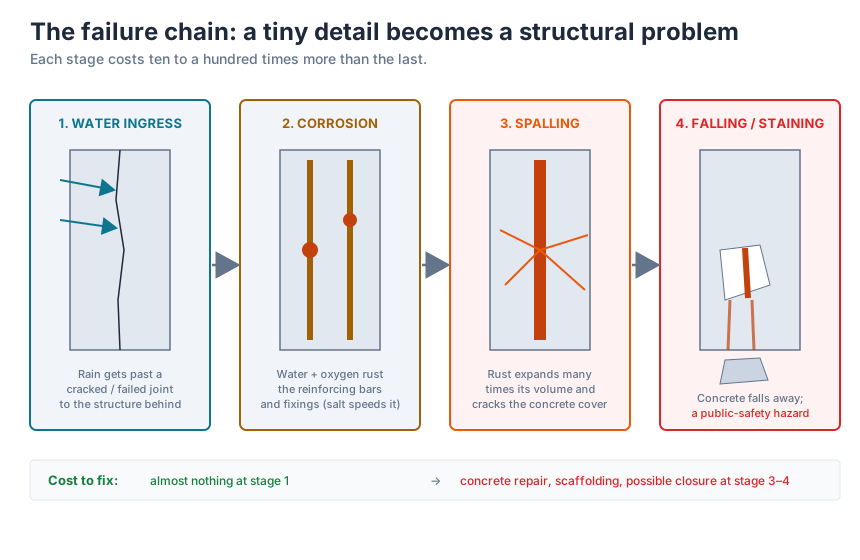
The chain is why facade maintenance is really risk management. Stopping water at stage one costs almost nothing. Once you reach stage three, you are into concrete repair, rebar treatment, scaffolding and re-finishing — often ten to a hundred times the cost, and sometimes a safety closure. The deeper mechanics of how and why buildings let water in are covered in our waterproofing guide.
4. Inspection and cleaning regimes
A facade should be inspected on a schedule, not when something falls off. A workable regime for an Indian building has three layers.
After every monsoon — the most important inspection of the year. Walk the building and look for fresh staining (new water tracks), efflorescence, algae, cracked or peeling paint, opened-up sealant joints and any rust bleed. This is when problems announce themselves while they are still cheap to fix.
Annually, a closer look. Check sealant joints for hardening or pulling away; metal railings, brackets and fixings for rust; that weep holes and cavity drains are clear, not painted over or blocked; and parapet copings and drip grooves.
Every 3 to 5 years, a detailed condition survey — ideally by a facade engineer above a few storeys — including touch inspection of fixings and tapping concrete for the hollow "drummy" sound that signals incipient spalling before it visibly breaks away.
Cleaning is durability, not just looks: washing dust and pollution off before it bonds, and removing growth before it spreads, extends the life of the finish. Most facades benefit from a gentle low-pressure wash once or twice a year; glass and ACP need more. Keep it gentle — harsh high-pressure jets and strong chemicals drive water into joints and strip protective coatings, causing the very damage you are trying to prevent.
5. Reaching the facade safely — access
You cannot maintain what you cannot reach, and access is often the largest single line in a facade maintenance budget. There are three common methods, and the right building design plans for them from the start.
Scaffolding — the familiar bamboo or steel framework — is cheap to erect on a low or mid-rise building and gives full, stable access, but it is slow, obstructive at street level and impractical above a certain height.
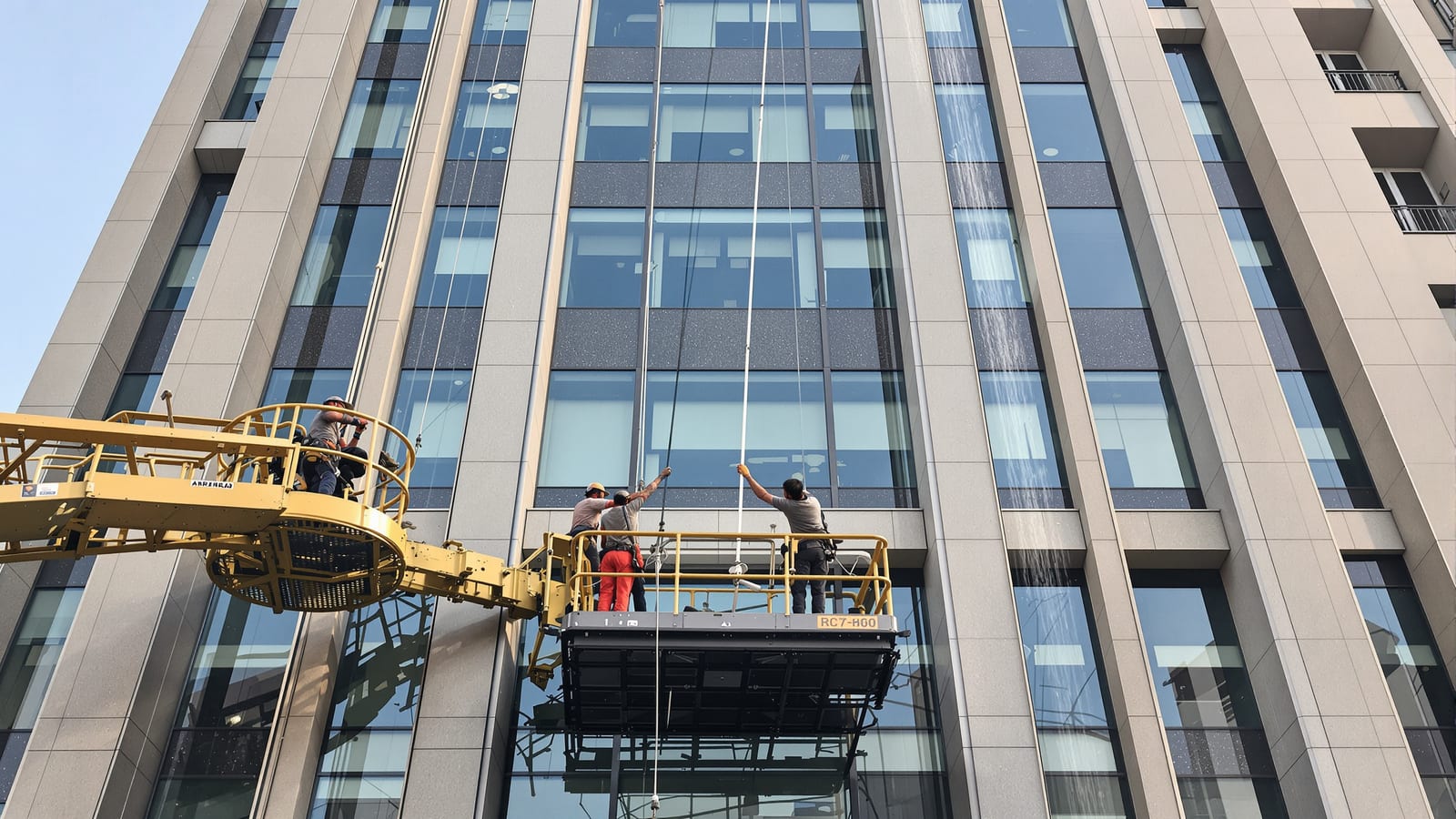
Suspended cradle or BMU. For taller buildings, a suspended platform (a "cradle" or gondola) hangs from the roof and is raised and lowered by ropes or a powered hoist. On premium towers this is formalised as a Building Maintenance Unit (BMU): a roof-mounted crane-and-cradle system, often on a track, designed into the building specifically so the facade can be cleaned and serviced for its whole life. A BMU is expensive but it is the difference between a tower whose glass can be washed and one whose facade is effectively unreachable.
Rope access. Trained technicians abseil down the facade on twin ropes — the same discipline as industrial climbing. It is fast to mobilise, low-cost compared with a BMU, and ideal for inspections, sealant work and spot repairs, though limited in how much material a worker can carry and weather-dependent.
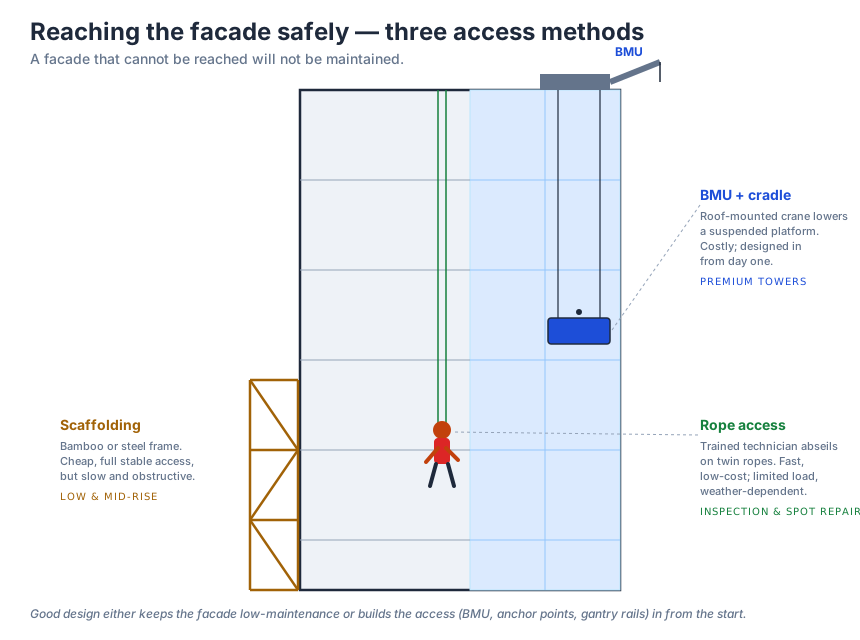
The design lesson is blunt: if a building's facade cannot be safely and affordably reached, it will not be maintained, and an unmaintained facade fails. Good design either keeps the facade simple and low-maintenance or designs the access (BMU, anchor points, gantry rails) in from day one.
6. The sealant and gasket question
On glass, ACP and most panel facades, the panels are durable and the joints between them are the weak point. Those joints are closed with wet-applied sealant (a gun-applied flexible compound) or with rubber gaskets in a glazing frame, and both age.
Sealant must stretch and squeeze as the facade moves with temperature, all day, every day, for years. UV, heat and that movement gradually harden it until it cracks, loses grip on the edges (adhesion loss) or tears. A good silicone sealant, properly specified and installed, may last 15 to 20 years; a cheap or wrongly applied one can fail in five, and India's UV and thermal swings push everything toward the shorter end. Rubber gaskets harden and shrink similarly and need replacement on a broadly similar cycle.
The practical takeaway: budget for periodic re-sealing and re-gasketing across a glass or panel facade's life — typically once or twice in its first few decades. It is routine planned maintenance, not a failure. Neglecting it is how a glass tower starts leaking at the joints, which feeds straight back into the failure chain of section 3.
7. How facade condition drives property value
This is the section that turns maintenance from a cost into an investment. A facade is the first thing every buyer, tenant, valuer and passer-by sees, and it shapes the value of the asset in several concrete ways.
First impressions set the price anchor. A clean, well-kept, dignified facade tells a buyer the whole building has been cared for; a streaked, cracked, algae-stained one tells them to expect hidden problems and to negotiate hard. The facade is read as a proxy for the building's overall health — often before anyone steps inside.
Resale value. A premium, well-maintained facade is frequently the biggest differentiator between two otherwise similar buildings, and it commands a price premium. Conversely, visible spalling, rust bleed and damp are red flags that depress offers, lengthen the time to sell, and trigger price chips during due diligence.
Rentability and yield. For rented homes, offices and retail, the facade drives footfall, tenant quality and the rent achievable. A smart facade lets you charge more and fill space faster; a tired one means longer vacancy and rent discounts. Over years, that gap in rental yield dwarfs the cost of the maintenance that would have prevented it.
Lifecycle cost, not just first cost. A building that re-seals on schedule and washes its facade is worth more than an identical one that deferred everything and now needs concrete repair — because the deferred-maintenance building carries an embedded liability that any sharp valuer will price in.
In short, facade maintenance is not money spent on appearances. It is money spent protecting the structure, the saleability, the rent and the headline value of the largest asset most people will ever own.
8. A homeowner maintenance checklist — and what to design in
If you take nothing else from this guide, take this routine and these design principles.
The ownership checklist:
- After every monsoon, walk the whole facade and photograph any new staining, cracks, rust bleed or algae — comparing year to year catches slow problems early.
- Wash dust, pollution and biological growth off gently, once or twice a year, before it bonds or spreads.
- Keep weep holes, cavity drains and gutters clear; a blocked drain is the start of most water-ingress stories.
- Renew sealant joints when they harden or crack, on a planned cycle, not after they leak.
- Treat any rust on railings, brackets or fixings immediately — it only ever gets worse, faster, near the coast.
- The moment you see spalling (broken concrete with bars showing), get a professional condition survey — that is a structural matter, not a cosmetic one.
- For anything above two or three storeys, commission a facade condition survey every few years and plan access (scaffold, rope access or BMU) accordingly.
What to design in for low upkeep, if you are building or renovating:
- Generous roof overhangs, chajjas and drip grooves so rain is thrown clear of the wall rather than running down it — the oldest and cheapest durability device in Indian architecture.
- Colour and finish baked into the material (fired clay, through-coloured render, stone) rather than surface paint that needs redoing.
- Drained, ventilated details (rainscreen thinking) so any water that gets in can leave.
- Materials matched to the exposure — corrosion-resistant fixings and tougher finishes on coastal and west-facing elevations.
- Safe, planned facade access from day one, so maintenance is actually possible.
What this means for you
The facade is a working part of your building, and like any working part it lasts as long as you look after it and fails fast if you do not. The mathematics are entirely on the side of maintenance: stopping water at a cracked joint costs almost nothing, while letting it run the full failure chain to spalling concrete costs orders of magnitude more and can become a safety hazard. Every rupee spent washing, inspecting and re-sealing on schedule buys down a much larger future bill and protects the resale value, rentability and headline worth of the asset.
So the practical advice is simple. Choose materials for their lifetime cost, not their sticker price — the cheap-to-build paint wall is often the expensive-to-own one. Inspect after every monsoon and act while problems are still small. Keep drains and weep holes clear, and renew sealants before they leak, not after. And if you are designing or renovating, design for low upkeep and safe access from the start: overhangs that throw water clear, baked-in colour, drained details, and a realistic plan for how anyone will ever reach the facade to clean it. A building whose face is cared for reads as cared-for to everyone who matters — buyers, tenants, valuers and residents — and that perception, year after year, is worth far more than the maintenance ever costs.
Continue with the pillar on why building facades matter, the overview of facade types, the sibling guide on terracotta and rainscreen facades, and the deep dive on why buildings leak and how waterproofing works.
Sources
- National Building Code of India (NBC 2016), Bureau of Indian Standards — provisions on external walls, cladding, weatherproofing and building maintenance.
- Bureau of Indian Standards codes on concrete durability and repair, including IS 456 (cover to reinforcement and durability) and guidance on corrosion of reinforcement in RCC.
- Building Science Corporation technical papers on rainscreen and drained-cavity wall design, water management and the mechanics of wind-driven rain.
- Indian Meteorological Department rainfall data for monsoon intensity in Mumbai, the Konkan, coastal Karnataka, Kerala and the Northeast, used for the wind-driven-rain loading described.
- Industry technical literature on construction sealants and structural glazing gaskets (service life, UV and thermal-cycling degradation, adhesion-loss failure modes), used for general description of sealant and gasket replacement cycles.
- Facade-access industry references on scaffolding, suspended cradles, Building Maintenance Units (BMUs) and rope access, used for the description of access methods.
- General corrosion-engineering literature on chloride-induced corrosion of steel reinforcement in coastal environments, used for the description of accelerated coastal ageing.
Export this guide
Related Guides — Deep-dive reading
Facade Cost in India: A Per-Sq-Ft Cost & Specification Guide (2025-2026)
A candid, system-by-system breakdown of what every facade material actually costs per square foot in India — from ₹40 painted render to ₹2,500+ structural glazing — plus what drives the price and how to compare quotes fairly.
Building FacadesPlaster, Render and Texture-Paint Facades in India: The Honest Guide to the Country's Default Wall Finish
A building-physics guide to cement and lime render, exterior emulsion and weatherproof paints, and textured coatings — how these everyday facades are built, why they crack, streak and grow algae, and what actually keeps them looking good in the Indian monsoon.
Building FacadesPorcelain, Ceramic & Sintered-Stone Facade Cladding in India: A Practical Guide
Thin large-format porcelain and sintered-stone slabs can clad a building with the look of marble, concrete or weathered steel at a fraction of stone's weight — but on a facade, the fixing system is a life-safety decision, not a finish choice.
Building FacadesRelated Tools — Try Free
Window Material Comparison Tool
Compare uPVC, aluminium, wood, steel and composite windows on cost, life, upkeep and insulation.
CompareBefore vs After — Cost Reality Check
Compare what you expected to pay vs what you actually paid, category by category.
Reality CheckMonsoon-Readiness Checklist
Pre-rain home audit across 9 categories — terrace, drains, waterproofing, electrical, HVAC, pest, vehicles, documents.
Seasonal Audit