
Fibre Cement & HPL Cladding in India: The Affordable Rainscreen Board Guide
How fibre-cement boards and high-pressure-laminate (HPL) compact panels deliver a crisp, contemporary ventilated rainscreen for a fraction of stone or terracotta — and the fixing, fire and UV truths that decide whether they last twenty years or two.
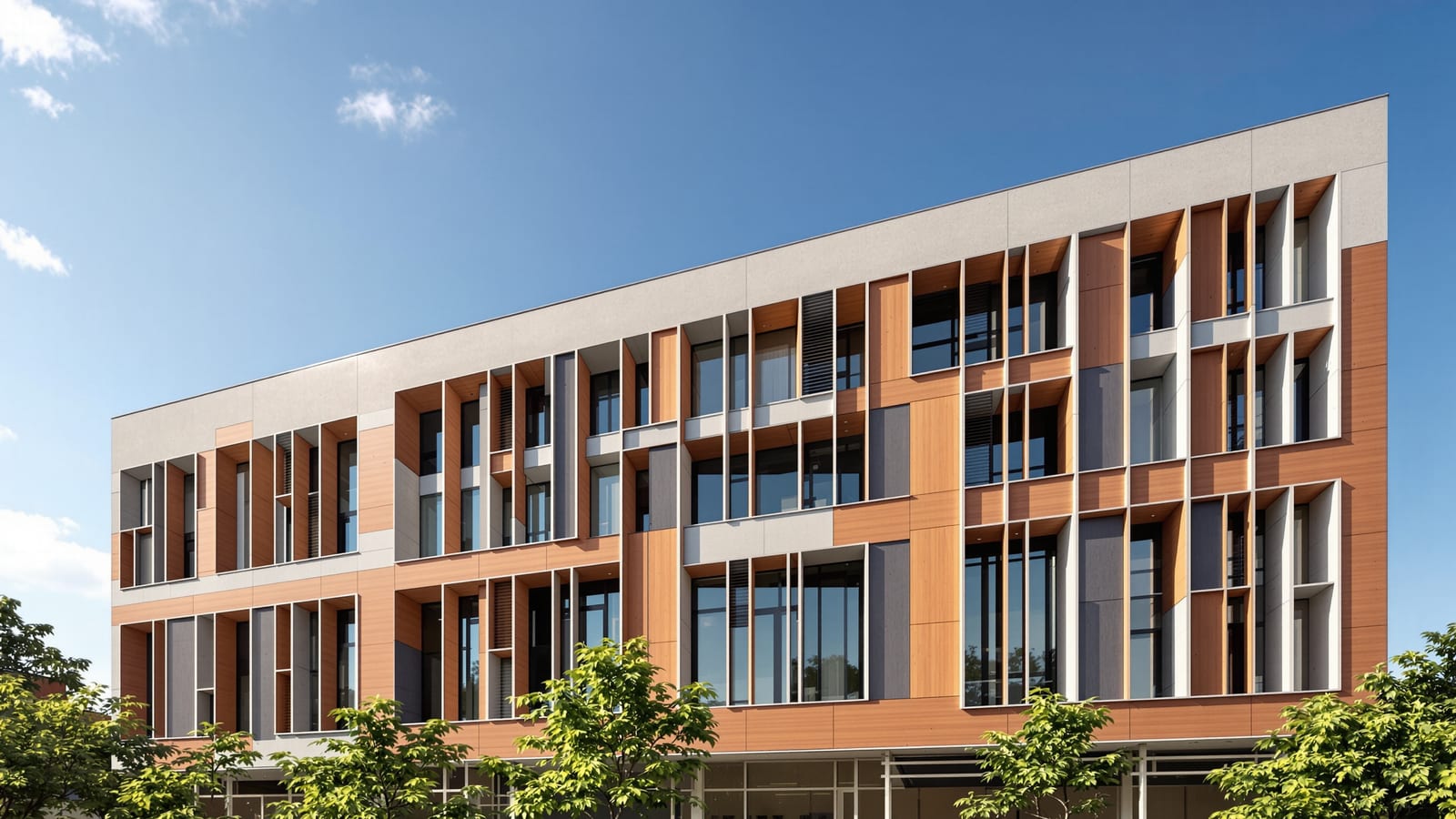
Walk past any new school, polyclinic, IT office or upgraded family home in urban India and you will see it: a flat, matte, modern skin of rectangular boards in warm browns, slate greys and terracotta tones, set in a precise grid with thin dark shadow-lines between every panel. No glossy mirror-finish, no heavy stone, no shimmer. Just a crisp, quiet, contemporary wall. That look is almost always one of two material families — fibre-cement board or HPL (high-pressure laminate) compact panel — hung as a rainscreen.
This is the affordable middle ground of facade design. It sits above plain cement render and paint, which streak and grow black with monsoon algae, but well below the cost of natural stone, terracotta baguettes or structural glass. It gives you a genuine ventilated rainscreen — the building-physics gold standard — without ACP's fire baggage and without a stone budget. For a very large share of real Indian projects, this is the cladding that actually gets built.
But the honesty starts early: these boards are only ever as good as the frame they hang on and the fasteners that hold them. The boards rarely fail. The sub-frame and the fixings fail. Get those wrong and a beautiful facade bows, stains, rattles and sheds panels within a few monsoons.
This is part of our Building Facades series. We have already covered the premium and specialist skins: metal and ACP facades, terracotta rainscreen facades, double-skin and ventilated facades, timber and natural facades, and the all-important facade fire safety and cladding guide. This guide is about the board family that most contemporary Indian projects can actually afford — and the trade-offs nobody puts in the brochure.
1. The two board families, defined
Almost every "flat board" facade in India is one of two things, and they are made completely differently.
Fibre-cement board is a cementitious sheet. It is made by mixing Portland cement, finely ground sand, water and cellulose-fibre reinforcement (wood-pulp fibres that replace the asbestos used in older sheets), then forming and curing it. The best boards are autoclaved — cured in a high-pressure steam chamber (also marketed as high-pressure steam curing, HPSC) — which densifies the board and improves strength and dimensional stability. The result is a dense, mineral, non-combustible panel. International facade-grade fibre cement is governed by EN 12467. Brands you will meet: Equitone and Swisspearl (premium imported), and Everest, Visaka and HIL/Aerocon (Indian).
HPL (high-pressure laminate) is a different animal entirely. Compact laminate, also written CGL (compact grade laminate), is made by stacking many layers of kraft paper soaked in phenolic resin, topping them with a decorative layer and a tough surface, then pressing the whole stack under high heat and pressure (around 7–9 MPa) into one solid, homogeneous board. Exterior-grade HPL is defined by EN 438-6 Type EDF ("EDF" = exterior, decorative, flame-retardant-class). It contains up to about 70% wood-based fibre held in cured resin — which is why, honestly, it is combustible (more on that in §7). The premium grades carry a special weather surface: Trespa cures its Meteon panels with Electron Beam Curing (EBC), a UV-protecting integral surface; Fundermax and others use a double-hard-coat of double-cured acrylic-polyurethane (PUR) resin. Brands: Trespa Meteon and Fundermax Max Compact Exterior (premium imported), Greenlam Clads and Merino (Indian exterior-grade HPL).
A third cousin gets mentioned in the same breath but is its own thing: WPC (wood-plastic composite) — boards or planks extruded from wood flour mixed with PVC or polyethylene plus UV stabilisers. It mimics timber, needs no painting, and resists rot and termites, but it is a plastic-based product with its own movement and fade behaviour. We treat it briefly in the comparison table.
2. Rainscreen: the principle that makes boards work in monsoon
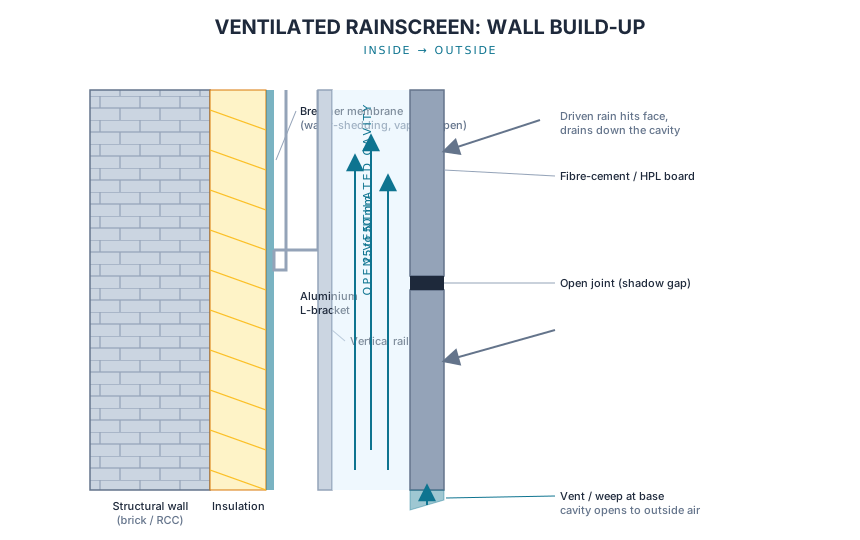
None of these boards waterproofs your building. That is the single most important sentence in this guide. They are a rainscreen — an outer skin that takes the wind and sun and most of the rain, with the real weatherproofing happening behind it.
A rainscreen works on a simple, robust idea: you accept that a little water will get past the outer boards (through joints, around fixings), so instead of fighting it you give it somewhere to go. Behind the boards sits a ventilated/drained cavity — a continuous air gap, typically 25–50 mm. Water that gets in runs harmlessly down the back of the boards and the face of a waterproof membrane, and drains out at the bottom. Air moves up the cavity by the stack effect, drying everything and carrying away heat before it reaches your wall. This is the same building science behind our double-skin and ventilated facades guide — boards are simply the most affordable way to build it.
The joints between boards are deliberately left open or lightly gasketed. Open joint means a clean shadow-gap with nothing in it; the cavity behind does the waterproofing. Gasketed joint uses a backing profile or gasket to baffle wind-driven rain while still venting. Open-joint drained rainscreen is genuinely well-suited to the Indian monsoon precisely because it never relies on a perfect, sealed face — and sealed faces always fail eventually.
3. The sub-frame: where money is saved and facades are lost
The sub-frame (also called the carrier system or substructure) is the skeleton that holds the boards off the wall and creates the cavity. It is, bluntly, more important than the boards. A genuine Trespa panel on a rusting frame is a future failure; a modest Indian fibre-cement board on a properly engineered aluminium frame can outlast the building's paintwork many times over.
A sub-frame has two parts. Brackets (usually aluminium L- or T-brackets) are anchored into the structural wall and project outward to set the cavity depth; they often carry a thermal-break pad so they do not conduct heat into the wall. Rails or profiles (vertical, sometimes with horizontal rails too) span between brackets and present a flat plane for the boards to fix to. The whole assembly must be designed for wind load, the building height, and — critically in India — corrosion.
Here is the honesty anchor: use aluminium or hot-dip galvanised steel for the sub-frame. Never bare mild steel (MS). Plain MS angle, welded up on site and given a coat of red-oxide primer, is the single most common cause of premature facade failure in Indian board cladding. The cavity is warm, humid and occasionally wet — a perfect corrosion chamber. Within a few monsoons the welds bleed rust, fixings lose their grip, and the facade starts to sag and streak. Pay for aluminium or proper hot-dip galvanising. It is not where you save money.
4. Fixing the boards: rivets, undercut anchors, adhesive
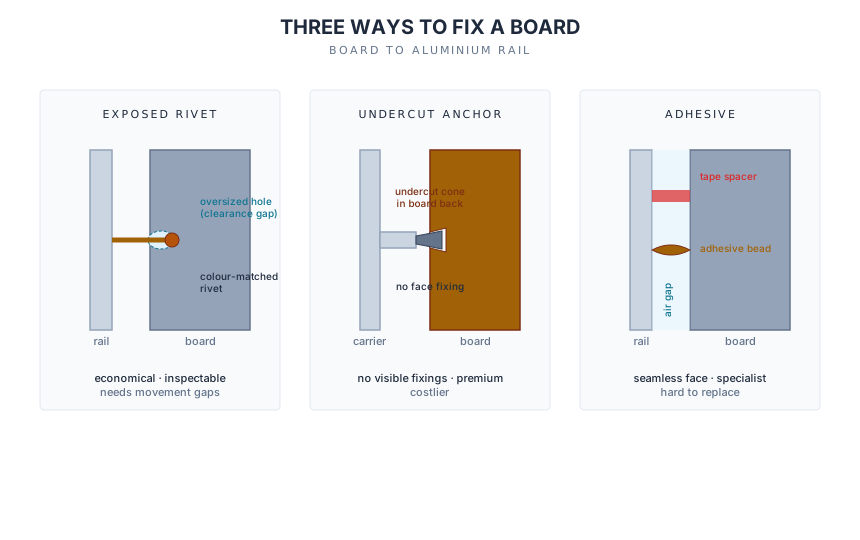
There are three accepted ways to attach the boards to the rails, and the choice drives both the look and the risk.
Exposed fixing — colour-matched rivets or screws. The board is drilled and a rivet or screw pins it to the rail. The fastener head is powder-coated to match the board, so from a few metres away it reads as a tiny neat dot. This is the most common, most economical and most forgiving method — it is easy to inspect and easy to replace a single board. The non-negotiable detail: the holes must be oversized (typically 2–3 mm larger than the fastener shank), with one "fixed point" per board and the rest "sliding points," so the board can expand and contract with heat without buckling. Skip this and the board oil-cans (see §6).
Concealed fixing — undercut anchors. The back of the board is machined with cone-shaped undercut holes (a special drill widens the hole inside without breaking through the face). Anchors expand into these and clip onto horizontal carriers, so the finished facade has no visible fasteners at all — a clean, premium look. It costs more, demands factory-grade drilling accuracy, and makes individual board replacement harder. Used widely for compact HPL where the customer is paying for a flawless face.
Adhesive bonding. The board is bonded to the sub-frame with structural adhesive (with a double-sided tape spacer setting the glue-line and air gap). It gives the most seamless face of all, but it removes the easy inspect-and-replace advantage, is unforgiving of poor surface prep, and is best left to specialist applicators using the board-maker's approved adhesive system. For most Indian projects, exposed colour-matched rivets remain the sensible default.
5. How the board family compares
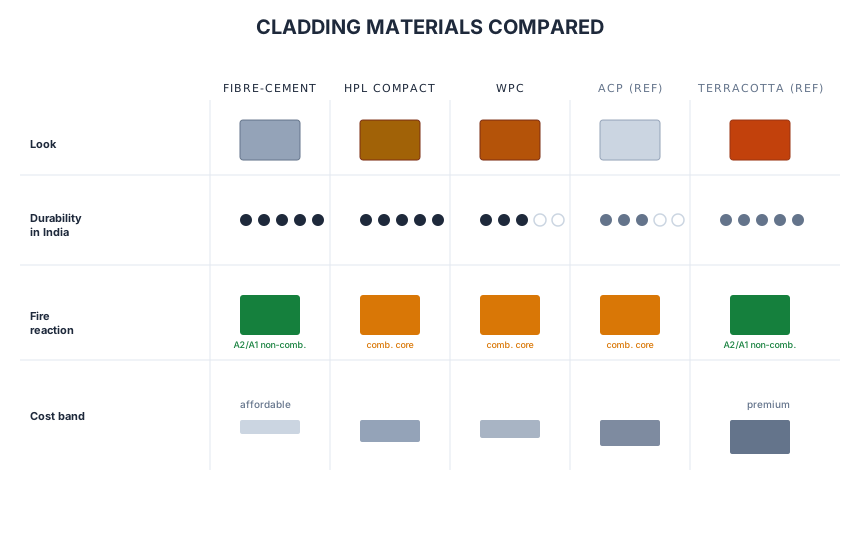
| Material | What it is | Look | Durability & India fit | Fire reaction | Cost band (installed) | Key risk |
|---|---|---|---|---|---|---|
| Fibre-cement board | Cement + sand + cellulose fibre, autoclaved | Matte, mineral, paintable; can mimic render, stone or wood | Robust, UV-stable colour if factory-finished; usually wants coating/edge-sealing; excellent monsoon fit | Non-combustible (A2-s1,d0 / A1 for top brands) | ₹150–500 / sq ft | Brittle — chips and cracks if mishandled; raw edges wick water |
| HPL compact laminate | Phenolic-resin + kraft paper, pressed; EBC or double-hard-coat surface | Sharp, modern, deep solid colours and convincing wood decors; very flat | Genuine Trespa/Fundermax colour-stable for decades; cheap unbranded HPL fades and bows | Combustible core (best grades EN 13501 Class B-s2,d0; few specials A2) | ₹250–700+ / sq ft | Bowing/oil-canning if fixed without movement gaps; cheap grades delaminate in UV |
| WPC (cousin) | Wood flour + PVC/PE + UV stabiliser, extruded | Timber-look planks; warmer than boards | No rot/termite, no painting; better grades hold colour 10+ yrs; cheap grades fade and sag | Combustible (varies; check rating) | ₹120–350 / sq ft | High thermal movement; cheap grades fade, warp and feel plasticky |
| ACP (reference) | Plastic core between aluminium skins | Glossy, flat, metallic; covered in our ACP guide | Easy to fabricate; FR-core grades now mandatory | Core-dependent; the Grenfell material — fire-critical | ₹160–450 / sq ft | Fire risk with non-FR core; see fire guide |
| Terracotta (reference) | Fired clay baguettes/tiles; see terracotta guide | Warm, textured, premium natural ceramic | Excellent, very long life | Non-combustible (A1) | ₹600–1,500+ / sq ft | Cost; weight; specialist install |
6. Real-world performance, not the brochure
The glossy catalogue shows a perfect, dead-flat facade in a European drizzle. Indian reality at 42°C with a vertical monsoon and twelve hours of UV a day is harsher, and a few failure modes recur often enough to name.
HPL bowing and oil-canning in direct sun. Oil-canning (or bowing) is the visible waviness a flat panel develops when it expands but cannot move freely — it has nowhere to go, so it buckles outward. HPL is a hygroscopic, thermally active material: a dark Trespa or Greenlam panel on a hot west wall can swing through a real temperature range across a day and will change dimension measurably. If the installer drilled tight holes, used too many fixed points, or skimped on perimeter movement gaps, the panel cannot breathe and it ripples. This is not a board defect — it is a fixing defect, and it is the most common complaint on Indian HPL facades. The cure is upstream: oversized holes, one fixed point per board, real expansion gaps.
Cheap "exterior HPL" fading and delaminating. This is where "you get what you pay for" is literally true. Genuine compact HPL with a proper weather surface — Trespa's EBC, Fundermax's double-hard-coat double-cured PUR — is tested for long-term UV in accelerated weathering labs and is genuinely colour-stable for decades, which is why those brands offer 10- to 12-year warranties (Trespa Meteon, Greenlam Clads). Unbranded or under-spec "exterior grade" HPL bought purely on the lowest per-sqft rate often lacks that engineered surface; in two or three Indian summers it chalks, fades to a washed-out version of its colour, and at the worst end the layers begin to delaminate at the edges. Buy the EN 438-6 Type EDF specification and a real warranty, not a number on a quotation.
Fibre-cement edges chipping and wicking water. Fibre-cement is brittle — drop a board on its corner and it chips; over-tighten a fastener and it can crack. Its cut edges are also porous and will wick water and grow dark if left raw. The remedy is discipline at install: handle boards on edge, do not over-torque, and seal and paint all cut edges with an alkali-resistant exterior primer and a flexible acrylic or elastomeric coating. Factory-finished boards (Equitone, Everest's pre-finished ranges) reduce this, but any board cut on site exposes a raw edge that must be sealed.
The sub-frame quietly rusting. Already said, worth repeating because it is the failure that hides: bare MS sub-frames corrode invisibly inside the cavity. The first symptom is often rust-coloured streaks weeping out of the joints, by which point the structural frame is already compromised. Aluminium or hot-dip galvanised only.
7. The honest case: cost, fire and fixing
Cost. This family wins on value, not on being cheap. Plain plaster-and-paint is cheaper up front, but it streaks and needs repainting every few years; board rainscreen is more expensive initially and far cheaper over twenty years because a good one barely needs maintenance. Indian fibre-cement board sits roughly ₹150–500/sq ft installed depending on finish and frame; exterior HPL runs higher — Greenlam Clads 6 mm lists around ₹340/sq ft for the board alone, and a fully installed premium Trespa/Fundermax wall on an aluminium sub-frame with concealed fixing climbs well past that. The sub-frame and fixings are a large, non-optional slice of that number — and the place where cutting corners costs you the whole facade.
Fire — the big honest point. This is the single most important difference between the two families, and it is the reason to read our facade fire safety and cladding guide before specifying either on a tall or critical building.
- Fibre-cement is non-combustible. It is a mineral, cementitious board. Top brands achieve EN 13501 Class A2-s1,d0 (or A1) — the best reaction-to-fire classification, usable on buildings of any height. On a hospital, a tall residential tower, or anywhere fire spread is a real concern, this is a genuine, decisive advantage.
- HPL/compact laminate is combustible. Its core is a timber-fibre phenolic — it will burn. The best exterior grades are flame-retardant and reach Class B-s2,d0 (Fundermax Max Compact Exterior, for example), and a few special products reach A2, but "fire-retardant Class B" is not the same as non-combustible. On tall buildings the open ventilated cavity behind any rainscreen can act as a chimney, so combustible cladding demands designed cavity barriers (intumescent fire-stops that seal the cavity at each floor and around openings) and full NBC 2016 compliance for facade fire performance. After Grenfell — where combustible cladding turned a contained fire into a catastrophe — this is not box-ticking. Specify the fire class explicitly, demand cavity barriers on anything tall, and never assume "exterior grade" means "fire safe."
Fixing — where most failures actually live. To close the loop: across thousands of Indian board facades, the boards themselves are rarely the problem. The recurring failures are bare-MS frames that rust, tight fastener holes that cause oil-canning, missing movement gaps, unsealed fibre-cement edges, and unbranded HPL that fades. Every one of those is a specification or workmanship choice, not a material flaw. Spend your scrutiny on the sub-frame metallurgy, the fixing detail and the board's actual specification — not on the brochure photograph.
What this means for you
If you want a crisp, modern, low-maintenance facade and you do not have a stone or terracotta budget, fibre-cement or HPL board rainscreen is the right family to be looking at — it is genuinely good architecture at an achievable price.
Choose by priority. If fire safety is paramount — a hospital, a school, a tall residential tower — lean fibre-cement: it is non-combustible, cheaper, and you accept that it is more brittle and usually wants a coating. If you want deep, decades-stable colour and convincing wood looks and you are building low-to-mid-rise, genuine compact HPL (Trespa, Fundermax, or a warranty-backed Greenlam/Merino exterior grade) is excellent — provided you respect its combustibility on anything tall, and provided it is fixed with movement gaps.
Then protect the investment with three rules that matter more than the brand on the board: insist on an aluminium or hot-dip-galvanised sub-frame and reject bare MS; demand oversized fastener holes, proper fixed/sliding points and real thermal-movement gaps; and build it as an open-joint drained rainscreen with a continuous ventilated cavity so the monsoon has somewhere to go. Do those three things and a modest board outperforms a premium board fixed badly — every single time.
Sources
- Trespa International — Trespa Meteon exterior HPL: Electron Beam Curing (EBC) weather surface, up to 70% wood-based fibre, weather-resistance and UV testing, 10-year warranty (trespa.com).
- Fundermax — Max Compact Exterior technical literature: duromer HPL to EN 438-6 Type EDF, double-cured acrylic-PUR weather protection, reaction-to-fire Class B-s2,d0 / B-s1,d0 and A2-s1,d0 (m.look) per EN 13501-1 (fundermax.com).
- Greenlam Industries — Greenlam Clads exterior-grade compact laminate: EN 438-6 Type EDF, three-layer UV/moisture protection, 12-year warranty (greenlamindustries.com / greenlamclads.com).
- EQUITONE (Etex) and Swisspearl — fibre-cement composition (sand, cement, cellulose fibre, water), ventilated rainscreen system, non-combustible A2-s1,d0 per EN 13501-1 / ASTM E136 (equitone.com, swisspearl.com).
- Everest Industries, Visaka, HIL/Birla Aerocon — Indian fibre-cement boards and planks for cladding; high-pressure steam curing (HPSC) (everestind.com and brand literature).
- National Building Code of India (NBC) 2016 — facade and external-cladding fire provisions and restrictions on combustible cladding.
- EN 13501-1 reaction-to-fire classification (Class A1/A2/B with s, d sub-classes) as referenced in manufacturer fire data; EN 438-6 (HPL Type EDF) and EN 12467 (fibre-cement sheets) product standards.
- fischer fixings — concealed (undercut anchor) and exposed (colour-matched rivet/screw) fixing systems for ventilated rainscreen facades; aluminium sub-frame carrier systems (fischer-international.com).
- HPL exterior-application technical guidance (pro-HPL / ICDLI) — oversized fastener holes, fixed/sliding points and movement gaps to prevent bowing.
- Building & Interiors and Indian distributor listings — indicative HPL and fibre-cement board price bands in India.
Export this guide
Related Guides — Deep-dive reading
Metal & ACP Facades in India — Appeal, Core Types, and the Fire Lesson
Aluminium composite panels and metal cladding are India's favourite modern facade after glass. Here is how ACP is built, why the PE vs FR vs A2 core decides whether it is a finish or a fuel, what NBC 2016 and IS 17682 require, and the real cladding-fire lessons India must heed.
Building FacadesPlaster, Render and Texture-Paint Facades in India: The Honest Guide to the Country's Default Wall Finish
A building-physics guide to cement and lime render, exterior emulsion and weatherproof paints, and textured coatings — how these everyday facades are built, why they crack, streak and grow algae, and what actually keeps them looking good in the Indian monsoon.
Building FacadesPorcelain, Ceramic & Sintered-Stone Facade Cladding in India: A Practical Guide
Thin large-format porcelain and sintered-stone slabs can clad a building with the look of marble, concrete or weathered steel at a fraction of stone's weight — but on a facade, the fixing system is a life-safety decision, not a finish choice.
Building FacadesRelated Tools — Try Free
Before vs After — Cost Reality Check
Compare what you expected to pay vs what you actually paid, category by category.
Reality CheckWindow Material Comparison Tool
Compare uPVC, aluminium, wood, steel and composite windows on cost, life, upkeep and insulation.
CompareCross-Ventilation Analyzer
Estimate airflow and air changes per hour (ACH) from room size, window areas, layout, and local wind — with NBC 2016 Part 8 compliance check.
Ventilation Calculator