
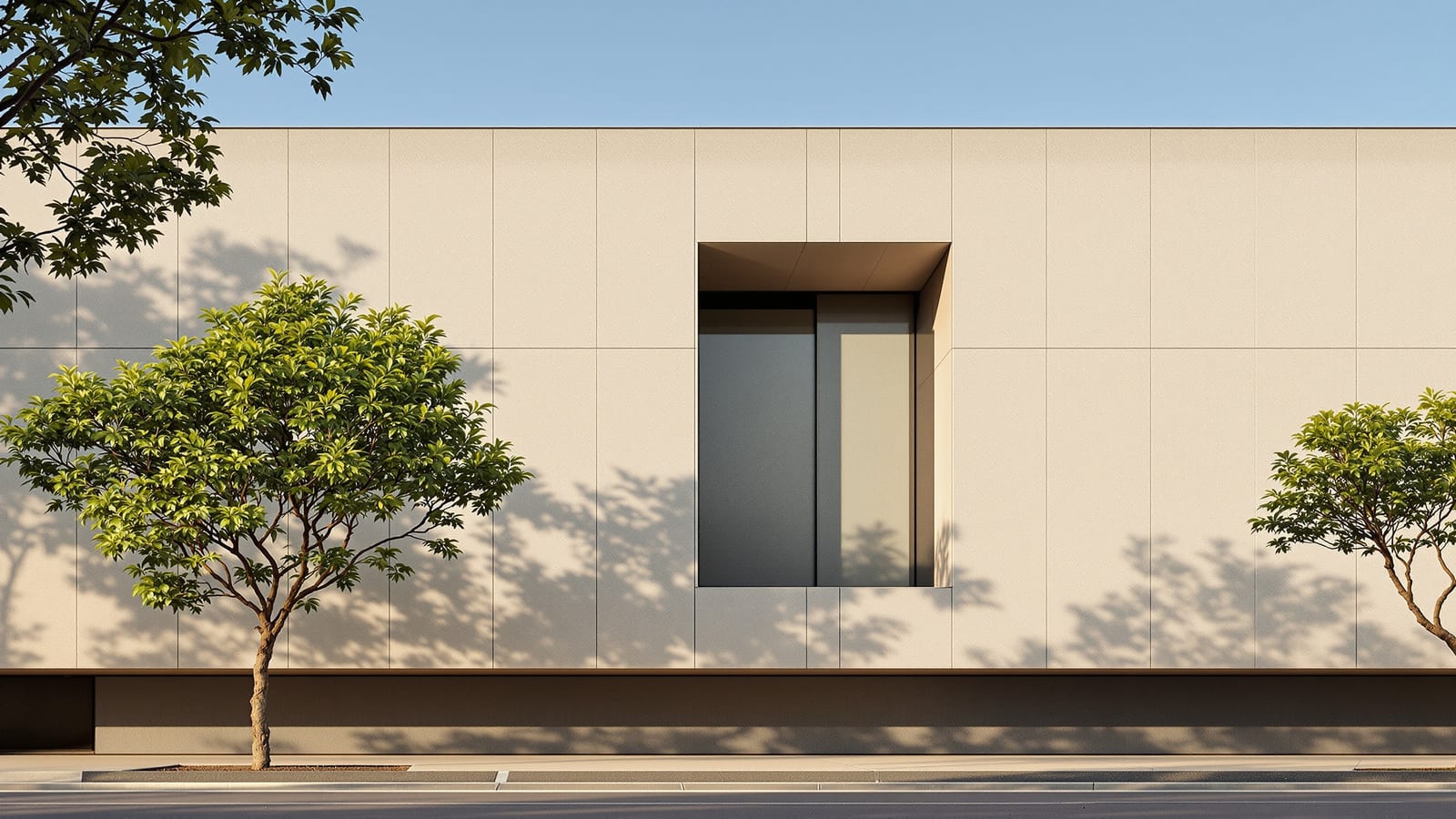
Concrete Facades in India: Fair-Faced, Board-Formed and GFRC Cladding, Honestly Explained
From Chandigarh's raw béton brut to factory-made GFRC rainscreen panels — how concrete works as a finished facade skin in India, why it streaks and stains in the monsoon, and which route actually delivers the look.
Leave concrete raw and it tells the truth. There is no paint to hide behind, no cladding bolted over the structure, no second chance — the wall you pour is the wall you keep. When it works, the result is monolithic and grave and quietly luxurious: the grey of a monsoon sky, the soft grain of the timber boards pressed into its face, the honest little holes left by the form ties. This is the tradition of béton brut — French for "raw concrete," the term Le Corbusier gave to the unfinished concrete of his post-war work, and the root of the word Brutalism. India owns one of the world's great chapters of it. Le Corbusier's Capitol Complex at Chandigarh, a UNESCO World Heritage Site since 2016, is béton brut at civic scale; B. V. Doshi carried the raw-concrete-and-brick idiom into a generation of Indian institutions; and in 1972 Raj Rewal and engineer Mahendra Raj built the Hall of Nations at Pragati Maidan as the world's first and largest cast-in-situ concrete space frame, because steel was too costly for newly independent India to import.
That is the heroic story. The honest modern story is different. Most of the "concrete-look" facades going up in India today are not heroic in-situ pours at all — they are architectural precast panels cast in a factory, or thin GFRC (glass-fibre-reinforced concrete) cladding hung on a frame. The reason is simple and it runs through this entire guide: getting genuinely good off-form concrete on an Indian site is brutally hard, and every mistake is permanent.
This is part of our Building Facades series. If you are choosing a facade material, start with the types of building facades overview, then weigh concrete against the stone and masonry facades guide. Whatever skin you pick, read facade maintenance and durability too — with raw concrete, weathering is the whole game. One thing this guide is not about: low-carbon or CO2-storing concrete. For that, see our separate guides on carbon-sequestering materials and embodied carbon in construction. Here, concrete is purely a finish — how it looks, how it is formed, and how it ages as a facade.
1. What "fair-faced concrete" actually means
Fair-faced concrete (also called exposed concrete or architectural concrete) is concrete whose surface is the finished, visible surface — left as it comes out of the mould, with nothing applied over it. The opposite is structural concrete that gets plastered, painted or clad. The moment you decide a concrete face will be fair-faced, you change the rules of the entire pour: the formwork, the mix, the pouring sequence and the labour all have to be controlled to a standard that ordinary structural concrete never demands, because every flaw stays on permanent display.
A few terms that recur throughout this guide:
- Off-form (or off-the-form) concrete — the surface is exactly as it left the formwork (the temporary mould the wet concrete is cast against). "Off-form finish" is the smooth, sheet-faced look you see in Tadao Ando's buildings.
- Formwork / shutter marks — the imprints the mould leaves on the face: the lines between formwork panels, the texture of the form material, and the small holes left by the form ties (the rods that hold the two faces of the mould apart against the pressure of wet concrete). Designers turn these into a deliberate, regular grid; uncontrolled, they read as defects.
- Board-formed (board-marked) concrete — concrete cast against rough-sawn timber boards so the wood grain is pressed permanently into the face. It softens the material's hardness into something tactile and warm.
- Honeycombing — voids and exposed aggregate where the concrete failed to fill the mould or was poorly compacted. On a fair-faced wall, a honeycomb is a scar you cannot remove.
2. The surface finishes — from glass-smooth to hand-roughened
The look of an exposed-concrete facade is decided by two things: the form face it was cast against, and any treatment done to the hardened surface afterwards. The main families:
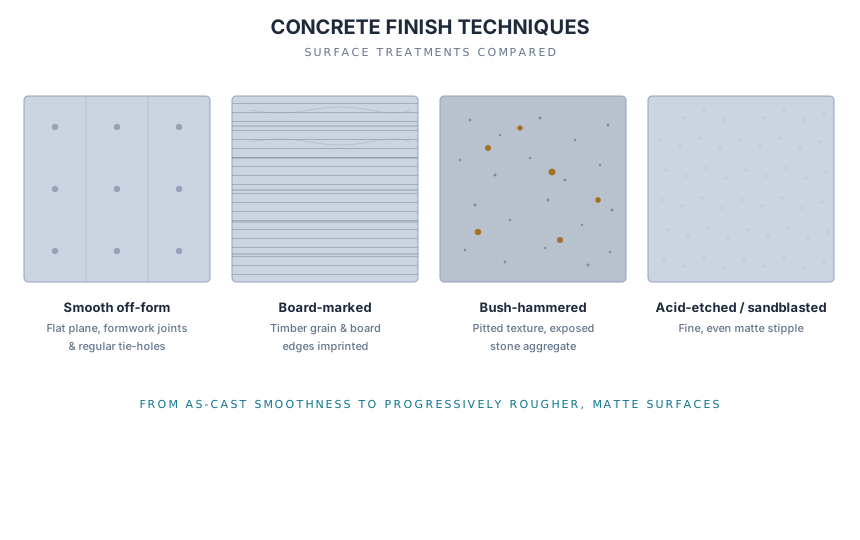
Smooth off-form (Ando-style). Cast against high-grade plywood or steel-faced ply with sealed joints and a precise grid of tie-holes. The benchmark is Louis Kahn's Salk Institute (1965), where Kahn cast against teak-edged plywood and sank the tie-holes deep, plugging them with lead — turning a structural necessity into ornament — and Tadao Ando, who pours concrete into formwork so exact that the panel joints and tie-holes become the entire composition. This is the most demanding finish on earth to reproduce; there is nowhere to hide.
Board-marked / board-formed. Cast against rough-sawn timber form-liner so the grain transfers. A form-liner is any textured sheet (timber, or moulded rubber/elastomeric/plastic) laid inside the formwork to imprint a pattern. Board-marked is the most forgiving of the "designed" finishes because the timber grain camouflages minor colour variation — which is exactly why it is popular.
Bush-hammered and exposed-aggregate. The hardened surface is mechanically hammered (a bush hammer is a toothed tool) to chip away the cement skin and expose the stone aggregate beneath, giving a rough, stony, light-scattering face that hides streaking well. Exposed-aggregate finishes wash or retard the surface so the pebbles show.
Acid-etched and sandblasted. Acid-etching uses a mild acid to dissolve the surface cement paste, leaving a fine matte, sandpaper-like texture; sandblasting abrades it to a similar effect. Both even out the look and dull the sheen, and both remove the outermost (and most carbonation-prone) skin.
Polished. Ground and polished to a dense, slightly reflective face — more common indoors than on exposed facades.
White and pigmented concrete. Use white cement instead of grey, and add mineral pigments, and you can cast concrete in off-white, buff, terracotta, charcoal or ochre. Pigmented concrete demands obsessive batch-to-batch consistency — a half-bag difference in cement or a wetter load shows as a visible colour band forever.
3. In-situ vs precast vs GFRC — the three routes
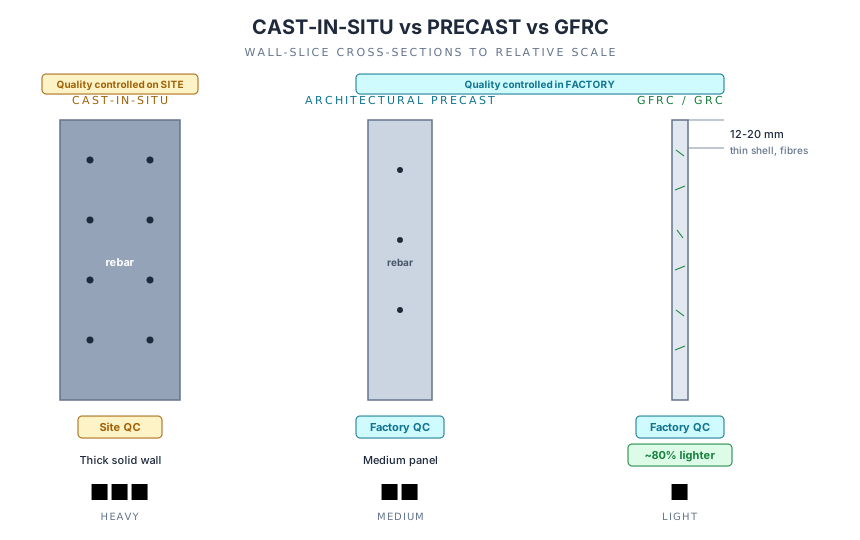
There are three fundamentally different ways to get a concrete facade, and the difference is where the quality is controlled — on a chaotic, monsoon-exposed site, or in a clean factory.
Cast-in-situ (in-situ / in place). The concrete is poured into formwork built in position on the building, and the structure is the facade. This is true béton brut — Chandigarh, Salk, Ando. It is monolithic and seamless, and it is the highest-risk option, because the finish is hostage to site conditions you can never fully control.
Architectural precast. Wall panels are cast in steel moulds in a factory, cured under controlled conditions, then transported and craned into place and bolted to the structure. Quality jumps because the factory controls the mix, the mould and the curing — but the panels are heavy (a solid precast panel is thick and dense), so you pay in transport, cranage and structural support, and you get visible joints between panels.
GFRC / GRC (glass-fibre-reinforced concrete). A thin shell — typically only 12–20 mm thick — of cement, fine sand and alkali-resistant glass fibres (the fibres replace steel reinforcement, so there is no rebar to corrode). GFRC panels can be up to around 80% lighter than solid precast. They are made as relatively large, light cladding panels and hung off a steel sub-frame as a rainscreen — a ventilated outer skin standing clear of the waterproofed structure behind. GFRC is the modern workhorse: it gives the concrete look — including board-marked and textured faces taken straight off a form-liner — with factory consistency and a fraction of the weight.
4. How GFRC rainscreen panels actually go on
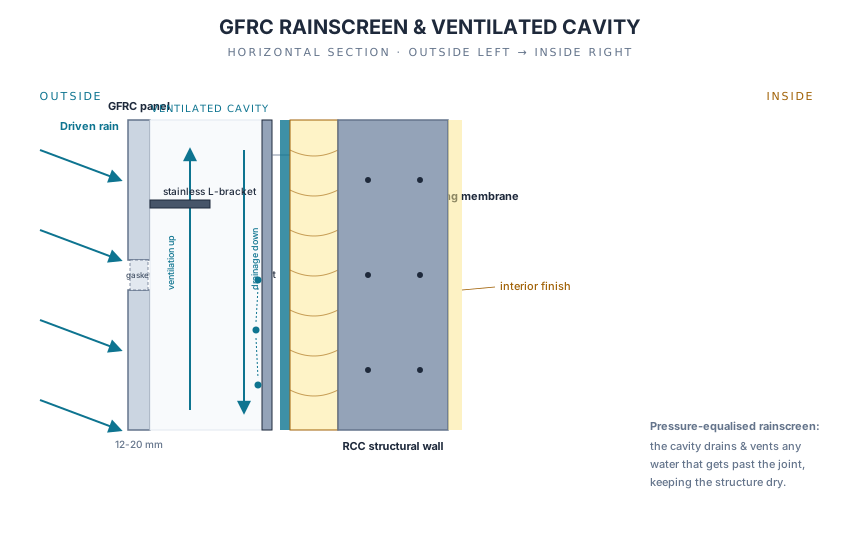
Because GFRC is the route most Indian projects realistically take for a concrete-look facade, it is worth understanding the detail. A GFRC rainscreen panel is fixed to a sub-frame of stainless or galvanised steel brackets and rails, which bolt back to the building's RCC structure. The panel stands forward of the structure, leaving a ventilated cavity behind it. The joints between panels are left open or fitted with gaskets.
The point of the design is that the GFRC skin is not the waterproof layer. Driven rain that gets past the joints runs down the back of the panel and drains away within the cavity, while the real weatherproofing — membrane and insulation — sits on the structure behind, kept dry. The ventilated gap also lets the panel and the wall breathe and dry out. For the Indian monsoon, this is a genuinely good system: it accepts that water will get behind the skin and gives it a path out, instead of pretending the joints are perfectly sealed forever (they never are).
5. Choosing an approach — a comparison
| Approach | What it is | Look | India fit | Cost note | Key risk |
|---|---|---|---|---|---|
| In-situ fair-faced | Structure poured in place, left exposed | Seamless, monolithic, true béton brut | Hardest to execute well; needs rare site skill | Moderate material cost, very high QC/formwork cost | Permanent — one honeycomb, shutter line or colour band is forever |
| Board-formed in-situ | Cast against rough-sawn timber boards | Warm timber grain pressed into concrete | More forgiving (grain hides variation) but still site-dependent | Premium formwork (boards used few times) | Streaking on shaded faces; formwork prep labour |
| Architectural precast | Wall panels cast in factory moulds, craned on | Crisp, consistent, visible panel joints | Good where a precast yard is within trucking distance | Higher upfront; cranage and transport | Panel weight; joint sealing; handling cracks |
| GFRC / GRC rainscreen | Thin 12–20 mm glass-fibre shell on a sub-frame | Concrete look in light panels, any texture | The practical modern route; light, factory-made | Mid-to-premium; specialist fabricator | Fixing/sub-frame corrosion; fabricator quality varies |
| "Concrete-look" alternatives | Microcement render, or concrete-effect porcelain tile | Mimics concrete without structural concrete | Easy retrofit; no heavy structure | Lower; tile is cheap, microcement mid | Looks like an imitation up close; render can craze/crack |
If your heart is set on the real thing and your site is not a museum project with an obsessive contractor, GFRC or precast will get you a better-looking, longer-lasting result than a risky in-situ pour. That is not a compromise — it is how serious modern concrete facades are built.
6. The building physics: why raw concrete streaks, stains and ages
Concrete is not inert, and a facade is its harshest exposure. Four things shape how exposed concrete ages in India:
Streaking and dirt run-off. Rain does not wash a wall evenly. It runs in rivulets off ledges, sills and panel edges, concentrating dirt into dark vertical streaks — and on a grey concrete face these show starkly. The monsoon makes it worse: month after month of driven rain leaves shaded, north-facing and sheltered concrete patterned with grime. The fix is detailing, not material — generous drip edges (a groove or projecting lip that forces water to drop clear of the face instead of running down it) at every sill and slab edge, and a clear-coat water-repellent sealer to slow soaking and dirt pick-up.
Efflorescence and lime leaching. Efflorescence is the white, chalky bloom left when water moving through concrete dissolves lime (calcium compounds) and deposits it on the surface as it evaporates. On new concrete it is common and usually fades; persistent lime leaching down a wall signals water repeatedly tracking through cracks or joints — a detailing problem to chase down, not just wash off.
Algae and biological growth. Warm, humid, shaded and damp — the Indian monsoon is ideal for algae and mould, and they colonise exactly the sheltered concrete faces that stay wet longest, greening and blackening them. Keeping the surface able to dry quickly (good drainage, sealer, ventilated rainscreen cavities) is the defence.
Carbonation — the slow, invisible one. Fresh concrete is strongly alkaline, and that high pH forms a passive film that protects the embedded steel reinforcement from rusting. Over years, atmospheric CO2 penetrates the concrete and reacts with it — carbonation — gradually neutralising that alkalinity from the surface inward. When the carbonation front reaches the steel, the protective film breaks down; if moisture and oxygen are present, the rebar corrodes, expands and spalls (cracks and pops off) the cover concrete. This is the single most important long-term reason that cover — the depth of concrete over the steel — and a dense, low-water mix matter on any concrete facade.
7. Cover, mix and IS 456 — the durability that decides everything
Indian practice for concrete durability is set by IS 456 (Plain and Reinforced Concrete — Code of Practice), and a facade lives or dies by two of its provisions: the exposure condition and the nominal cover (the minimum thickness of concrete over the outermost steel).
IS 456 classifies exposure as mild, moderate, severe, very severe or extreme, and ties cover and concrete grade to it. As a guide, the nominal cover increases with severity — roughly 20 mm for mild, 30 mm for moderate, 45 mm for severe, 50 mm for very severe and 75 mm for extreme exposure — with a minimum concrete grade that rises in step (richer mixes, lower water-cement ratios) as the exposure worsens. A coastal or monsoon-lashed facade is not a mild interior; it should be designed at severe or worse, which means more cover and a denser, lower-permeability mix.
Why this is the whole ballgame for a concrete facade: cover is what stands between the carbonation front and your rebar, and a dense, well-compacted, low-water mix slows both carbonation and water ingress. Thin cover plus a porous mix plus driven monsoon rain is the recipe for spalling concrete a decade or two on. The discipline that makes a facade look good — tight formwork, controlled mix, proper compaction, careful curing — is the same discipline that makes it last. Note that GFRC sidesteps the rebar problem entirely: with glass fibres instead of steel, there is no bar to corrode, which is part of why thin GFRC panels weather so well.
Real buildings, not renders
Concrete as a finished facade has a deep, verifiable lineage — much of it Indian.
- Chandigarh Capitol Complex, Le Corbusier (1950s–60s). The Secretariat, Palace of Assembly and High Court are béton brut at monumental scale, their raw concrete textured, board-marked and weathered. Inscribed as a UNESCO World Heritage Site in 2016. The reference point for raw concrete in India.
- Salk Institute, Louis Kahn, La Jolla (1965). The global benchmark for fair-faced concrete: warm-grey pozzolanic concrete cast against teak-edged plywood, with deliberately expressed, lead-plugged tie-holes. The standard every off-form facade is measured against.
- Tadao Ando's work (Japan and worldwide). The smooth off-form ideal — concrete poured into formwork so precise that the panel grid and tie-holes are the only ornament. A reminder of the QC that flawless off-form demands.
- B. V. Doshi's institutions (CEPT, Ahmedabad; Sangath studio). India's first Pritzker laureate (2018) built a powerful idiom of exposed concrete and exposed brick — raw, climate-tuned, rooted in Indian light and courtyard tradition.
- Hall of Nations, Pragati Maidan, Raj Rewal with engineer Mahendra Raj (1972). The world's first and largest-span cast-in-situ concrete space frame (around 78 m), built in concrete because imported steel was too expensive. It was demolished in April 2017 during the Pragati Maidan redevelopment — a loss mourned across the architectural world, and a sobering note in any honest account of Indian concrete.
The honest case: getting good concrete on an Indian site
Here is the verdict, candidly. Fair-faced in-situ concrete is the highest-risk facade you can attempt, because there is no fixing it later. A honeycomb, a cold joint, a shutter line that didn't seal, a load of concrete that came wetter or with different cement than the last — each becomes a permanent mark on the finished building. Patching fair-faced concrete almost always looks worse than the flaw it hides.
To get it right you need genuinely excellent formwork (rigid, sealed, accurately set out), tight mix control batch to batch, disciplined placing and vibration (compaction so the concrete fills the mould without voids and without segregating), and a skilled, supervised crew that has done it before. That combination is rare on Indian sites, where formwork is reused too many times, mixes vary load to load, and the people pouring have usually been trained for structure-to-be-plastered, not for a finished surface. Add the monsoon — which streaks raw concrete, greens its shaded faces with algae, and demands obsessive drip detailing and sealing — and the carbonation clock quietly ticking against thin rebar cover over the decades, and the difficulty compounds.
This is precisely why the industry moved the quality control into a factory. Precast and GFRC are cast in steel moulds, under cover, cured properly, inspected before they ever reach the site, and rejected if they're wrong — before they're bolted to your building, not after. GFRC adds the bonus of being thin, light, free of corrodible steel, and naturally suited to a ventilated rainscreen that handles monsoon water intelligently. For the overwhelming majority of Indian projects that want the concrete look, GFRC or architectural precast is not the budget option — it is the better-engineered one.
What this means for you
If you want a concrete facade in India, decide first whether you want the romance of true béton brut or the result of a clean concrete skin. If it is the romance, commit fully: a top-tier contractor, mock-up panels approved before the real pour, board-marked or bush-hammered finishes (which forgive variation) rather than glass-smooth off-form, a severe-exposure mix with generous cover, and obsessive drip detailing plus a water-repellent sealer. Budget for the QC, not just the concrete.
If it is the result you want, choose GFRC or architectural precast. You will get a consistent, durable, monsoon-sensible concrete look without betting your facade on one irreversible pour. And if budget is tight, a concrete-effect porcelain tile or a microcement render can read convincingly from a distance — just know it is a finish, not structure. Whichever route you take, the facade's fate is decided by water: detail the drips, ventilate the cavity, seal the surface, and give the steel its cover. Concrete rewards discipline and punishes shortcuts — permanently.
Sources
- IS 456 : 2000, Plain and Reinforced Concrete — Code of Practice (Bureau of Indian Standards) — exposure conditions, nominal cover and minimum grade/durability requirements.
- GRCA — International Glassfibre Reinforced Concrete Association (grca.online) — technical guidance on GRC/GFRC composition, panel thickness (typically 12–20 mm), weight and cladding/rainscreen use.
- The Concrete Centre — guidance on visual/fair-faced in-situ concrete and formwork for visual concrete.
- UNESCO World Heritage Centre / Le Corbusier World Heritage — Chandigarh Capitol Complex inscription (2016) and béton brut.
- Salk Institute / Louis Kahn references — fair-faced concrete technique, teak formwork, lead-plugged tie-holes.
- MAP Academy and The Twentieth Century Society — Hall of Nations (Raj Rewal and Mahendra Raj, 1972; cast-in-situ concrete space frame; demolished April 2017).
- Building-science references on carbonation and rebar corrosion (RILEM; cover-depth and corrosion field studies) — mechanism of carbonation-induced depassivation and spalling, and the protective role of cover depth and dense, low-water mixes.
Export this guide
Related Guides — Deep-dive reading
Tadao Ando's Façade Signature: Silky Off-Form Concrete and the Tie-Hole Grid
How Tadao Ando turned exposed concrete into the world's most disciplined façade language — the tatami-proportioned formwork panel, the rhythmic six-hole grid, and walls that frame light, water and sky instead of opening to the street.
Building FacadesPlaster, Render and Texture-Paint Facades in India: The Honest Guide to the Country's Default Wall Finish
A building-physics guide to cement and lime render, exterior emulsion and weatherproof paints, and textured coatings — how these everyday facades are built, why they crack, streak and grow algae, and what actually keeps them looking good in the Indian monsoon.
Building FacadesPorcelain, Ceramic & Sintered-Stone Facade Cladding in India: A Practical Guide
Thin large-format porcelain and sintered-stone slabs can clad a building with the look of marble, concrete or weathered steel at a fraction of stone's weight — but on a facade, the fixing system is a life-safety decision, not a finish choice.
Building FacadesRelated Tools — Try Free
Material Comparison Sheet
India's interior material cheatsheet — plywood, finishes, hardware, countertops, paints, waterproofing.
Reference GuideDoor Material Comparison Tool
Compare 2–4 door materials on cost, durability, maintenance, security and moisture resistance.
Comparison ToolBefore & After Studio
Generate AI before-and-after renders to preview how your redesign could look.
DesignAI