
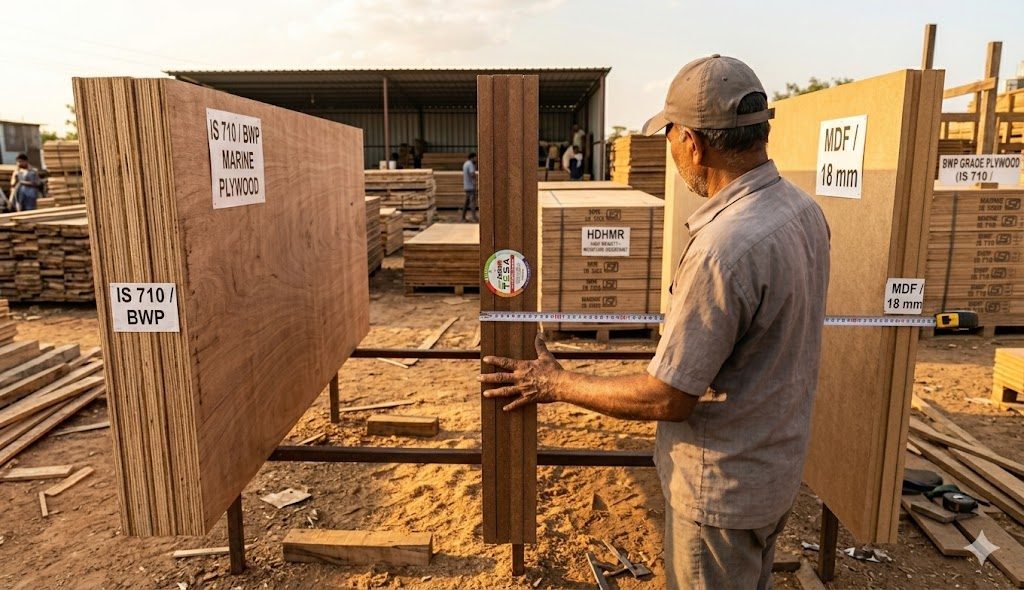
Marine Ply vs HDHMR vs MDF
When each engineered-wood substrate is the right answer for an Indian interior
Walk into any well-organised carpenter's workshop in India and you will find three different brown sheets stacked against the wall. They look almost identical at a glance — same eight-foot-by-four sheet, same thickness, same dusty edge. They behave nothing alike. One survives twenty years under a kitchen sink. One routes into a perfect shaker shutter and takes PU paint like a piece of architectural plastic. One swells to half-again its thickness the first time it sees a damp slab.
The three are BWP marine plywood, HDHMR engineered fibreboard, and MDF. The single biggest source of regret in modern Indian interiors is not the colour or the layout — it is the wrong substrate in the wrong zone. A budget designer puts MDF carcases under a sink and the kitchen fails in eighteen months. A premium designer uses marine ply for shaker shutters and the routed edges tear, and the carpenter ends up sanding away half the detail. None of this is necessary. Each material has a zone where it is brilliant and a zone where it is a disaster.
This guide is a deep-dive companion to our complete guide to plywood grades in India. The pillar covered the IS-code grade ladder; this one zooms in on the substrate decision — when to specify marine ply, when to specify HDHMR, and when (and only when) MDF earns its place.
What each material actually is
Before any cost comparison, the chemistry. The three substrates differ in what is inside them — and the inside decides the behaviour.
BWP marine plywood (IS 710) is a sandwich of cross-grain hardwood plies — typically gurjan, eucalyptus or a hardwood blend — bonded with phenol-formaldehyde (PF) resin. Each ply is laid at ninety degrees to the one above and below, so the sheet resists movement in every direction. The PF glue line is the thing that earns the BWP label: it survives boiling water, hot oil splash, and the years of damp under a sink.
HDHMR — High Density High Moisture Resistant board — is an engineered fibreboard made from finely refined wood fibres bonded with PF resin, with wax additives stirred into the slurry before pressing. There are no plies, no grain direction, no internal structure. It is one homogeneous dense matrix, pressed to between 800 and 1000 kg per cubic metre. The wax is what makes it moisture-tolerant — not waterproof like marine ply, but far better than ordinary MDF.
MDF — Medium Density Fibreboard — is the same general idea as HDHMR but with cheaper inputs: finer wood fibre, urea-formaldehyde (UF) resin (which is water-soluble), no wax, and a lower target density of 650–750 kg/m³. The surface is buttery-smooth and takes laminate or paint better than almost anything else. The body, however, drinks water.
The five-number comparison
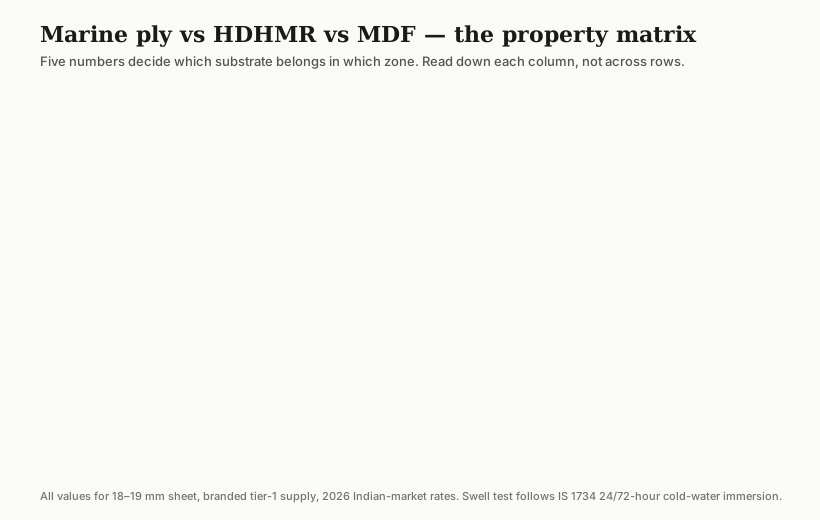
| Property | Marine ply (BWP) | HDHMR | MDF |
|---|---|---|---|
| Standard / spec | IS 710 | PF resin + wax | UF resin |
| Density (kg/m³) | 700 – 800 | 800 – 1000 | 650 – 750 |
| Weight, 19 mm 8×4 sheet | 36 – 41 kg | 41 – 51 kg | 33 – 38 kg |
| Screw-hold (edge) | Excellent | Strong | Weak |
| 72-h soak swell | 5 – 10 % | 8 – 12 % | 25 – 50 % |
| Price, 18–19 mm | ₹95 – 150 / sqft | ₹75 – 110 / sqft | ₹35 – 55 / sqft |
| Life (correct zone) | 15 – 25 yrs | 12 – 18 yrs | 7 – 10 yrs |
Read down each column rather than across. Marine ply leads on screw-hold, life and moisture survival. HDHMR leads on density, smoothness and routing cleanliness. MDF leads on price and price alone.
Cross-section — why each behaves the way it does
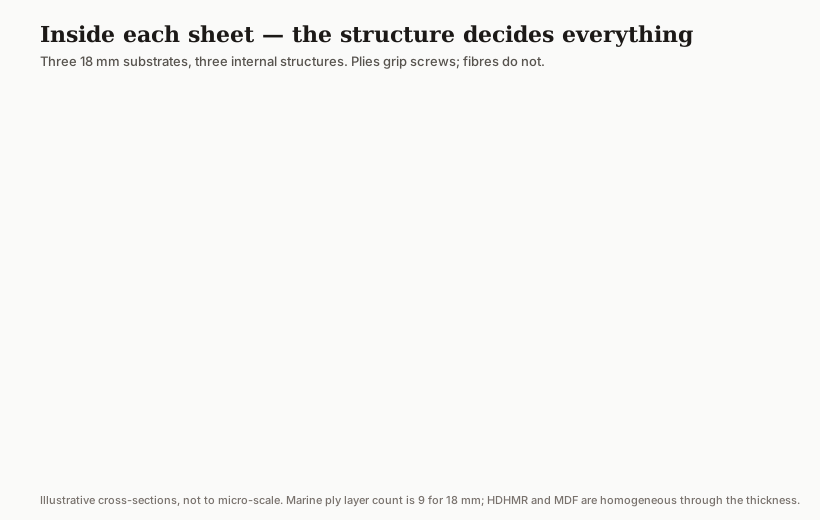
The picture explains the behaviour. Marine ply's nine cross-grain plies give a screw three or four end-grain layers to bite into; that is why a 16 mm screw will hold 35–40 kg of withdrawal load at the edge. HDHMR's compressed fibre matrix is dense enough to grip threads at roughly 80–90% of marine ply's edge strength, and PF + wax keeps water from breaking the bonds. MDF, by contrast, is fine fibre held together by water-soluble UF — water enters between the fibres, the resin softens, the body swells, and once swollen it does not recover.
Plies grip screws. Fibres grip nothing. The resin decides moisture. The routing surface decides the shutter style. Get those four right and the substrate decision makes itself.
Routing, edge sealability and laminate adhesion
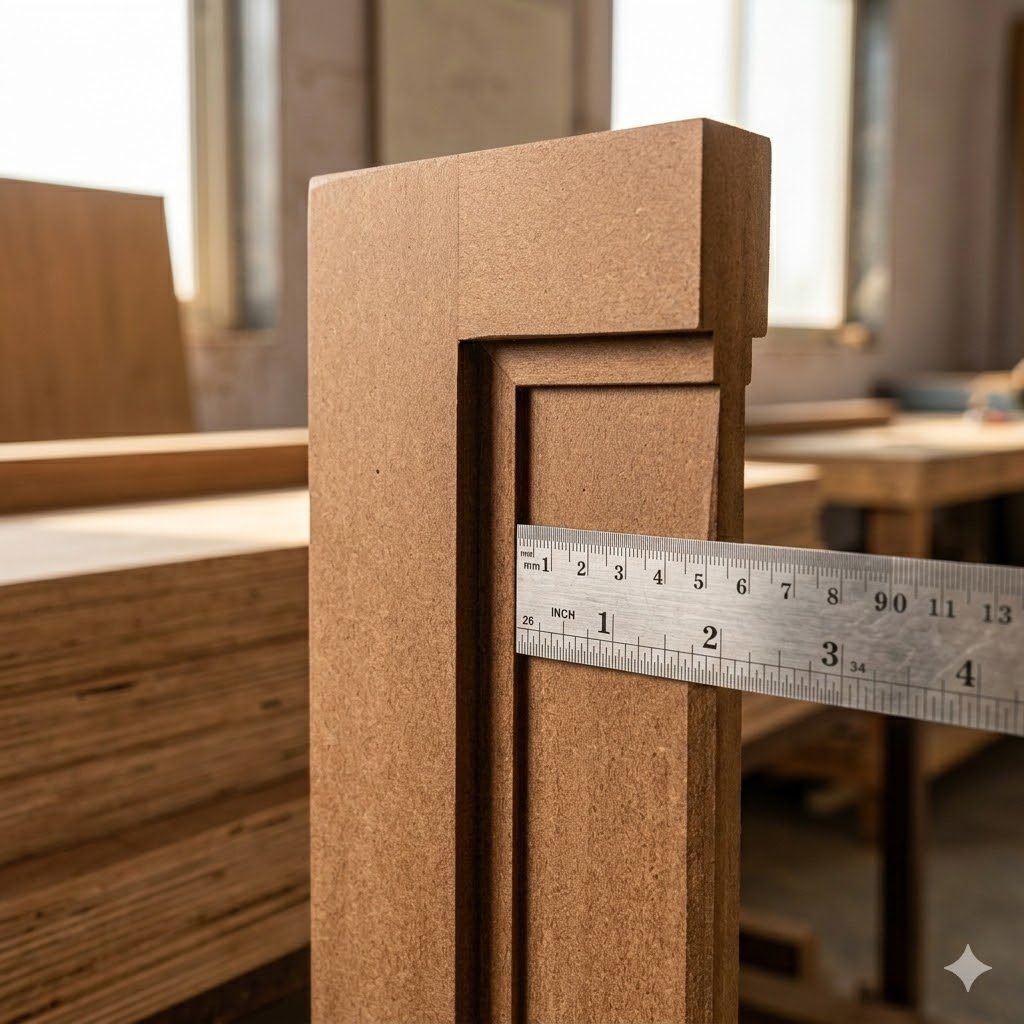
The reason a premium kitchen designer reaches for HDHMR instead of marine ply for shutter fronts is the routing surface. A CNC router cutting a shaker frame or a J-pull profile leaves a glass-smooth edge on HDHMR and MDF — no fibres standing up, no chipout, no patching. The same router on marine ply tears the face veneer and exposes the ply layers, which then have to be filled and sanded, and even then the laminate or PU will telegraph the seam. Marine ply is built to be flat-laminated, not routed.
Edge sealability runs the same way. A 2 mm PVC anti-microbial edge band sticks beautifully to a clean dense HDHMR edge. The same band on a marine-ply edge has to span the slight variations between the plies; on MDF the fibrous edge needs an extra primer coat or it will absorb the EVA adhesive unevenly.
Laminate adhesion is best on HDHMR (densest, smoothest surface) and excellent on MDF, both of which press flat under a vacuum laminator. Marine ply needs heavier rollers and longer dwell because of micro-undulations from the underlying plies.
When each is the right answer
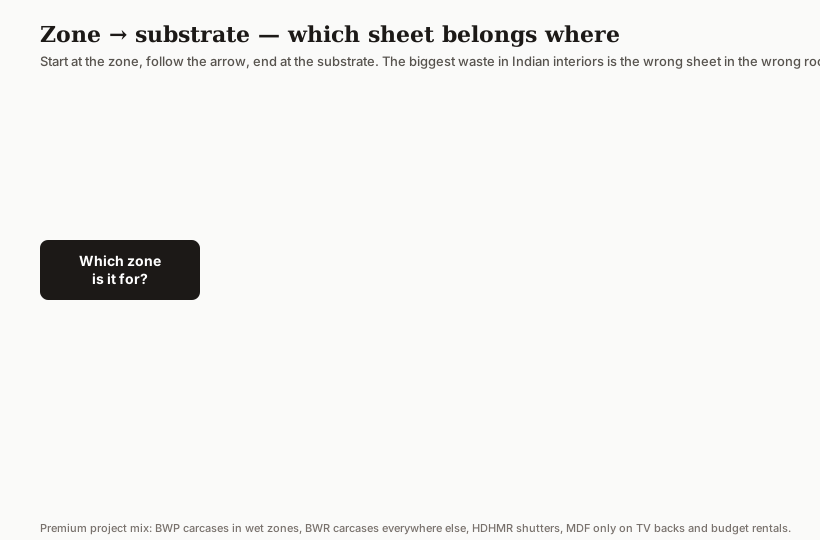
| Zone | Use this | Why |
|---|---|---|
| Sink-base, vanity, utility | Marine ply (BWP) | 5–10% swell, 15–25 yr life, screw-hold |
| Kitchen tall units and base carcase | BWR ply (IS 303 Type I) | Cycled doors need ply screw-hold |
| Wardrobe carcase, dry rooms | MR ply or BWR | Carcase loaded, needs plies |
| Shaker/PU/acrylic shutters | HDHMR | Routes clean, takes finish flat |
| Drawer fronts (premium) | HDHMR | Surface accepts laminate flat |
| TV back panels, dado, skirting | MDF | Surface only, no structural load |
| Rental fit-out (budget, dry) | MDF + good laminate | 7–10 yr life is enough |
| Anywhere damp | NEVER MDF | Swells 25–50%, irreversible |
The premium-project mix is now standard in Bengaluru, Hyderabad and Mumbai: BWP plywood under sinks and in utility, BWR plywood for every other carcase, HDHMR for every routed or laminated shutter face, MDF restricted to TV backs and decorative dados.
Brand landscape, 2026
The reliable Indian supply at each substrate, in the order most professional studios specify:
- Marine plywood (BWP, IS 710): Century Sainik / Architect Ply, Greenply Greenply Marine, Archidply, Kitply Champion. Tier-1 sheets carry the ISI mark on every sheet edge — without that mark, it is not BWP, whatever the bill says.
- HDHMR: Action Tesa HDHMR Pro and Boilo, Greenpanel HDHMR, CenturyHDHMR, Merino HDHMR. Action Tesa dominates the shutter market.
- MDF: Greenpanel Ecoboard, Action Tesa MDF Boilo (moisture-resistant variant), MarinoMDF. The "MR MDF" or "HDF" variants sit between regular MDF and HDHMR — better than the cheap stuff, never as resilient as HDHMR.
When NOT to use each
- Don't use marine ply for routed shutter fronts. The face veneer tears at the router; the laminate or PU telegraphs the ply seams. Reserve marine ply for carcases and flat-laminated faces, and use HDHMR for routed faces.
- Don't use HDHMR as a wet-zone carcase. It is moisture-tolerant, not waterproof. A sink leak hitting an HDHMR carcase will eventually soften it. BWP is the right answer below a sink.
- Don't use MDF anywhere damp, ever. Not in a kitchen carcase. Not in a wardrobe on a Mumbai ground floor. Not in a bathroom vanity. The savings will be eaten by the rebuild within two years.
The fix, in order
1. Decide the zone of each carcase first — wet, damp, dry, structural, surface-only.
2. Match the zone to the substrate (BWP for wet, BWR/MR ply for structural-dry, HDHMR for routed faces, MDF for non-structural dry only).
3. Demand the ISI mark / brand stamp on every sheet edge — no mark, no proof of grade.
4. Specify edge banding that suits the substrate (2 mm PVC on HDHMR/MDF, primer + band on marine ply).
5. Lock the BOQ with IS-code citations, not material names alone.
Prevent it / Plan it: Pick substrates by zone with the material decision framework and verify each spec with the material quality checklist and material comparison tool. Pair with our complete guide to plywood grades, the acrylic vs laminate kitchen guide, the engineered-wood lifecycle costing and the wardrobe finish ideas guide.
References
- Bureau of Indian Standards (2010) IS 710: Marine Plywood — Specification. New Delhi: BIS.
- Bureau of Indian Standards (1989, Reaff. 2018) IS 303: Plywood for General Purposes — Specification. New Delhi: BIS.
- Forest Products Laboratory (2010) Wood Handbook — Wood as an Engineering Material. General Technical Report FPL-GTR-190. Madison, WI: USDA.
- Thoemen, H., Irle, M. and Sernek, M. (eds.) (2010) Wood-Based Panels — An Introduction for Specialists. London: Brunel University Press.
- Bureau of Indian Standards (1983) IS 1734: Methods of Test for Plywood — Thickness Swelling. New Delhi: BIS.
Part of the Studio Matrx Materials & Finishes series.
Export this guide
Related Guides — Deep-dive reading
Complete Guide to Plywood Grades in India
MR, BWR, BWP, FR — the IS-code ladder, the right grade per zone, and how to verify it on site
Materials & FinishesThe Complete Guide to Furniture for Indian Homes (2026)
The start-here master guide for furnishing an Indian home — what furniture actually does, the five families of pieces, the decisions in the order you face them (space and needs, loose vs modular vs built-in, materials, size and layout, budget, buy, maintain), an honest read on plywood, humidity and termites, and where every choice hands off to the carpenter, the brand or the fixer.
FurnitureMoisture-Resistant Building Materials in India: The Right Material for Every Wet Zone (2026)
Moisture is the biggest enemy of Indian buildings - monsoon, rising damp, condensation, leaks and coastal humidity. This guide separates waterproofing (a system) from choosing inherently moisture-tolerant materials, then names the right material for bathrooms, exteriors, roofs, basements and finishes - with a zone-by-zone selector table. A specify-and-select guide.
Building MaterialsRelated Tools — Try Free
Material Comparison Sheet
India's interior material cheatsheet — plywood, finishes, hardware, countertops, paints, waterproofing.
Reference GuideCross-Ventilation Analyzer
Estimate airflow and air changes per hour (ACH) from room size, window areas, layout, and local wind — with NBC 2016 Part 8 compliance check.
Ventilation CalculatorDoor Paint Calculator
Estimate paint and primer litres and cost to paint your doors by size, number of doors, coats and paint type.
Door Calculator