
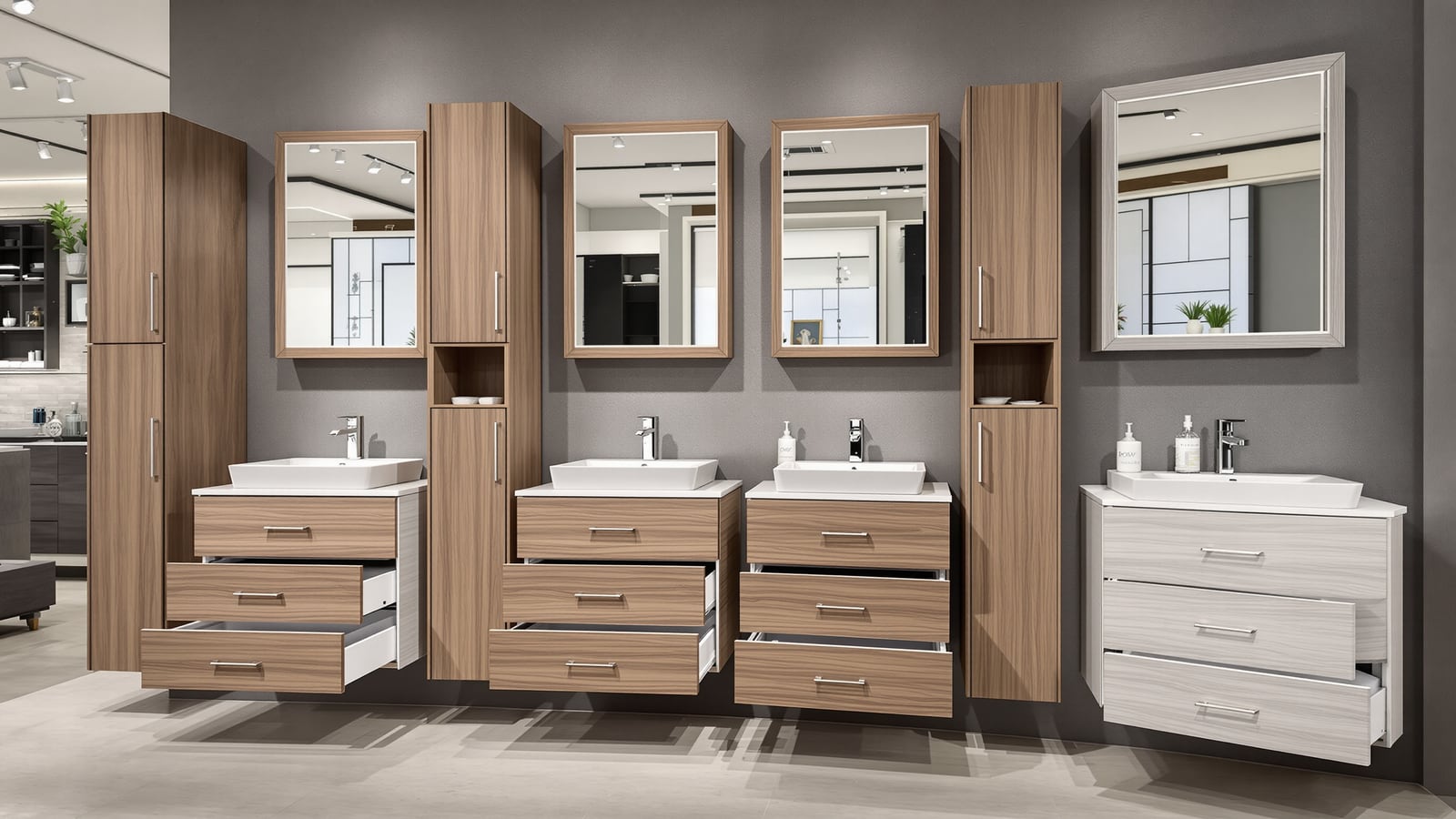
How to Choose Bathroom Furniture in India: The Buyer's Guide to Vanities, Mirror Cabinets & Storage
A buyer's decision guide to bathroom furniture in India — the one check that matters most (moisture-proof material), wall-hung versus floor, soft-close hardware, counter tops, ready-made versus custom, good/better/best ₹ tiers, warranty, and how to spot MDF sold as ply.
Bathroom furniture is the one category where the showroom lies to you by omission. The vanity, mirror cabinet and storage tower on display look identical whether the box behind the laminate is marine ply that will outlast your renovation or plain MDF that will swell into a swollen, stinking mess by its second monsoon. Everything you can see — the finish, the handle, the soft glide of a drawer — is the easy part. The one thing you cannot see, the core material, is what actually decides whether the piece survives an Indian bathroom. This guide is about buying the right thing, not about what a vanity is.
This is a buying guide in the Studio Matrx bathroom hub. Start from the bathroom shopping guide for India for the whole-room purchase picture. For the deep technical specs behind each piece, read the bathroom vanity guide, the mirror cabinet guide and the composite bathroom materials guide — this page tells you how to choose and what to check before you pay.
The finish sells the furniture. The core material decides whether you keep it. In an Indian bathroom, buy the board first and the looks second — a beautiful vanity on an MDF carcass is a five-year piece pretending to be a twenty-year one.
The #1 check: what is the core actually made of?
Nothing else on the spec sheet matters if the core swells. A bathroom is wetted, splashed, mopped and — for four months a year — soaked in humidity, and the health faucet sprays everything within a metre of the WC. So the very first question in any showroom is: what is the carcass made of, and does the moisture resistance come with a document?
Here is the plain hierarchy of core materials, worst to best for a wet room:
| Core material | Moisture behaviour | Verdict for a bathroom |
|---|---|---|
| Plain MDF / particle board / commercial ply | Drinks water, swells, delaminates, grows mould and stinks | Avoid outright — this is the material sold as "engineered wood" that fails |
| MR (moisture-resistant) grade board | Resists splashes, not soaking; better than plain but not wet-room proof | Only for dry powder rooms, or high-and-dry mirror cabinets |
| BWR / BWP plywood (IS 303 / IS 710) | Boiling-water resistant / boiling-water proof phenolic glue lines | Good to best — the traditional durable choice, marine (IS 710) is the top |
| HDHMR | Dense, uniform, moisture-resistant, takes membrane and paint well | Better — stable, screw-holds well, good for shaker and membrane finishes |
| PVC / WPC board | Genuinely waterproof polymer, will not swell, immune to termites | Best for the wet zone — a little softer, screws need care, but it cannot rot |
| Stainless steel (SS 304) | Rustproof metal carcass | Best-in-class durability, premium price, industrial look |
The rule is simple: for anything in the splash and mop zone — the vanity base, the under-sink storage, the plinth — insist on BWR/BWP ply, HDHMR, PVC/WPC or stainless. Reserve MR-grade board for pieces that stay high and dry. Never accept plain MDF or "commercial ply" anywhere water can reach.
Wall-hung vs floor-standing: the second decision
The mounting choice changes durability more than most buyers realise. A floor-standing unit is cheaper, holds more and needs no special wall strength, but its base sits exactly where mop water, floor-washing and health-faucet spray collect — so the plinth is the first thing to rot. A wall-hung (floating) unit is cantilevered clear of the floor on a concealed frame; the floor wipes under it in one pass, nothing stands in water, and the room reads larger. It costs more and needs a solid wall or a hidden steel frame in drywall.
For most Indian bathrooms, where the floor is washed and the faucet sprays, wall-hung is the more durable buy because it keeps the cabinet up out of the wet zone. Keep floor-standing for dry powder rooms, heavy stone counters that want ground support, or where wall strength is genuinely doubtful.
The hardware you can hear: soft-close hinges and channels
Cheap furniture hides its economy in the hinges and drawer runners. Ask for the hardware brand by name and insist on soft-close throughout. In the Indian market Hettich, Blum, Ebco and Häfele are the neutral benchmarks; a vendor who cannot name the hinge is fitting an unbranded one that will sag and rust. Look for:
- Soft-close hinges rated for the number of open-close cycles, ideally nickel-plated or stainless to survive humidity.
- Full-extension soft-close drawer channels (telescopic or tandem box) so the drawer pulls right out and closes silently.
- Concealed, adjustable hinges you can re-align later — bathroom doors go out of true as boards move.
- Marine or coated fasteners — ordinary MS screws rust and bleed brown stains down a white shutter.
Counter and top material
The vanity top takes the daily wetting, so it must be non-porous. Granite (honed, sealed) and quartz / engineered stone are the workhorse choices; solid surface (acrylic composite) allows an integrated seamless basin with no rim to leak; ceramic or sintered tops are premium and stain-proof. Avoid raw marble in hard-water bathrooms — it etches and stains. The composite bathroom materials guide covers these surfaces in depth.
Ready-made vs custom carpenter
Both routes can produce good or bad furniture — the difference is control and paperwork:
- Branded ready-made / modular (from a sanitaryware or modular-furniture brand) gives you a warranty, factory-pressed edge banding, tested hardware and a known core spec — but limited sizes and higher cost.
- Local custom carpenter fits any awkward Indian bathroom exactly and can be cheaper — but you must specify and inspect the core yourself, because this is where MDF quietly substitutes for ply. Put the board grade, hardware brand and edge sealing in writing before work starts.
Buy ready-made when you want the warranty and a clean spec; go custom when the space is non-standard and you can supervise the material.
Good / better / best: honest ₹ tiers
Indicative Indian retail ranges for a standard single-basin setup. Treat as a planning guide — city, brand and finish shift these.
| Tier | Vanity (base + top + basin) | Core & hardware | Mirror cabinet | Tall / side storage |
|---|---|---|---|---|
| Good | ₹8,000–18,000 | HDHMR or BWR ply, branded soft-close, laminate finish | ₹3,000–7,000 | ₹6,000–12,000 |
| Better | ₹18,000–40,000 | Marine ply or WPC, Hettich/Ebco soft-close, membrane or acrylic finish, quartz top | ₹7,000–15,000 | ₹12,000–25,000 |
| Best | ₹40,000–1,20,000+ | WPC/stainless carcass, Blum/Häfele hardware, sintered or solid-surface top, integrated basin | ₹15,000–40,000+ | ₹25,000–60,000+ |
The jump from Good to Better is almost entirely the core and the hardware — the two things that decide lifespan. On a fixture bolted to the plumbing that you cannot swap easily, that is the right place to spend.
Red flags and how to spot MDF sold as ply
This is the single most common mis-sale in Indian bathroom furniture — cheaper board dressed up and billed as marine ply. Catch it before you pay:
- Look at a cut edge. BWR/marine ply shows distinct wood veneer layers with dark phenolic glue lines. MDF is a uniform, smooth, pale brown biscuit with no layers; particle board shows visible chips.
- Heft it. Marine ply is dense and heavy; a suspiciously light "ply" panel is often MDF or low-grade commercial ply.
- Ask for the IS mark and the bill. Genuine ply carries an IS 710 or IS 303 stamp; insist the invoice states the grade, not just "ply".
- Distrust "waterproof MDF" and "German engineered wood" as blanket pitches — MR-grade MDF resists splashes, it is not wet-room proof, and the label is often looser than the product.
- Beware "lifetime warranty" with no written terms — a verbal lifetime promise from a carpenter is worth nothing; a one-page warranty naming the board and hardware is worth a lot.
- Reject unbranded hinges and raw, unbanded edges on sight — both signal the corners cut where you cannot see them.
Questions to ask the showroom or carpenter
- What exactly is the carcass core, and can you show me the IS mark or brand? Will the grade be written on my bill?
- Which brand of hinge and drawer channel, and is every one soft-close?
- Are all edges banded and the back panel sealed against the wall?
- What does the warranty cover — swelling of the board, rust of hardware, delamination — and for how long?
- Is installation, the wall bracket or frame, silicone sealing and the basin cut-out included in this price?
- For online buys: who installs it, and how is a swollen or damaged unit replaced under warranty?
References
- NBC 2016 (National Building Code of India) — Part 9 Plumbing Services; sanitary appliance provision and fixture setting-out.
- IS 710 (Marine-grade / BWP plywood) and IS 303 (Plywood for general purposes, incl. BWR grade) — bonding and moisture-resistance grades for furniture carcass boards.
- IS 12406 (Medium-density fibreboard) and IS 3097 — reference specifications distinguishing MDF and blockboard grades.
- IS 2556 (Vitreous sanitary appliances / wash basins) — specification for basins fitted into vanities.
- BIS product certification — confirm plywood, boards, sanitaryware and hardware carry the relevant IS marking before you pay.
Export this guide
Related Guides — Deep-dive reading
Bathroom Vanity India: Floor-Standing vs Wall-Hung Units, Materials & Cost
The complete India-first guide to bathroom vanity units — floor-standing versus wall-hung (floating), the carcass materials that actually survive Indian bathroom humidity, counter tops and basin fixing, sizes, heights and honest ₹ costs.
BathroomsHow to Choose a Wash Basin in India: Mount Type, Size, Tap Holes & Budget (2026 Buyer's Guide)
A buyer's decision guide to picking the right wash basin — matching the mount type to your vanity and space, sizing it to the room, getting the tap-hole config right for your faucet, judging material and durability, checking what's in the box, good/better/best rupee tiers, the IS 2556 vitreous-china mark, and how to spot seconds, hairline cracks and warranty traps.
BathroomsComposite Bathroom Materials India: WPC, HDHMR, Engineered Stone, Resin & FRP Guide
The India-first guide to engineered composite materials for bathrooms — WPC and HDHMR boards for waterproof vanities, engineered stone and terrazzo for basins and counters, resin and mineral composites, FRP and SMC panels — why they beat natural wood and plywood in humidity, where each fits and what they cost.
BathroomsRelated Tools — Try Free
Door Material Comparison Tool
Compare 2–4 door materials on cost, durability, maintenance, security and moisture resistance.
Comparison ToolMaterial Comparison Sheet
India's interior material cheatsheet — plywood, finishes, hardware, countertops, paints, waterproofing.
Reference GuideMaterial Compare — Side by Side
Compare materials side-by-side: granite vs quartz vs marble, laminate vs acrylic vs PU, and more.
Comparison