
Lift Safety Standards Every Homeowner Should Know (India)
The plain-language homeowner digest of what IS 17900, mandatory since 22 December 2025, actually requires on your new home lift, and the four pieces of compliance proof you can verify or ask your vendor for.
A home lift is the only machine in your house that carries your family vertically through the structure several times a day. When it works, you never think about it. When a safety system fails, the consequences are serious. That is exactly why India now has a dedicated, mandatory lift safety code, and why you, as the homeowner paying for the lift, should understand what it requires.
This guide is the plain-language homeowner digest of the lift safety standards that govern a new home lift in India. It explains what the law now demands on your machine, what each safety feature actually does, and, most importantly, what you can personally verify or ask your vendor for before you sign and after you commission. It deliberately does not re-catalogue the hardware in detail or repeat the safe-use checklist; for those, follow the cross-links. Here the focus is the standard itself and your compliance proof.
Quick orientation. Three guides in this cluster work together. This one covers the safety standards (what the lift must protect you against). The component catalogue at Elevator safety components in India explains the hardware in depth. The Home lift safety guide for India covers safe day-to-day use. Read all three to be fully covered.
The headline change: IS 17900 is now mandatory
The single most important fact for any homeowner buying a lift in 2026 is this.
IS 17900 became mandatory for all new lift installations in India from 22 December 2025. It is the Bureau of Indian Standards (BIS) lift safety code, modelled on the European norms EN 81-20 and EN 81-50, and it is the standard your new home lift should be built and certified to.
On the same date, the older codes that lifts used to be built to, IS 14665 (electric traction lifts), IS 15785 and IS 14671, were withdrawn. So if you read an older brochure, a forum post, or even an older Studio Matrx guide that names IS 14665, understand that for a new lift the current safety standard is IS 17900. Older installed lifts were certified to the previous codes and that is normal; the change applies to new installations going forward.
A few points to hold onto:
- IS 17900 is a multi-part standard, covering safety rules, components, inspection and related matters. Your vendor works to it; you do not need to read it, but you should see it named in your documents.
- It brings India in line with the international EN 81-20 / EN 81-50 and ISO 8100 lineage, which is a genuine improvement in protection over the old codes.
- Adoption into law is state-by-state. As of mid-2025, roughly 15 states plus one Union Territory had folded IS 17900 into their Lift Acts. In a state with no Lift Act, there is no central legal compulsion, which means a lift could legally be built to an old or weak standard. In that situation, insisting on IS 17900 compliance in your contract is your own safeguard. Treat every date and adoption figure here as indicative and confirm the current position with BIS, your state Lift Inspectorate and a licensed lift contractor.
The standards, the building codes and the licensing each do a different job and are covered in the sibling guides: Residential elevator standards in India, Building codes for residential elevators in India and Home lift approvals and regulations in India.
What IS 17900 actually requires on your lift
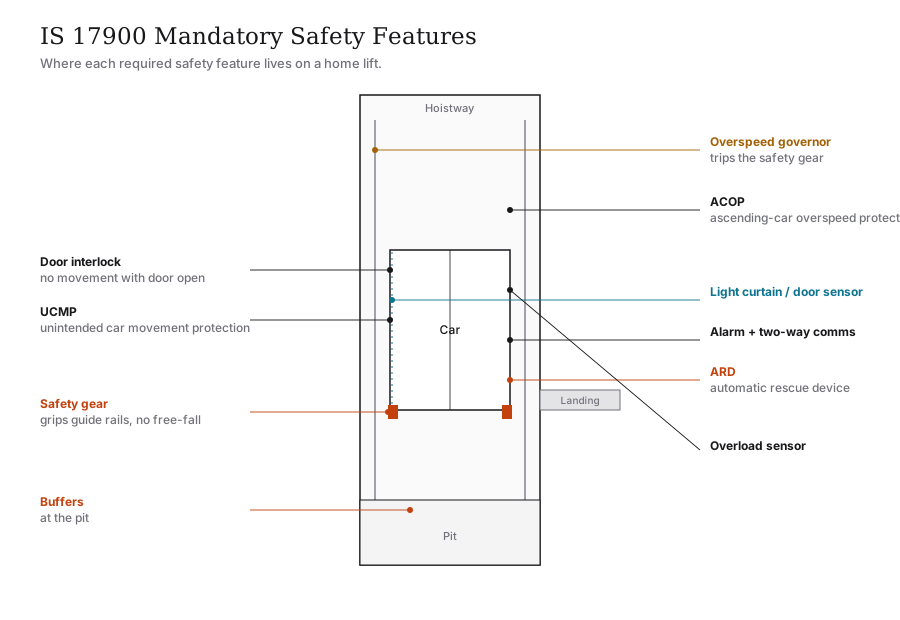
Below are the mandatory safety provisions you should expect on a compliant new home lift. Several of these are long-standing requirements that the new code keeps and strengthens; two of them, UCMP and ascending-car overspeed protection, are the headline additions that the EN 81-20/50 lineage brings.
Doors that interlock
Your lift must not move while any door, landing or car, is open, and a door must not be openable while the car is away from that floor. This is the door interlock, and it is the most fundamental lift safety principle. Secure door closure has to be electrically verified before the car will move at all.
UCMP: Unintended Car Movement Protection
One of the new emphases under IS 17900. UCMP stops the car if it ever starts to move away from a floor with the doors open, for example because of a brake or rope-grip failure during loading. It directly addresses the dangerous "the car drifted while I was stepping in" scenario.
Overspeed governor and safety gear
This pair is the reason a properly built lift cannot free-fall. The overspeed governor senses the car descending too fast; if it does, it triggers the safety gear, mechanical jaws on the car frame that grip the guide rails and bring the car to a controlled stop. This is the classic life-safety chain, and it is non-negotiable.
Ascending-car overspeed protection (ACOP)
The mirror image of the governor-and-gear system, and another point IS 17900 emphasises. ACOP stops the car if it overspeeds in the upward direction because of a control or drive failure, protecting against the car being driven into the headroom.
Buffers
At the bottom of the shaft sit buffers, which absorb the impact and decelerate the car (or counterweight) safely if it ever travels past the lowest floor. They are the last line of defence at the pit.
Door sensors / light curtain
A light curtain (an infrared safety edge across the door opening) detects a person, pet or object in the doorway and prevents the doors from closing on them. This replaces or supplements simple mechanical safety edges and is essential where children or elderly relatives use the lift.
Emergency alarm and two-way communication
A compliant car has an alarm button and a means of two-way voice communication so a trapped occupant can call for help and speak to someone. For a home lift this should connect to a reliably monitored point.
ARD: Automatic Rescue Device
Not a quirk of IS 17900 so much as a practical necessity in India. The ARD is a battery unit that, on a power cut, automatically drives the car to the nearest floor and opens the doors so no one is stranded. Given the reality of Indian power supply, do not accept a home lift without an ARD.
For the full engineering detail on any of these components, see Elevator safety components in India.
The mandatory safety feature table
This is the heart of the guide: each mandatory safety feature, what it protects you against, and how you, the homeowner, can confirm it is present and tested.
| Mandatory safety feature | What it does for you | How to verify it |
|---|---|---|
| Door interlocks | The car cannot move with any door open; a door cannot be opened away from a floor | Ask vendor to demonstrate; should be named in the spec sheet and IS 17900 declaration |
| UCMP (unintended car movement protection) | Stops the car if it drifts from a floor with doors open | Listed as a feature on the spec; confirmed in the IS 17900 compliance declaration |
| Overspeed governor + safety gear | The car cannot free-fall; jaws grip the rails on downward overspeed | Named on the spec; the governor/safety-gear test must be in your AMC schedule |
| Ascending-car overspeed protection (ACOP) | Stops the car on upward overspeed from a control failure | Confirm it is listed in the IS 17900 feature set on your quotation |
| Buffers | Safely decelerate the car at the pit if it over-travels | Specified by type in the technical sheet; checked at inspection |
| Door sensors / light curtain | Doors will not close on a person, child, pet or object | Demonstrate at handover by breaking the beam; listed on the spec |
| Emergency alarm + two-way communication | A trapped occupant can call for help and speak to someone | Test the alarm and intercom at handover; confirm where the call lands |
| ARD (automatic rescue device) | On a power cut, the car reaches the nearest floor and opens | Ask for a live power-cut demonstration; ARD load-test in the AMC |
| Overload sensor | Prevents operation when the car is loaded beyond its rating | Listed on the spec; demonstrate the overload warning at handover |
What you can verify or ask for
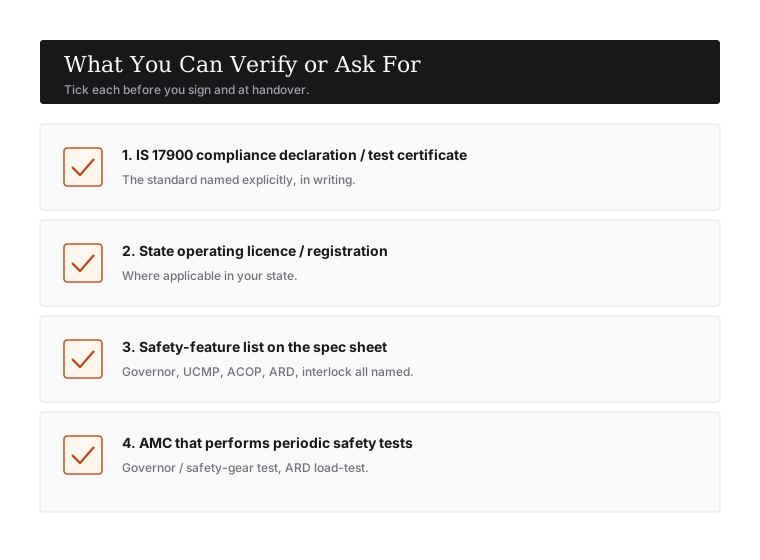
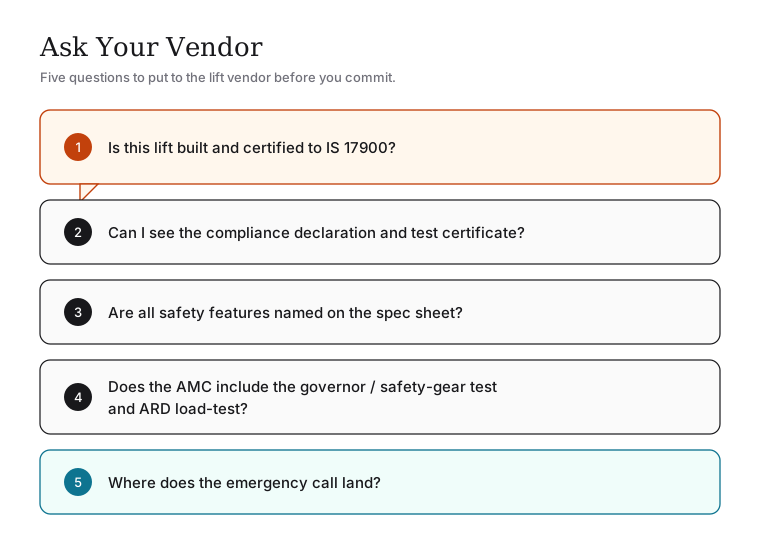
You do not need to be an engineer to hold a vendor to the standard. There are four concrete pieces of evidence to insist on, and a homeowner who asks for all four is in a strong position.
1. The IS 17900 compliance declaration / test certificate
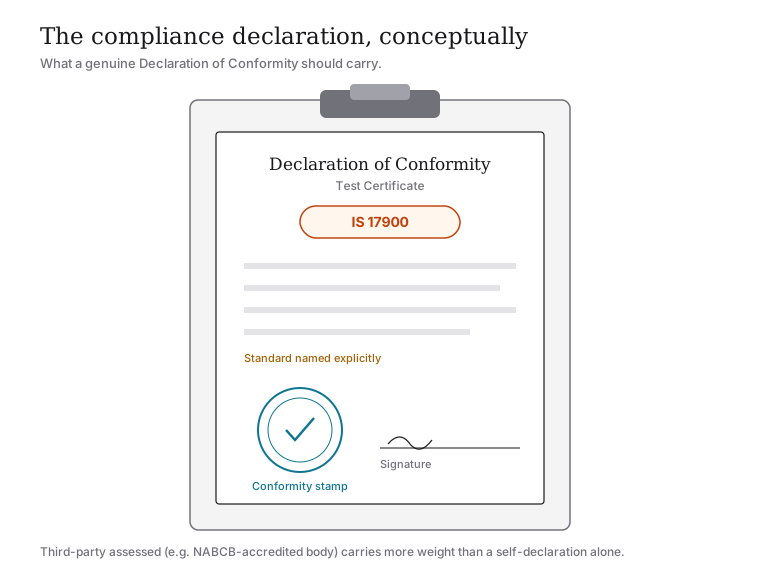
This is your headline proof. A reputable vendor will provide a declaration of conformity to IS 17900 and the relevant test certificates for the installation. Increasingly these are backed by third-party conformity assessment; certification bodies in India are being accredited (for example through NABCB) specifically to certify IS 17900 lift safety. Ask to see the document, and ask that the standard, IS 17900, is named explicitly on it.
2. The state operating licence / registration (where applicable)
In a state with a Lift Act, a lift typically needs installation permission before it goes in and an operating licence or registration after commissioning and inspection, with periodic (often annual) safety inspection by government inspectors. The inspectorate is a government body, not a private company. In a state with no Lift Act there may be no mandatory registration, in which case IS 17900 compliance plus a reputable vendor and a real AMC are your responsible course. The licensing path is covered fully in Home lift approvals and regulations in India.
3. The safety-feature list on the spec
Before you sign, get the specification sheet and confirm that every feature in the table above is named on it: interlocks, UCMP, governor and safety gear, ACOP, buffers, light curtain, alarm and intercom, ARD and overload sensor. A missing feature is a question to raise now, not after handover. Use Lift specification checklist for India to run a complete spec review.
4. An AMC that performs the periodic safety tests
A safety feature that is never tested is a safety feature you cannot rely on. Your Annual Maintenance Contract should explicitly schedule the safety tests, not just lubrication and cleaning. In particular it should include the overspeed governor / safety-gear test and the ARD load-test, alongside the standard cycle of roughly twelve monthly preventive visits plus emergency call-outs. Indicative residential AMC cost runs around ₹20,000 to ₹38,500 per year; read the fine print for what is and is not covered.
How this fits the bigger compliance picture
Safety standards are one of four interlocking layers of compliance, and it helps to see where each sits:
- The lift safety standard (this guide): IS 17900 governs the machine itself, what it must protect you against.
- Building codes: NBC 2016 Part 8 Section 5 and your municipal bye-laws govern the building, when and where a lift is required and the shaft, fire and structural provisions around it. See Building codes for residential elevators in India.
- Approvals and licensing: the state Lift Acts govern permission to install and operate. See Home lift approvals and regulations in India.
- Accessibility: the RPwD Act 2016 and CPWD Harmonised Guidelines govern barrier-free design, door width, car size, handrails, audible and tactile signals. See Accessibility standards for residential lifts in India.
For the consolidated view across all four, the Residential elevator standards in India guide maps the whole standards landscape, and the Residential elevator buyer's guide for India is the pillar. Architects and design-stage readers should also see the Architect's residential elevator handbook for India. For what it all costs, see Home lift cost in India 2026.
Bottom line for the homeowner
You do not need to memorise a standard to be safe. You need to do three things. First, insist your new lift is built and certified to IS 17900 and get the declaration in writing. Second, confirm the safety features on the spec and, where your state has a Lift Act, the operating licence. Third, sign an AMC that actually tests the safety systems, the governor and safety gear and the ARD, on a schedule. Do those three and you have closed the gap between a lift that looks safe and a lift that is provably safe. As always, treat dates and adoption figures as indicative and confirm the current rule with BIS, your state Lift Inspectorate and a licensed lift contractor.
References
- IS 17900 (2025) — current mandatory BIS lift safety code, EN 81-20/50 based, mandatory for new installations from 22 December 2025; superseded IS 14665, IS 15785 and IS 14671.
- EN 81-20 / EN 81-50 — European lift safety norms on which IS 17900 is modelled; ISO 8100 international lineage.
- IS 17515 — Indian Standard on the energy performance of lifts, escalators and moving walks (separate from safety).
- IS 14665 (legacy, electric traction lifts) and IS 15259 (hydraulic) — Part 1: https://law.resource.org/pub/in/bis/S05/is.14665.1.2000.pdf and Part 2: https://law.resource.org/pub/in/bis/S05/is.14665.2.1-2.2000.pdf
- NBC 2016, Part 8, Section 5 (Installation of Lifts, Escalators and Moving Walks): https://www.bis.gov.in/standards/technical-department/national-building-code/ and Guide for Using NBC 2016: https://www.bis.gov.in/wp-content/uploads/2022/08/Booklet-Guide-for-Using-NBC-2016.pdf
- RPwD Act 2016: https://ssepd.odisha.gov.in/sites/default/files/2024-01/RPWD%20ACT.pdf and DEPwD FAQs: https://depwd.gov.in/en/faqs-4/
- CPWD Harmonised Guidelines and Space Standards for a Barrier-Free Built Environment: https://www.cpwd.gov.in/Publication/Harmonisedguidelinesdreleasedon23rdMarch2016.pdf
- State Lift Acts (Maharashtra 2017, Karnataka 2015, Tamil Nadu 1997, Delhi 2007, and others) and the Maharashtra licence-to-operate portal: https://services.india.gov.in/service/detail/maharashtra-license-to-operate-lift
- Elevator World on India and IS 17900: https://elevatorworld.com/article/indias-elevator-revolution-why-is-17900-is-the-biggest-market-opportunity-since-eu-harmonization/
- TUV SUD NABCB accreditation for IS 17900 lift safety: https://www.industrialautomationindia.in/news/tuv-sud-achieves-nabcb-accreditation-for-is-17900-lift-safety-standard
- Elevator World on IS 17515 energy performance: https://elevatorworld.com/article/new-indian-standard-is-17515-on-energy-performance-of-lifts-escalators-moving-walks/
- 99acres on lift regulations in India: https://www.99acres.com/articles/know-all-about-the-lift-regulations-in-india.html and lift rules FAQs: https://www.99acres.com/articles/faqs-about-lift-rules-and-regulations-in-india.html
Export this guide
Related Guides — Deep-dive reading
Residential Elevator Standards in India (2026): IS 17900, NBC and What Governs a Home Lift
The consolidated standards map for a home lift — IS 17900 (mandatory since 22 December 2025), IS 17515, NBC 2016 Part 8 Section 5, the RPwD/CPWD accessibility rules, the state Lift Acts and the EN 81-20/50 / ISO 8100 lineage, and which one governs what.
Home Lifts & AccessibilityElevator Safety Components Guide (India): Governor, Safety Gear, Buffers and Interlocks
A plain-language catalogue of the layered safety devices that keep a home lift safe — the overspeed governor and safety gear, buffers, door interlocks, limit switches and more — referenced to IS 14665 Part 4 and IS 17900 / EN 81-20/50.
Home Lifts & AccessibilityHome Lift Safety Guide (India): How Safe Home Lifts Are and How to Use One Safely
Why modern home lifts cannot free-fall or open onto an empty shaft, the safety features explained, and how to use one safely every day — for children, seniors and emergencies.
Home Lifts & AccessibilityRelated Tools — Try Free
Accessibility Compliance Calculator
Check a planned lift against the CPWD and RPwD accessible-lift benchmarks for a score.
Lift CheckerHome Lift Cost Calculator
All-in home lift cost by floors, type, capacity and city — equipment, civil, GST and AMC, with a drive-type comparison.
Lift CalculatorLift Safety Audit Checklist
Interactive checklist that scores your home lift on safety devices, compliance and upkeep.
Checklist