
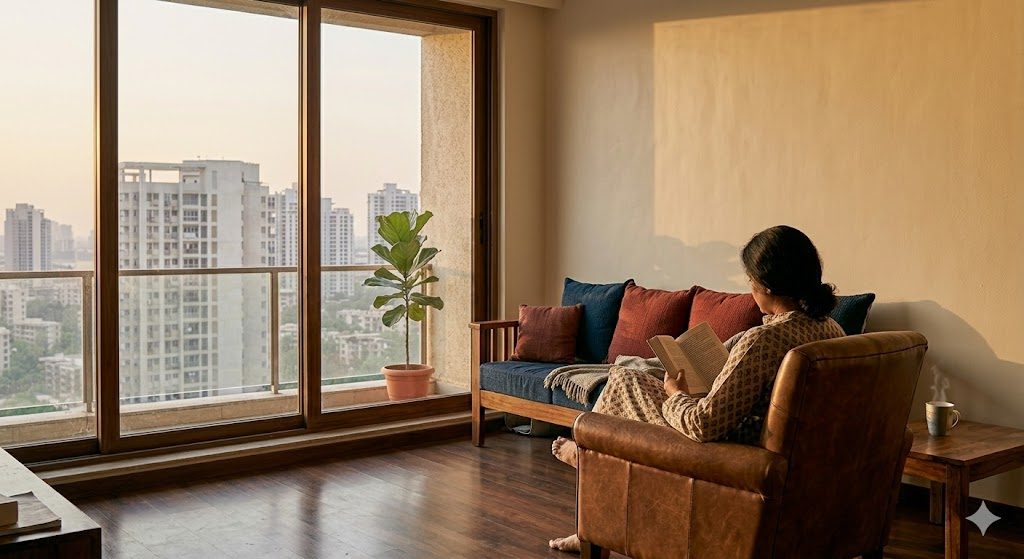
The Architectural Psychology of Comfortable Spaces
Why some rooms feel right and others never do — the science of space and the human mind
You have walked into two rooms of roughly the same size and felt completely different things. One — maybe a friend's living room, or a small temple, or a corner café — wrapped around you the moment you entered. You sat down without thinking, your shoulders dropped, you stayed an hour longer than you meant to. The other — perhaps a glossy new flat, a hotel lobby, a freshly "done up" hall — was objectively nicer, more expensive, better lit, and yet you stood near the door, never quite settled, and left early. Nobody had to tell you which was which. Your body knew before your mind did.
This guide is about why. It is the front door to a small library of pieces we have written on the science of space — and it explains the underlying machinery that all of them draw on: the field of environmental and architectural psychology, the study of how built space acts on the human mind. We will keep it readable but never thin. You will leave able to look at any room — yours included — and say, with some precision, what is making it feel the way it does.
The core idea is this: a room is not just a container for your stuff; it is a continuous, silent message to your nervous system about whether you are safe, in control, and well. Comfort is what happens when that message comes out right. Discomfort is the message coming out wrong — and it is fixable, because the levers are known.
What "architectural psychology" actually means
Strip away the academic phrasing and the field asks one question: what does space do to people? Not what it looks like in a photograph, but what it does to your heart rate, your stress hormones, your attention, your sleep, your willingness to talk to the person across the room.
It is a real, evidence-backed discipline, not interior-design folklore. Roger Ulrich's famous 1984 study in the journal Science showed that hospital patients recovering from gallbladder surgery in rooms with a window onto trees needed fewer strong painkillers and went home almost a day sooner than identical patients facing a brick wall. Same operation, same care — different view, measurably different bodies. That single finding cracked open a whole field. We now have decades of work linking ceiling height to the kind of thinking you do, daylight to how well you sleep, corridor width to whether you feel hurried or held.
The reason space reaches us so deeply is that we did not evolve in rooms. For almost the entirety of human history, "reading a space" for safety and resource was a survival skill. The savannah-dwellers who instantly sensed can something sneak up on me here? can I see what's coming? is there water, shelter, a way out? lived longer and had more children. We are their descendants, and we have brought those ancient instruments indoors. A badly shaped room trips the same wiring that a dangerous clearing once did. This is why comfort feels like an emotion rather than an opinion — because, underneath, it is a safety judgement.
A room is a message to your nervous system about whether you are safe. Good design simply makes sure that message reads "yes."
The seven levers of psychological comfort
Across all the research, the same handful of dials keep appearing. Get them roughly right together and almost any space feels good; push any one to an extreme and the whole thing curdles. Here are the seven this guide is organised around — and that the rest of the cluster goes deep on.
| Lever | The feeling when it is right | The feeling when it is wrong | Where it lives in your home |
|---|---|---|---|
| Proportion & scale | settled, dignified, "human" | cramped, or cold and cavernous | ceiling height, room shape, furniture size |
| Natural light | awake by day, calm by evening | dull, low, "why am I tired here" | window size, orientation, depth of room |
| Nature connection | restored, unhurried | sterile, airless, anxious | views, plants, real wood and stone |
| Enclosure & refuge | protected, able to relax | exposed and watchful, or boxed in | wall at your back, the open outlook |
| Order & legibility | clear-headed, oriented | confused, low-grade stressed | layout you can read at a glance |
| Control & territory | "this is mine to adjust" | helpless, on edge | adjustable light, a place of your own |
| Thermal & acoustic | you forget the room exists | distracted, irritable, drained | temperature, draughts, noise |
The rest of this guide walks each one, with the numbers and the Indian-home specifics that make them usable.
Lever 1 — Proportion and scale: the room must be built for a body
Human beings carry an internal sense of their own size and read every space against it. A doorway that clears your head by a comfortable margin feels generous; one you must duck through feels hostile, even if you are short enough not to hit it. We are measuring constantly.
Two numbers matter most. The first is ceiling height. The National Building Code of India (NBC 2016) sets a habitable-room minimum of 2.75 m (about 9 ft) for most of the country, and many builder flats sit right on that floor. There is real psychology in the extra. Joan Meyers-Levy's studies at the University of Minnesota found that higher ceilings (around 3 m / 10 ft) prime abstract, free, creative thinking — the mind feels released — while lower ceilings prime focused, detail, cosy thinking. Neither is "better"; they are tools. A drawing room wants height and air; a study or a reading nook is often nicer slightly lower and more enclosed. We unpack this fully in our companion on the science of ceiling heights.
The second is the relationship between dimensions — proportion. Rooms whose length, width and height relate in calm, simple ratios (the classic guidance hovers near the 1 : 1.6 "golden-ish" range, but anything from a square to about 1 : 1.5 reads as resolved) feel composed. A long, thin "shoebox" hall at 1 : 3 feels like a corridor pretending to be a room, no matter how you furnish it. Christopher Alexander, in A Pattern Language, devotes whole patterns to this — Ceiling Height Variety, Short Passages, The Shape of Indoor Space — arguing that rooms with no sharp, awkward proportions are simply where people choose to be.
What this means for your home: before you fall in love with a flat plan, check the proportions of the rooms you will live in most. A 3.0 m × 3.0 m bedroom is calmer than a 2.4 m × 4.2 m one of identical area. Furniture scale matters too — an oversized sectional sofa in a small hall makes the hall feel smaller, not grander.
Lever 2 — Prospect and refuge: see out, sit safe
Of all the ideas in this field, this is the one that, once you see it, you cannot unsee. The geographer Jay Appleton proposed it in The Experience of Landscape (1975): we are drawn to places that offer prospect — an open outlook, light, a view of what is coming — and refuge — a protected spot, something solid at our back, a sense that nothing can approach unseen. We are happiest where we get both at once.
Watch where people actually sit and the theory proves itself. In any café, the corner tables with a wall behind and a view of the room go first; the exposed table in the middle goes last. At home, the favourite chair is almost always the one with its back to a wall and its face to a window or the doorway. The verandah chair is the perfect prospect-refuge object — roof and wall behind you, the whole garden or street in front. So is the window seat, the jharokha, the courtyard edge.
The failure modes are equally clear. Too much refuge, no prospect is a cave — a windowless box that feels safe for ten minutes and oppressive after an hour. Too much prospect, no refuge is exposure — a glass-walled room with your back to open space, bright and beautiful and subtly unrelaxing; you keep wanting to put your back somewhere.
What this means for your home: arrange your main seating so the primary chairs have a wall or solid element behind them and an outlook in front — a window, the room, a doorway. Do not float the sofa in the middle of the floor with its back to the entrance. Give every room one good "anchor seat" that satisfies both.
Lever 3 — Nature connection: the biophilia dial
In 1984 the biologist E. O. Wilson named our innate pull toward living things biophilia — "the urge to affiliate with other forms of life." Stephen Kellert later turned it into a design vocabulary. The evidence is now overwhelming: views of greenery, the presence of plants, daylight, natural materials and water all measurably lower stress and speed mental recovery. Ulrich's hospital window was biophilia in action; so is the way a single well-placed plant can change the temperature of a room's mood.
Crucially, the effect does not require a forest. It works through three channels, and Indian homes have rich access to all of them:
- Direct nature — a view to trees or sky, indoor plants, a small water element, a courtyard. The traditional courtyard home (the nalukettu, the haveli) is essentially a biophilia machine: it pulls sky, light, rain and a slice of garden into the centre of the house.
- Natural analogues — real materials that carry the grain and irregularity of nature: solid wood, stone, terracotta, cane, khadi and cotton. A teak door reads as nature in a way a laminate-printed-to-look-like-teak door does not; the eye is not fooled for long.
- Nature of the space — the prospect-and-refuge quality above, which is itself a "natural" spatial pattern.
What this means for your home: you do not need to renovate to move this dial. Position a chair where it sees green. Add real plants in real numbers (three healthy plants do more than one token pot). Choose at least a few honest natural materials your hand will touch daily — a wooden armrest, a stone counter, a cotton throw. To quantify how well your space lands on this, our biophilic-score tool walks you through it room by room, and the natural-light planning guide covers the daylight half in depth.
Lever 4 — Order, legibility and the Kaplan preference matrix
Why do some rooms feel restful to be in and others, even tidy ones, leave you faintly tense? Rachel and Stephen Kaplan, environmental psychologists at Michigan, gave us the cleanest answer in The Experience of Nature (1989). They found that the spaces people reliably prefer balance two needs — the need to understand a space and the need to explore it — across two timescales, immediate and over time. That gives four qualities.
- Coherence (immediate understanding): the room hangs together. Colours, materials and furniture share a family; nothing fights for attention. This is what tidy-but-tense rooms usually lack — they are clean but incoherent, a committee of unrelated objects.
- Legibility (understanding over time): you can read where to sit, where the kitchen is, where the way out is, without a mental map. Legible homes feel safe because you are never lost in them.
- Complexity (exploration, immediate): enough richness to hold the eye — texture, a plant, a patterned dhurrie, a gallery wall. Too little and the room is sterile; the trick is richness without clutter.
- Mystery (exploration over time): a hint of more just out of view — a passage that curves, a glimpse of the courtyard through a half-open door. Mystery is what gives a home depth and draws you gently through it.
The everyday lesson: comfort is not the same as minimalism, and it is not the same as "more stuff." It is coherence plus legibility (so the mind relaxes) alongside complexity plus mystery (so the mind is quietly engaged). A bare white box fails on complexity; a cluttered showroom fails on coherence. The rooms you love get all four into balance.
Lever 5 — Personal space, control and territory
Edward T. Hall, the anthropologist who coined the word proxemics in The Hidden Dimension (1966), showed that every human carries invisible bubbles of distance and reacts — physiologically — when they are crossed by the wrong person. These zones shape how a room should be laid out far more than aesthetics do.
Hall's bands run roughly: intimate (under ~450 mm, for the very close), personal (~0.45–1.2 m, for friends and easy talk), social (~1.2–3.6 m, the drawing-room circle for guests), and public (beyond ~3.6 m, for addressing a room). These vary by culture — Indian social distances often run a little closer than Hall's North-American figures — but the structure holds. The practical upshot for a living room is sharp: seating placed 2.4–3.0 m apart lands a conversation comfortably in the social band — warm but not crowding. Push the sofas past 4 m and the room feels cold and the talk dies; squeeze them under 1.8 m and it feels pushy. The right room is the right distances, made physical.
Two related ideas matter as much. Control — Robert Gifford and others have shown that the single biggest predictor of whether people feel comfortable indoors is whether they feel they can adjust their environment: dim the light, open a window, move a chair, claim a corner. A room you cannot change is a room that subtly stresses you, however lovely. Territory and defensible space — the architect Oscar Newman's work showed how clearly-owned, clearly-bounded zones make people feel secure and behave well. At home this is the child's own desk, the parent's reading corner, the grandparent's chair that is theirs. People need a patch that is unmistakably their own.
What this means for your home: plan seating to the proxemic bands, not to fill the walls. Give every regular occupant one piece of "territory" they control. And never trade away controllability for neatness — hidden, fiddly, or fixed controls (one switch for eight lights, a window that no longer opens) quietly tax everyone who lives there.
Lever 6 — Thermal and acoustic comfort: the invisible half
You can get proportion, light, nature and layout perfect and still have a room nobody wants to be in — because it is too hot, draughty, or noisy. Thermal and acoustic comfort are invisible when right and impossible to ignore when wrong, and in the Indian climate they are not optional.
On thermal comfort, the body's comfort band sits roughly between 24°C and 29°C in naturally ventilated Indian homes, with the India Model for Adaptive Comfort (IMAC) showing that people acclimatised to local conditions tolerate a wider range than the old international standards assumed — provided there is air movement. A gentle breeze of even 0.5–1.0 m/s makes 30°C feel like 27°C. This is why cross-ventilation, shading and ceiling fans matter more to felt comfort than air-conditioning alone, and why a still, sealed room at a "correct" temperature can still feel stuffy and oppressive. Our companion guides on how ventilation changes home quality and passive cooling strategies go deep here.
On acoustic comfort, noise is one of the most underrated stressors in modern Indian flats. The WHO guidance for restful indoor environments is around 35 dB(A) for bedrooms at night; many city flats sit well above that from traffic and neighbours. Hard, parallel surfaces — tile, glass, bare RCC — let sound bounce and build, so a beautiful all-marble hall can be exhausting to hold a conversation in. Soft materials (curtains, rugs, upholstery, a bookshelf) absorb it. Juhani Pallasmaa, in The Eyes of the Skin, reminds us that we experience architecture with the whole body, not just the eyes — the hush of a thick-walled old house, the echo of an empty new one, are as much "design" as anything visible.
What this means for your home: secure air movement before you spend on cooling; add soft, absorptive materials to any room that echoes; and treat a quiet bedroom as a design requirement, not a luxury.
How this plays out in the Indian home
The seven levers are universal, but they wear local clothes. Indian domestic space has spent centuries solving the psychology of comfort in its own vocabulary, and the best modern homes still draw on it.

- The verandah and the threshold. The ottla, the thinnai, the verandah — these are not leftover space; they are masterpieces of prospect-and-refuge and of the gentle transition between public street and private interior. They let you watch the world (prospect) from a sheltered, owned perch (refuge), and they soften the psychological jolt of moving from the loud, bright outside to the quiet inside. Christopher Alexander would recognise them instantly as his pattern Entrance Transition.
- The courtyard. The central aangan or nadumuttam is biophilia, daylight, cross-ventilation, prospect-and-refuge and family territory all at once — a slice of regulated nature held safely inside the house. It is no accident these homes feel calm.
- The pooja corner. A small, defined, slightly enclosed zone of high meaning is a textbook example of legible, owned, refuge-rich space — a place the mind reliably settles. The psychology of a good pooja niche (enclosure, focus, a sense of " thisness") is the same psychology as a good reading nook.
- The baithak / drawing room. The traditional baithak is proxemics made architecture: a defined social-distance circle for receiving guests, distinct from the family's intimate inner rooms. Indian homes have always understood that different relationships need different distances and different rooms.
- Joint-family territory. In a multi-generational home, the deepest comfort question is territorial: does each generation have a patch that is unmistakably theirs, with control over its light, noise and access? Where that fails, the friction is rarely about the people and almost always about the space. (Our guide on multi-generational home design takes this further.)
What makes a room feel cramped, cold or anxious — versus calm
It helps to name the failure states directly, because each maps cleanly onto a lever you can now adjust.
| The room feels… | What is usually wrong | The lever to reach for |
|---|---|---|
| Cramped | low ceiling + bad proportion + oversized furniture | proportion & scale |
| Cold / unwelcoming | seating too far apart, no refuge, no nature, hard echo | proxemics + refuge + nature + acoustics |
| Anxious / on-edge | exposed back, illegible layout, no control | refuge + legibility + control |
| Dull / lifeless | no daylight, no complexity, sterile materials | natural light + complexity + nature |
| Stuffy / oppressive | no air movement, too enclosed, no view out | thermal + prospect |
| Calm / expansive / safe | all seven roughly in balance | — |
Notice that almost no failure is about money or style. A modest, cheaply furnished room with good proportion, a wall to sit against, a window with green outside, soft materials and a fan can outperform an expensive one that gets the levers wrong. Comfort is a design property, not a price tag.
What this means for your home — apply it, in order
1. Find every room's anchor seat. For the spot you sit in most, give it a solid back and an outlook in front (prospect + refuge). If your sofa floats with its back to the door, turn it.
2. Audit proportion and scale. Check that your key rooms are not shoeboxes, that furniture is sized to the room, and that ceilings suit their use — airy for living, cosier for studies and bedrooms.
3. Bring in real nature, in real quantity. Three healthy plants, one good green view, and a few honest natural materials your hand touches daily. Run the biophilic-score tool to see where you stand.
4. Make the layout legible, then add a little mystery. Clear sightlines to the obvious destinations; one curve, niche or half-glimpse to draw you through.
5. Set the distances. Place seating to the social band (2.4–3.0 m across a conversation), not to line the walls. Sketch it first with the layout-planner.
6. Give everyone territory and control. One owned corner per person; dimmable light, an openable window, a chair they can move.
7. Secure air movement and quiet. Cross-ventilation and fans before AC; soft, absorptive materials in any room that echoes; protect the bedroom toward 35 dB at night.
8. Then, and only then, decorate. Style sits on top of comfort. Get the seven levers right and almost any aesthetic will feel good; get them wrong and no amount of styling will rescue the room.
If you want a space that gets these levers right from the first sketch rather than fixed in hindsight, that is exactly what DesignAI is built for — it reasons about light, layout, proportion and flow as it generates plans for your room, so psychological comfort is designed in, not bolted on. Start from your real dimensions and let it propose arrangements that put the anchor seat, the daylight and the distances where your nervous system wants them.
References
1. National Building Code of India 2016 (NBC 2016), Bureau of Indian Standards — habitable-room minimum dimensions and ceiling heights.
2. Ulrich, R. S. (1984). "View Through a Window May Influence Recovery from Surgery." Science, 224(4647).
3. Appleton, J. (1975). The Experience of Landscape. Wiley. (Prospect-and-refuge theory.)
4. Kaplan, R. & Kaplan, S. (1989). The Experience of Nature: A Psychological Perspective. Cambridge University Press. (Coherence, legibility, complexity, mystery.)
5. Hall, E. T. (1966). The Hidden Dimension. Doubleday. (Proxemics and personal-space zones.)
6. Alexander, C., Ishikawa, S. & Silverstein, M. (1977). A Pattern Language. Oxford University Press.
7. Pallasmaa, J. (2005). The Eyes of the Skin: Architecture and the Senses. Wiley; and Wilson, E. O. (1984). Biophilia. Harvard University Press; IMAC adaptive-comfort model (Manu et al., 2016) for naturally ventilated Indian buildings; WHO Environmental Noise Guidelines.
Continue through the Design Education cluster: the science of ceiling heights, why corridor width matters, understanding spatial flow, how good architecture reduces stress, how ventilation changes home quality, passive cooling strategies, understanding structural walls before renovation, and architect vs interior designer vs contractor — plus our deep dive on space-planning principles.
Export this guide
Related Guides — Deep-dive reading
Homes That Improve Mental Wellbeing
The whole-home, indoor-biophilia approach to calm — how plants, light, air, quiet and the right balance of togetherness and retreat make an Indian home restorative.
Healthy HomesWhy Scale Matters: Keeping Rooms Comfortable for Humans
How sizing furniture, art and lighting to the human body — not the showroom — keeps small Indian flats from feeling crushed and large halls from feeling empty.
Design PrinciplesDesigning Low-Stress Living Spaces
The practical design moves that lower everyday stress at home — from hidden storage and a restrained palette to acoustic calm, soft light and a place to retreat — tuned for Indian flats, joint families and multi-use rooms.
Healthy HomesRelated Tools — Try Free
Cross-Ventilation Analyzer
Estimate airflow and air changes per hour (ACH) from room size, window areas, layout, and local wind — with NBC 2016 Part 8 compliance check.
Ventilation CalculatorHealing View Impact Calculator
Evidence-Based Design dashboard quantifying the recovery impact of nature view + daylight factor on analgesic use, length of stay, and HCAHPS patient-experience uplift. Calibrated against Ulrich 1984 (Science), Park & Mattson 2008, and the CHD EBD evidence base.
EBD CalculatorAcoustic Privacy (STC) Visualizer
Indian healthcare acoustic visualizer — compare wall assemblies and noise sources, see received SPL after STC attenuation, and check FGI 2018 / IS 1950 / NABH speech-privacy compliance with live dual-canvas waveform.
Acoustic Tool