
Stainless Steel vs Glass Lift Cabins (India): Which Should You Choose?
A focused head-to-head on look, space, privacy, cost, durability and cleaning — with a clear choose-steel-if / choose-glass-if verdict for Indian homes.
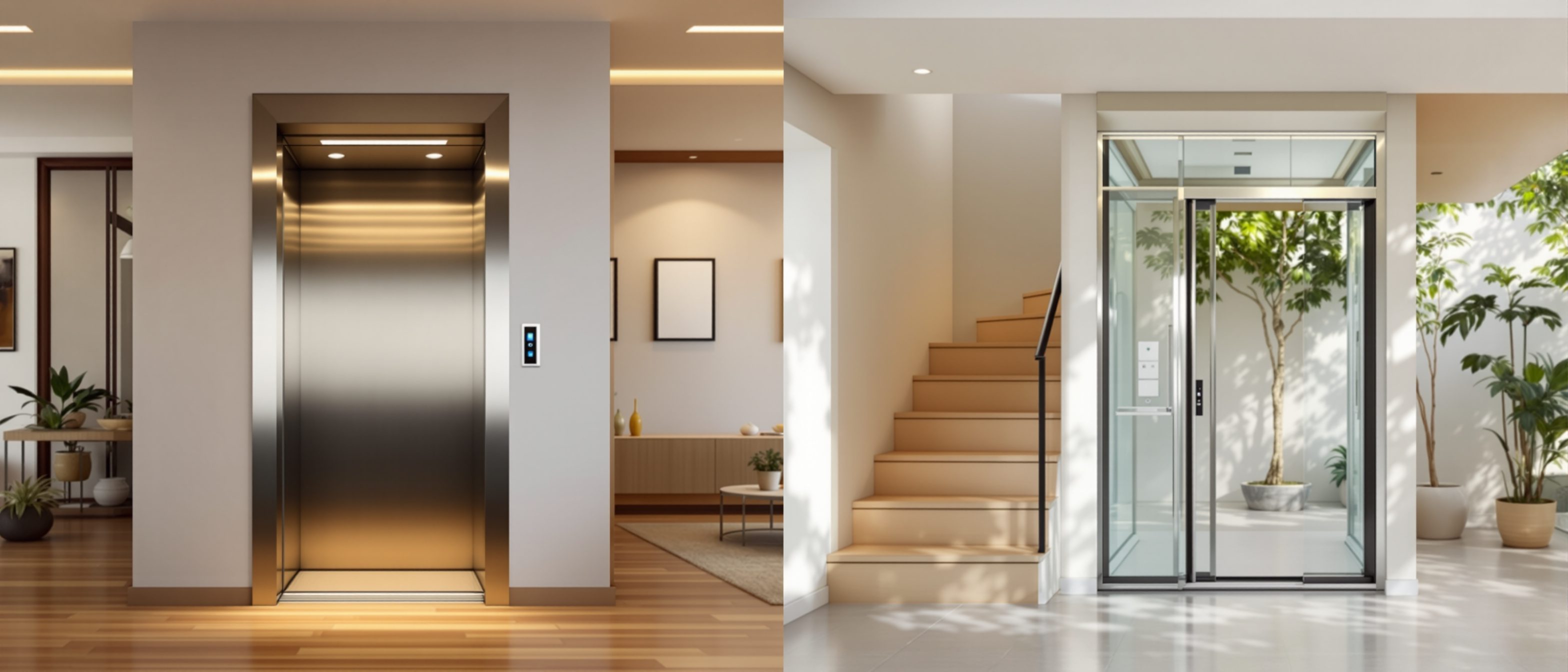
When a home lift moves from "we should add one" to "what should it look like inside," the choice almost always narrows to two finalists: brushed stainless steel or laminated safety glass. They are the two most-specified cabin shells in Indian homes for good reason — both are durable, both photograph beautifully, and both suit a clean, contemporary villa or apartment. But they create completely different experiences. One disappears into the architecture; the other becomes the architecture.
This is a focused head-to-head. If you want the full menu of cabin materials — veneer, stone, mirror, powder-coat, leather — read the broader lift cabin material selection guide. If you are leaning glass and want the deep version (panoramic engineering, tints, privacy films, PVE cabins), read the glass elevator design guide. This page does one job: helps you pick stainless steel vs glass for your home, then sends you off to decide finishes.
Steel is the finish you stop noticing. Glass is the finish your guests notice first. Both are right — for different homes.
The two contenders, honestly
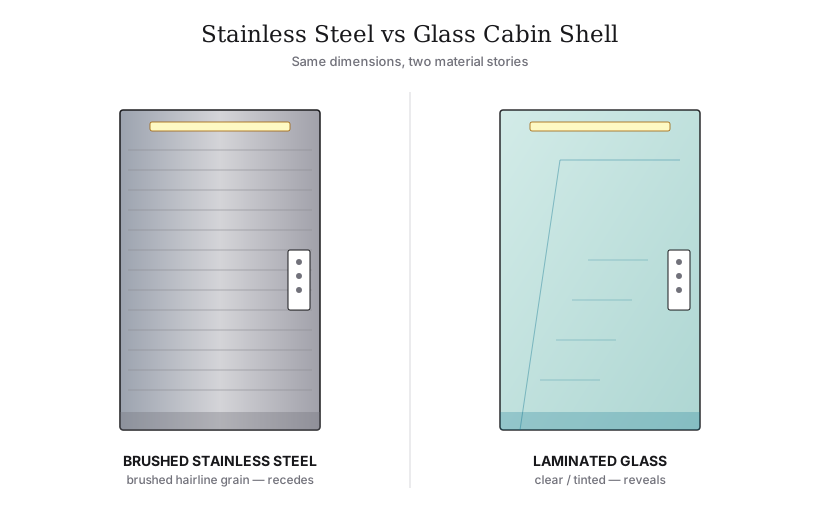
Stainless steel in a modern Indian home is not the mirror-polished lift of a 1990s office tower. The contemporary default is brushed / hairline / matte steel — a soft satin grain that reads calm and expensive, resists fingerprints, and hides the small scuffs of daily family use. It is neutral, it ages well, and it asks nothing of you. It is the cabin that lets a wooden floor, a stone wall or a gold handrail be the hero.
Glass means laminated or tempered safety glass — clear, tinted, or frosted. A glass cabin (square traction-style or cylindrical pneumatic/PVE) turns a vertical commute into a small event: you watch the stairwell, the courtyard or the garden slide past. In a compact home it is genuinely transformative — the shaft stops feeling like a box and starts feeling like a window. The trade is that glass is honest: it shows everything, including itself when it needs cleaning, and it gives you nowhere to hide.
The head-to-head table
This is the heart of the guide. Read across each row, then weight the rows that matter to your home.
| Factor | Brushed stainless steel | Laminated / tempered glass |
|---|---|---|
| Look and feel | Calm, neutral, contemporary "clean" default; recedes | Open, dramatic, makes the ride a visual experience; statement |
| Sense of space | Solid walls — cabin feels its actual size | Transparent — small cabins and homes feel noticeably larger |
| Daylight | Reflects ambient light but blocks none and adds none | Borrows daylight from stairwell / courtyard / garden; bright |
| Privacy | Fully private by default | Low by default; needs frosting, tint, film or smart-glass for privacy |
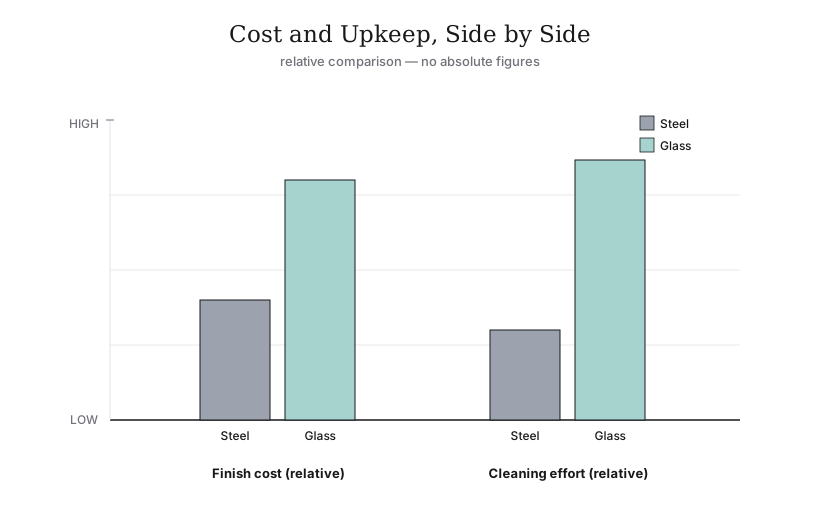
| Cost (finish premium) | Lower / mid — the cost-effective contemporary baseline | Higher — safety glass, framing and panoramic engineering add up |
| Durability | Excellent; shrugs off knocks and daily wear | Tough safety glass, but edges/fittings need care; respect load limits |
| Scratch resistance | Good; brushed grain disguises fine scratches | Surface scratches show and cannot be "blended" out |
| Fingerprints / smudges | Brushed/matte hides them well (avoid mirror polish) | Shows every fingerprint, palm-print and water spot |
| Cleaning effort | Low — wipe along the grain occasionally | High — frequent streak-free glass cleaning to keep the magic |
| Best room / placement | Anywhere; service-adjacent, family lift, neutral interiors | Hero placement — by a staircase, atrium, courtyard or feature wall |
| Maintenance over time | Forgiving; minor scuffs vanish into the grain | Unforgiving cosmetically; demands routine attention |
Cost notes are relative, not rupee figures — finish choices sit on top of the base lift price. For real numbers see the home lift cost guide; always treat any quote as indicative and confirm with your vendor.
How each one wins (and loses), row by row
Sense of space and daylight
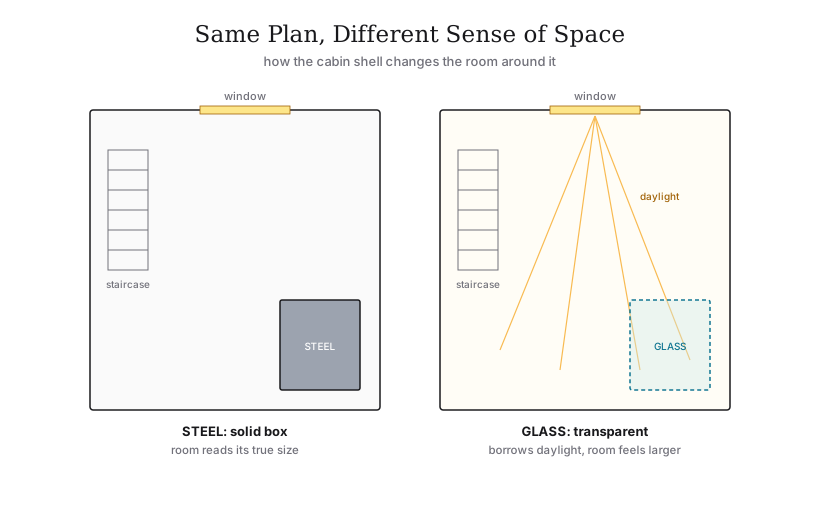
This is glass's home turf. In a narrow stair-core or a compact 2–3 storey home, a glass cabin removes the visual "wall" and lets the eye travel — the lift reads as part of the room, not an intrusion into it. Position it beside a stairwell window or an internal courtyard and it borrows that daylight on every floor. Steel cannot do this; it is opaque by definition. What steel can do is reflect and bounce the light already in the cabin, which keeps it from feeling dark — but it never makes a small home feel bigger the way glass does.
Privacy
Steel wins on privacy without you having to think about it — the walls are solid, full stop. Glass starts from zero privacy, which is fine in a private home shaft but awkward where the cabin passes a guest area, a neighbour's sightline or a bedroom landing. The fix is real and well-proven — frosted or tinted glass, an applied privacy film, or switchable smart glass that turns opaque at the touch of a button — but each is an added cost and a decision. If "I never want to think about who can see in" is a priority, that points to steel.
Cost
Steel is the cost-effective contemporary baseline; glass is the premium move. Safety glass, its framing, and (for true panoramic or cylindrical PVE cabins) the engineering and shaft treatment all push toward the upper finish bands. Neither is a fixed number — both ride on top of your base lift price and vary by vendor, capacity and city. Don't anchor on any figure you read online; get it in your quote and read what the finish line item actually includes.
Durability, scratches and fingerprints
Both are built to last. Steel is simply more forgiving cosmetically: the brushed grain absorbs fine scratches and disguises the inevitable knocks of trolleys, suitcases and kids. Glass is structurally tough — it is laminated/tempered safety glass, not a pane from a window — but a surface scratch on glass shows and stays, and you cannot blend it into a grain. On fingerprints the gap is widest: matte steel hides them; glass advertises them. This is also why you should avoid old-style mirror-polished steel — it inherits glass's smudge problem without glass's payoff.
Maintenance and cleaning, realistically
A glass cabin is gorgeous on day one and on the day after you cleaned it — and it asks for that cleaning often. Smudges, water spots and the haze of daily handling are visible, so a glass lift you don't keep up actually looks worse than a steel one in the same state. Steel rewards neglect: an occasional wipe along the grain and it looks the part. Be honest with yourself about who in the house will keep the glass streak-free before you commit to it.
Match the cabin to the home
| Your situation | Lean toward |
|---|---|
| Compact home, want it to feel bigger | Glass |
| Lift sits beside a staircase / atrium / courtyard | Glass (panoramic) |
| Statement piece, you want guests to notice it | Glass |
| Busy family, kids, trolleys, suitcases | Steel |
| You won't commit to frequent cleaning | Steel |
| Privacy near bedrooms / guest areas | Steel (or frosted/smart glass) |
| Neutral interior, want the floor or art to be the hero | Steel |
| Tight finish budget, contemporary look | Steel |
| Retrofit pneumatic vacuum (PVE) lift | Glass (it's the native PVE look) |
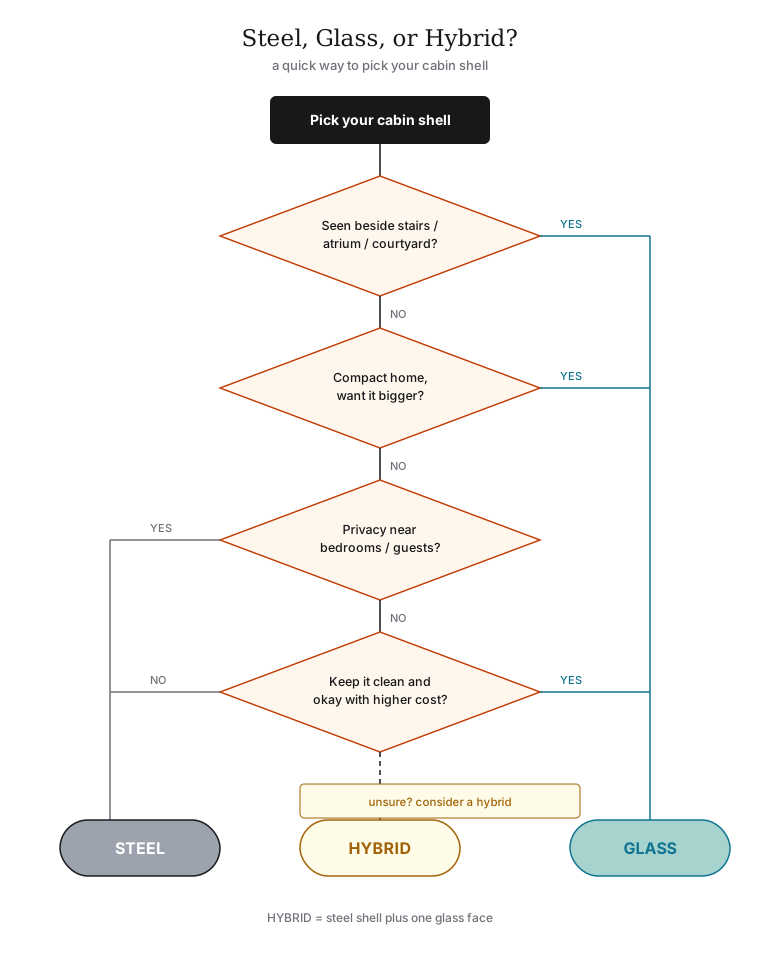
You are not strictly limited to one. A very common, satisfying middle path is a hybrid: brushed-steel structure and frame with a single glass panel — typically the rear wall or the door — so you get one open, light-filled face plus the durability and privacy of steel everywhere else. That sidesteps most of the cleaning burden while keeping much of the drama.
A note on flooring, lighting and safety — whatever you choose
The cabin shell is one decision; the floor, ceiling and doors finish the look. Use an anti-slip floor regardless — textured vinyl, granite/stone or a wood-look surface — because a slick floor is a hazard in a small moving box. Light it well: an even LED ceiling panel as the default, with cove or indirect LED strips for a softer glow, and pick a colour temperature that suits the mood (warm ~2700–3000K for cosy, cool ~4000K for crisp). Glass cabins especially come alive with good lighting because the light reads through them. For the full treatment see home lift lighting design and the designer elevator doors guide.
On safety, two points apply to both: any glass used must be laminated/tempered safety glass (this is non-negotiable and standard practice — never plain glass in a cabin), and if anyone in the household uses a wheelchair, prioritise an automatic sliding door with ≥900 mm clear width and a rear mirror or glass panel to reverse out, per the CPWD Harmonised Guidelines and the spirit of the RPwD Act 2016. Glass's transparency can actually help here — sightlines and orientation are easier. See accessible home design and the lift specification checklist.
The verdict
Choose stainless steel if you want a calm, contemporary cabin that recedes and lets the rest of your interior shine; you have a busy household with kids, trolleys and daily wear; you don't want to commit to frequent cleaning; privacy matters near bedrooms or guests; or you're keeping the finish budget tight. Brushed/matte steel is the low-drama, low-maintenance, never-wrong default — and that is a compliment.
Choose glass if the lift sits where it can be seen — beside a staircase, atrium, courtyard or garden — and you want it to be a feature, not a fixture; your home is compact and you want it to feel larger; you're installing a pneumatic vacuum (PVE) cabin where glass is the native look; and you (genuinely) will keep it clean and are happy to spend a little more on the finish and on privacy treatment where needed.
Choose a hybrid — steel shell, one glass face — if you want most of the openness with most of the durability, which for many Indian homes is the smartest answer of all.
Whichever shell you pick, the deeper finish decisions — veneers, trims, handrails, RAL colours, lighting scenes — are where a cabin becomes yours. Start with the modern home lift design ideas, browse premium lift finishes and luxury home elevator interiors, and ground the whole project in the residential elevator buyer's guide.
References
- Brio Elevators — Custom elevator cabins: materials, finishes and lighting: https://brioelevators.com/blog/custom-elevator-cabins-materials,-finishes-lighting
- Elite Elevators — Top classic home elevator styles for Indian homes: https://www.eliteelevators.com/blog/top-classic-home-elevator-styles-for-indian-homes/
- Nibav — Best home elevators in India 2026 (pneumatic vacuum / panoramic glass cabins): https://www.nibavlifts.com/blog/best-10-home-elevators-in-india/
- IS 14665 Part 1 — Electric traction lifts, outline dimensions (BIS): https://law.resource.org/pub/in/bis/S05/is.14665.1.2000.pdf
- CPWD / MoHUA Harmonised Guidelines and Space Standards for a Barrier-Free Built Environment (accessible-lift door width, rear mirror): https://www.cpwd.gov.in/Publication/Harmonisedguidelinesdreleasedon23rdMarch2016.pdf
- RPwD Act 2016 (Rights of Persons with Disabilities, accessibility benchmark): https://ssepd.odisha.gov.in/sites/default/files/2024-01/RPWD%20ACT.pdf
Export this guide
Related Guides — Deep-dive reading
Glass Elevator Design for Indian Homes: Panoramic, Tinted and Frosted
How laminated safety glass, the clear-tinted-frosted choice and panoramic PVE versus square glass cabins make a compact Indian home feel larger and turn the ride into an experience.
Home Lifts & AccessibilityLift Cabin Material Selection Guide (India): Steel, Glass, Wood, Laminate and Stone
A practical decision framework for choosing your home lift cabin material — compared on look, durability, maintenance, weight, cost and best-fit home style.
Home Lifts & AccessibilityPremium Lift Finishes Guide (India): Brass, Leather, Veneer and Stone
A curated catalogue of high-end home-lift cabin finishes — the look each gives, where to use it, how it ages in Indian conditions and its cost tier.
Home Lifts & AccessibilityRelated Tools — Try Free
Home Lift Cost Calculator
All-in home lift cost by floors, type, capacity and city — equipment, civil, GST and AMC, with a drive-type comparison.
Lift CalculatorAccessibility Compliance Calculator
Check a planned lift against the CPWD and RPwD accessible-lift benchmarks for a score.
Lift CheckerFalse Ceiling Cost Estimator
Live ₹/sqft across 8 ceiling types — POP, gypsum, designer, metal, PVC, wooden — with cove and spot lighting for 20 Indian cities.
Cost Calculator