
Home Lift Lighting Design (India): LED Panels, Cove Light and Mood
How to light a home-lift cabin well — the even LED ceiling panel, soft cove glow, accent spotlights and backlit panels, warm-versus-cool colour temperature, dimmable scenes, and the safety layer that keeps the light on in a power cut.
A home lift is one of the smallest rooms in the house — and, for a few seconds at a time, one of the most intimately lit. Step inside and the light is right above your head, wrapping a space barely larger than a wardrobe. Get it right and the cabin feels calm, expensive and effortless; get it wrong and the same cabin reads like a service lift: flat, glaring, clinical. Home lift lighting is the cheapest, most transformative lever you have over how the ride feels, and it costs a fraction of the finishes it flatters.
This guide is about lighting the cabin well — the even, efficient LED ceiling panel that should be your default, the cove strips that add a soft ambient glow, the spotlights and backlit panels that bring drama, and the colour-temperature and dimming decisions that set the mood. It also covers the part homeowners forget until a power cut: lighting that stays safe — glowing on emergency backup, gentle on ageing eyes, glare-free for a parent with a walking frame.
Finishes get the credit, but light does the work. The same brushed-steel cabin can feel like a boutique hotel or a hospital corridor depending entirely on what is glowing above your head.
For where lighting sits within the wider cabin scheme, read it alongside our lift cabin material selection guide, the premium lift finishes guide, and the luxury home elevator interiors guide. For the smart-control layer — scenes, app dimming, auto cut-off — see the smart home lift design guide. New to the whole purchase? Start at the residential elevator buyer's guide.
Start with the ceiling: the LED panel as default
Almost every well-designed home cabin begins with one thing overhead — a flush LED ceiling panel. It is the workhorse: even, shadow-free illumination across the whole floor, long-life, energy-sipping, and slim enough to disappear into the ceiling line. There is no bulb to replace every monsoon, no hot spot, no buzzing tube. For most homes, a good LED panel alone is a complete, comfortable lighting scheme.
The reason it works is evenness. A single bright downlight in a 1-metre-square cabin throws a harsh pool of light in the middle and leaves the corners in shadow — unflattering, and genuinely unhelpful when someone is feeling for the handrail. A diffused panel washes the whole car uniformly, which is exactly what you want in a space people enter, turn around in, and exit within seconds.
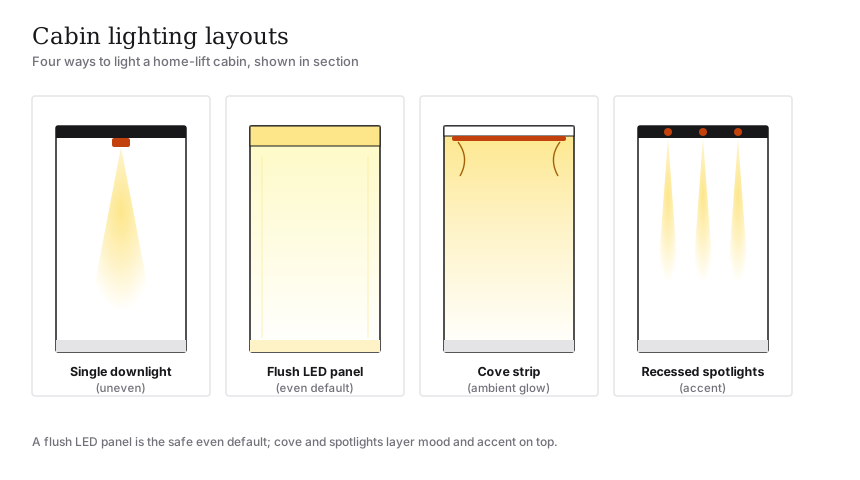
Treat the panel as your baseline and layer the more theatrical options on top — never instead of it. A cabin lit only by cove strips or only by spotlights looks moody in photos and feels gloomy in use.
Cove and indirect light: the soft glow that reads as "premium"
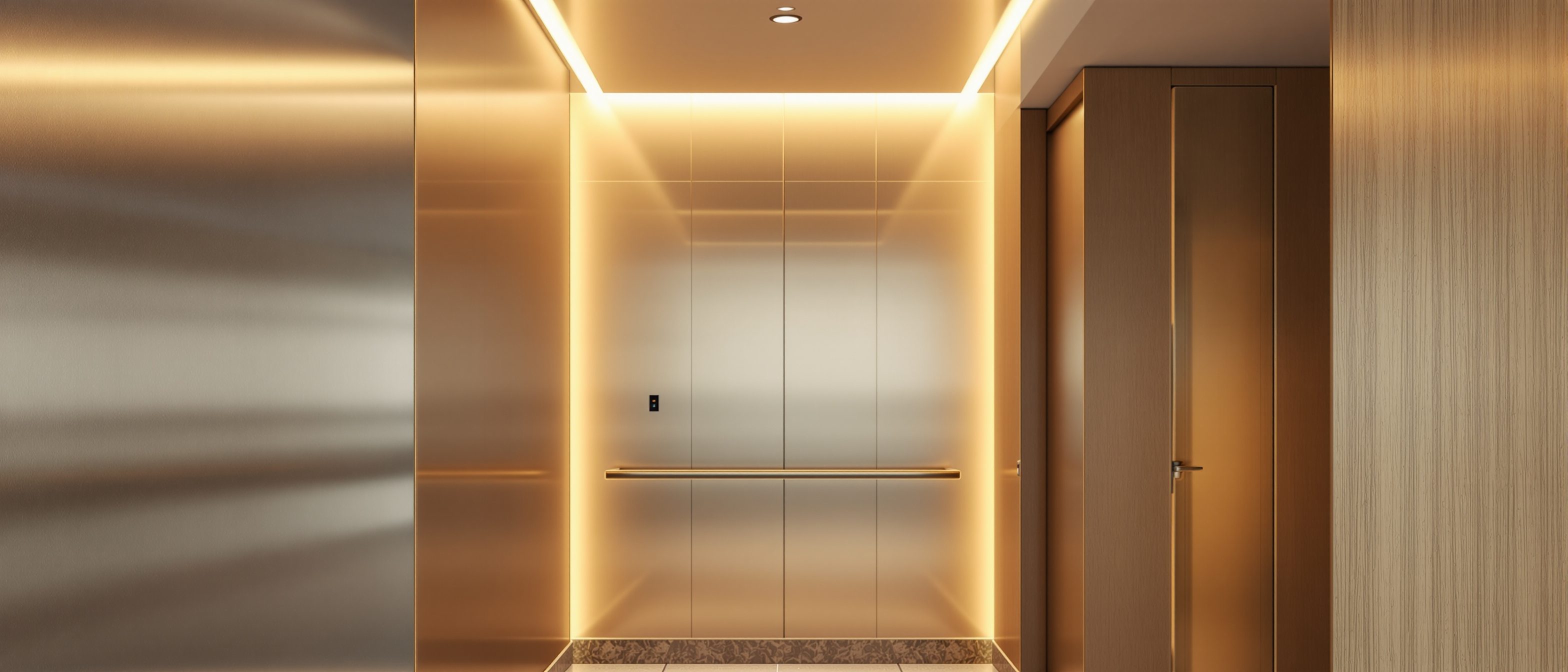
If one upgrade quietly signals a designer cabin, it is indirect cove lighting — a continuous LED strip tucked into a recess along the ceiling edge or the top of the wall panels, hidden from direct view so you see the glow, not the source. The light grazes up and across the surfaces, softening every edge and giving the small box a sense of height and warmth that a flat panel alone cannot.
Cove light works on a simple principle: bounce, don't beam. Because the strip is concealed behind a lip and the light reflects off the ceiling or wall before reaching your eye, there is no glare and no visible diode line — just a halo around the perimeter. On a brushed-steel or wood-veneer wall it reads as genuinely luxurious; on a glass cabin it can trace the frame and turn the ride into a small lightshow.
A few things make cove lighting succeed rather than disappoint:
- Hide the source completely. The recess lip must conceal the strip from every standing eye-line. A visible diode dot-line cheapens the whole effect.
- Mind the strip density. Closely spaced LEDs (high LEDs-per-metre) give a continuous ribbon; sparse strips show a "dotted" line through a diffuser.
- Match the colour temperature to the panel. A warm cove behind a cool panel looks like a mistake. Pick one mood (see below) and commit.
- Keep it serviceable. Strips do eventually fail; the channel should allow a replacement without dismantling the ceiling.
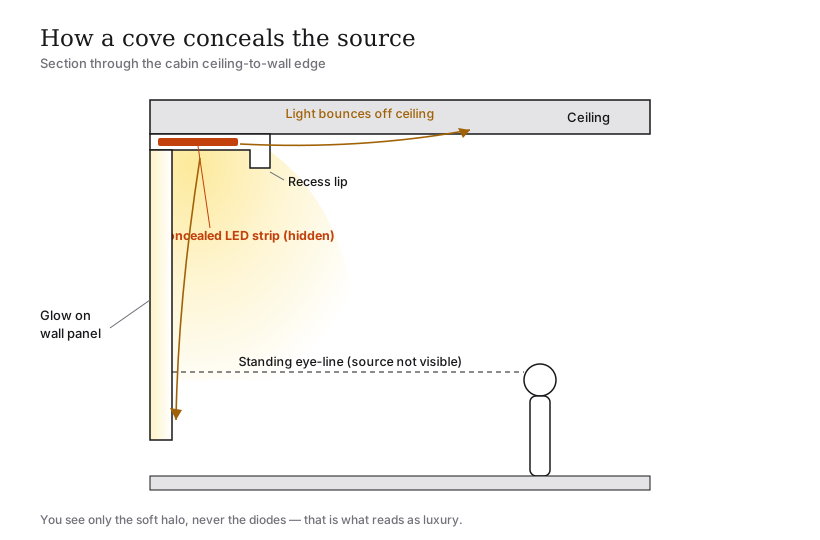
The test of good cove lighting is that you can't find the light. You see a warm halo around the ceiling and the wall seems to glow on its own — and you never once spot the strip making it happen.
Spotlights and backlit panels: accent and drama
Where the panel gives you general light and the cove gives you ambient glow, spotlights and backlit panels give you accent — the deliberate highlights that make a cabin feel composed rather than merely lit.
A small array of recessed spotlights can pick out a feature wall, graze a fluted-glass or stone panel to reveal its texture, or frame a handrail. The trick is restraint: a couple of well-aimed accents read as design; a ceiling peppered with downlights reads as an office. Spotlights are accent on top of the panel, not a replacement for it.
Backlit panels are the more theatrical move — a translucent surface (frosted or back-painted glass, onyx-look stone, a perforated metal screen) lit from behind so the whole panel becomes a soft, glowing plane. A backlit rear wall or a luminous strip beside the car-operating panel turns the lift into a small lit object and pairs beautifully with the back-painted and fluted glass finishes covered in the premium lift finishes guide. It is also one of the signature looks in our contemporary elevator design trends guide.
These accent layers are where lighting and finish merge, so plan them with the cabin material from the start rather than bolting them on later.
The lighting-options table
Think of cabin lighting as a kit of four parts you mix to taste. Here is how they compare — what each does, where it belongs, and roughly how efficient and long-lived it is. (Energy and life are LED-typical; indicative — confirm exact wattage and lifespan with your vendor.)
| Lighting type | Effect / mood | Where it belongs | Efficiency and life |
|---|---|---|---|
| Flush LED ceiling panel | Even, shadow-free, neutral — the comfortable baseline | Default in every cabin; the main light source | Very efficient; long life (often 25,000–50,000 hr LED-typical) |
| Indirect / cove LED strip | Soft ambient halo; adds warmth and perceived height; "premium" cue | Recessed along ceiling edge or top of wall panels | Efficient; long life if quality strip + good heat channel |
| Recessed spotlights | Focused accent; grazes texture, highlights a feature wall or handrail | Sparingly, as accent over the panel | Efficient; long life; can run warm if poorly ventilated |
| Backlit translucent panel | Glowing plane; theatrical, signature luxury look | Rear wall, side feature panel, or beside the control panel | Moderate (lights a larger area); life depends on strip quality |
| Emergency / ARD-backed light | Stays on during a power cut; safety, not mood | Mandatory layer alongside any of the above | Low draw; runs off the rescue battery |
The last row is not optional — more on it below.
Choosing colour temperature: warm versus cool
Colour temperature — measured in kelvin (K) — is the single biggest decision in cabin lighting, and it is purely about the feeling you want.
- Warm white (~2700–3000 K) is golden and cosy. It flatters wood veneer, brass and bronze trims, leather panels and stone, and makes the cabin feel like an extension of a softly-lit Indian home. This is the right default for villas, premium residences and anything with warm or natural finishes.
- Neutral / cool white (~4000 K) is crisp and contemporary. It sharpens brushed stainless steel, glass and white or grey panels, and reads as clean and modern. It suits minimalist, gallery-like and tech-forward cabins.
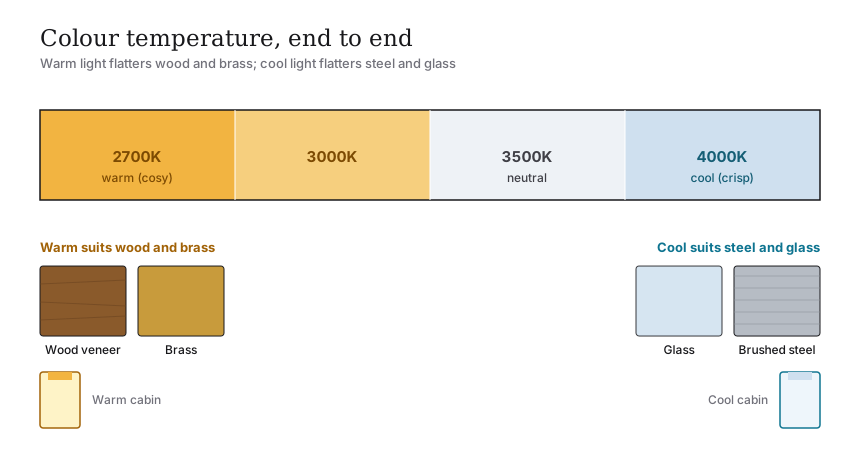
Two rules keep you out of trouble. First, match the light to the finish, not to fashion — cool light on warm wood drains the warmth; warm light on cool steel can look dingy. Second, be consistent across every layer: panel, cove and spotlights should share one colour temperature unless you are deliberately using a warmer accent. A jumble of temperatures in a one-metre box is instantly, subtly wrong.
Pick warm for cosy, cool for crisp — then commit. The cabin's mood is decided in kelvin long before anyone notices the finish.
Dimming and lighting scenes on premium cabins
On premium and smart cabins, lighting stops being a single "on" and becomes a set of scenes. Dimmable LEDs let the same cabin shift from a bright, practical daytime setting to a low, warm evening glow; tunable-white fixtures can even slide the colour temperature cooler by day and warmer at night. Tie this into the cabin's smart controls — touch panel, mobile app or voice — and you have a lift that reads the time of day.
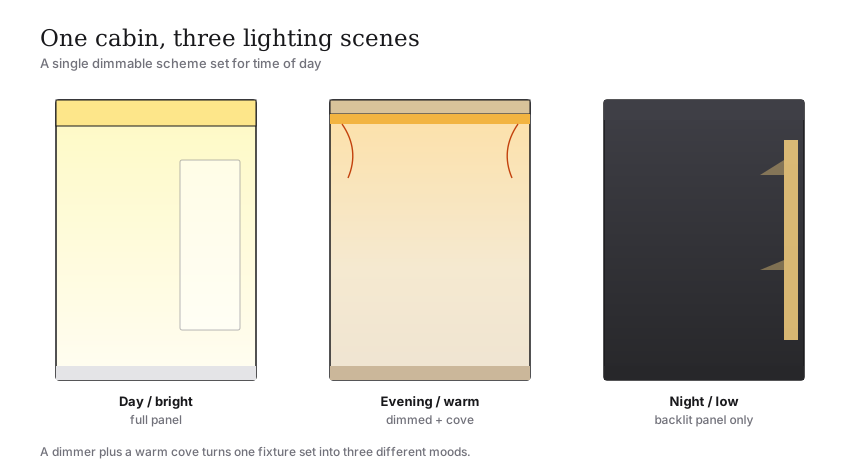
Typical scene presets people actually use:
- Day / bright — full panel, neutral-to-cool, for everyday clarity and safety.
- Evening / warm — dimmed panel plus warm cove glow, for a softer arrival home.
- Night / low — backlit panel or cove only at low level, enough to see by without a jarring blaze at 2 a.m.
- Showcase — accents and backlit panels lifted, for when the lift is part of welcoming guests.
The control logic for these scenes — app, touch and touchless dimming — lives in the smart home lift design guide, and the scene-led look is one of the headline moves in our modern home lift design ideas guide. Scenes sit firmly on the upper finish bands; for how lighting and finish choices stack onto the base price, see the home lift cost guide and frame any figure as indicative — confirm with your vendor.
Energy efficiency and lifespan
LED is the only sensible choice, and not only for looks. A modern cabin lit by LED panels and strips draws a small fraction of the power of older halogen or fluorescent cabins, runs cool (which matters in a closed box during an Indian summer), and lasts for years rather than months between replacements — LED service life is typically many tens of thousands of hours, indicative — confirm with your fixture supplier.
Pair efficient fixtures with sensible controls. Cabin lighting that switches to a low standby or cuts off entirely when the lift is idle — a standard energy-saving feature on smart cabins, often bundled with auto fan cut-off — saves power and extends fixture life across a decade of small daily trips. Choose drivers and strips rated for continuous use and easy replacement; the cheapest strip is rarely the one that survives five monsoons.
The safety layer: emergency light and senior-friendly lighting
Lighting in a lift is never only aesthetic — it is a safety system, and India's power supply makes that literal.
Emergency light on a power cut. The same battery-backed Automatic Rescue Device (ARD) that brings the car to the nearest floor and opens the doors during an outage must also keep a light on inside the cabin. Being stalled mid-floor is unpleasant; being stalled in total darkness is frightening, especially for a child or an older relative. An emergency cabin light (plus the alarm and intercom) is a non-negotiable layer — never specify a beautiful lighting scheme without confirming it stays lit when the grid drops. The ARD itself is treated as essential across the lift specification checklist.
Even, glare-free light for seniors. If the lift exists partly so an ageing parent or a wheelchair user can move between floors — the whole premise of our accessible home design guide — then the lighting must serve them. Older eyes need more light but are far more sensitive to glare. That argues for the same evenly-diffused panel we started with: bright enough to read the control buttons and find the handrail, with no bare bright source to dazzle. Steady, flicker-free LEDs help anyone prone to discomfort, and a well-lit, evenly-illuminated rear mirror genuinely helps a wheelchair user reverse out safely.
Good cabin lighting, in other words, is where mood and safety meet: the diffuse, warm-but-bright, glare-free scheme that feels welcoming is the very same one that is kindest to a senior and clearest in an emergency.
The most beautiful lighting you can put in a home lift is also the safest: even, glare-free, and still glowing when the power goes out.
Bringing it together
Start with a flush LED panel for even, efficient light. Add a concealed cove strip for the soft glow that reads as premium. Use spotlights and a backlit panel sparingly for accent and drama. Pick one colour temperature — warm for cosy, cool for crisp — and carry it across every layer. On premium cabins, dim it into day, evening and night scenes through the smart controls. And underneath all of it, keep the safety layer honest: a light that stays on through a power cut, and an even, glare-free wash that an older relative can trust.
Lighting is the smallest line item in a home lift and the one your family will feel every single day. Spend your attention here.
References
- Brio Elevators — Custom elevator cabins: materials, finishes and lighting: https://brioelevators.com/blog/custom-elevator-cabins-materials,-finishes-lighting
- Elite Elevators — Top classic home elevator styles for Indian homes: https://www.eliteelevators.com/blog/top-classic-home-elevator-styles-for-indian-homes/
- Nibav — Best home elevators in India 2026: https://www.nibavlifts.com/blog/best-10-home-elevators-in-india/
- IS 14665 Part 1 — Electric traction lifts, outline dimensions (BIS): https://law.resource.org/pub/in/bis/S05/is.14665.1.2000.pdf
- IS 14665 Part 2 — Code of practice for installation, operation and maintenance (BIS): https://law.resource.org/pub/in/bis/S05/is.14665.2.1-2.2000.pdf
- CPWD / MoHUA Harmonised Guidelines and Space Standards for a Barrier-Free Built Environment (2016): https://www.cpwd.gov.in/Publication/Harmonisedguidelinesdreleasedon23rdMarch2016.pdf
- RPwD Act 2016 (full text): https://ssepd.odisha.gov.in/sites/default/files/2024-01/RPWD%20ACT.pdf
Export this guide
Related Guides — Deep-dive reading
Premium Lift Finishes Guide (India): Brass, Leather, Veneer and Stone
A curated catalogue of high-end home-lift cabin finishes — the look each gives, where to use it, how it ages in Indian conditions and its cost tier.
Home Lifts & AccessibilitySenior Citizen Safety Features in Home Elevators (India)
The cabin and control features that make a home lift genuinely safe and easy for an older person — automatic doors, level entry, handrail, fold-down seat, reachable contrasting controls, ARD and an alarm pendant.
Home Lifts & AccessibilityLED Bathroom Mirror India: Backlit vs Front-Lit, Colour Temperature, Cost & The Point Behind the Glass
A practical India-first guide to LED and backlit bathroom mirrors — integrated shadow-free face lighting, 2700K-6500K colour temperature and tunable white, halo backlight versus sandblasted front strips, plus the concealed electrical point, IP rating, demister and driver access you must plan behind the mirror before you tile.
BathroomsRelated Tools — Try Free
Circadian Light Meter
Patient-centric circadian lighting visualizer for Indian healthcare design — time-of-day × intensity → CCT, melanopic lux (EML / mEDI), melatonin suppression, and an alertness curve. Calibrated against WELL v2 L03 Circadian Lighting Design, CIE S 026:2018, Brainard 2001, and Lucas et al. 2014.
Circadian ToolAccessibility Compliance Calculator
Check a planned lift against the CPWD and RPwD accessible-lift benchmarks for a score.
Lift CheckerLift Safety Audit Checklist
Interactive checklist that scores your home lift on safety devices, compliance and upkeep.
Checklist