
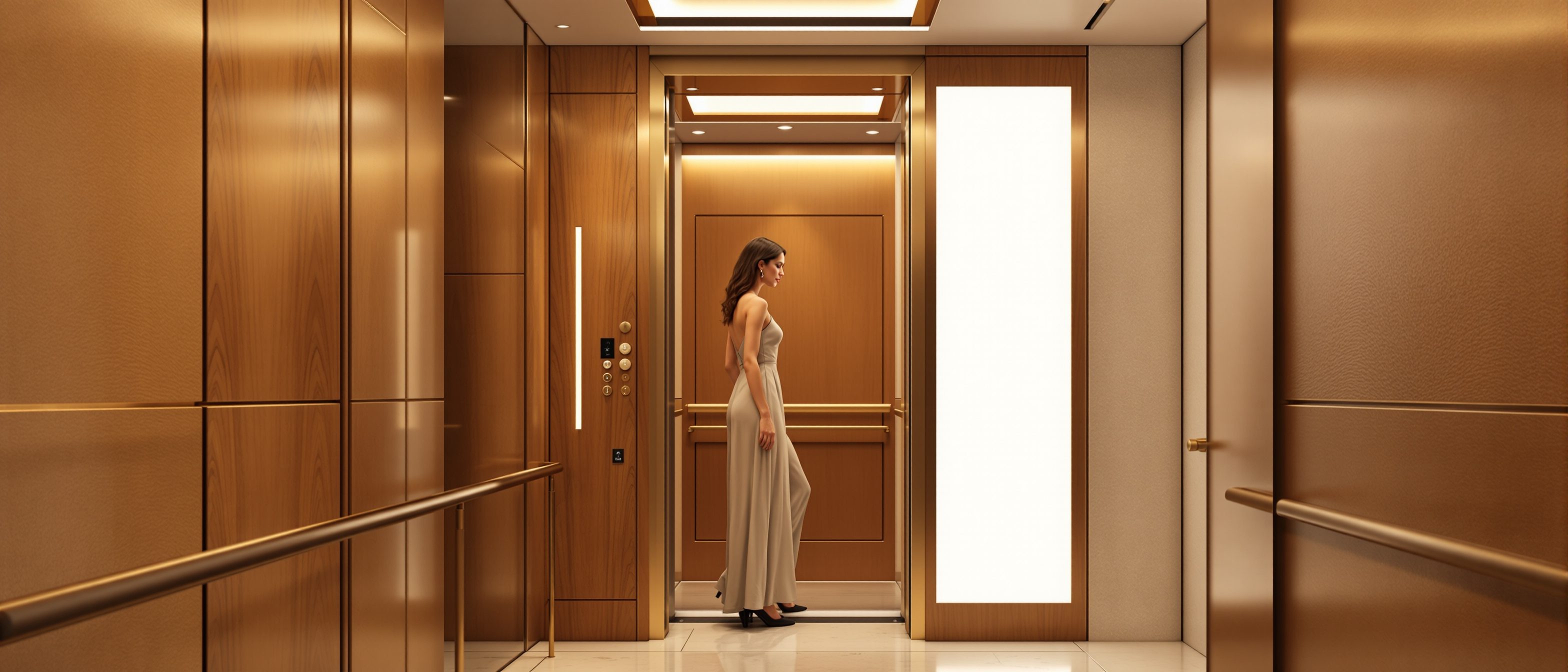
Premium Lift Finishes Guide (India): Brass, Leather, Veneer and Stone
A curated catalogue of high-end home-lift cabin finishes — the look each gives, where to use it, how it ages in Indian conditions and its cost tier.
There is a moment, somewhere between deciding yes, we are putting in a home lift and actually living with it, when the conversation stops being about pits and rails and starts being about feel. The cabin is, after all, a tiny room you step into several times a day. In a luxury home it deserves the same finish vocabulary as a powder room or a bar nook — brushed brass, soft leather, figured veneer, honed stone, fluted glass. This guide is that vocabulary: a curated catalogue of the premium finishes worth knowing about, what each one does to a cabin, how it ages in real Indian conditions, and roughly where it sits on the cost ladder.
It is deliberately a material and finish catalogue. If you want the whole cabin composed as a designed room — proportion, ceiling, the lift as a centrepiece — read Luxury Home Elevator Interiors. If you want the lift treated as a statement object inside a luxury residence — placement, the panoramic moment, automation — read Lift Design in Luxury Residences. Here we stay on the surfaces themselves.
A cabin is the smallest room in the house and the one your hands touch most. Choose finishes the way you would for a jewel box, not a corridor.
How to read a premium finish
Before the swatches, four lenses to hold every finish up against. Skip none of them — the prettiest sample in the showroom can be the worst choice for a south-facing villa with three children and a Labrador.
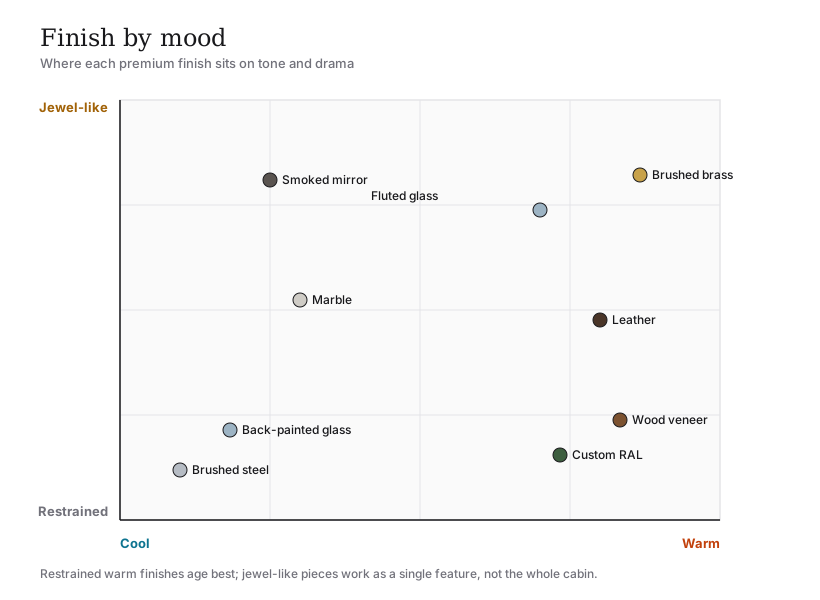
- The look it gives — warm or cool, restrained or jewel-like, matte or reflective. A finish sets the mood of a 1.2 m by 1.2 m room instantly.
- Where to use it — back wall, side panels, full wrap, threshold, ceiling, handrail. Most premium cabins are layered: a hero surface plus quiet supporting ones, not one material everywhere.
- Maintenance reality — fingerprints, water spots, scratching, humidity, sunlight fade. India is hot, humid in monsoon, dusty in summer. A finish that looks flawless in a Milan catalogue may struggle in a coastal Kerala home.
- Cost tier — every finish here sits on top of the base lift price. We use three bands (Accessible-premium, Premium, Bespoke) and deliberately quote no rupee figures for finishes, because they swing wildly by vendor, area and customisation. For the base lift and how finishes push you up the bands, see Home Lift Cost in India 2026. Treat every cost cue here as indicative — confirm with your vendor.
The premium finishes, one by one
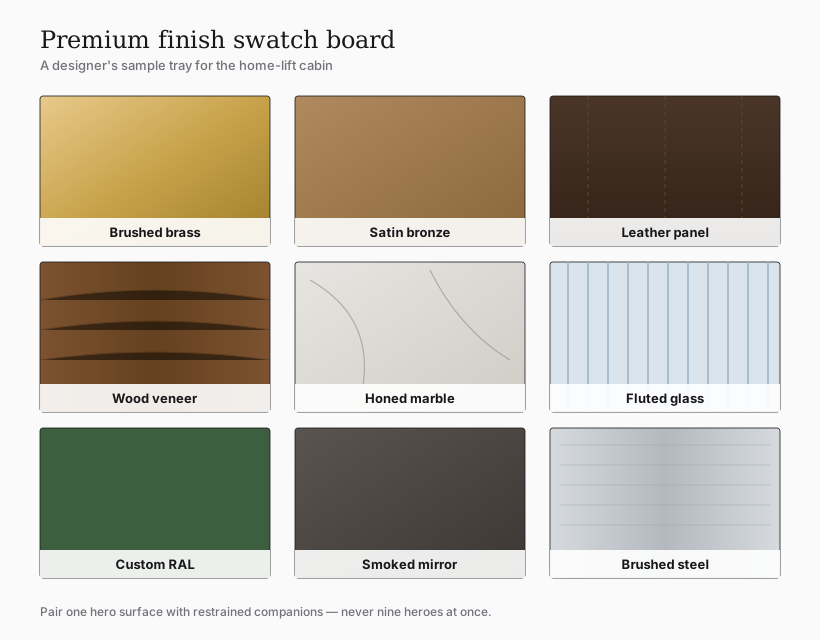
Brushed brass, bronze and champagne-gold trims
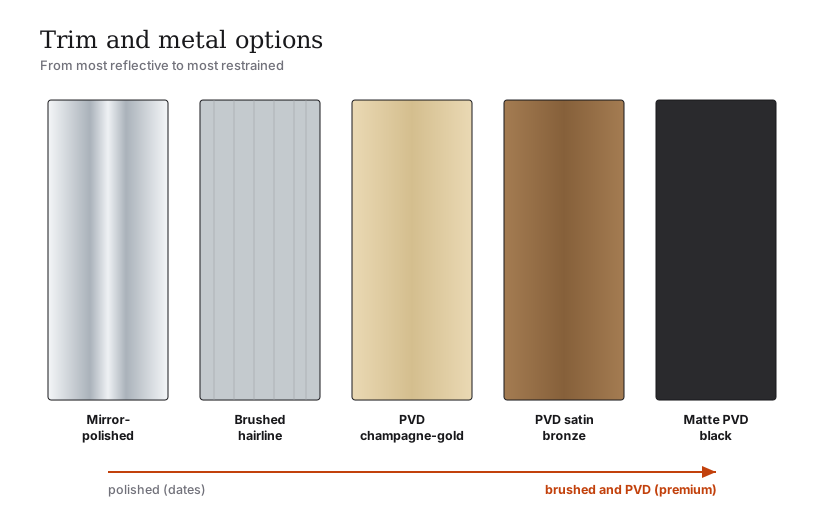
The single most recognisable luxury cue in a 2026 cabin is not gold-plated mirror — that look has dated — it is restrained brushed metal: brushed brass, satin bronze, or the soft warm-neutral the trade calls champagne-gold. Used as trims — door frames, skirting, the reveal line around a back-painted panel, the handrail — it reads expensive without shouting.
- The look: warmth and jewellery. A thin brushed-brass reveal against a dark veneer wall is the difference between a cabin and a lift.
- Where to use: frames, skirtings, reveals, handrails, button-panel surrounds. As an accent, almost never the whole wall.
- Maintenance: brushed and lacquered finishes resist fingerprints far better than polished. Unlacquered "living" brass will patina over time — beautiful if you want it, a maintenance commitment if you do not. Avoid harsh abrasive cleaners.
- Cost tier: Premium to Bespoke depending on solid metal versus PVD-coated stainless that mimics it.
A practical Indian note: genuine solid brass is heavy and pricey, so many premium cabins use PVD-coated stainless steel in brass/bronze/champagne tones. It gives the colour and the brushed texture at a fraction of the weight, and PVD is genuinely durable. Ask your vendor which they are quoting — the look is similar, the price and longevity are not.
Leather and upholstered panels
Soft panels — stitched leather, faux-leather or fabric-wrapped padding — are the most surprising luxury move and the most tactile. A leather-clad back wall turns the ride into something closer to a chauffeured car interior.
- The look: hospitality, hush, a quiet hotel-suite quality. Upholstery also deadens sound, so the cabin feels calmer.
- Where to use: back wall and side panels at hand and shoulder height. Never the floor, never the threshold.
- Maintenance: the honest part. Real leather in Indian humidity needs conditioning and dislikes direct sun and damp; it can mark. High-grade faux-leather (PU) and contract upholstery fabrics are far more forgiving and often the smarter specification for a home that is actually lived in.
- Cost tier: Premium to Bespoke; bespoke stitching, channel-tufting or contrast piping pushes it up.
Natural wood veneer
Wood is the warmth play, and in a luxury cabin it should be real veneer, not print laminate. Walnut, teak, oak, smoked or fumed veneers, book-matched so the grain mirrors across a panel — this is the finish that makes a cabin feel like it belongs to the house rather than the lift company.
- The look: warmth, calm, the Japandi register that is everywhere in 2026. Pairs beautifully with brushed brass and stone.
- Where to use: side and back panels, sometimes a full three-wall wrap with a metal-and-glass front. Best when it echoes the home's flooring or joinery.
- Maintenance: veneer wants a stable environment — keep it out of direct afternoon sun (fade) and away from standing damp. A matte PU lacquer protects it and is easy to wipe. Good veneer ages gracefully; cheap veneer chips at edges, so insist on quality edge-banding.
- Cost tier: Premium for standard veneers; Bespoke for exotic, book-matched or fluted-timber treatments.
For the deeper trade-offs of veneer versus laminate versus steel versus glass as a cabin substrate, see Lift Cabin Material Selection.
Marble and natural stone
Stone is the heavyweight, literally. Honed marble, granite, or a slim stone-effect sintered panel reads as the most permanent, most architectural finish of all — but it comes with a structural conversation.
- The look: gravitas. A stone floor or a single stone feature wall anchors a cabin and ties it to a stone lobby outside.
- Where to use: flooring above all (it survives footfall and looks magnificent), and as an accent feature panel. Rarely a full wrap.
- Maintenance: marble is porous and stains — it wants sealing and gentle, pH-neutral cleaning. Granite and sintered stone are far more stain- and scratch-resistant and are usually the wiser pick for a working home. All of it must be non-slip underfoot — specify honed or textured, never polished, for the floor (an accessibility and safety point as much as a style one).
- Cost tier: Premium to Bespoke; real marble and the weight-handling it forces sit at the top.
The structural caveat matters in a home lift: stone is heavy, and weight eats into rated capacity. A fully stone-clad cabin can force a larger drive or reduce how many people the car carries. This is exactly why premium cabins use stone as flooring and accents, not as full walls. Talk to your vendor early — see Residential Elevator Buyer's Guide and put it on your Lift Specification Checklist.
Textured, fluted and back-painted glass
Glass is no longer just the panoramic PVE wall. As a finish, specialist glass has become one of the most versatile luxury surfaces — and all of it must be laminated or tempered safety glass (a genuine safety requirement under IS 14665, not a nicety).
- Back-painted glass — colour or metallic lacquer behind clear glass gives a deep, seamless, wipe-clean panel in any custom shade. The easiest-to-maintain premium wall there is.
- Fluted / reeded glass — vertical ribs that catch light and blur what is behind; quietly luxurious, very 2026, and it hides fingerprints better than flat glass.
- Textured / frosted glass — softens light, adds privacy on a panoramic cabin.
- The look: depth, light-play, jewel colour. Fluted glass in particular is the current designer favourite.
- Where to use: feature walls, door vision panels, ceiling diffusers. Back-painted glass makes an excellent low-maintenance back wall.
- Maintenance: flat clear/back-painted glass shows smudges (a quick wipe fixes it); fluted and frosted disguise them well. All of it is easy to clean and unaffected by humidity — a genuine Indian advantage.
- Cost tier: Accessible-premium for standard back-painted; Premium to Bespoke for fluted, curved or custom-printed glass.
For when glass becomes the whole cabin rather than a finish, see Glass Elevator Design and Stainless Steel vs Glass Lift Cabins.
Bespoke and feature mirror
Mirror is the oldest trick for making a small cabin feel large, and in a premium cabin it gets upgraded: antique/smoked mirror, bronze-tinted mirror, or a single full-height feature mirror rather than the cheap all-walls box.
- The look: depth and space, with a vintage-glamour edge if smoked or bronzed.
- Where to use: classically the rear wall — which doubles as an accessibility feature, letting a wheelchair user reverse out safely. A half-height mirror dado is a more restrained option.
- Maintenance: clear mirror shows every smudge and water spot — be honest about who is touching the cabin. Smoked and antique mirror hide marks far better and are the more forgiving luxury choice.
- Cost tier: Accessible-premium for plain mirror; Premium to Bespoke for antiqued/tinted feature mirror.
Brushed and PVD stainless steel
Worth naming even in a premium catalogue, because the restrained version is genuinely high-end. Forget mirror-polished steel (it dates and shows every fingerprint) — the luxury default is brushed, hairline or matte stainless, increasingly in PVD-coloured finishes (champagne, bronze, smoked grey, even matte black).
- The look: clean contemporary; the quiet neutral that lets a veneer or stone accent shine.
- Where to use: anywhere — frames, full panels, ceilings, thresholds. The reliable supporting actor.
- Maintenance: brushed and PVD finishes are the most fingerprint-resistant and lowest-maintenance surfaces in this whole guide. Hard to beat for a busy home.
- Cost tier: Accessible-premium; PVD colours nudge into Premium.
Custom RAL colour and powder-coat
Sometimes the luxury is colour, matched exactly to the home. Powder-coated steel panels in a custom RAL shade — many brands offer sixteen or more standard RAL options, and full custom beyond that — let a cabin pick up a deep green, oxblood, or off-black from the interior palette.
- The look: bespoke, architectural, calm. A matte custom colour can be more luxurious than any metallic.
- Where to use: full panels or as a colour-blocked accent against metal and glass.
- Maintenance: quality powder-coat is tough, even and easy to wipe; just avoid abrasives that scratch the matte.
- Cost tier: Accessible-premium to Premium.
Designer handrails and hardware
The smallest move with the biggest hand-felt impact. A designer handrail — a solid brass rod, a leather-wrapped grip, a sculpted bronze profile — is the one piece of the cabin every passenger actually touches. Premium cabins also upgrade the button panel (brushed-metal surround, backlit or tactile buttons) and the door hardware.
- The look: the jewellery of the cabin; a tactile signature.
- Where to use: one wall, at 800–1000 mm above the floor — and here the style choice doubles as accessibility. CPWD/RPwD best practice asks for a handrail at least 600 mm long near the controls, so a beautiful rail can also be the compliant one.
- Maintenance: lacquered or PVD hardware stays bright; leather-wrapped grips need the same care as leather panels.
- Cost tier: Premium to Bespoke for solid-metal or custom-profile rails.
The premium-finish catalogue at a glance
Use this as your starting shortlist with a vendor. Cost tiers are relative (Accessible-premium, Premium, Bespoke) and sit on top of the base lift price — indicative, confirm with your vendor.
| Finish | The look it gives | Best used as | Maintenance reality (India) | Cost tier |
|---|---|---|---|---|
| Brushed brass / bronze / champagne trims | Warm jewellery, restrained luxury | Frames, reveals, skirting, handrail | Brushed/lacquered resist marks; "living" brass patinas; no abrasives | Premium–Bespoke |
| Leather / upholstered panels | Hushed, hotel-suite hospitality | Back and side panels at hand height | Real leather dislikes humidity/sun; PU and contract fabric far easier | Premium–Bespoke |
| Natural wood veneer | Warmth, Japandi calm, ties to the house | Side/back panels, partial wrap | Keep from direct sun and damp; matte lacquer; insist on edge quality | Premium–Bespoke |
| Marble / natural stone | Gravitas, permanence | Flooring above all; accent panel | Marble seals and stains; granite/sintered tougher; floor must be non-slip; weight cuts capacity | Premium–Bespoke |
| Textured / fluted / back-painted glass | Depth, light-play, custom colour | Feature walls, vision panels, ceilings | Safety glass required; fluted hides marks; humidity-proof | Accessible-premium–Bespoke |
| Bespoke / feature mirror | Space, depth, vintage glamour | Rear wall (also accessibility) | Clear mirror smudges; smoked/antique forgiving | Accessible-premium–Bespoke |
| Brushed / PVD stainless | Clean contemporary neutral | Anywhere; supporting surfaces | The most fingerprint-resistant, lowest-maintenance | Accessible-premium–Premium |
| Custom RAL / powder-coat | Bespoke colour, matte calm | Full panels or colour-block accent | Tough, wipe-clean; avoid abrasives | Accessible-premium–Premium |
| Designer handrails / hardware | The cabin's tactile jewellery | One wall at 800–1000 mm | Lacquered/PVD stay bright; leather grips need care | Premium–Bespoke |
How to combine them — the layering rule
The mistake amateurs make is using one luxury material everywhere. The mistake the cabin makes is reading as a box. Premium cabins almost always follow a simple recipe:
- One hero surface — the wall you see on entering (book-matched veneer, a stone feature, a leather back wall, a fluted-glass panel).
- Quiet supporting surfaces — brushed or PVD steel, back-painted glass, or matte RAL on the remaining walls.
- A metal accent line — brushed brass or bronze trims tying it together.
- One tactile signature — the designer handrail and button panel.
- A considered floor and ceiling — non-slip stone or wood-look flooring, and a lit ceiling (back-painted glass, a back-lit panel, or cove LED). Lighting is what makes every finish above either glow or fall flat — get the colour temperature and layering right by reading Home Lift Lighting Design.
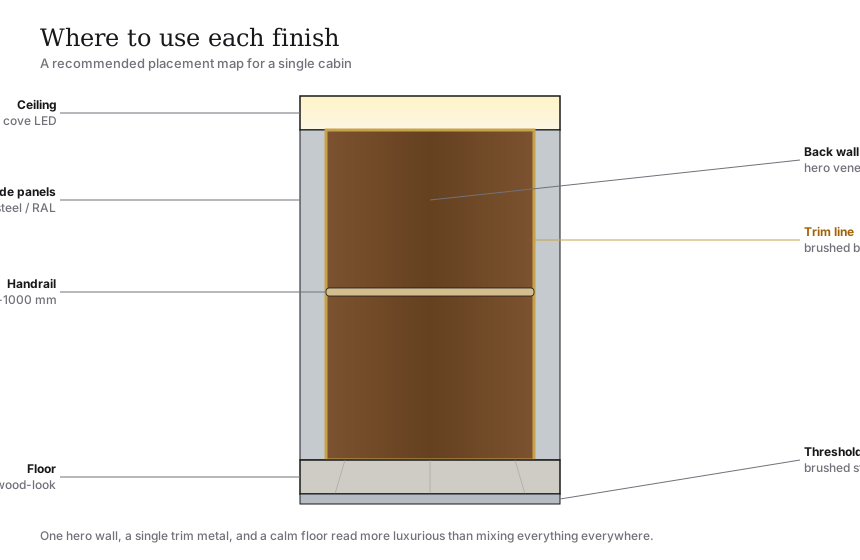
Layer, do not smother. The most expensive-looking cabins use fewer materials than you would guess — one star and a calm supporting cast.
A short word on safety inside the glamour
Premium finishes never override the basics. The floor must be genuinely non-slip whatever it is made of. All decorative glass must be laminated or tempered safety glass per IS 14665. A handrail, however designer, should still sit at the 800–1000 mm height and length that CPWD/RPwD accessibility best practice recommends. Heavy stone must be weighed against rated capacity. And none of the finish talk changes the one non-negotiable in an Indian home: the ARD (Automatic Rescue Device) that brings the car to a floor and opens the doors during a power cut. Beauty first to the eye, safety first to the spec.
Where to go next
- Luxury Home Elevator Interiors — composing the whole cabin as a designed room.
- Lift Design in Luxury Residences — the lift as a statement within a luxury home.
- Lift Cabin Material Selection — the substrate-level material trade-offs.
- Home Lift Lighting Design — making the finishes glow.
- Contemporary Elevator Design Trends and Modern Home Lift Design Ideas — the wider 2026 direction.
- Home Lift Cost in India 2026 — how finishes move you up the cost bands.
- Residential Elevator Buyer's Guide — the full buying pillar.
References
- Brio Elevators — Custom elevator cabins: materials, finishes and lighting: https://brioelevators.com/blog/custom-elevator-cabins-materials,-finishes-lighting
- Elite Elevators — Classic home elevator styles for Indian homes: https://www.eliteelevators.com/blog/top-classic-home-elevator-styles-for-indian-homes/
- Nibav — Best home elevators in India 2026: https://www.nibavlifts.com/blog/best-10-home-elevators-in-india/
- IS 14665 Part 1 (Electric traction lifts — outline dimensions; safety-glass and cabin requirements), BIS: https://law.resource.org/pub/in/bis/S05/is.14665.1.2000.pdf
- IS 14665 Part 3 (Safety rules), BIS: https://law.resource.org/pub/in/bis/S05/is.14665.2.1-2.2000.pdf
- CPWD / MoHUA Harmonised Guidelines and Space Standards for a Barrier-Free Built Environment (handrail height, non-slip floors, rear mirror), CPWD: https://www.cpwd.gov.in/Publication/Harmonisedguidelinesdreleasedon23rdMarch2016.pdf
- RPwD Act 2016 (accessibility benchmark), DEPwD: https://ssepd.odisha.gov.in/sites/default/files/2024-01/RPWD%20ACT.pdf
Export this guide
Related Guides — Deep-dive reading
Lift Cabin Material Selection Guide (India): Steel, Glass, Wood, Laminate and Stone
A practical decision framework for choosing your home lift cabin material — compared on look, durability, maintenance, weight, cost and best-fit home style.
Home Lifts & AccessibilityLuxury Home Elevator Interiors (India): Designing the Cabin as a Room
Compose the five surfaces, palette, lighting and touch of the smallest room in the house
Home Lifts & AccessibilityLift Design for Luxury Residences (India): Panoramic Cabins, Bespoke Finishes and Statement Placement
Treating the home lift as a design statement — panoramic glass and pneumatic cabins, bespoke wood/leather/stone/mirror/light finishes, prestige-scaled cars, double-height foyer placement and smart-home integration.
Home Lifts & AccessibilityRelated Tools — Try Free
Accessibility Compliance Calculator
Check a planned lift against the CPWD and RPwD accessible-lift benchmarks for a score.
Lift CheckerHome Lift Cost Calculator
All-in home lift cost by floors, type, capacity and city — equipment, civil, GST and AMC, with a drive-type comparison.
Lift CalculatorLift Safety Audit Checklist
Interactive checklist that scores your home lift on safety devices, compliance and upkeep.
Checklist