
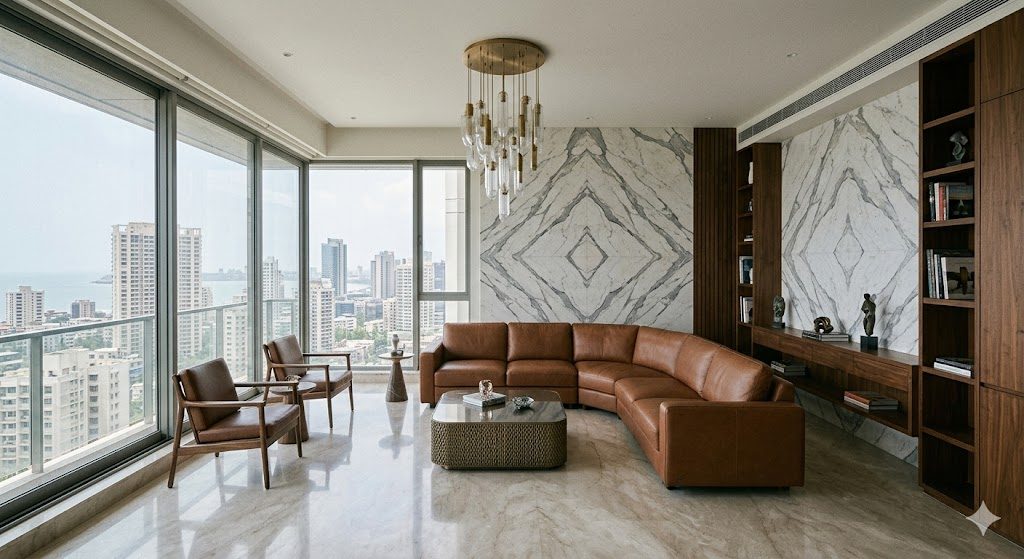
Cost of Luxury Interiors in Indian Metro Cities
What true luxury interiors cost per sqft across Mumbai, Delhi-NCR, Bengaluru, Hyderabad, Chennai, Pune (2026)
A Mumbai homeowner and a Bengaluru homeowner sit across a table, both with a 1,500 sqft 3BHK and both saying the same sentence: "I want a luxury interior." The Bengaluru quote lands around ₹1.1 crore. The Mumbai quote, for what looks like the same brief on paper, lands at ₹1.7 crore. Neither designer is overcharging. The gap is real, structural, and almost entirely about where the flat sits — not about who is greedier.
This guide is the city-by-city cost map nobody publishes honestly. It gives you the ₹ per square foot bands that genuine luxury interiors actually run at in 2026 across Mumbai, Delhi-NCR, Bengaluru, Hyderabad, Chennai and Pune, what each band buys, why the same brief costs 35–45% more in Mumbai than Pune, and where luxury budgets quietly blow out. If you want to know what luxury means as a design idea, read our pillar what defines luxury interiors in India. If you want a luxe look on a tight budget, that is a different craft entirely — see budget luxury interiors. This page owns one question only: what does the real thing cost, city by city.
At the luxury end, square footage stops being the price driver. Material provenance, bespoke percentage and automation depth are — and all three are priced differently in every metro. Two flats of identical size can sit ₹50 lakh apart on spec and location alone.
What "luxury interiors" actually means at this cost level
Before any number means anything, fix the spec. "Luxury" is one of the most abused words in Indian interiors — builders sell "luxury packages" at ₹2,500/sqft that are good standard fit-outs with a glossier brochure. Genuine luxury interiors, the kind that run at the bands below, share a consistent material and labour signature.
| Element | Standard / "package luxury" | Genuine luxury |
|---|---|---|
| Joinery | 80%+ catalogue modular, pre-lam | 40–80% bespoke, made-to-measure, hand-finished |
| Surfaces | Vitrified tile, laminate | Imported marble, natural veneer, solid wood, micro-cement |
| Stone | Indian granite/quartz | Italian marble (Statuario, Calacatta), onyx, book-matched slabs |
| Hardware | Economy Hettich/Häfele | Blum, premium Häfele, Hansgrohe, Dornbracht |
| Lighting | Profile lights, basic ceiling | Designer fixtures (Flos, Vibia, Lasvit), layered scenes on dimmers |
| Automation | None or basic switches | Lighting scenes, climate, shades, AV, access control |
| Furniture | Catalogue loose furniture | Curated/imported pieces, custom upholstery, an art budget |
| Who runs it | Contractor or builder | A named designer or design firm with a PM |
The throughline is bespoke craft and provenance, not visible bling. Most of what you pay for at the top end is invisible: the carcass that is built to the millimetre, the slab flown in and book-matched, the lighting circuit that took a programmer three days. Our pillar on what defines luxury interiors goes deeper on the design philosophy; here we price it. For the surface choice that swings luxury budgets most, see Italian marble vs quartz in India.
The ₹/sqft bands for luxury interiors
Luxury is not a single number — it is a ladder. The figures below are 2026 fit-out costs per square foot of carpet area, excluding shell and civil work, for a metro apartment. Villas and penthouses sit a band higher for the same spec because of scale, double-height detailing and external works.
| Band | ₹/sqft (carpet) | Bespoke share | What it buys |
|---|---|---|---|
| Premium (luxury floor) | ₹4,000–6,000 | 20–30% | Natural veneer + acrylic, Blum soft-close, engineered wood floor, a little imported stone, a designer in charge |
| True luxury | ₹6,000–10,000 | 40–60% | Italian marble accents, designer lighting, premium German hardware, basic automation, curated furniture + art budget |
| High luxury | ₹10,000–15,000 | 60–80% | Statement Italian marble, solid wood, designer brands (Flos, Poliform), full automation, specialist trades |
| Ultra-luxury | ₹15,000–40,000+ | 80–100% | Book-matched rare slabs, imported kitchens (Boffi, Bulthaup), bespoke everything, international consultants — no ceiling |
A useful sanity check: the honest floor for the word "luxury" in a metro flat is roughly ₹6,000/sqft. Below that you are in premium territory — lovely, but not what most people picture when they say luxury. Above ₹15,000/sqft you are buying provenance and rarity, and the relationship between spend and visible difference flattens sharply. The jump from ₹6,000 to ₹12,000 is mostly invisible craft, not twice the bling. For the full premium-vs-standard logic, our sibling budget vs premium interiors in India maps the whole spectrum.
Luxury at the top end is bought in the carcass, the slab and the lighting circuit — the things your guests never consciously see. Pay for the invisible and the visible takes care of itself.
City-by-city: the metro luxury cost map
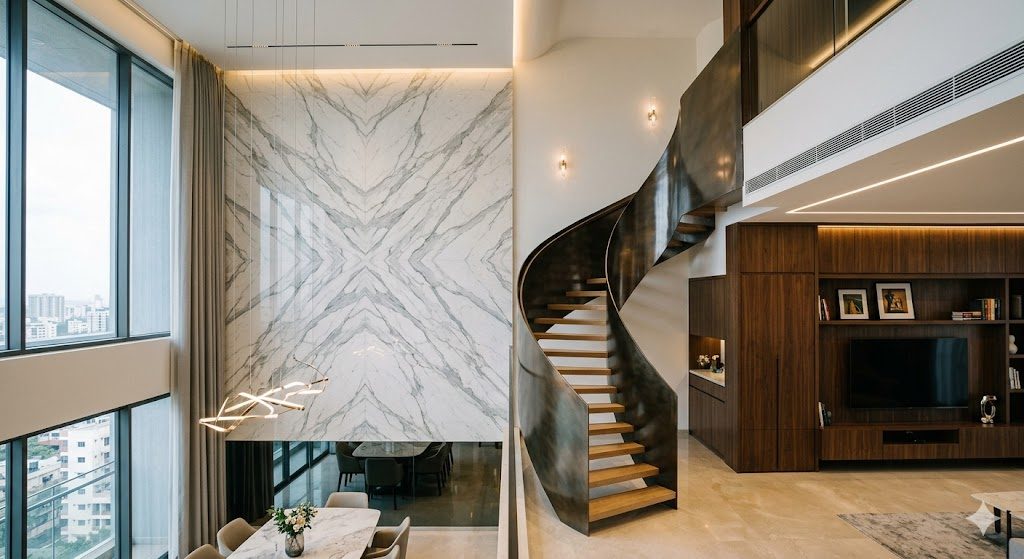
Here is the part this guide exists for. The same luxury brief — same spec, same finishes, same designer ambition — costs materially different amounts in each metro. The drivers are labour and karigar rates, real-estate-driven expectations, vendor ecosystems, import logistics and the depth of the local fine-craft talent pool.
| City | Luxury ₹/sqft (carpet) | Relative index | Why it sits here |
|---|---|---|---|
| Mumbai | ₹6,000–16,000 | 100 (base) | Highest labour + karigar rates, premium-real-estate expectation, port for imports but priciest logistics, space at a premium so detailing is dense |
| Delhi-NCR | ₹5,500–14,000 | ~88 | Deep luxury vendor ecosystem (Kirti Nagar, Okhla), strong karigar base, large-format villas pull spec up; slightly cheaper labour than Mumbai |
| Bengaluru | ₹5,000–13,000 | ~82 | Tech-money demand, excellent modular + automation vendors, good import access via Chennai/Bangalore, competitive designer market keeps fees keen |
| Hyderabad | ₹4,500–12,000 | ~75 | Rising luxury demand, strong stone supply (granite belt), good value karigars, automation ecosystem maturing |
| Chennai | ₹4,500–11,500 | ~74 | Port access for imports, conservative luxury taste, strong traditional joinery craft, slightly thinner designer-luxury vendor depth |
| Pune | ₹4,000–11,000 | ~70 | Proximity to Mumbai supply but lower labour, growing demand, value-driven luxury buyer; many vendors are Mumbai spillover |
Read the table as ranges, not verdicts — a frugal Mumbai project can land below a maximalist Pune one. But on like-for-like spec, the Mumbai-to-Pune delta at the luxury end is roughly 35–45%. Mumbai leads on almost every driver: karigar day-rates are the highest in the country, real-estate values set a baseline expectation (a ₹12-crore Worli flat will not accept a ₹5,000/sqft fit-out), and tight floor plates push designers into denser, more bespoke detailing.
Why the deltas exist — the five drivers
1. Labour and karigar rates. A skilled carpenter or polish karigar costs 30–50% more per day in Mumbai than in Pune or Hyderabad. At the luxury end, where 40–80% of the build is bespoke, labour is a huge share — so this delta compounds.
2. Real-estate-driven expectation. Where flats sell at ₹40,000–80,000/sqft (south Mumbai, Lutyens Delhi), buyers expect the interior to match. Designers spec up accordingly. This is the most underrated driver — the neighbourhood sets the floor.
3. Vendor ecosystem. Delhi-NCR (Kirti Nagar, Okhla) and Bengaluru have deep benches of luxury fabricators, stone yards and automation integrators. A mature ecosystem means competition and choice — sometimes cheaper, always more capable.
4. Import logistics. Italian marble, European kitchens and designer lighting enter through Mumbai, Chennai and Mundra. Inland cities (Bengaluru, Hyderabad, Pune) carry freight and handling on top; coastal cities have access but higher warehousing costs. Customs, breakage and wastage on rare slabs are real line items.
5. Karigar availability for fine craft. Hand-carved work, French polish, fine veneer matching and bespoke upholstery need a specific talent pool. Mumbai and Delhi have the deepest; Chennai has exceptional traditional joinery; Pune and Hyderabad are catching up but sometimes import karigars, adding cost.
For a deeper read on how these cluster effects play out in one city, our realistic 2BHK interior budget for Bengaluru 2026 breaks down a single metro line by line.
What drives a luxury budget up
Within any city, the same six levers decide whether your ₹/sqft lands at the bottom or top of the band. Square footage barely moves the needle by comparison — these do.
| Driver | Share of the luxury premium | Cost behaviour |
|---|---|---|
| Bespoke joinery % | ~35% | Each point of bespoke replaces catalogue modular with karigar hours — the single biggest controllable lever |
| Imported material | ~25% | Italian marble, European veneer, German hardware + freight, customs, wastage on rare slabs |
| Automation depth | ~15% | Lighting scenes, climate, shades, AV, access — wiring and programming scale fast |
| Designer fees | ~12% | 10–18% of project value at the luxury end (see below) |
| Art & decor | ~8% | Loose furniture, art, custom upholstery — often under-budgeted, then blows out |
| Project management | ~5% | A dedicated PM keeping karigars and imports on schedule; cheap insurance |
The headline lesson: provenance and bespoke share, not size, decide where you land. Cut bespoke from 70% to 45% — swapping some hand-built joinery for top-tier modular — and the headline ₹/sqft can fall 20–25% with very little loss of feel. That single decision is worth more than any negotiation. Our sibling guide on smart budget allocation for Indian homes shows how to spend the same rupee where it shows most.
Worked example: luxury 3BHK fit-out, Mumbai vs Bengaluru
Take an identical brief: a 1,500 sqft carpet-area 3BHK, true-luxury spec (Italian marble accents, 55% bespoke joinery, designer lighting, basic automation, a modest art budget, a named designer running it). Here is how the same brief prices in two cities.
| Line item | Mumbai (₹) | Bengaluru (₹) | Note |
|---|---|---|---|
| Bespoke joinery (wardrobes, units, panelling) | 42,00,000 | 33,00,000 | Karigar-rate delta is largest here |
| Modular kitchen (premium, imported hardware) | 14,00,000 | 11,50,000 | Bengaluru vendor depth helps |
| Imported stone (marble accents, flooring) | 16,00,000 | 14,00,000 | Freight inland but lower handling |
| Flooring (engineered wood + stone) | 9,00,000 | 7,50,000 | — |
| False ceiling + designer lighting | 11,00,000 | 9,00,000 | See false-ceiling sibling below |
| Home automation (basic scenes, shades, AV) | 8,00,000 | 7,00,000 | Bengaluru integrator market keen |
| Painting, polish, finishes | 6,50,000 | 5,00,000 | Labour-heavy, Mumbai dearer |
| Loose furniture + art budget | 14,00,000 | 12,00,000 | Buyer-driven, similar |
| Soft furnishings, drapery, upholstery | 5,00,000 | 4,00,000 | — |
| Subtotal (build + supply) | 1,25,50,000 | 1,03,00,000 | |
| Designer fee (~13%) | 16,30,000 | 13,40,000 | % of project value |
| Project management + contingency (~8%) | 11,30,000 | 9,30,000 | |
| Total | ₹1,53,10,000 | ₹1,25,70,000 | ~22% city delta |
| Effective ₹/sqft | ~₹10,200 | ~₹8,400 |
The roughly ₹27 lakh gap on an identical brief is not waste — it is Mumbai's labour, logistics and expectation premium, fully accounted. Note how the joinery line alone carries about a third of the difference: that is the karigar-rate delta in action. For the full anatomy of one such build, our room-by-room interior cost breakdown decomposes spend space by space, and the false ceiling cost guide and wardrobe cost guide drill into the two biggest joinery lines.
Designer fees at the luxury end
At the luxury level, you are not paying a contractor a markup — you are retaining a designer whose taste and procurement are the product. Fee structures vary, but the common models in 2026 are:
| Fee model | Typical luxury range | How it works | Best for |
|---|---|---|---|
| Percentage of project | 10–18% | Fee scales with build value; aligns designer to spec quality | Most luxury apartment projects |
| Fixed design fee | ₹150–400/sqft | Design + drawings + supervision priced upfront, procurement separate | Clients wanting cost certainty |
| Per-square-foot turnkey | Built into ₹/sqft | Designer delivers everything; margin embedded | Hands-off clients (verify transparency) |
| Retainer + sourcing margin | Retainer + 8–15% on supply | Common at the very top; international firms | Ultra-luxury, imported procurement |
A genuine luxury designer at 12–15% is not expensive — they typically save more than their fee by sourcing right, avoiding rework and stopping the blow-outs below. The danger is the opaque turnkey model where fee and margin are buried in the ₹/sqft; demand an itemised BOQ before signing. Our guide on turnkey interiors in India and the broader BOQ explained cover how to read what you are actually paying for.
Where luxury budgets blow out
Luxury projects rarely overrun because of the headline finishes — those are quoted upfront. They overrun in predictable, avoidable places.
| Blow-out zone | Why it happens | Typical damage |
|---|---|---|
| Scope creep | "While we're at it" additions mid-build | 10–25% over budget |
| Imported material wastage | Rare slabs break; book-matching needs extra | 15–30% extra stone cost |
| Automation feature drift | Adding zones, scenes, devices after wiring | ₹3–10 lakh creep |
| Loose furniture + art | Under-budgeted at the start, indulged at the end | ₹10–30 lakh |
| Delays carrying labour | Imports stuck in customs while karigars wait | ₹50,000–2 lakh/month |
| Rework from poor drawings | Cutting corners on design upfront | 5–15% rebuild |
| Premium hardware "upgrades" | Late switch to Dornbracht-tier fittings | ₹2–8 lakh |
Two-thirds of luxury overruns trace to scope creep and under-budgeted loose items. Both are killed by a disciplined BOQ and a decided furniture budget on day one. Our siblings on the hidden costs of home renovation and the most expensive interior mistakes catalogue the traps in detail, and our note on why cheap hardware destroys expensive interiors explains why the hardware line is non-negotiable at this level.
How to brief and control a luxury budget
Luxury budgets are controlled at the brief, not the build. Once karigars are on site and slabs are ordered, your leverage is gone. Get these right at the start.
1. Fix the ₹/sqft band first, with assumptions. Decide premium / true-luxury / high-luxury for your carpet area and city, using the bands above. Write down the spec each band assumes. This is your anchor.
2. Set the bespoke % deliberately. This is your biggest lever. Decide where you want hand-built craft (the pieces guests touch) and where top-tier modular is fine. Document it.
3. Lock the imported material list early. Choose slabs and brands before site work starts so freight and lead times are known. Order rare stone with wastage allowance built in.
4. Budget loose furniture and art on day one. Put a real number against it — ₹10–30 lakh on a luxury 3BHK — so it does not become an end-of-project shock.
5. Get an itemised BOQ, not a turnkey ₹/sqft. Insist on line items for every supply and labour head. Opacity is where money leaks.
6. Hire a designer on a transparent fee. 12–15% of a well-specced project is value, not cost. Verify the model and what procurement margin sits on top.
7. Hold 8–10% contingency, ring-fenced. Luxury builds always meet a surprise. Fund it upfront and stop dipping into it for upgrades.
8. Decide the spec freeze date. After a set date, every change is logged, costed and signed. This single rule kills scope creep.
Run your spec and city against our style and budget calculator and the broader cost calculator to pressure-test the bands before you commit a rupee.
How to budget it, in order
1. Pick your city band from the metro table — that is your honest starting ₹/sqft.
2. Multiply by carpet area for a rough total, then add 13% designer fee and 8–10% contingency.
3. Decide your bespoke % — the single biggest swing — and adjust within the band.
4. Lock imported materials and the loose-furniture/art budget as named numbers.
5. Demand an itemised BOQ; reject any opaque turnkey ₹/sqft.
6. Set a spec-freeze date and ring-fence contingency.
7. Track against the BOQ monthly; treat every "while we're at it" as a logged change.
A luxury villa carries its own rules — scale, external works and double-height detailing shift the maths — so if that is your project, read luxury villa interior planning in India alongside this.
Want the heavy lifting done for you? DesignAI drafts an itemised BOQ and a city-grounded budget straight from your floor plan and chosen spec — so you walk into the first designer meeting already knowing what your luxury brief should cost in your metro, not just what someone quotes.
References
- CIDC (Construction Industry Development Council) — published labour and material rate schedules, used for cost benchmarking across Indian metros.
- CPWD Plinth Area Rates and Delhi Schedule of Rates (DSR) 2023, updated cost indices — baseline civil and finishing rates.
- National Building Code of India (NBC) 2016, Bureau of Indian Standards — specification and quality benchmarks for finishes and services.
- RERA (Real Estate Regulatory Authority) state portals — carpet-area definitions and registered-project cost disclosures informing real-estate-driven expectation.
- BIS / IS standards for natural stone, plywood (IS 303/710) and decorative laminates — material-grade references for luxury specification.
- BMTPC (Building Materials & Technology Promotion Council) — material cost and technology guidance.
- Industry rate cards and procurement data from luxury fabricators and stone yards in Mumbai, Delhi-NCR and Bengaluru (2026), cross-checked across vendors.
Related cost reading: what defines luxury interiors in India, budget luxury interiors, budget vs premium interiors, smart budget allocation for Indian homes, and the most expensive interior mistakes in India.
Export this guide
Related Guides — Deep-dive reading
The Design Decisions With the Biggest Cost Consequences
A cost-leverage map of Indian home interiors — the handful of decisions that swing your total budget the most, so you spend your attention where a single choice has an outsized rupee impact.
Cost & MoneyThe Homeowner's Guide to Interior Design Budgets in India
Where the money really goes in an Indian fit-out — realistic 2026 ranges, cost-per-sqft truths, bang-for-buck upgrades, life-cycle costing and contracts
Home PlanningBudget vs Premium Interiors: What Actually Changes?
Where the extra money really goes — and where premium is just a markup
Cost & MoneyRelated Tools — Try Free
Home Building & Interior Cost Calculator — 20 Cities
Construction + interior costs for 20 Indian cities across kitchen, wardrobes, flooring, painting, ceiling.
Cost CalculatorFalse Ceiling Cost Estimator
Live ₹/sqft across 8 ceiling types — POP, gypsum, designer, metal, PVC, wooden — with cove and spot lighting for 20 Indian cities.
Cost CalculatorFlooring Cost Calculator
Estimate the all-in cost of a floor — material, laying, wastage, skirting and GST — by area and material.
Flooring Calculator