
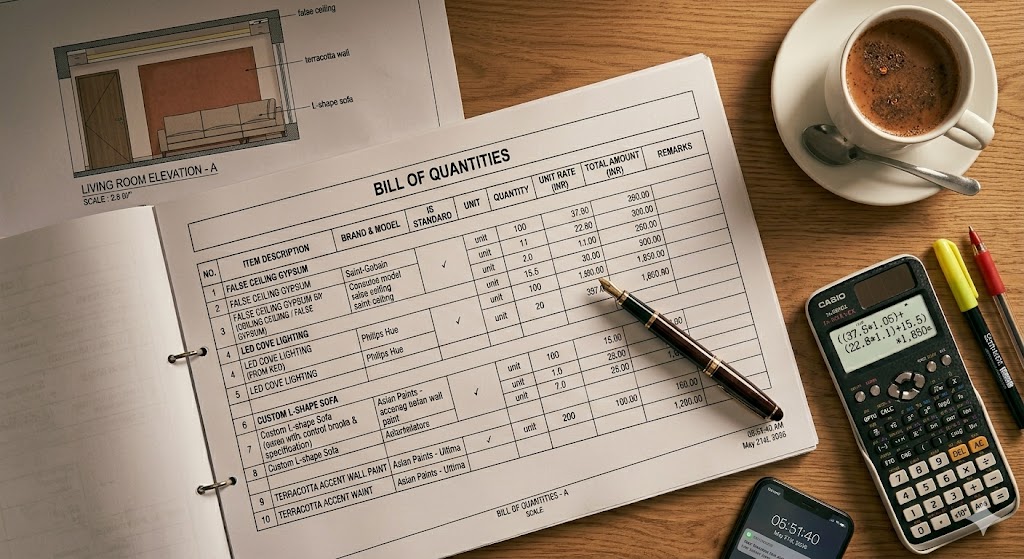
BOQ Explained for Indian Homeowners — What It Is and Why You Need One
The Anatomy of a Good BOQ, a 20-Line Sample, How to Compare Three Contractor Quotes, Ten Red Flags & the Variation Order Discipline
A BOQ — Bill of Quantities — is the single most important document protecting an Indian homeowner from cost surprises, spec disputes, and material substitution. Without a detailed BOQ, you don't have a contract. You have a promise.
A ₹ 21 L "all-inclusive" contractor quote without a BOQ is a verbal commitment. The contractor decides what "modular kitchen" means, what "branded hinges" means, what's "included." By the time you discover the gap, work is 70% done and you have no leverage.
This guide is the homeowner's working reference for BOQ in Indian residential construction and interior projects. It covers what a BOQ is, the eight elements every line must contain, a worked twenty-line sample BOQ as a template, how to compare three contractor quotes line-by-line, ten red flags that should make you refuse to sign, and the variation order discipline for handling mid-build scope changes.
Demand a BOQ before any signature. Verify every line has brand + model + IS standard + unit rate + GST clarity + remarks. Compare three contractor quotes line-by-line, not total-by-total. Track variations in a running log capped at 10%. This is the discipline that converts a builder's promise into a homeowner's protection.
For the cost-cluster context, see Construction Cost in India, Interior Cost per Sft in India, Hidden Costs in Interiors, Home Renovation Cost in India, and Turnkey Interiors in India.
What Is a BOQ — and Why It Is Your Most Important Document
A Bill of Quantities is a line-item document listing every material, fitting, finish, and labour activity in your project, with each line specifying:
- WHAT is being done or supplied (item description)
- WHICH brand and model (specification lock)
- WHAT QUANTITY (size of order)
- WHAT UNIT RATE (price discipline)
- WHAT TOTAL amount (line subtotal)
- WHAT GST treatment (tax clarity)
- WHAT CAVEATS, exclusions, assumptions (remarks)
A signed BOQ becomes Annexure A to your construction contract. It is the legally enforceable specification for what the contractor delivers and what you pay. Any change requires a written Variation Order with cost and timeline impact.
Without a BOQ, you don't have a contract
A "₹ 21 L all-inclusive interior" without a BOQ is an aspirational target. Mid-build, the contractor says "we used MR plywood instead of BWP since BWP wasn't available" or "the kitchen is 95 sft not 110 sft because of column position." You have no document to enforce the original spec. Dispute resolution defaults to "what's reasonable" — which usually favours the contractor (he has the work; you've paid 60% upfront).
A signed BOQ flips this. "Line 4 of the BOQ specifies BWP IS 710 plywood. You delivered MR IS 303. Either replace it or refund ₹ X." The contractor has no defence — the specification is locked.
The Anatomy of a Good BOQ Line — Eight Essential Elements
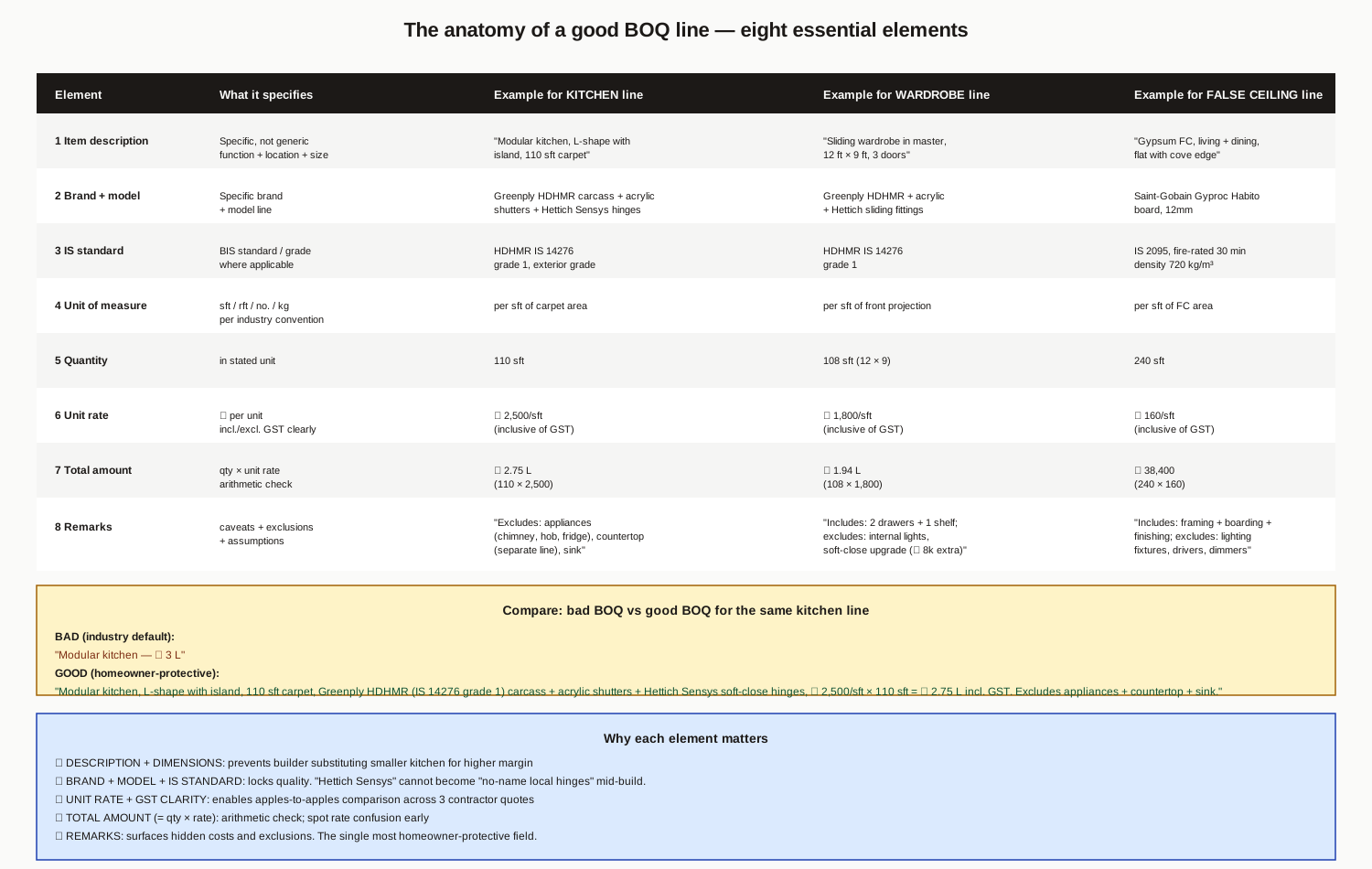
Every BOQ line must contain these eight elements. Missing any one is a red flag.
1. Item description — specific, not generic
Bad: "Modular kitchen." Good: "Modular kitchen, L-shape with island, 110 sft carpet area."
The description must specify function + location + dimensions/scope. "Wardrobe" is bad. "Sliding wardrobe in master BR, 12 ft × 9 ft, 3 doors" is good.
2. Brand + model number
Bad: "Branded hinges, premium plywood, designer fixtures." Good: "Hettich Sensys soft-close hinges. Greenply HDHMR carcass. Philips Smartbright 12W LED downlights, model RC050B."
The brand alone is not enough — "Hettich" has 6 hinge lines from economy to premium. The specific model matters.
3. IS standard or grade
Bad: "Plywood." Good: "HDHMR IS 14276 grade 1, exterior grade."
BIS standards lock material quality objectively. IS 303 (commercial plywood) is a different product from IS 710 (BWP marine plywood) at a different price point. Without IS reference, "plywood" can be anything.
Common IS standards every interior BOQ should reference:
- IS 14276 — HDHMR (high-density high-moisture-resistant board)
- IS 710 — BWP marine plywood
- IS 303 — commercial plywood
- IS 12823 — pre-laminated particle board
- IS 14276 — MDF (medium density fibreboard)
- IS 2095 — gypsum board (for FC)
- IS 15916 — designer paint
- IS 1124 — granite
4. Unit of measure
Bad: "Kitchen — ₹ 3 L" (per what?). Good: "Kitchen carcass — ₹ 2,500/sft × 110 sft."
Standard units: per sft (kitchen, wardrobe, FC, painting), per rft (running foot — for boundary walls, skirting), per number (lights, switches, taps, sinks, doors), per kg (steel), per lot (when the scope is genuinely a lump-sum bundle, e.g. CP fittings for one bathroom).
5. Quantity
Bad: BOQ shows "Kitchen — ₹ 3 L" with no quantity. Good: "Kitchen — 110 sft."
Quantity enables verification at site. After install, you measure 95 sft of actual kitchen — you have a basis to demand correction.
6. Unit rate — with GST clarity
Bad: "₹ 2,500/sft." Good: "₹ 2,500/sft (inclusive of 18% GST)" or "₹ 2,118/sft (ex-GST, GST extra at 18%)."
GST clarity is non-negotiable. 18% on services + 12-28% on materials is a 12-22% surprise at invoicing without explicit treatment.
7. Total amount
Bad: missing column. Good: "Total = qty × unit rate" computed and shown.
Forces arithmetic check. Spot rate confusion early (₹ 2,500/sft × 110 = ₹ 2.75 L, not ₹ 3.5 L which the verbal might suggest).
8. Remarks — the homeowner's protective field
Bad: missing column. Good: "Excludes: appliances (chimney, hob, fridge), countertop (separate line), sink. Includes: pull-out + cutlery tray accessories."
The remarks column surfaces inclusions, exclusions, and conditions. The single most homeowner-protective field. Demand it explicitly.
Bad BOQ vs Good BOQ — the same kitchen line
BAD (industry default):
"Modular kitchen — ₹ 3 L"
GOOD (homeowner-protective):
"Modular kitchen, L-shape with island, 110 sft carpet, Greenply HDHMR (IS 14276 grade 1) carcass + acrylic shutters + Hettich Sensys soft-close hinges, ₹ 2,500/sft × 110 sft = ₹ 2.75 L incl. GST. Excludes appliances + countertop + sink."
The difference: ₹ 2-3 L of mid-build dispute risk avoided. Demand the second format. Always.
A Sample BOQ — 1,500 sft 3 BHK Bangalore Mid-Spec
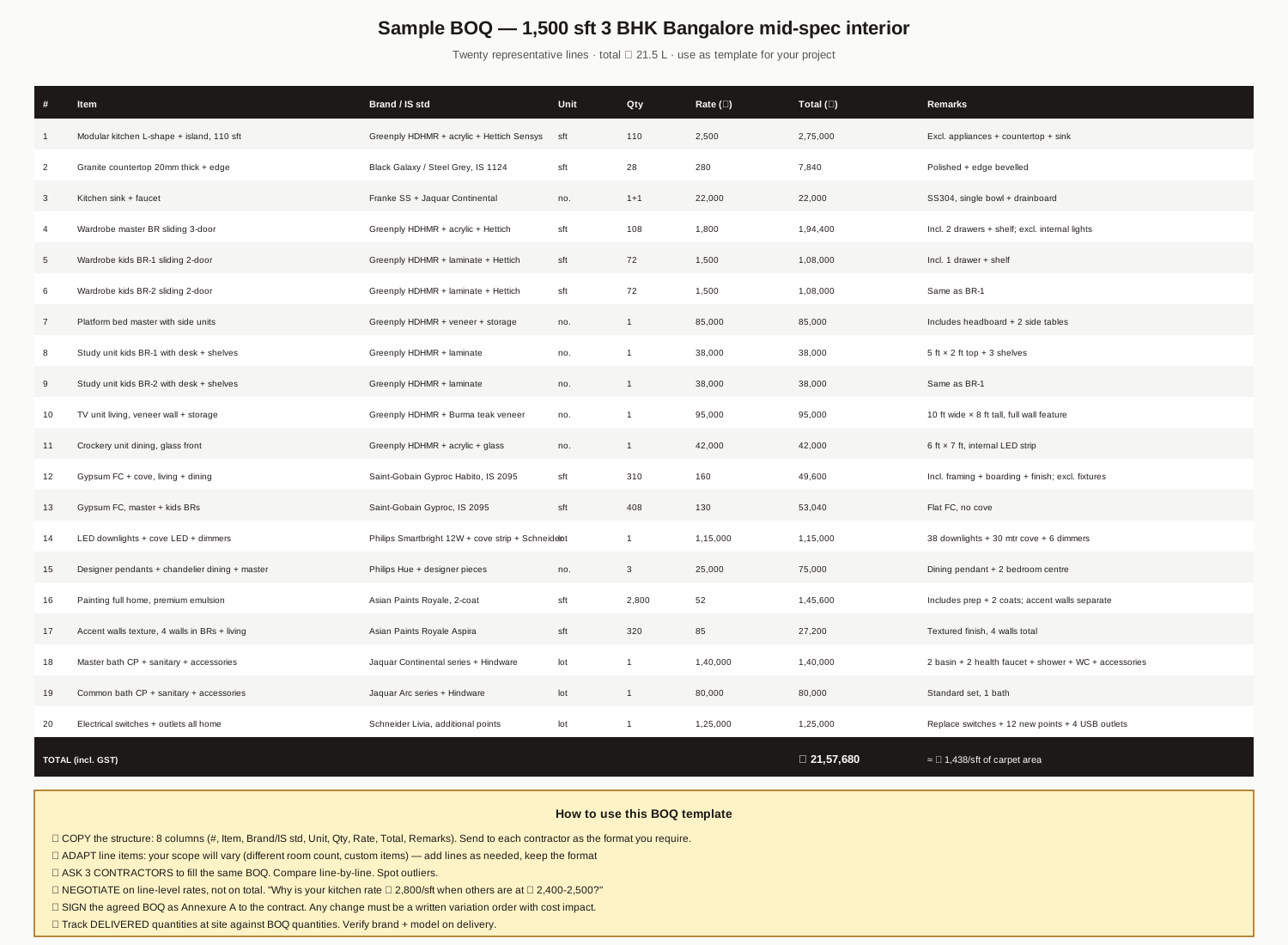
The figure above is a full twenty-line BOQ for a representative 1,500 sft mid-spec project totaling ₹ 21.5 L. Use as a template for your project.
Reading the sample
The BOQ covers twenty representative scope categories:
1-3. Kitchen (module + countertop + sink/faucet) = ₹ 3.05 L
4-9. Wardrobes and joinery (master + 2 kids' BRs + master bed + 2 study units) = ₹ 6.78 L
10-11. Living + dining joinery (TV unit + crockery) = ₹ 1.37 L
12-13. False ceiling (living + dining + all BRs) = ₹ 1.03 L
14-15. Lighting (LED + cove + dimmers + designer pendants) = ₹ 1.90 L
16-17. Painting + accents = ₹ 1.73 L
18-19. CP + sanitary (master + common bath) = ₹ 2.20 L
20. Electrical (switches + new points + USB) = ₹ 1.25 L
Total: ₹ 21.5 L (inclusive of GST). ₹ 1,438/sft of carpet area.
How to use this template
1. Copy the structure — 8 columns (#, Item, Brand/IS std, Unit, Qty, Rate, Total, Remarks). Send to each contractor as the format you require.
2. Adapt line items — your scope will vary (different room count, custom items). Add lines as needed. Keep the format.
3. Ask 3 contractors to fill the same BOQ. Compare line-by-line. Spot outliers.
4. Negotiate on line-level rates, not on total. "Why is your kitchen rate ₹ 2,800/sft when others are at ₹ 2,400-2,500?"
5. Sign the agreed BOQ as Annexure A to the contract. Any change must be a written variation order.
6. Track delivered quantities at site against BOQ quantities. Verify brand + model on delivery.
How to Compare Three Contractor BOQs
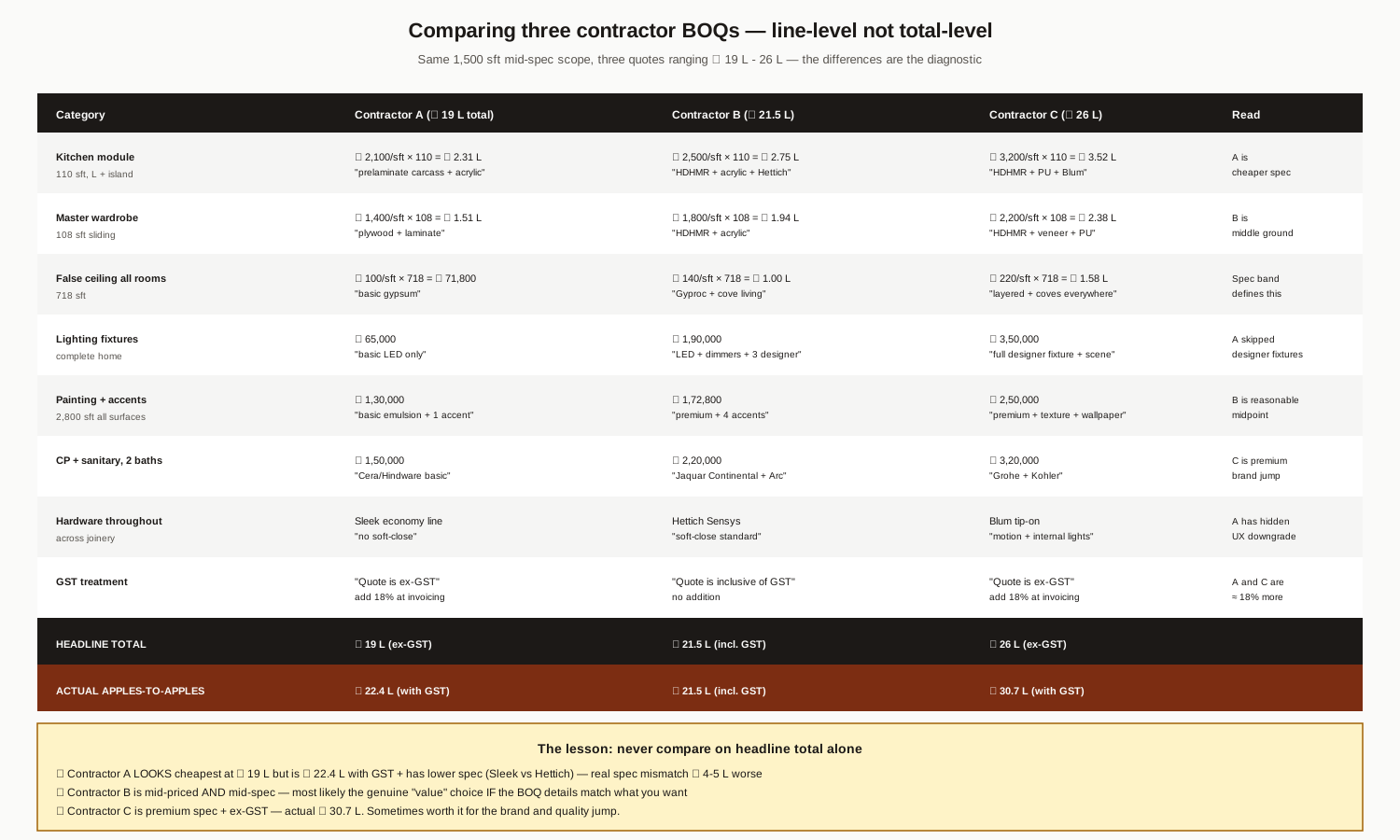
The single biggest BOQ mistake is comparing on headline total rather than on line-level rates and spec.
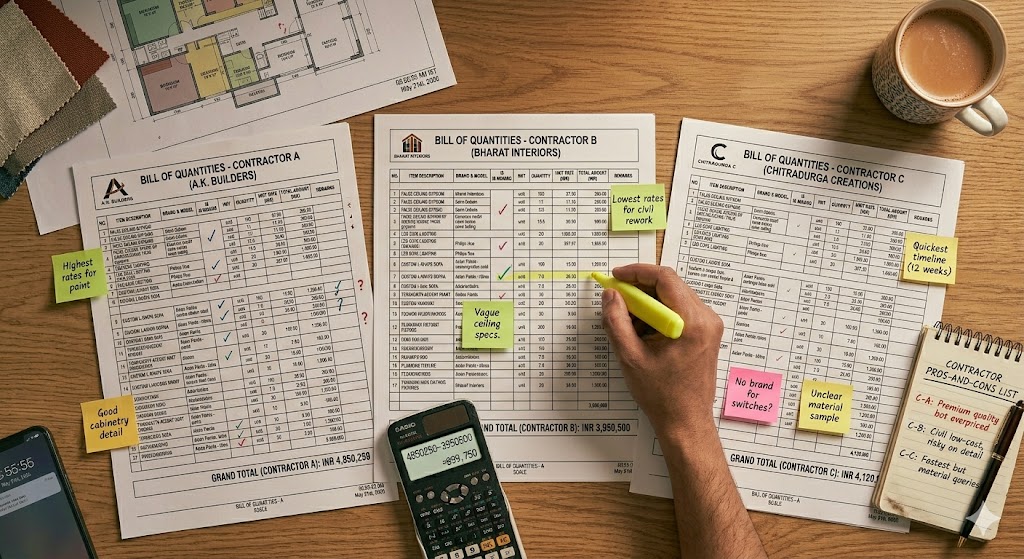
A worked three-quote comparison
Three contractors quote on the same 1,500 sft mid-spec scope:
- Contractor A: ₹ 19 L (ex-GST). Looks cheapest.
- Contractor B: ₹ 21.5 L (incl. GST). Middle.
- Contractor C: ₹ 26 L (ex-GST). Looks expensive.
Headline ranking: A < B < C.
But when normalised — both for GST and for spec — the picture changes:
- Contractor A: ₹ 19 L + 18% GST = ₹ 22.4 L. Spec uses Sleek economy hinges (Hettich grade in B), prelaminate carcass (HDHMR in B), basic LED only (no designer fixtures). Real apples-to-apples = ₹ 22.4 L + ₹ 4-5 L to match B's spec = ₹ 26-27 L.
- Contractor B: ₹ 21.5 L all-in, mid spec.
- Contractor C: ₹ 26 L + 18% GST = ₹ 30.7 L. Premium spec — Blum tip-on, PU finishes, designer scene lighting, Grohe/Kohler CP. Real apples-to-apples for mid-spec = ₹ 30.7 L - ₹ 6-8 L downgrade premium = ₹ 22-25 L for mid spec.
True ranking: A and C are roughly equivalent at mid spec (₹ 26-27 L vs ₹ 22-25 L); B is the lowest at ₹ 21.5 L for the same spec.
Contractor A is NOT the cheapest despite looking like it. The headline saving disappears when you normalise for spec and GST. Contractor B wins.
The discipline applied across line items
Line by line, look for:
- Spec mismatches: same line description, different brand/model. The cheaper contractor is using cheaper equivalents — costs less but is not "the same."
- GST treatment: ex-GST vs inclusive of GST. Always normalise to inclusive.
- Bundled vs unbundled lines: "Electrical work — ₹ 4 L" vs "Electrical — see sub-BOQ with 35 line items." Unbundled is harder to compare.
- Hidden scope exclusions: one contractor includes painting in the BOQ, another quotes it separately. Cross-reference for completeness.
Never compare on total alone
This is the single biggest BOQ discipline. The lowest total is rarely the lowest cost. The cheapest contractor with the same spec is the right answer.
Ten BOQ Red Flags
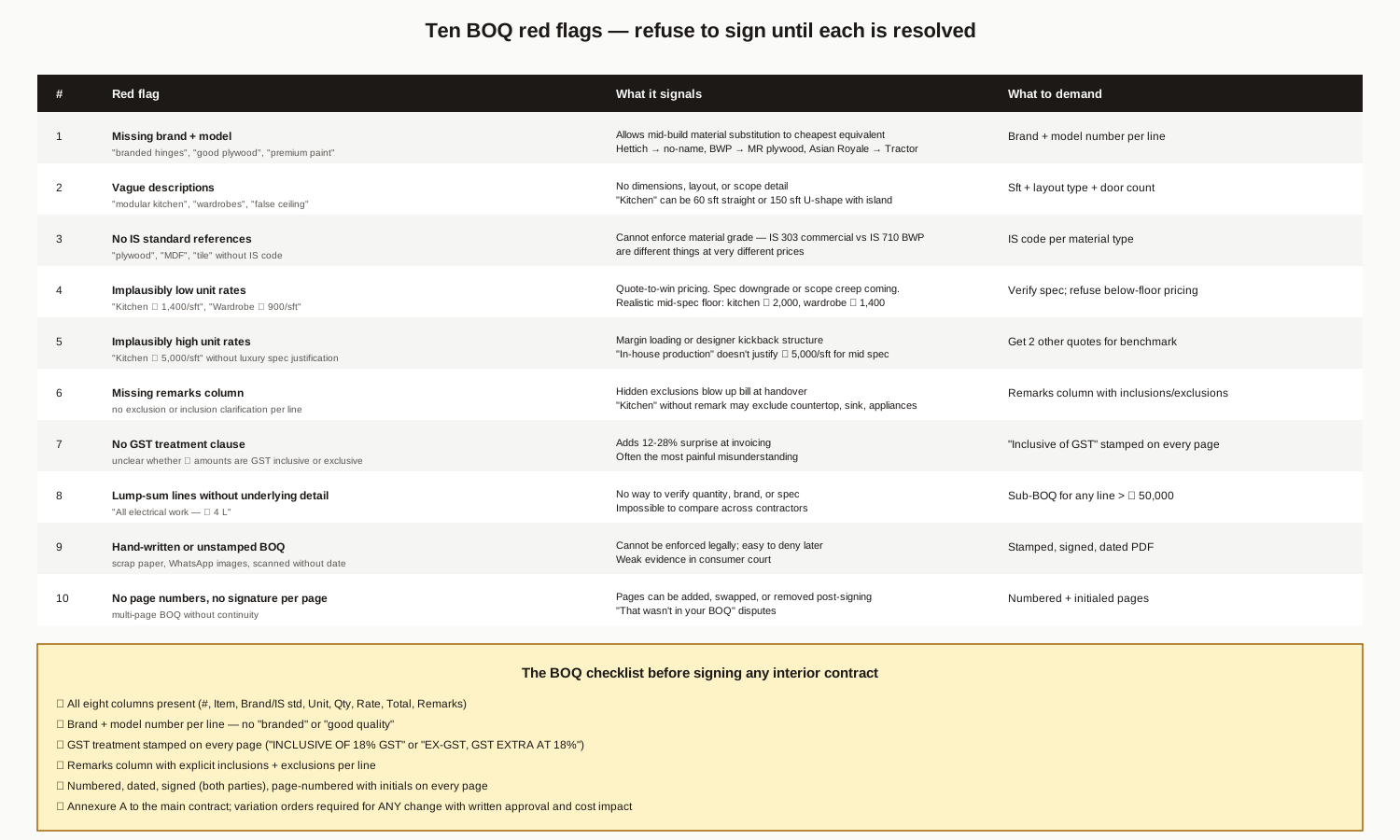
Any single red flag is a yellow alert; multiple simultaneously is a refuse-to-sign condition.
1. Missing brand + model: "branded hinges", "good plywood", "premium paint" → allows material substitution. Demand brand + model number per line.
2. Vague descriptions: "modular kitchen", "wardrobes", "false ceiling" → kitchen can be 60 sft straight or 150 sft U + island. Demand sft + layout + door count.
3. No IS standard references: "plywood" without IS code → IS 303 commercial vs IS 710 BWP are different products at very different prices. Demand IS code per material type.
4. Implausibly low unit rates: "Kitchen ₹ 1,400/sft" → quote-to-win pricing. Spec downgrade or scope creep coming. Realistic mid-spec floor: kitchen ₹ 2,000/sft. Verify spec; refuse below-floor pricing.
5. Implausibly high unit rates: "Kitchen ₹ 5,000/sft" without luxury spec → margin loading or designer kickback. Get 2 other quotes for benchmark.
6. Missing remarks column: no exclusion/inclusion clarification per line → hidden exclusions blow up at handover. Demand remarks column with inclusions/exclusions.
7. No GST treatment clause: unclear inclusive/exclusive → adds 12-28% surprise at invoicing. Demand "Inclusive of GST" stamped on every page.
8. Lump-sum lines without underlying detail: "All electrical work — ₹ 4 L" → impossible to compare or verify. Demand sub-BOQ for any line > ₹ 50,000.
9. Hand-written or unstamped BOQ: scrap paper, WhatsApp images, scanned without date → cannot be enforced legally. Demand stamped, signed, dated PDF.
10. No page numbers, no signature per page: multi-page BOQ without continuity → pages can be added, swapped, or removed post-signing. Demand numbered + initialed pages.
The BOQ checklist before signing
- All eight columns present (#, Item, Brand/IS std, Unit, Qty, Rate, Total, Remarks)
- Brand + model number per line — no "branded" or "good quality"
- IS standard or grade per material type
- GST treatment stamped on every page ("INCLUSIVE OF 18% GST" or "EX-GST, GST EXTRA AT 18%")
- Remarks column with explicit inclusions + exclusions per line
- Numbered, dated, signed (both parties), page-numbered with initials on every page
- Annexure A to the main contract; variation orders required for ANY change
Variation Orders — The Discipline for Mid-Build Scope Changes
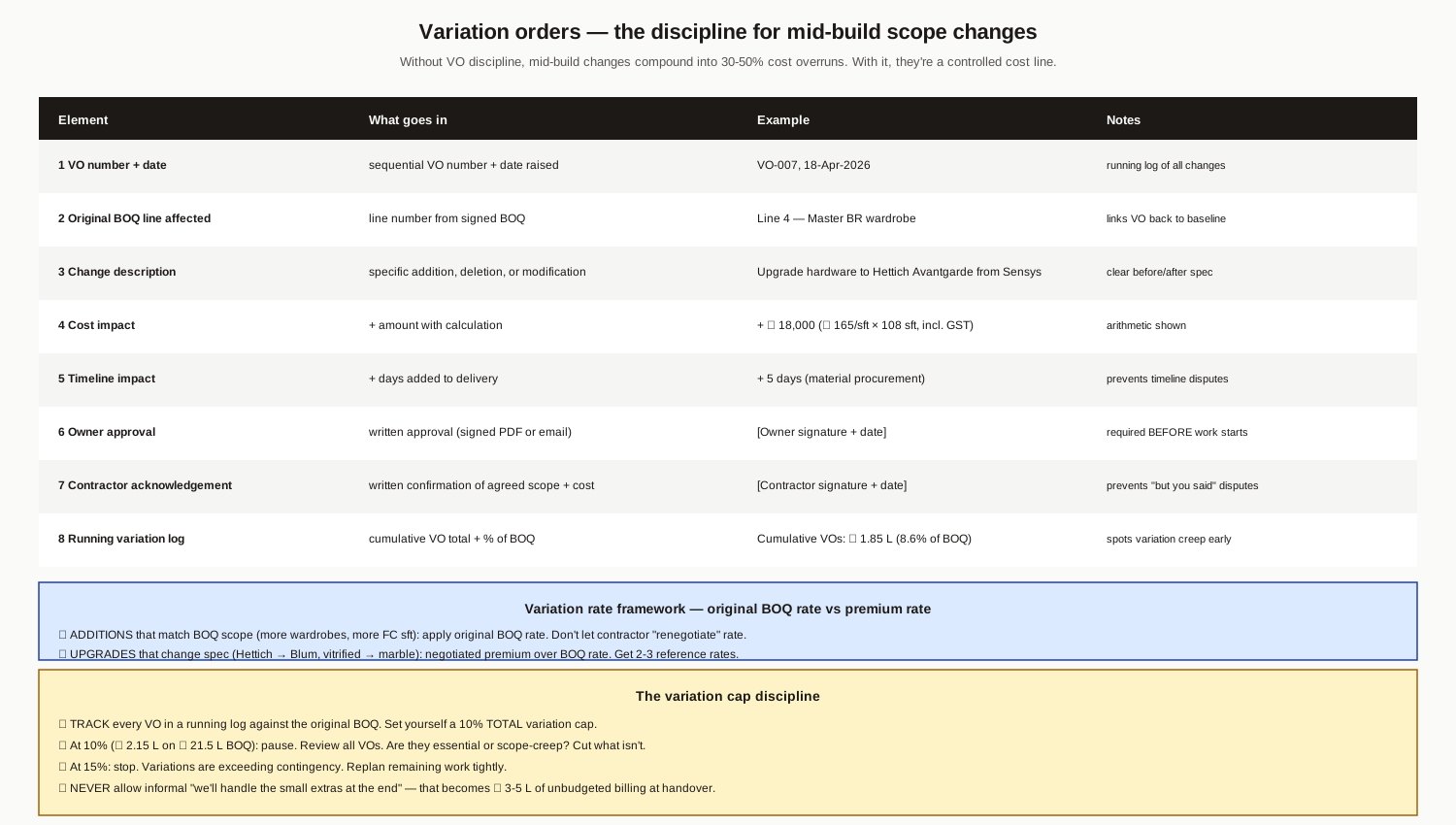
Scope changes happen in every project. Without VO discipline, they compound into 30-50% cost overruns. With it, they're a controlled cost line.
The eight-element variation order template
Every variation order should contain:
1. VO number + date — sequential VO number + date raised (e.g., VO-007, 18-Apr-2026)
2. Original BOQ line affected — line number from signed BOQ
3. Change description — specific addition, deletion, or modification (e.g., "Upgrade hardware to Hettich Avantgarde from Sensys")
4. Cost impact — + amount with calculation (e.g., "+ ₹ 18,000 (₹ 165/sft × 108 sft, incl. GST)")
5. Timeline impact — + days added to delivery (e.g., "+ 5 days for material procurement")
6. Owner approval — written approval, BEFORE work starts
7. Contractor acknowledgement — written confirmation of agreed scope + cost
8. Running variation log — cumulative VO total + % of BOQ
Variation rate framework
- Additions matching BOQ scope (more wardrobes, more FC sft): apply ORIGINAL BOQ rate. Don't let contractor "renegotiate" rate.
- Upgrades that change spec (Hettich → Blum, vitrified → marble): negotiated premium over BOQ rate. Get 2-3 reference rates.
The variation cap discipline
- TRACK every VO in a running log against the original BOQ
- Set yourself a 10% total variation cap
- At 10% (₹ 2.15 L on ₹ 21.5 L BOQ): pause. Review all VOs. Are they essential or scope-creep? Cut what isn't.
- At 15%: stop. Variations are exceeding contingency. Replan remaining work tightly.
- NEVER allow informal "we'll handle the small extras at the end" — that becomes ₹ 3-5 L of unbudgeted billing at handover.
Six Common BOQ Mistakes
1. Signing a quote without a BOQ. The single most common and most expensive mistake. Demand BOQ before any signature.
2. Comparing contractor quotes on total only. Spec normalisation and GST treatment must be applied first.
3. Accepting "branded" without specifying brand + model. Hettich Sensys ≠ Hettich economy line ≠ "Hettich-equivalent". Specify the model.
4. No remarks column. Then every dispute becomes "I assumed it was included." The remarks column is the homeowner's protective field.
5. Verbal variation orders. "Just add a bar shelf, we'll bill at the end." That's how a ₹ 21.5 L BOQ becomes a ₹ 28 L invoice with no enforceable basis.
6. Not tracking delivered quantities at site. BOQ says 110 sft kitchen; contractor builds 95 sft and bills for 110. Measure at site, cross-check against BOQ.
Pre-Signing BOQ Checklist
1. Complete BOQ in hand with all eight columns
2. Brand + model per line, no vague specs
3. IS standard or grade per material
4. Quantities verifiable at site post-installation
5. Unit rates within market benchmark (not too low to be spec downgrade, not too high to be margin loading)
6. Total per line = qty × rate (arithmetic check)
7. GST treatment stamped on every page
8. Remarks with inclusions + exclusions per line
9. Page numbers + initial signatures per page
10. Annexure to contract explicitly named
11. Variation order template agreed in advance
12. Variation cap of 10% set as informal target
13. Compare with at least 2 other contractor BOQs, line-by-line
14. Lawyer review for projects > ₹ 50 L
15. Final BOQ signed by both parties before any payment
Where to Go Next
- For construction cost framework: Construction Cost in India
- For interior cost framework: Interior Cost per Sft in India
- For hidden costs that the BOQ should surface: Hidden Costs in Interiors
- For renovation cost specifics: Home Renovation Cost in India
- For turnkey decision and red flags: Turnkey Interiors in India
- For the BOQ calculator tool: BOQ Calculator and BOQ IS Pre-filled
- For full-room BOQ generator: BOQ Full Room Tool
- For comparing contractor quotes: Quote Comparison Tool
- For choosing the right designer / contractor: How to Choose the Right Architect or Interior Designer in India
References
1. Indian Contract Act 1872. Legal framework for BOQ as part of construction contracts.
2. CPWD Manual 2019 (Central Public Works Department). Government BOQ format and rate framework.
3. NBC 2016, Part 7 — Construction Management. BOQ and quantity surveying guidance.
4. BIS material standards (IS 303, IS 710, IS 12823, IS 14276, IS 2095, IS 1124). Material specification baselines.
5. GST Council India. GST rate schedules for construction services and materials (latest).
6. Council of Architecture Practice Bylaws (2020). Architect-side BOQ practice standards.
7. Institute of Indian Interior Designers (IIID). Practice guidance for interior BOQ format.
8. National Consumer Disputes Redressal Commission case law. Construction service disputes precedent — BOQ as evidence.
9. Hettich India + Hafele India + Blum India product catalogues. Hardware model and pricing reference.
10. Greenply + Century + Mehta + Asian Paints product catalogues. Material brand and grade reference.
Author's note: A signed, detailed, page-numbered BOQ is the single highest-leverage homeowner protection in Indian residential construction and interior projects. The discipline takes 4-6 hours of effort to prepare and review — and prevents ₹ 3-8 L of mid-build disputes and surprises on a ₹ 21 L project. The math is obvious; the practice is rare. Most homeowners sign on "₹/sft all-inclusive" promises and discover the gap at handover. Don't be one of them. Demand the BOQ. Verify the eight elements. Compare line-by-line across three contractors. Track variations against a 10% cap. Track delivered quantities at site. That is the discipline. It is the difference between a happy handover and a courtroom dispute.
Disclaimer: BOQ format conventions, line-item structure, and rate ranges cited are 2025-26 indicative for Indian residential construction and interior practice and vary by project type, scope, region, and contractor. The sample BOQ is illustrative for a representative 1,500 sft 3 BHK Bangalore mid-spec project; specific projects should adapt line items, scope, brands, and rates to local conditions and personal preferences. Material brand and model references are illustrative and not endorsements; verify current product availability, pricing, and specifications independently. GST rates are subject to GST Council revisions; verify current applicable rates at the time of contracting. Studio Matrx, its authors and contributors accept no liability for contract or budget decisions made on the basis of this guide; engage a quantity surveyor for project-specific BOQ preparation and review, a chartered accountant for tax verification, and a property lawyer for contract review on projects above ₹ 50 L. The BIS material standards referenced are authoritative for material grade and quality validation in disputed engagements; the CPWD Manual is the authoritative reference for BOQ format in government-related works.
Export this guide
Related Guides — Deep-dive reading
The Truth About Cost Per Square Foot
Why a ₹/sqft interior quote is the most misleading number in Indian home costing — and how to convert it into a real BOQ
Cost & MoneyThe Design Decisions With the Biggest Cost Consequences
A cost-leverage map of Indian home interiors — the handful of decisions that swing your total budget the most, so you spend your attention where a single choice has an outsized rupee impact.
Cost & MoneyUnderstanding Construction Contracts & Retainage in India
A homeowner-protective guide to the contract and payment structure behind every interiors or build project — the contract types and when each fits, how to stage payments so your money trails the work, and the retention clause that quietly protects you more than any other.
Cost & MoneyRelated Tools — Try Free
False Ceiling Cost Estimator
Live ₹/sqft across 8 ceiling types — POP, gypsum, designer, metal, PVC, wooden — with cove and spot lighting for 20 Indian cities.
Cost CalculatorInterior Contract Clause Checklist
16 sections and 98 checkboxes covering scope, BOQ, milestones, penalties, warranty, and disputes.
Contract ChecklistMaterial Comparison Sheet
India's interior material cheatsheet — plywood, finishes, hardware, countertops, paints, waterproofing.
Reference Guide