
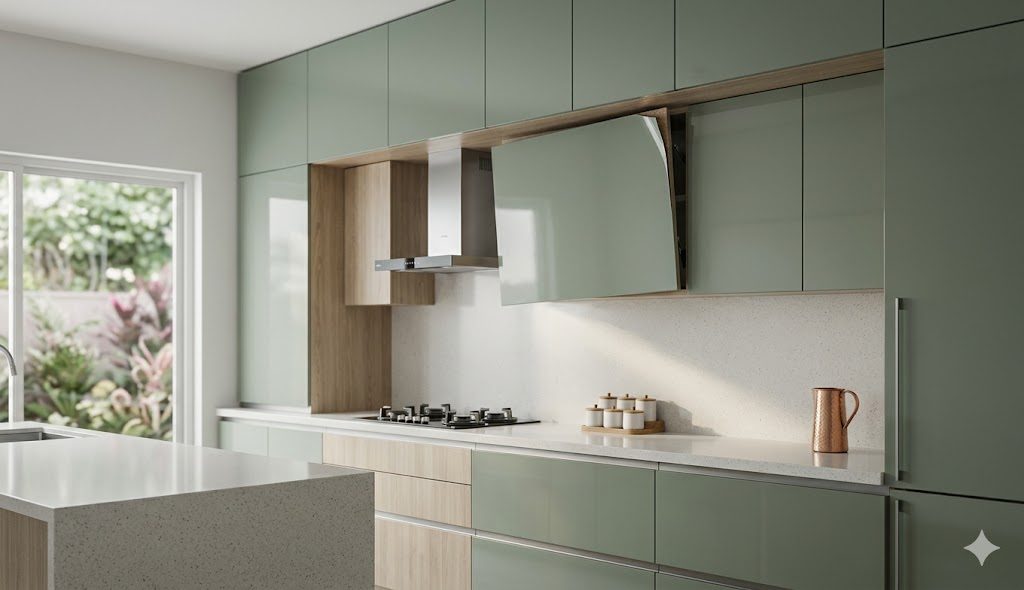
Why Cheap Hardware Destroys Expensive Interiors
The catalogue trick where the carcase is premium and the hardware is invisible — and how to prevent it
The single most-expensive small decision in an Indian interior project is the line in the quote that reads "all soft-close hardware included". No brand. No model. No cycle rating. No finish. Just a five-word phrase that legally allows the contractor to install ₹40 cup hinges into the ₹5 lakh modular kitchen you spent three weekends choosing.
It is the catalogue trick. The carcase is BWP plywood. The shutter is acrylic. The countertop is quartz. The taps are Grohe. And then, hidden inside every cabinet, are the cheapest hinges and slides the contractor could buy at the local hardware market. They are invisible the day you take handover, they are invisible at the housewarming, and they become catastrophically visible somewhere between year three and year five.
This guide walks through the exact failure cascade that turns a ₹40 hinge into a ₹6,500 shutter replacement, the four hardware failure modes that take everything with them, and the BOQ clause that makes substitution impossible to slip through. It is a deep-dive companion to our complete guide to plywood grades in India, and pairs with the premium kitchen hardware guide and the why Indian kitchens fail after 5 years guide.
The four failure modes that take everything with them
There are four hardware failure modes in an Indian home. Each one is small at the start, each one cascades into a much larger damage event, and each one is preventable for a tiny fraction of the eventual repair cost.
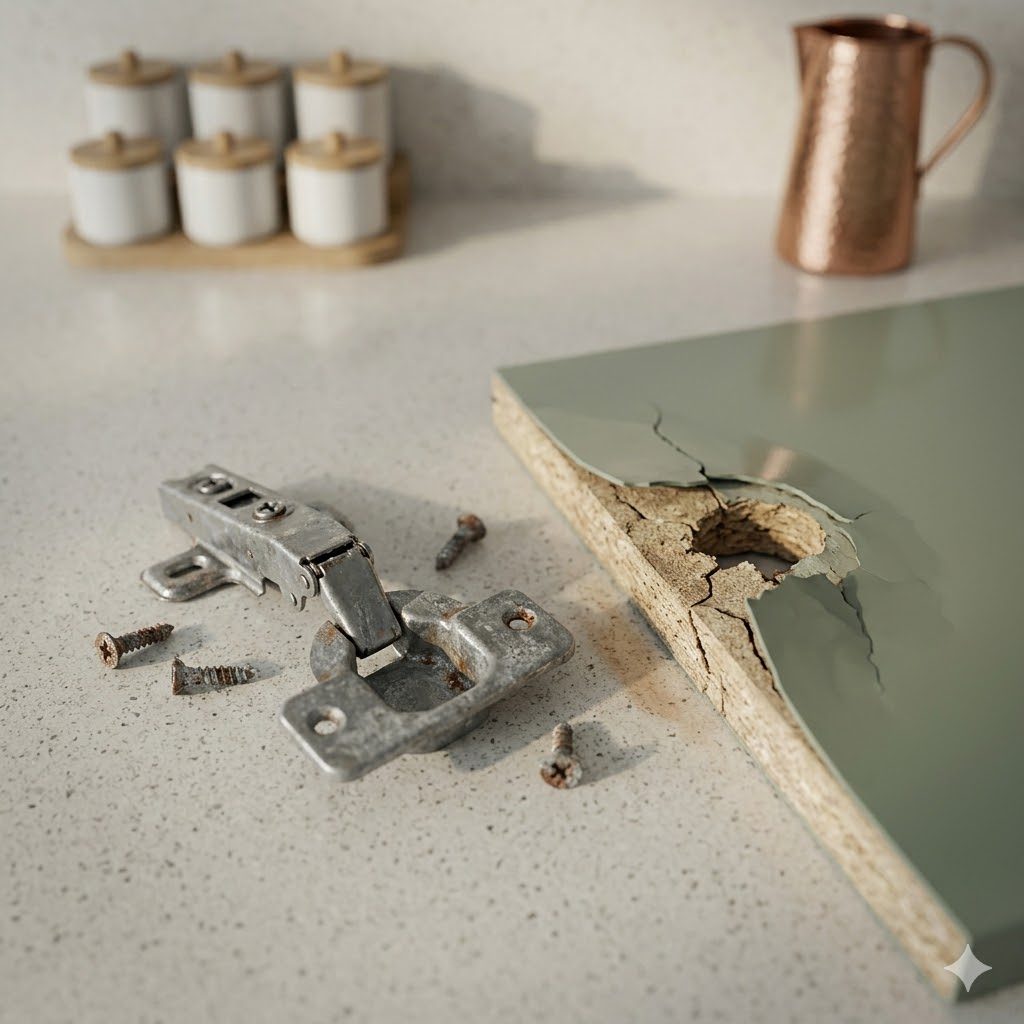
1. The sagging hinge. A budget cup hinge fatigues at 30,000 to 50,000 open-close cycles — roughly three to five years of normal use. The cup loosens in the MDF or particle-board substrate, the shutter sags 3 to 8 mm, the leading edge starts rubbing the carcase, the laminate band lifts. Within months of the first sag, the laminate has chipped, the substrate is exposed, and moisture begins entering the core.
2. The jamming drawer slide. A budget roller slide loses its alignment as the rollers wear. The drawer no longer travels parallel; it tilts a few degrees as it slides. Within a year the drawer front is bent at the hinge edge, the soft-close is dead, and pulling the drawer out requires a real effort. By year three, the drawer has stopped closing flush — it sticks proud of the cabinet front by 2 to 5 mm.
3. The broken pull-out trolley. A budget tall pull-out is built with light-gauge wire baskets and undersized slides. Loaded with the actual contents of a kitchen — rice tins, glass jars, oil bottles — it sags under the weight. The slides bind, the user yanks, the welds at the basket joints fail, and the whole loaded pull-out crashes to the floor. The damage is rarely just the pull-out; the contents take down the cabinet floor and often the adjacent shutter.
4. The slamming damper. A budget damper has no oil cylinder — just a spring-and-cam mechanism. It works for the first thousand cycles and degrades steadily after that. By year two the shutter slams instead of cushioning, every closure transmits an impact through the hinge, the hinge cup loosens faster, and failure mode 1 begins to accelerate.
Each of these failures is individually annoying. Together, they take down the entire interior.
The failure cascade — from ₹40 saved to ₹55,000 spent
The destructive part is not any one failure — it is the cascade. A single budget hinge in a single kitchen cabinet starts a chain of events that, four to five years later, requires replacing the entire shutter assembly and sometimes the carcase itself.
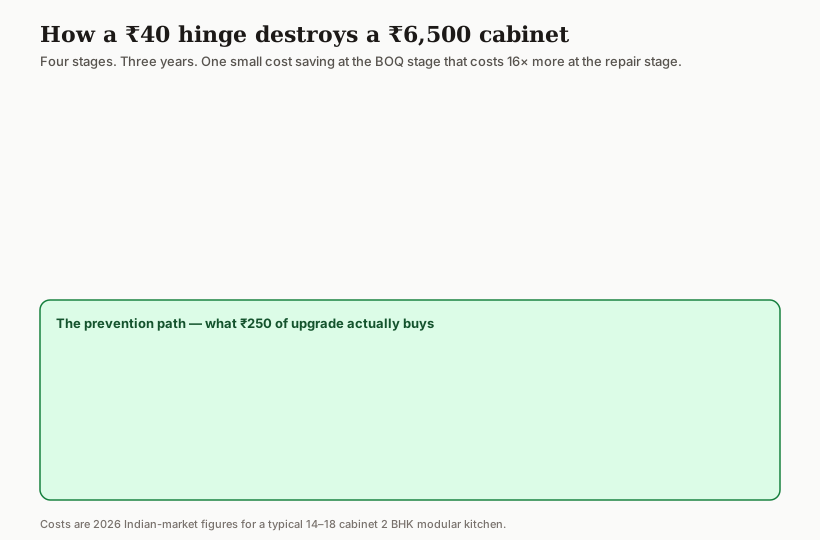
| Stage | Year | Event | Cumulative damage |
|---|---|---|---|
| 1 | 3 | Hinge fatigues, cup loosens | ₹40 hinge ruined |
| 2 | 3–4 | Shutter sags 3–8 mm, laminate chips | Edge band lifts, ₹600 repair-attempt |
| 3 | 4–5 | Water enters substrate, carcase swells | Shutter cannot be re-hinged |
| 4 | 5 | Full shutter assembly replacement | ₹6,500 + labour + disruption |
Multiply that cascade across a 14–18 cabinet kitchen and the maths is brutal. A 2 BHK modular kitchen on budget hardware suffers an average of three to six shutter failures and one to two carcase failures in years three through five. The total tab — including service-visit chaos, mismatched replacement parts and the time spent without a fully working kitchen — runs to ₹40,000 to ₹70,000.
The premium-hardware upgrade that would have prevented all of it costs ₹250 to ₹450 per cabinet. On a 14–18 cabinet kitchen, that is ₹5,000 to ₹9,000.
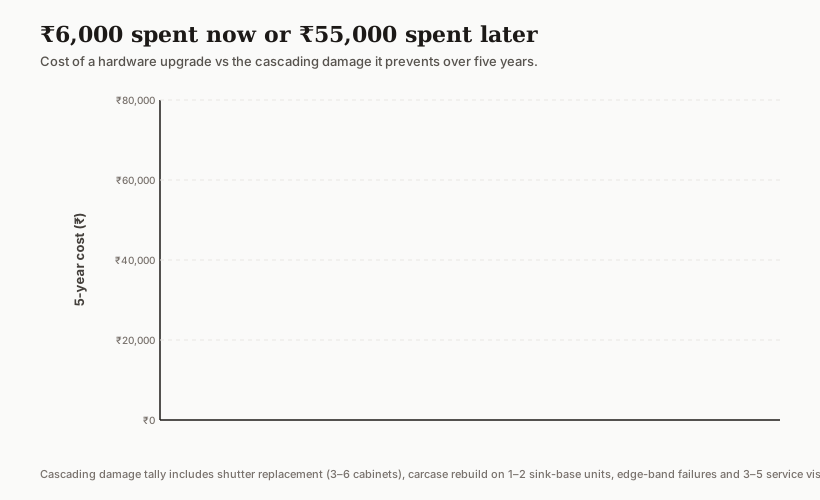
The honest reading: a ₹6,000 line in the BOQ at the start prevents ₹55,000 of repair and replacement at the end. The return on the upgrade is roughly eight to ten times the cost, before counting the absence of disruption.
How it shows up in quotes — and how to read past it
Substitution rarely happens with a wink and a nudge. It happens because the contract allowed it. The phrase "soft-close hardware included" in a quote is legally compatible with any soft-close mechanism, by any manufacturer, at any quality. The contractor is not breaking the contract; the contract was written to be broken.
The five attributes that make a hardware BOQ line enforceable are: brand, model, cycle rating, finish, warranty. Any line missing any of those five is a line that permits substitution.
| The wrong line | The right line |
|---|---|
| "Soft-close hardware included" | "Hinges: Hettich Sensys 8645i, 200k-cycle" |
| "Imported soft-close fittings" | "Slides: Hettich Quadro V6 50 kg, undermount" |
| "Premium pull-outs included" | "Pull-outs: Hettich Cargo Wari 600 mm tall" |
| No finish stated | "Finish: nickel-plated, PVD on visible items" |
| No warranty stated | "Warranty: lifetime mechanical, written" |
| No catalogue annexure | Catalogue page photo attached to contract |
Two real-world failure walk-throughs
The Mumbai 3 BHK kitchen. A homeowner signed off on a ₹4.8 lakh modular kitchen with "all soft-close hardware included". The carcase was BWP, the shutters were acrylic, the countertop was Caesarstone. The hardware turned out to be unbranded Chinese cup hinges at roughly ₹40 each. The first shutter sagged in month 32. By month 48, three uppers and two tall units were misaligned, two soft-closes had failed, and one tall pull-out had collapsed. The repair bill, including replacing five shutters and rebuilding two tall units with new BWP backs (the laminate edges had let water in during a monsoon), came to ₹62,000 — and three weeks of the kitchen being partially out of service. The hardware upgrade at BOQ stage would have cost ₹7,000.
The Bengaluru 2 BHK wardrobe. A four-door sliding wardrobe was specified as "top-hung sliding system with soft-close". The contractor installed an unbranded bottom-roll system. Within fourteen months the rollers had worn flat, the leaves tilted under their own weight, the soft-close brake had failed, and the doors no longer met flush at the centre. Three service visits later, the system was beyond repair. Replacing it with a proper Hettich TopLine top-hung system cost ₹38,000 retrofitted; specifying it at the start would have cost ₹14,000 extra over the bottom-roll original.
The hardware is the only part of the interior you cannot see and the only part you use every day. Specify it like it matters. Because, more than the laminate and more than the marble, it actually does.
The BOQ clause that prevents substitution
A single paragraph in the contract, read out loud at signing, defeats the catalogue trick. The exact wording matters:
"All hardware items are specified by brand and model number in Annexure A. Substitution of any item is not permitted without written approval from the client, supported by manufacturer-catalogue evidence of equivalent or superior cycle rating, load rating, and finish. Substitutions discovered after installation will be replaced at the contractor's cost."
That paragraph, plus a one-page annexure listing brand, model, cycle rating, finish and warranty for each item, removes the substitution loophole.
The fix, in order
1. Write Annexure A first. Brand, model, cycle rating, finish and warranty for every hinge, slide, pull-out and track.
2. Photograph every catalogue page. Attach them as a contract annexure — physical proof against substitution.
3. Insert the no-substitution clause. The two-sentence paragraph above is non-negotiable.
4. Hold ₹50,000 in retention. Released only after a 30-day audit of installed hardware against Annexure A.
5. Audit on delivery. Open every cabinet, check the brand stamp on the actual installed hinge — not on the sample shown in the showroom.
6. Plan replacements at year 4. Even premium hardware has a service interval; budget a small replacement cycle.
Prevent it / Plan it: Lock the hardware spec with the material quality checklist, benchmark vendors with the quote comparison tool, and study the premium kitchen hardware guide, why Indian kitchens fail after 5 years and why cheap interiors are expensive later before any contract is signed.
References
- Bureau of Indian Standards (2011) IS 3389: Specification for Cup Board Locks, Drawer Locks and Cup Board Bolts. New Delhi: BIS.
- Bureau of Indian Standards (2007) IS 7196: Specification for Hold Fasts. New Delhi: BIS.
- Forest Products Laboratory (2021) Wood Handbook — Wood as an Engineering Material. General Technical Report FPL-GTR-282. Madison, WI: USDA Forest Service.
- DIN Deutsches Institut für Normung (2011) EN 15570: Furniture Hardware — Strength and Durability of Hinges and their Components — Overhead Hinges. Berlin: DIN.
- Bell, V. B. and Rand, P. (2014) Materials for Architectural Design. London: Laurence King Publishing.
Part of the Studio Matrx Materials & Finishes series.
Export this guide
Related Guides — Deep-dive reading
Complete Guide to Interior Hardware
The 8–12% of the interior budget that decides whether everything else works
Materials & FinishesHow to Compare Security Quotations in India (2026): Read Three Quotes Like an Expert
Three quotes for the same home security job will name different amounts, different equipment and different scope. This homeowner guide shows how to make them truly like-for-like first, read every line item, spot what a cheap quote hides, and pick on total value rather than the lowest number.
SecurityThe Design Decisions With the Biggest Cost Consequences
A cost-leverage map of Indian home interiors — the handful of decisions that swing your total budget the most, so you spend your attention where a single choice has an outsized rupee impact.
Cost & MoneyRelated Tools — Try Free
Interior Contract Clause Checklist
16 sections and 98 checkboxes covering scope, BOQ, milestones, penalties, warranty, and disputes.
Contract ChecklistMaterial Comparison Sheet
India's interior material cheatsheet — plywood, finishes, hardware, countertops, paints, waterproofing.
Reference GuideModular Kitchen Budget Calculator
Live breakdown by running feet, countertop area, material tier and city — with wastage, design fee, GST.
Kitchen Calculator