
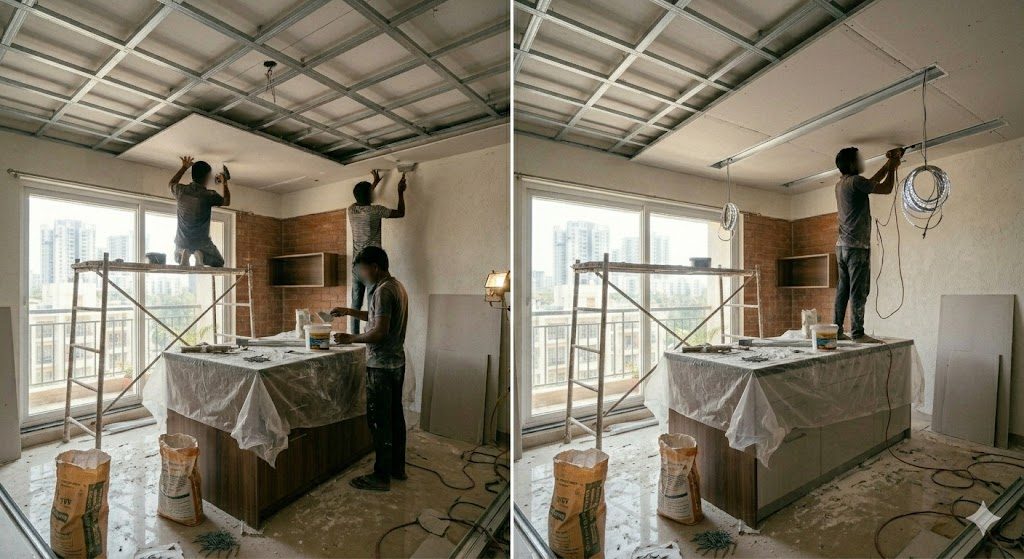
False Ceiling Cost Guide (India 2026)
What a false ceiling really costs per sqft — by material, type and room
A Bengaluru homeowner gets three false-ceiling quotes for the same 2BHK. One says ₹45,000, one says ₹78,000, one says ₹1.4 lakh — for ceilings that, on the drawing, look almost identical. Nobody on the WhatsApp group can explain the gap. The contractor mutters "per sqft rate, sir," and moves on. So she signs the middle one, hopes for the best, and finds out at the final bill that cove lighting, primer and a second paint coat were "extra."
This guide exists to close that gap. It is a pure cost reference: what a false ceiling actually costs per square foot in India in 2026, broken down by material, by ceiling type, by room, and by what is quietly left out of the quote. We will not re-explain how false ceilings are designed or built — the comprehensive false-ceiling design guide already covers types, materials and installation, and the biggest false-ceiling mistakes guide covers the pitfalls. Here we stay strictly in the cost lane.
The single idea to carry through: a false-ceiling quote is meaningless until you know the ₹/sqft rate, the area being treated, and exactly what that rate does and does not include. Get those three numbers and every quote becomes comparable.
What actually drives the cost
Every false-ceiling price in India is built from the same seven levers. When two quotes differ, it is always one of these — never magic.
| Cost driver | Cheaper end | Costlier end | Why it moves the price |
|---|---|---|---|
| Material | PVC, POP | Wooden / metal | Board and finish cost per sqft varies 5–8x |
| Coverage | Peripheral border | Full ceiling | Area treated can double |
| Layers | Single plain | Multi-level | More framework, board, edges, labour |
| Lighting integration | None / few spots | Dense cove + profile | Wiring, channels, drivers ride along |
| Finish | One paint coat | PU / texture / veneer | Surface cost per sqft |
| Labour rate | Tier-2 city, local crew | Metro, branded firm | City + overhead delta of 20–40% |
| Access & height | Open slab | Beams, ducts, low slab | Cutting, dropping, scaffolding |
The first three — material, coverage and layers — explain roughly 80% of any price gap. If you control those, you control the bill.

Material rates: ₹/sqft installed, 2026
These are installed rates — supply of board plus GI framework plus jointing plus a basic finish, fitted. They are not bare-material rates. Bands assume a standard residential ceiling in a metro/tier-1 city; tier-2 towns run 10–20% lower, premium branded firms 15–30% higher.
| Material | Installed ₹/sqft (2026) | What you get | Best for |
|---|---|---|---|
| PVC panel | ₹70–120 | Waterproof, wipe-clean, visible joint lines | Bathrooms, utility, tight budgets |
| POP on GI | ₹90–160 | Seamless, mason-built, unlimited curves | Curved & ornamental, value jobs |
| Gypsum board (Gyproc / Saint-Gobain) | ₹110–190 | Factory-flat, crack-resistant, fast | Living, bedrooms — the default |
| Gypsum, moisture-resistant (green board) | ₹130–210 | Same, for damp zones | Kitchen, semi-wet areas |
| Grid / metal tile | ₹130–280 | Removable tiles, full service access | Wet rooms, balconies, utility |
| Plywood / wooden | ₹220–600 | Veneer, rafters, slatted feature panels | Feature walls of the ceiling only |
Two things people get wrong here. First, the branded gypsum premium is real but small — a genuine Gyproc or Saint-Gobain board adds maybe ₹15–25/sqft over a generic board, and buys you consistent thickness, fewer sags and a proper warranty. Worth it. Second, "wooden false ceiling" is almost never a whole-room rate — it is a feature strip priced as if it were, and a 40 sqft wooden raft at ₹450/sqft is ₹18,000 for one accent. Budget it as a feature, not a ceiling.
A false ceiling is the one interior element where the cheapest material — PVC at ₹70/sqft — and the dearest — wooden at ₹600/sqft — can sit in the same flat and both be correct. The skill is putting each where it earns its rate.
Cost by ceiling type
Material sets the floor; the design type multiplies it. The same gypsum board costs very different amounts depending on whether it runs as a slim border or folds into three layers. These rates are per sqft of the room's floor area (the standard way Indian contractors quote a "ceiling"), assuming a gypsum/POP base.
| Ceiling type | ₹/sqft of room area | Relative cost | Notes |
|---|---|---|---|
| Peripheral / border | ₹80–140 | Lowest | Treats only the perimeter; hides AC piping |
| Plain / flat | ₹110–170 | Low | Full flat sheet, no steps |
| Single cove | ₹140–210 | Medium | One recessed channel for hidden light |
| Tray | ₹150–230 | Medium | Recessed centre panel |
| Floating / island | ₹180–280 | High | Detached raft, light spills around it |
| Multi-level | ₹220–360 | Highest | Two or more stepped planes |

Peripheral vs full-ceiling: the cost logic that matters most
This is the single biggest lever a homeowner controls, so it deserves its own line. A peripheral ceiling runs a band only along the room's edges — typically 1.5 to 2.5 feet wide — and leaves the centre as the bare slab, painted. A full ceiling drops board across the entire room.
The cost difference is brutal. In a 12 ft × 14 ft (168 sqft) living room, a 2 ft peripheral band covers roughly 100 running sqft of board; a full ceiling covers all 168 sqft plus the same perimeter detailing. On material and labour, peripheral typically lands 35–45% cheaper for the same room — and often looks better, because it keeps ceiling height in the centre, hides cornice-line wiring and AC piping, and gives you a clean cove for indirect light without boxing the room in. Unless you genuinely need a full board (very uneven slab, ceiling-mounted equipment, a flat acoustic surface), peripheral is the smart-money default. The room-by-room cost breakdown makes the same case across the whole flat.
What is included — and what is "extra"
This is where quotes diverge invisibly. A ₹150/sqft rate from one contractor and a ₹120/sqft rate from another can end up costing the same once the second adds line items the first had baked in. Pin down each of these before signing.
| Item | Usually included? | Typical extra if not | Watch for |
|---|---|---|---|
| GI framework / sections | Yes | — | Cheap rates skip proper section spacing |
| Board / POP supply | Yes | — | Generic vs branded board |
| Jointing tape + compound | Usually | ₹8–15/sqft | The crack-prevention step |
| Primer coat | Often NOT | ₹10–18/sqft | Frequently omitted to lower the rate |
| Final paint (1–2 coats) | Often NOT | ₹15–30/sqft | "Painting is separate, sir" |
| Cove / profile channel | NOT | ₹150–350/rft | The recess the light sits in |
| Cove-light wiring + driver | NOT | varies | Electrical scope, separate trade |
| Profile / spot lights | NOT | ₹400–1,200 each | The fixtures themselves |
| Scaffolding / height work | Sometimes | site-dependent | Tall ceilings, atriums |
The rule: ask the contractor to state the rate "with primer and two coats of paint, jointing included." If the number jumps, the original rate was a bare-board rate dressed up as a finished one.
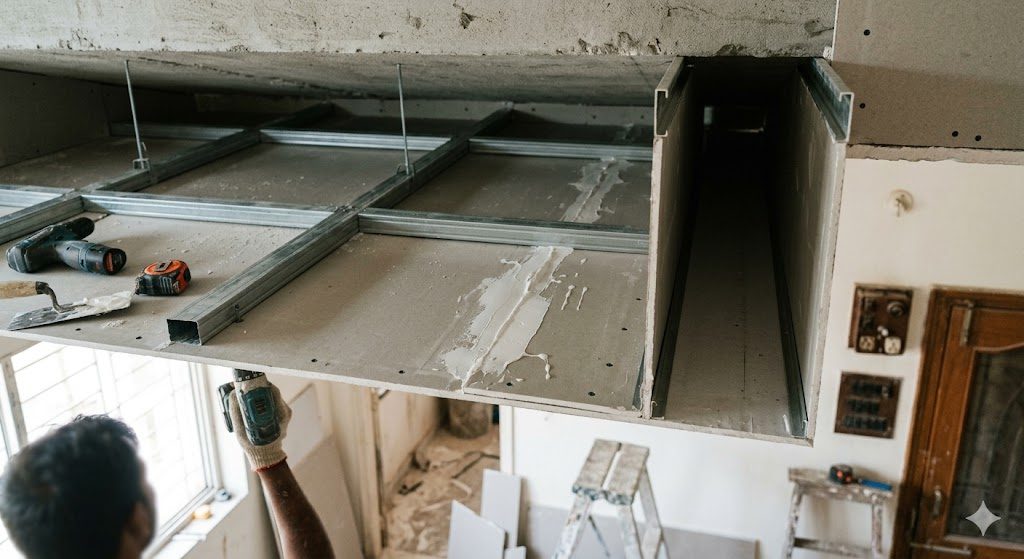
A worked 2BHK example
Numbers in the abstract are slippery, so here is a full ceiling spec for a typical 900–1,000 sqft 2BHK, using sensible material choices per room: peripheral gypsum in the dry rooms, moisture-resistant grid over the kitchen, PVC in the bathrooms, with a realistic lighting allowance.
| Room | Area treated | Rate | Line cost | Running total |
|---|---|---|---|---|
| Living + dining (peripheral gypsum) | 130 sqft | ₹150 | ₹19,500 | ₹19,500 |
| 2 bedrooms (peripheral gypsum) | 80 sqft | ₹140 | ₹11,200 | ₹30,700 |
| Kitchen (MR grid) | 30 sqft | ₹220 | ₹6,600 | ₹37,300 |
| 2 bathrooms (PVC) | 36 sqft | ₹100 | ₹3,600 | ₹40,900 |
| Profile + cove lighting (allowance) | — | — | ₹14,000 | ₹54,900 |
| 2BHK false-ceiling total | ~276 sqft | — | — | ≈ ₹54,900 |

So a sensibly-specced 2BHK false ceiling lands around ₹50,000–60,000 before the final paint coat. Now watch what choices do to that number:
| Choice | This 2BHK total |
|---|---|
| Peripheral + selective (the spec above) | ≈ ₹55,000 |
| Plain full gypsum in every room | ≈ ₹85,000–95,000 |
| Multi-level living + dense cove everywhere | ₹1.2 lakh+ |
| Wooden feature raft added to living | + ₹15,000–25,000 |
The ₹45,000-to-₹1.4-lakh spread our Bengaluru homeowner saw at the top is not three honest quotes for the same thing. It is three different specs — and once you see the levers, you can ask each contractor to quote the same one.
POP vs gypsum: cost and merit
These two cover the vast majority of Indian residential ceilings, so the choice deserves a clean comparison rather than folklore.
| Factor | POP (on GI) | Gypsum board |
|---|---|---|
| Installed ₹/sqft | ₹90–160 | ₹110–190 |
| Finish | Seamless, smooth | Factory-flat, joints taped |
| Curves & ornament | Excellent — any shape | Limited — needs cutting |
| Speed | Slow, wet, mason-dependent | Fast, dry, predictable |
| Cracking over time | More prone at joints | Less, if jointed properly |
| Mess on site | High (wet plaster) | Low (dry boards) |
| Repairability | Patch and re-plaster | Cut and replace section |
POP is genuinely cheaper per sqft and unbeatable for curves and traditional ornamentation. But its lower rate hides labour intensity and a longer, messier site, and a sloppy POP job cracks. Gypsum costs a little more, goes up faster and cleaner, and gives a more predictable flat result — which is why most metro firms default to it. For a straight, modern, well-lit ceiling, the ₹20–30/sqft gypsum premium usually pays for itself in finish and timeline. For curves, coves and a tight budget with skilled labour available, POP still wins.
Lighting: the cost that rides along
A false ceiling and its lighting are sold as one breath — "ceiling with cove" — but they are two budgets. The ceiling rate almost never includes the light. Plan it separately or it ambushes you at handover.
| Lighting element | Typical 2026 cost | Notes |
|---|---|---|
| Cove channel (the recess) | ₹150–350/running ft | Built into the ceiling profile |
| LED strip + driver (cove) | ₹120–300/rft fitted | Quality of strip matters most |
| Profile light (linear) | ₹600–1,500 each | Surface or recessed |
| Recessed spot / COB | ₹400–1,200 each | Fixture + fitting |
| Hanging / feature pendant | varies widely | A décor line, not ceiling |
For our 2BHK, the ₹14,000 lighting allowance covers cove strips along the living and dining border plus a handful of spots — modest and realistic. Go heavy on profile lights and downlights and lighting alone can match the cost of the ceiling it sits in. The smart budget allocation guide covers how to weigh this against the rest of the home spend.
Maintenance and repair cost
False ceilings are low-maintenance but not no-maintenance, and repair economics differ sharply by material.
| Material | Typical issue | Repair cost / effort |
|---|---|---|
| Gypsum | Joint hairline crack, water stain | ₹500–2,000 patch; section swap if soaked |
| POP | Crack, sag, fall in damp zones | Re-plaster patch; messy, ₹1,000–3,000 |
| PVC | Discolour, panel pop | Replace a panel cheaply |
| Grid | Tile stain | Lift and swap one tile — cheapest of all |
| Wooden | Warp, termite, fade | Costly — refinish or replace panel |
The honest takeaway: a leak from above is the real enemy. Gypsum and POP both fail when wet, which is exactly why the worked example puts grid over the kitchen and PVC in bathrooms — those rooms see the most moisture and benefit from materials you can lift, dry and swap. Spending a little more on the right wet-area material is cheaper than a ₹20,000 ceiling pull-down after a slab leak. This is the broader theme of why cheap interiors get expensive later.
How to read and compare a quote
A false-ceiling quote is only comparable when reduced to three numbers. Use this checklist on every quote you receive.
1. Find the ₹/sqft rate. If it is not stated, it is being hidden. Ask for it explicitly.
2. Confirm the area basis. Is the rate per sqft of room area, or per sqft of board actually fitted? Peripheral jobs are sometimes quoted on board area, which can make a cheap-looking rate expensive.
3. Pin down the finish. "With primer and two paint coats, jointing included" — say it back and watch the number.
4. Separate the lighting line. Cove channel, wiring, drivers and fixtures should be their own lines, not absorbed silently or omitted.
5. Check the material name. Branded gypsum, generic board, or POP? A vague "gypsum ceiling" can be either.
6. Look for the framework spec. Proper GI section spacing prevents sag; the cheapest rates skip it.
Run any quote through the false-ceiling cost estimator to get an independent ₹ range for your area and material before you negotiate, and the broader cost calculator to slot it into the full interior budget.
Where people overspend
Three patterns account for most false-ceiling waste in Indian homes:
- Full ceiling where peripheral would do. The most common and most expensive mistake. You pay 35–45% more per room for board nobody sees once furniture is in, and lose ceiling height.
- Multi-level for the sake of it. Each added plane multiplies framework, edges and labour. One clean cove reads as premium; three steps read as busy — and cost double.
- Over-lighting the recess. Cove strips and a dozen downlights per room push the lighting budget past the ceiling budget, and the room ends up looking like a showroom, not a home.
Premium spend belongs in one feature — a single floating raft, a wooden accent over the dining table — not spread thin across every ceiling. The budget-vs-premium interiors comparison shows where that premium rupee actually shows.
How to budget it, in order
1. Decide coverage first. Peripheral as the default; full ceiling only where you genuinely need it. This one call moves the bill more than any other.
2. Match material to room. Gypsum in dry rooms, MR grid over the kitchen, PVC in baths, wooden only as a feature.
3. Set a ₹/sqft band per room from the material table, then multiply by area treated.
4. Add a separate lighting line — cove channel, strip, drivers, spots — don't let it hide inside the ceiling rate.
5. Specify the finish explicitly — primer plus two coats, jointing included — and get it in writing.
6. Hold a 10% contingency for slab levelling, beam drops and access surprises.
7. Compare quotes on the same spec, reduced to rate × area × finish, never on the headline total.
A DesignAI tip: feed your floor plan and room sizes to DesignAI and it drafts an itemised false-ceiling BOQ — area per room, material rate, lighting allowance and a contingency line — so you walk into the contractor conversation already knowing the fair number.
References
1. CPWD, Delhi Schedule of Rates (DSR) 2023 and current addenda — false ceiling, gypsum board and POP item rates used as a public benchmark.
2. Construction Industry Development Council (CIDC), labour and finishing-trade rate guidance, India.
3. Bureau of Indian Standards — IS 2095 (gypsum plaster boards) and IS 9842 (PVC ceiling panels) for material specification.
4. National Building Code of India (NBC) 2016, Part 6 — false ceilings, fire and material provisions.
5. Saint-Gobain Gyproc India — published technical and installation literature for gypsum ceiling systems.
6. BMTPC (Building Materials & Technology Promotion Council) — material performance notes for boards and panels.
For the design and how-to side, see the false-ceiling design guide and the biggest false-ceiling mistakes. To place this within the whole-home budget, read smart budget allocation for Indian homes and the room-by-room cost breakdown.
Export this guide
Related Guides — Deep-dive reading
The Truth About Cost Per Square Foot
Why a ₹/sqft interior quote is the most misleading number in Indian home costing — and how to convert it into a real BOQ
Cost & MoneyHow to Compare Security Quotations in India (2026): Read Three Quotes Like an Expert
Three quotes for the same home security job will name different amounts, different equipment and different scope. This homeowner guide shows how to make them truly like-for-like first, read every line item, spot what a cheap quote hides, and pick on total value rather than the lowest number.
SecurityThe Design Decisions With the Biggest Cost Consequences
A cost-leverage map of Indian home interiors — the handful of decisions that swing your total budget the most, so you spend your attention where a single choice has an outsized rupee impact.
Cost & MoneyRelated Tools — Try Free
False Ceiling Cost Estimator
Live ₹/sqft across 8 ceiling types — POP, gypsum, designer, metal, PVC, wooden — with cove and spot lighting for 20 Indian cities.
Cost CalculatorFull-Room BOQ — Living, Bedroom, Kitchen, Bath
Room-wise BOQ across living, bedrooms, kitchen, utility, and bathrooms with line-item pricing.
Full-Room BOQHome Building & Interior Cost Calculator — 20 Cities
Construction + interior costs for 20 Indian cities across kitchen, wardrobes, flooring, painting, ceiling.
Cost Calculator