

Smart Budget Allocation for Indian Homes
Where every rupee should go — the allocation framework that prevents overspend and regret
A Bengaluru couple set aside ₹12,00,000 for their new 2BHK interiors. By the time the kitchen was installed, the living-room TV unit was clad in fluted PU, and the master wardrobe had soft-close everything, they had spent ₹10,40,000 — and the second bedroom, the study, the balcony, the second bathroom and the entire painting bill were still untouched. They had splurged on what they could photograph and starved everything else. The project limped to the finish eight months late, ₹3,80,000 over, with a credit-card balance nobody planned for. The money was never the problem. The allocation was.
This guide gives you the framework that prevents exactly that: how to divide an interior budget across categories so the visible and the invisible both get funded, so you do not run out before you finish, and so each rupee lands where it buys the most lived value. You will get recommended percentage splits, how those splits shift for a rental versus an owned home and budget versus premium, two fully worked rupee examples for a 2BHK and a 3BHK at 2026 rates, and the allocation mistakes that drain budgets quietly.
The single idea that fixes most interior-budget pain is this: allocate by category share first, in percentages, before you fall in love with any single item — and protect the invisible essentials (civil works, electrical, contingency) before you spend a rupee on anything Instagrammable.
The core problem: we allocate emotionally
Left to instinct, almost everyone allocates an interior budget the same wrong way. We fund what we can see and show — the TV unit, the kitchen island, the bedroom headboard, the feature wall — and we treat the rest as an afterthought. Three predictable failures follow.
First, the visible-item splurge. The living room and master bedroom soak up 50–60% of the budget because that is where guests look and where the "before/after" photos get taken. The second bedroom, the study, the utility, the children's room get whatever is left.
Second, the starved-essentials trap. Civil work, waterproofing, wiring, distribution boards, earthing, sufficient light points — none of these photograph, so none of them get funded properly. People discover mid-project that the flat needs eight more electrical points, that the bathroom needs re-waterproofing, that the false ceiling has to be re-done to hide a beam. This invisible 25–30% of a real budget is exactly what the emotional allocator forgets.
Third, running out before finishing. Because there was never a category-level plan, spend is sequential and unbudgeted — each vendor quotes for their bit, the homeowner says yes, and the money is gone two-thirds of the way through. The last rooms get cancelled, downgraded or pushed to "phase 2" that never arrives.
The fix is not more money. It is a top-down allocation: decide the slices of the pie first, in percentages, then fit your wishlist inside each slice. Our room-by-room cost breakdown shows how the same total reads very differently once it is split by space; this guide splits it by category.
Nobody overspends on the things they planned for. The damage is always in the slice they never allocated — the eighth power point, the re-done waterproofing, the contingency that did not exist.
The allocation framework: the master split
Here is the baseline allocation for a typical owned 2BHK at mid-spec in 2026 — an 850–1,000 sqft carpet-area flat finished to a comfortable, durable standard (not bare-budget, not luxury). These are shares of the interior fit-out budget, with the civil shell of the building excluded (you are not building the structure, you are finishing it).
| Category | Share | Why it gets this slice | 2026 ₹ for a typical 2BHK (₹12,00,000 budget) |
|---|---|---|---|
| Kitchen (modular) | 20% | Highest-use, hardest-to-redo, resale-sensitive room; carcass + shutters + counter + appliances-fit | ₹2,40,000 |
| Wardrobes / storage | 18% | Every bedroom needs it; built-in joinery dominates carpentry spend | ₹2,16,000 |
| Furniture + FFE | 14% | Sofa, beds, dining, TV unit, loose chairs, fixtures, fittings & equipment | ₹1,68,000 |
| Civil + false ceiling | 12% | Demolition, masonry, waterproofing, plaster, POP/gypsum ceiling, leveling | ₹1,44,000 |
| Electrical + lighting | 10% | Re-wiring, points, DBs, switchgear, layered light fittings | ₹1,20,000 |
| Flooring | 8% | Tiles/vitrified/wood where existing floor is replaced or topped | ₹96,000 |
| Contingency | 7% | The known-unknown buffer (sits inside a 10–15% discipline — see below) | ₹84,000 |
| Painting | 6% | Full-flat putty + primer + 2-coat emulsion, plus texture/accent walls | ₹72,000 |
| Soft furnishings | 5% | Curtains, blinds, rugs, cushions, bed linen, décor | ₹60,000 |
| Total | 100% | ₹12,00,000 |
A few notes on the slices that surprise people. The kitchen + wardrobes together are 38% — well over a third of the entire budget — because modular joinery is the single most labour-and-material-intensive part of any Indian fit-out. Civil + electrical together are 22% and almost none of it is visible in a finished photo; this is the slice the emotional allocator destroys first. And contingency is a real line, not a rounding error — more on that below.
These shares are a starting frame, not a law. They assume you are not moving walls heavily (which inflates civil), not importing furniture (which inflates FFE), and not doing a full luxury build (which inflates everything). For the per-square-foot logic underneath these numbers, see our interior cost per sqft guide, and run your own numbers on the budget allocation tool.
How the split shifts by home type
The master split is for an owned, mid-spec home. The moment the situation changes, the slices move — sometimes dramatically. The biggest single variable is how long you will live there and whether you can take the money with you when you leave.
| Category | Rental fit-out | Budget owned | Premium owned | Why it moves |
|---|---|---|---|---|
| Kitchen | 12% | 20% | 22% | Renters minimise fixed kitchen spend; owners invest for the long haul |
| Wardrobes / storage | 22% | 18% | 16% | Renters prefer free-standing (takeable); owners build in |
| Furniture + FFE | 26% | 12% | 14% | Renters put money in loose, movable furniture |
| Civil + false ceiling | 5% | 12% | 14% | Renters avoid permanent works on someone else's flat |
| Electrical + lighting | 8% | 10% | 12% | Premium homes add automation, scene lighting, more circuits |
| Flooring | 2% | 8% | 9% | Renters rarely touch the floor; owners may upgrade |
| Painting | 7% | 6% | 4% | Smaller share of a bigger premium pie |
| Soft furnishings | 10% | 5% | 5% | Renters lean on textiles to personalise cheaply |
| Contingency | 8% | 9% | 4% | Owned-budget jobs hit more surprises; premium jobs are better surveyed |
The headline: rental fit-outs push ~48% of spend into loose furniture and free-standing storage — money you can pick up and carry to the next flat. Permanent works (civil, flooring, built-in joinery) shrink to a sliver. Premium owned homes do the opposite — more goes into permanence, finishes and systems that are hard to redo, because the owner intends to live with them for a decade. For the full picture of what separates the two ends, read budget vs premium interiors and, for the top end specifically, the cost of luxury interiors in metro cities.
Apartment versus villa shifts things too: a villa adds external works, staircases, more bathrooms and often a larger kitchen, so civil and flooring rise while the per-room joinery intensity falls. The percentages above hold reasonably for apartments; villas typically need civil bumped 3–5 points.
Spend on permanence, save on swappables
This is the principle that makes the whole framework work, and it is brutally simple: put your good money into the things that are expensive or disruptive to change later, and economise on the things you can swap in an afternoon.
Permanence is anything that is built-in, wet, behind a wall, or under your feet — wiring, plumbing, waterproofing, flooring, the kitchen carcass, structural joinery, the bathroom. Getting these wrong is not a ₹5,000 fix; it is breaking tiles, chipping plaster, calling an electrician back into a finished home. This is where quality earns its keep. Skimping here is the single most expensive false economy in Indian interiors — our guide on why cheap interiors get expensive later is a catalogue of exactly this regret, and why cheap hardware destroys expensive interiors shows how a ₹120 hinge ruins a ₹40,000 shutter.
Swappables are everything you can change without a contractor: curtains, cushions, rugs, loose furniture, lampshades, décor, even the paint colour. These are where you economise without anyone ever knowing, and where you can upgrade later when cash allows.
Where rupees buy the most perceived value
Within the "save on swappables" idea sits a sharper one: some rupees are high-leverage — small spend, big visible payback — and some are low-leverage — large spend, thin payback. Knowing the difference lets you look expensive without spending like it.
| Spend area | Leverage | Why | Smart move |
|---|---|---|---|
| Layered lighting | High | A ₹40,000–70,000 lighting plan changes how every room feels, day to night | Spend here generously; warm 2700–3000K, dimmable, three layers |
| Paint + one feature wall | High | Whole-room mood for the price of a few cans + labour | One accent wall per room beats panelling everywhere |
| Handles, hinges, channels | High | Touched dozens of times daily; cheap ones fail visibly | Buy tier-1 hardware (Hettich/Hafele/Ebco) even on a budget job |
| Curtains + drapery | High | Soften and lift any room; reads as "designed" | Floor-to-ceiling, wider than the window; mid fabric is fine |
| Kitchen worktop + sink | High | The daily workhorse surface; failure is constant irritation | Quartz/granite + good sink & tap; economise on shutters instead |
| Imported marble everywhere | Low | Huge cost; most visitors cannot tell it from good Indian stone | Use one statement slab; Indian marble/large-format tile elsewhere |
| Over-built false ceiling | Low | Eats ceiling height and budget; rarely the thing people admire | Peripheral cove + a single feature drop, not full-flat boxing |
| Branded loose furniture | Low | Depreciates fast; status without lasting value | Buy good-bones pieces, spend the saving on upholstery |
| Niche smart gadgets | Low | Novelty fades; many go unused within a year | Wire for it; add devices later only where you will use them daily |
| Decorative wall panelling | Low | Trend-dated quickly; pricey to remove | Limit to one wall; paint and texture age better |
The pattern is consistent: spend on what you touch and what is hard to change; economise on what is swappable, trend-bound, or rarely noticed. Our deep dive on expensive choices that age poorly extends this list with a decade-long view.
Phasing and sequencing the spend
Even with a perfect percentage split, the order you spend in matters — partly for cash flow, partly because some work physically must precede other work. A sane sequence protects both.
The non-negotiable physical order: civil and waterproofing → electrical and plumbing rough-in → flooring → false ceiling → carpentry/modular → painting → loose furniture and soft furnishings. You cannot tile over un-waterproofed slabs or chase a wall for wiring after the paint is done. The first four bullets are the "wet and rough" phase — get them right and the rest is reversible.
For cash flow, if you cannot fund everything at once, phase by room rather than by half-finishing every room. A common, livable phasing:
| Phase | What gets done | Rough share of budget | Why this order |
|---|---|---|---|
| Phase 1 (move-in critical) | Kitchen, one bedroom wardrobe, all civil + electrical + flooring + painting, essential lighting | ~65% | The flat must be functional and the "wet and rough" work is one-shot |
| Phase 2 (3–6 months) | Second/third bedroom joinery, TV unit, study, balcony | ~25% | Defer the joinery you can live without briefly |
| Phase 3 (as cash allows) | Soft furnishings, décor, smart devices, accent upgrades | ~10% | Pure swappables — never block move-in for these |
The cardinal rule of phasing: never defer the one-shot work. Civil, waterproofing, concealed wiring and flooring are far cheaper to do once, up front, than to retrofit into a lived-in home. Defer the swappables, never the structure. For more on funding the gaps between phases, see how an EMI plan compares against an interior budget.
Contingency discipline: the 10–15% rule
Of all the lines in this framework, contingency is the one people delete first and regret most. A real interior project should carry a contingency of 10–15% of the total budget, and on older flats or anything with demolition, the higher end.
In the master table it shows as 7% — that is the planned-allocation portion that sits inside the donut. The discipline is broader: you hold an additional buffer outside your committed allocation, so that the figure you quote vendors against and the figure you actually have are not the same number. If your true budget is ₹12,00,000, you plan your scope against ₹10,50,000 and keep ₹1,50,000 (12.5%) in reserve.
What contingency is for: the wall that turns out to be load-bearing, the extra waterproofing the bathroom needs, the eight power points you discover you want, the price revision between quote and order, the GST you forgot, the small scope creep that every project breeds. None of these are bad luck — they are statistically certain, which is exactly why you fund them in advance. The professional treatment of this, including provisional sums, is covered in contingency, provisional sums and risk allocation, and the surprises themselves are mapped in our companion hidden costs of home renovation.
The discipline in one sentence: a budget without a contingency is not a budget, it is a wish.
Worked example: a ₹12,00,000 2BHK
Let us put real rupees on the framework. Assume an owned 2BHK, ~950 sqft carpet, Bengaluru, mid-spec, total interior budget ₹12,00,000, no major wall changes.
| Category | Share | ₹ Allocation | What it buys at this spec |
|---|---|---|---|
| Kitchen | 20% | ₹2,40,000 | L-shaped modular, BWP-ply carcass, laminate shutters, quartz counter, chimney + hob fit, tall unit |
| Wardrobes / storage | 18% | ₹2,16,000 | Two built-in wardrobes (master + second BR), soft-close, laminate finish, one with loft |
| Furniture + FFE | 14% | ₹1,68,000 | Sofa, dining set, two beds, TV unit, study table, fixtures |
| Civil + false ceiling | 12% | ₹1,44,000 | Minor demolition, bathroom re-waterproofing, peripheral cove ceiling in living + master |
| Electrical + lighting | 10% | ₹1,20,000 | Re-wiring of key circuits, ~40 points, DB upgrade, layered fittings + drivers |
| Flooring | 8% | ₹96,000 | Vitrified tile in two rooms where existing floor is dated; rest retained |
| Contingency | 7% | ₹84,000 | Held in reserve (top up toward 12.5% from buffer) |
| Painting | 6% | ₹72,000 | Full-flat putty + primer + 2-coat emulsion, one texture wall |
| Soft furnishings | 5% | ₹60,000 | Curtains all rooms, rugs, cushions, basic décor |
| Total | 100% | ₹12,00,000 |
This lands at roughly ₹1,260/sqft on carpet area — a sane mid-spec Bengaluru number for 2026. For a complete, city-specific build-up of exactly this brief, our realistic 2BHK interior budget for Bengaluru walks it line by line. And if your number is tighter, see what ₹10 lakhs of interiors actually buys.
Worked example: an ₹18,00,000 3BHK
Scale up to an owned 3BHK, ~1,300 sqft carpet, same city and spec band, total ₹18,00,000. The percentages hold, but the rupee weight grows and a third bedroom + extra bathroom nudge a couple of slices.
| Category | Share | ₹ Allocation | Notes vs the 2BHK |
|---|---|---|---|
| Kitchen | 19% | ₹3,42,000 | Larger U-shaped kitchen, more tall storage |
| Wardrobes / storage | 19% | ₹3,42,000 | Three wardrobes now, not two |
| Furniture + FFE | 14% | ₹2,52,000 | Extra bedroom set + larger living |
| Civil + false ceiling | 12% | ₹2,16,000 | Second bathroom waterproofing adds civil |
| Electrical + lighting | 10% | ₹1,80,000 | ~55 points, more circuits |
| Flooring | 8% | ₹1,44,000 | Larger area to cover |
| Contingency | 7% | ₹1,26,000 | Held in reserve (top up from buffer) |
| Painting | 6% | ₹1,08,000 | Larger wall area |
| Soft furnishings | 5% | ₹90,000 | Curtains/rugs across more rooms |
| Total | 100% | ₹18,00,000 | ≈ ₹1,385/sqft |
Notice the kitchen share dips a point and wardrobes rise a point versus the 2BHK — the third bedroom adds joinery, while the kitchen, though bigger, does not scale linearly. This is the framework working as designed: the percentages flex, the discipline does not.
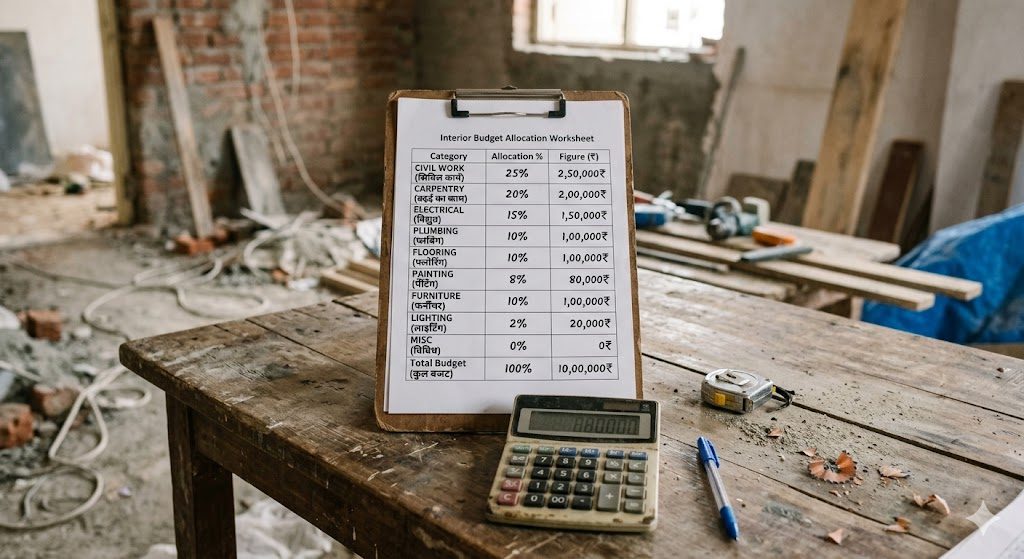
Common allocation mistakes
These are the patterns we see drain budgets, in rough order of how much damage they do.
| Mistake | What it looks like | The fix |
|---|---|---|
| No category plan at all | Saying yes to vendors one quote at a time | Set the percentage split before any vendor visit |
| Starving the invisible 30% | Civil, electrical, contingency under-funded | Ring-fence them first; they are not optional |
| Front-loading two rooms | 55% in living + master, rest scrambles | Allocate every room before spending on any |
| Zero or token contingency | "We will manage" | Hold a hard 10–15% outside committed scope |
| Splurging on swappables | Imported marble, branded sofa, full panelling | Move that money to permanence and lighting |
| Skimping on permanence | Cheap wiring, thin waterproofing, low-grade hardware | Buy quality on anything built-in or wet |
| Ignoring GST + design fees | Budgeting only the BOQ subtotal | Add 18% GST and any design/PM fee on top |
| No phasing for cash flow | Half-finishing every room | Phase by room; never defer one-shot civil work |
For the full taxonomy of money-losing decisions, our guide on the most expensive interior mistakes in India goes deeper on each, and the broader behavioural list is in 25 interior mistakes Indian homeowners regret.
How to budget it, in order
1. Fix your true total, then plan scope against 87–90% of it — the rest is your hard contingency reserve.
2. Apply the percentage split for your home type (owned/rental, budget/premium) to get rupee slices per category.
3. Ring-fence the invisible essentials first — civil, waterproofing, electrical — before allocating a rupee to anything visible.
4. Allocate every room in the home before you spend on any single one; no room is "phase 2" by default.
5. Decide your high-leverage splurges — lighting, hardware, kitchen worktop — and your economise list — swappables, trend items.
6. Sequence the spend in physical order; complete the wet-and-rough phase fully before carpentry and paint.
7. Add 18% GST and any design/PM fee on top of the BOQ subtotal so the headline number is the real number.
8. Track actuals against the plan weekly; when one slice overruns, cut from a swappable slice, never from civil or contingency.
Want this done for you from your floor plan? DesignAI drafts an itemised BOQ and a category-by-category budget allocation from your plan in minutes — every slice in the donut above filled with real 2026 rates for your city, so you start from a number instead of a guess. Pair it with the budget planner to stress-test the total before you commit.
References
1. Central Public Works Department (CPWD), Delhi Schedule of Rates (DSR) and Plinth Area Rates — Government of India baseline for civil and finishing item rates.
2. Construction Industry Development Council (CIDC), construction cost indices and labour-rate references for Indian projects.
3. Bureau of Indian Standards, National Building Code of India (NBC) 2016 — services, electrical, and space-planning provisions referenced for points and circuits.
4. Real Estate (Regulation and Development) Act, 2016 (RERA) — carpet-area definition used as the costing basis throughout.
5. Building Materials & Technology Promotion Council (BMTPC), cost and material guidance for Indian residential construction.
6. Bureau of Indian Standards, IS 2185 / IS 1077 and finishing-material standards referenced for spec-tier assumptions.
7. CBRE and Anarock India residential market reports, 2025–26, for city-level fit-out cost deltas.
Plan further with our related cost guides: the room-by-room cost breakdown, interior cost per sqft, budget vs premium interiors, what ₹10 lakhs buys, and the most expensive interior mistakes to avoid.
Export this guide
Related Guides — Deep-dive reading
The Design Decisions With the Biggest Cost Consequences
A cost-leverage map of Indian home interiors — the handful of decisions that swing your total budget the most, so you spend your attention where a single choice has an outsized rupee impact.
Cost & MoneyThe Truth About Cost Per Square Foot
Why a ₹/sqft interior quote is the most misleading number in Indian home costing — and how to convert it into a real BOQ
Cost & MoneyThe Homeowner's Guide to Interior Design Budgets in India
Where the money really goes in an Indian fit-out — realistic 2026 ranges, cost-per-sqft truths, bang-for-buck upgrades, life-cycle costing and contracts
Home PlanningRelated Tools — Try Free
False Ceiling Cost Estimator
Live ₹/sqft across 8 ceiling types — POP, gypsum, designer, metal, PVC, wooden — with cove and spot lighting for 20 Indian cities.
Cost CalculatorHome Building & Interior Cost Calculator — 20 Cities
Construction + interior costs for 20 Indian cities across kitchen, wardrobes, flooring, painting, ceiling.
Cost CalculatorApartment Interior Planning Checklist
51-item checklist across structural, ceiling, lighting, furniture, storage, electrical, kitchen, bathroom.
Checklist