

The Homeowner's Guide to Interior Design Budgets in India
Where the money really goes in an Indian fit-out — realistic 2026 ranges, cost-per-sqft truths, bang-for-buck upgrades, life-cycle costing and contracts
Almost every interior project in India begins the same way: a number gets mentioned, everyone nods, and work starts. Six months later the conversation is no longer about ceilings and wardrobes — it is about why the final bill is forty percent higher than the number everyone nodded at. The problem is rarely greed or incompetence. It is that the original number was never really a budget. It was a wish.
A budget is not the cheapest a job could possibly cost, nor the figure that lets you avoid an uncomfortable conversation with your spouse. It is an honest meeting point between two things: what you are genuinely willing to spend, and what the home you actually want will actually cost to build. When those two numbers disagree — and at the start they almost always do — you have only three real options. Spend more, want less, or some sensible blend of both. Most people who finish a renovation happy did a bit of both, early and on purpose.
This guide is the money chapter of the Studio Matrx Home Design Foundations series. It will not give you one magic per-square-foot figure, because that figure does not exist and anyone who sells it to you is selling you a surprise for later. Instead it will show you where the rupees actually go in an Indian fit-out, which upgrades repay you many times over, which ones quietly eat a third of your budget, how contracts apportion risk, and how to keep a contingency you will almost certainly need.
Facing the Number Before It Faces You
The single most expensive habit in home budgeting is selective hearing. A designer says "this kind of work runs somewhere between ₹12 lakh and ₹18 lakh for your flat," and the brain — helpfully, protectively — files away ₹12 lakh and quietly discards the ₹18 lakh. From that moment, every subsequent decision is measured against a ceiling that was actually a floor. The disappointment is then baked in before a single hinge is bought.
The cure is uncomfortable but cheap: write down two numbers on the same page, today. On the left, the amount you are truly prepared to part with, including the part you have been pretending you do not have. On the right, an honest first estimate of what your brief — your wishlist of kitchen, wardrobes, ceilings, finishes, furniture — will cost at the quality you are imagining. Then look at the gap. The gap is not a failure. The gap is the actual work of budgeting.
A budget you have not yet faced is just a number you will be forced to face later, at a worse exchange rate.
If the right number is bigger than the left number, you change the brief, change the budget, or both. Changing the brief does not mean ruining the house. It usually means doing fewer rooms now and the rest in phase two, choosing a beautiful laminate instead of acrylic in the spare bedroom, or skipping the false ceiling in rooms nobody will look up in. The families who renovate without regret are the ones who made these trades deliberately, on a spreadsheet, instead of having them forced on them at week ten when the money simply ran out.
Why "Cost Per Square Foot" Is a Murky Number
Ask three vendors what interiors cost per square foot and you will get three numbers and zero comparability. One quotes ₹1,200, another ₹1,800, another ₹2,500 — and all three may be describing the same flat. The figure feels precise. It is not.
The trouble is that "per square foot" hides the two things that matter most: which square feet, and what is on them. Some vendors divide by carpet area, some by built-up area, some by the super built-up area printed on your sale deed — which can be twenty to thirty-five percent larger. Divide the same total by a bigger area and the per-foot number magically drops, making the costlier vendor look cheaper. Then there is scope: does the figure include the modular kitchen, or is that "extra"? Does it count the balcony, the utility, the loft, the pooja unit? Does it include loose furniture and curtains, or only the fixed civil and carpentry?
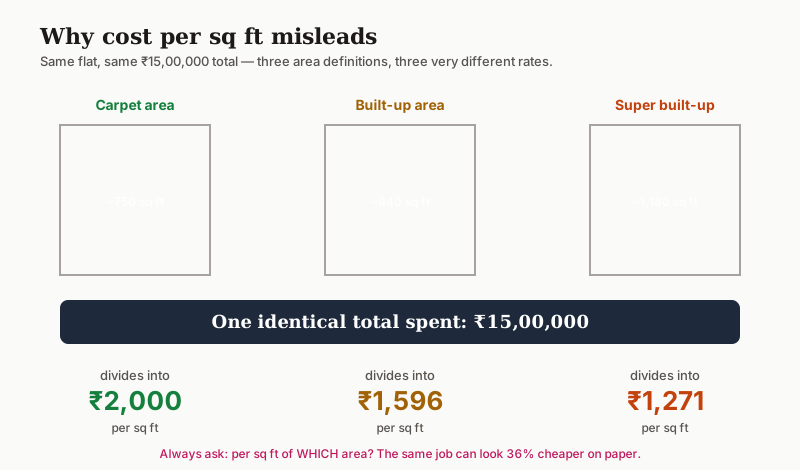
Use cost-per-square-foot for exactly one thing: a rough sanity check that a quote is in the right galaxy. Never sign a contract on it. Before comparing two quotes, force both onto the same basis — same area definition (insist on carpet area), same inclusion list, same brand tier — or you are comparing a kilo of one thing to a litre of another.
| Per-sqft basis | What it includes | Typical 2026 range (metro) | Honest verdict |
|---|---|---|---|
| Carpet area | Fixed interiors only (carpentry, ceiling, paint, electrical) | ₹1,400–₹2,800 | Most meaningful basis; insist on it |
| Built-up area | Same scope, divided by larger area | ₹1,100–₹2,200 | Looks cheaper, identical work |
| Super built-up area | Same scope, divided by largest area | ₹900–₹1,800 | Most flattering, least honest |
| "All-in" carpet | Includes loose furniture, curtains, decor | ₹2,200–₹4,500 | Closest to your real outflow |
Tier-2 cities (Indore, Coimbatore, Jaipur, Kochi) typically run fifteen to thirty percent below metro figures on labour, less on materials, which are nationally priced. All ranges here are indicative for 2026 and move with steel, copper, and freight; this is why the guide carries a verify-by date.
Where the Money Actually Goes
Open up any Indian fit-out and the spend clusters in a handful of line items. Carpentry — your modular kitchen and wardrobes — almost always leads, often forty to fifty-five percent of a fixed-interiors budget. False ceiling, flooring, electrical and lighting, and painting form the next band. Loose furniture, soft furnishings and decor are technically optional, which is exactly why they get squeezed and then resented later.
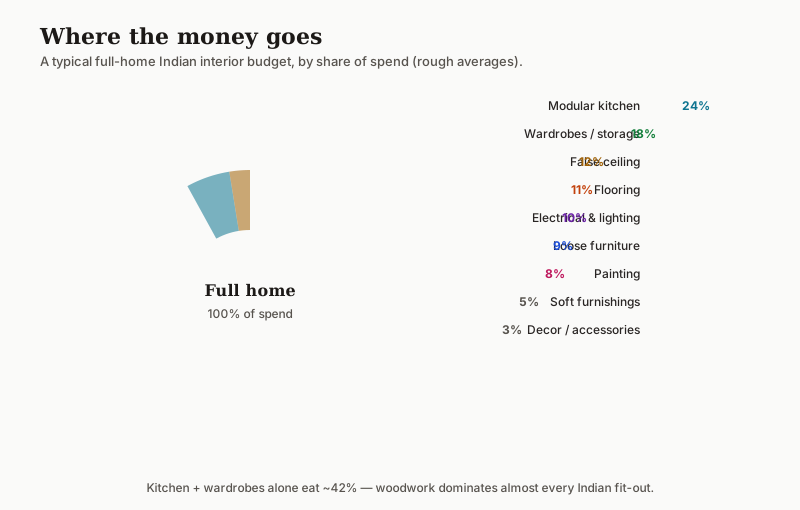
Here is an indicative line-item breakup for a typical 2BHK of roughly 650–850 sq ft carpet area, in 2026 rupees, across three quality tiers. "Basic" means honest laminate and standard fittings done well; "Mid" means selective premium finishes and branded hardware; "Premium" means designer-led, imported accents and high-gloss work.
| Line item (2BHK) | Basic | Mid | Premium |
|---|---|---|---|
| Modular kitchen | ₹1.8–2.8 L | ₹3.0–5.0 L | ₹6–12 L |
| Wardrobes & storage | ₹1.5–2.5 L | ₹3.0–4.5 L | ₹5–9 L |
| False ceiling | ₹0.6–1.0 L | ₹1.2–2.0 L | ₹2.5–4.5 L |
| Flooring (over existing) | ₹0.4–0.9 L | ₹1.0–2.0 L | ₹2.5–6 L |
| Electrical & lighting | ₹0.7–1.2 L | ₹1.5–2.5 L | ₹3–5 L |
| Painting | ₹0.5–0.9 L | ₹1.0–1.6 L | ₹1.8–3 L |
| Civil & plumbing changes | ₹0.3–0.8 L | ₹0.8–1.8 L | ₹2–4 L |
| Loose furniture | ₹0.8–1.5 L | ₹2.0–4.0 L | ₹5–12 L |
| Soft furnishings & decor | ₹0.3–0.6 L | ₹0.8–1.5 L | ₹2–5 L |
| Indicative total | ₹7.9–12.2 L | ₹15.3–25.4 L | ₹32–60.5 L |
For a 3BHK of roughly 950–1,300 sq ft carpet area, the same logic scales — but not linearly, because the kitchen does not double when you add a bedroom. Below is a per-quality view alongside a rough per-sqft band, useful only as the sanity check discussed above.
| Tier | 3BHK indicative total | Per sq ft (carpet) | What it buys |
|---|---|---|---|
| Basic | ₹11–17 L | ₹1,200–1,700 | Solid laminate carpentry, standard fittings, partial ceiling |
| Mid | ₹20–34 L | ₹1,900–2,900 | Branded hardware, selective veneer, full lighting plan |
| Premium | ₹42–80 L+ | ₹3,500–6,000+ | Designer-led, imported stone, acrylic, custom loose furniture |
Treat every cell as approximate and city-dependent. A premium kitchen in Mumbai and the same kitchen in Nagpur can differ by a third on installation alone.
Bang for the Buck — and Where the Buck Disappears
Not all rupees buy the same amount of happiness. A small set of upgrades punch far above their cost, because they touch you every single day or quietly prevent expensive misery later. Another set looks irresistible in a moodboard and then consumes a quarter of your budget while adding little you will actually notice.
The cheap-but-mighty list is short and worth memorising. Good soft-close hinges and channels cost a few hundred rupees more per unit and transform how a home feels for fifteen years. A lighting plan decided early — layered, dimmable, with the right colour temperature — costs almost nothing extra in conduit but is nearly impossible to retrofit. Proper waterproofing in wet areas is invisible until it isn't, and then it is the most expensive thing in the house. A nicer tap or a single statement handle changes a room's whole register for a four-figure sum.
| Cheap upgrade | Rough extra cost | Why it pays off |
|---|---|---|
| Soft-close hinges & drawer channels | ₹300–700 per unit | Daily delight, far fewer slammed-door repairs |
| Dimmers & layered lighting plan | ₹15,000–40,000 | Sets mood; near-impossible to add later |
| Good waterproofing (wet areas) | ₹20,000–50,000 | Prevents seepage costing lakhs to undo |
| Branded taps / one statement handle | ₹2,000–8,000 each | Outsized perceived quality |
| One flush feature wall element | ₹15,000–35,000 | Focal point without ceiling everywhere |
| Quality door locks & hardware | ₹3,000–9,000 per door | Security and tactile feel every day |
Spend where your fingertips and eyes land daily; economise where only the contractor will ever look.
The other list — the budget-eaters — is just as important. Designer false ceilings in every room, lots of imported stone, curved or fully custom carpentry, high-gloss acrylic instead of laminate, and double-height drama all carry consequences far beyond their own line. They multiply electrical, structural, and labour costs around them.
| Big-cost-consequence element | Cost driver | Cheaper path that keeps the soul |
|---|---|---|
| Full designer ceiling everywhere | Plus wiring, painting, height loss | Cove only in living/dining; plain elsewhere |
| Imported stone (marble, onyx) | 3–6× domestic; fragile; sealing | Indian marble or large-format vitrified |
| Curved / fully custom carpentry | Labour-intensive, wastage | Modular with one curved accent |
| High-gloss acrylic across all units | 1.5–2.5× laminate | Acrylic on kitchen shutters only |
| Double-height volume | Lost floor area, AC load | Generous single height, tall windows |
Buying Once Versus Buying Twice — Life-Cycle Costing
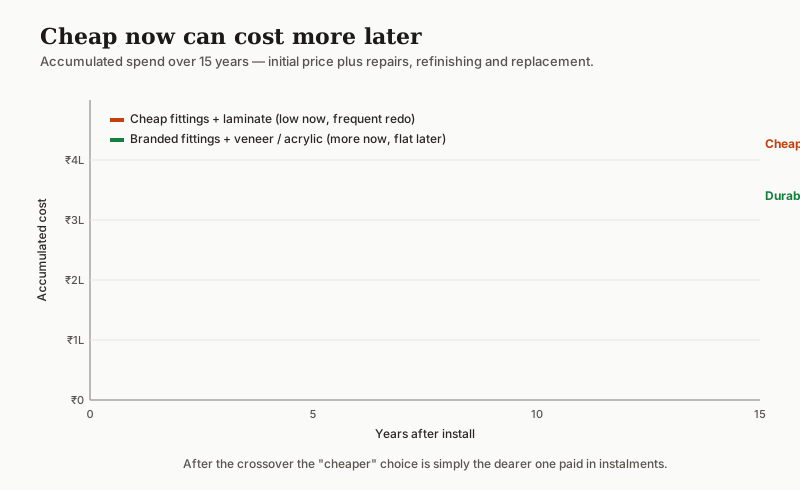
The cheapest material on quotation day is frequently the most expensive material over the decade you live with it. A budget that only compares purchase prices is reading half the bill. Veneer costs more than laminate up front but, refinished once, outlives it gracefully; acrylic resists scratches and yellowing better than both. Vitrified tile is a fraction of marble's cost and asks almost nothing of you, where marble wants periodic polishing and weeps at turmeric. Cheap fittings save four-figure sums and then drip, corrode, and get replaced inside three years.
| Choice | Initial cost | Upkeep | Typical lifespan | Buy-twice risk |
|---|---|---|---|---|
| Laminate finish | Low | Minimal | 8–12 yrs | Low |
| Veneer finish | Medium | Occasional polish | 12–20 yrs | Low |
| Acrylic finish | High | Wipe-clean | 12–18 yrs | Low |
| Vitrified flooring | Low–medium | Almost none | 15–25 yrs | Very low |
| Marble flooring | High | Periodic polish | 25–40 yrs | Low (but stains) |
| Kota stone | Low | Oiling/sealing | 20–30 yrs | Low |
| PVC carcass | Low | None | 6–10 yrs | Medium (swells, sags) |
| BWR / marine ply (IS 303 / IS 710) | Medium–high | None | 15–25 yrs | Very low |
| Unbranded fittings | Very low | Frequent | 2–4 yrs | High |
| Branded fittings (Jaquar/Cera) | Higher | Rare | 10–15 yrs | Very low |
The honest rule: in wet areas and high-use carpentry, buy the durable option once; in low-traffic rooms and decorative skins, the cheaper choice is genuinely fine. Spend the saving on the kitchen, not on a guest-room ceiling.
Allowances, Change Orders, and Honest Provisional Sums
When the project starts, you will not have chosen every tile, light, tap, and handle. The contract handles this with allowances — provisional sums set aside for items not yet selected. The danger is structural: vendors quoting competitively are tempted to set allowances unrealistically low so their headline total looks attractive. You select an actual ₹85-per-sqft tile against an allowance of ₹45, and the difference becomes a "change order" that lands as a surprise at billing.
Protect yourself by interrogating every allowance before signing. Ask what tile, tap, and light the provisional figure assumes, then walk a showroom to see whether you could live with it. If you cannot, raise the allowance now, on paper, so the headline total tells the truth. A budget built on fantasy allowances is not cheaper — it is just dishonest about when you will feel the pain.
| Item | Lowball allowance (red flag) | Realistic 2026 allowance |
|---|---|---|
| Floor / wall tile | ₹40–50 /sq ft | ₹70–140 /sq ft |
| Sanitaryware (per bath) | ₹12,000–18,000 | ₹25,000–55,000 |
| Light fixtures (whole home) | ₹25,000–40,000 | ₹60,000–1.5 L |
| Hardware & fittings | ₹15,000–25,000 | ₹40,000–90,000 |
Insist that every change order is priced and approved in writing before the work happens, never after. "We will adjust at the end" is how budgets quietly grow by lakhs.
Contracts, GST, and the Brand Premium
How you contract the work decides who carries the risk when reality diverges from the plan. Three structures dominate Indian interiors, and each suits a different temperament.
| Contract type | How it works | You carry | Best when |
|---|---|---|---|
| Turnkey (lumpsum) | One fixed price for a defined scope | Scope-change risk; little overrun risk if scope holds | You want certainty and a tight brief |
| Item-rate (BOQ) | Priced per unit/sqft against measured quantities | Quantity risk; pay for what is actually done | You want transparency and may tweak scope |
| Cost-plus (labour + material) | Actuals plus a fixed fee or percentage | Most overrun risk; full visibility | High customisation, evolving design, trust in vendor |
Turnkey feels safest and often is — provided the scope is genuinely complete and the allowances are honest; otherwise its certainty is an illusion punctured by change orders. Item-rate rewards homeowners willing to track measurements. Cost-plus gives you the truest picture and the loosest leash, which is wonderful with a trusted designer and dangerous without one.
On payments, resist large advances. A healthy structure is a modest mobilisation advance (around ten to twenty percent), milestone payments tied to verifiable completion (carpentry erected, ceiling done, paint complete), and a retention of five to ten percent held thirty to sixty days against defects. Never let payments run ahead of work; a vendor paid in full has no incentive to return for the snag list.
GST applies to interior works contracts and bundled supply-and-install services — commonly at eighteen percent for the works-contract service component as of 2026. A quote that is silent on GST is not a cheaper quote; it is an incomplete one. Always ask whether the figure is inclusive or exclusive, and get the GSTIN on the invoice so the tax you pay is the tax that reaches the government.
When the Brand Premium Is Worth It
Indian interiors are a tug-of-war between brand names and value picks. Hettich and Hafele hardware genuinely outlast generic hinges in daily-slammed kitchens — worth it. Tiles from Kajaria, Somany, or Johnson buy consistency and warranty; a good value brand is often fine for low-traffic floors. Asian Paints commands a premium for finish and durability that shows on large wall expanses. Jaquar, Cera, and Hindware sanitaryware reward you in wet areas where failure is expensive. Branded modular systems — Sleek, Godrej Interio, Häcker — buy precision and service, but a competent local carpenter using branded hardware and BWR ply can match much of it for less.
Pay the brand premium where failure is wet, daily, or load-bearing; skip it where the only payoff is a label nobody will read.
Beware the "other guy" trap — choosing a glossier, costlier finish for an imagined future buyer who may never exist. You are designing for the family that lives here now. Resale rarely returns the marginal lakh you spent chasing someone else's taste; design for yourself.
Designer Fees, Contingency, and Financing
A good designer or architect is not a cost you bolt on — they are the person who keeps the other costs from running away. Indian fee structures take three common shapes, sometimes blended.
| Fee model | Typical 2026 range | What you get |
|---|---|---|
| Percentage of project cost | 8–15% of works value | Full design, drawings, vendor coordination, site supervision |
| Per square foot | ₹80–₹350 /sq ft | Design and documentation; supervision often extra |
| Lump-sum / fixed | ₹75,000–₹5 L+ | Defined deliverables; predictable for you |
What you are buying is not decoration — it is a brief turned into buildable drawings, a BOQ that exposes lowball allowances, vendor comparison, and someone on your side when a change order appears. On a ₹25 lakh project, a designer who prevents a single ten percent overrun has more than paid for themselves.
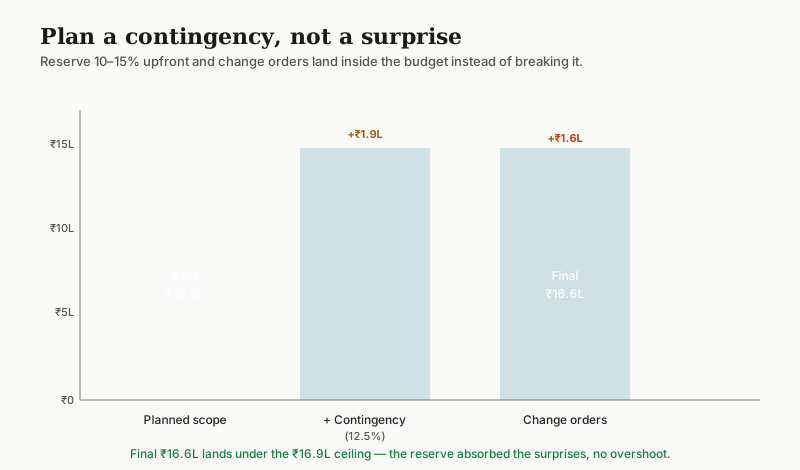
Finally, the line item nobody wants and everyone needs: contingency. Walls hide surprises, scope creeps, and you will fall in love with one thing you had not budgeted. Set aside ten to fifteen percent of the total, untouched, in a separate mental (or actual) account. It is not slack to be spent — it is the difference between finishing the project and abandoning it three rooms short.
If you are financing, match the borrowing to the work. A home-improvement loan or a top-up on an existing home loan typically prices better than a personal loan and can be drawn against milestones, so you are not paying interest on lakhs sitting idle. Structure disbursements to follow completion, mirroring how you pay the vendor. A budget, a contract, and a loan that all march to the same milestones is a project that finishes — on the number you actually faced at the start.
References
- Central Board of Indirect Taxes and Customs (CBIC) — GST rates and rules on works contracts and composite supply. https://www.cbic.gov.in
- Goods and Services Tax — official portal, taxpayer and rate information. https://www.gst.gov.in
- National Building Code of India 2016 (NBC), Bureau of Indian Standards — building services, materials, and construction practice.
- Real Estate (Regulation and Development) Act, 2016 (RERA) — carpet area definition and buyer protections. https://mohua.gov.in
- Central Public Works Department (CPWD) — Schedule of Rates and Delhi Analysis of Rates, a public reference for civil and finishing costs. https://cpwd.gov.in
- Bureau of Indian Standards — IS 303 (plywood for general purposes) and IS 710 (marine/BWP plywood). https://www.bis.gov.in
- Bureau of Indian Standards — IS 15622 and related standards for ceramic and vitrified tiles.
- Hirsch, William J. Jr. Designing Your Perfect House: Lessons from an Architect. Dalsimer Press. (A general inspiration for this series' approach to thinking honestly about a home budget.)
This guide is part of the Studio Matrx "Home Design Foundations" series. Continue with How a Home Feels Right, From Space to Place, Planning Your Home Before You Spend a Rupee, Programming Your Home, and Designing a Naturally Energy-Efficient Home. Put the priorities you set here to work with the Priority Ranking Tool and the Design Trade-Off Helper — then bring your brief and budget to life with Studio Matrx DesignAI.
Export this guide
Related Guides — Deep-dive reading
The Design Decisions With the Biggest Cost Consequences
A cost-leverage map of Indian home interiors — the handful of decisions that swing your total budget the most, so you spend your attention where a single choice has an outsized rupee impact.
Cost & MoneyThe Truth About Cost Per Square Foot
Why a ₹/sqft interior quote is the most misleading number in Indian home costing — and how to convert it into a real BOQ
Cost & MoneyThe Trade-Offs Every Homeowner Has to Make
No one gets everything — every home is a stack of compromises. This is about the sacrifices: the cost-quality-time triangle, the recurring homeowner trades, and how to make your cuts on purpose instead of having them forced by a blown budget.
Planning Your ProjectRelated Tools — Try Free
False Ceiling Cost Estimator
Live ₹/sqft across 8 ceiling types — POP, gypsum, designer, metal, PVC, wooden — with cove and spot lighting for 20 Indian cities.
Cost CalculatorHome Building & Interior Cost Calculator — 20 Cities
Construction + interior costs for 20 Indian cities across kitchen, wardrobes, flooring, painting, ceiling.
Cost CalculatorWindow Hardware Cost Calculator
Estimate window hardware cost — hinges, handles, locks, rollers and multipoint gears.
Window Calculator