
Hidden Costs in Home Renovation Nobody Explains
The line items that blow renovation budgets — and how to see them coming
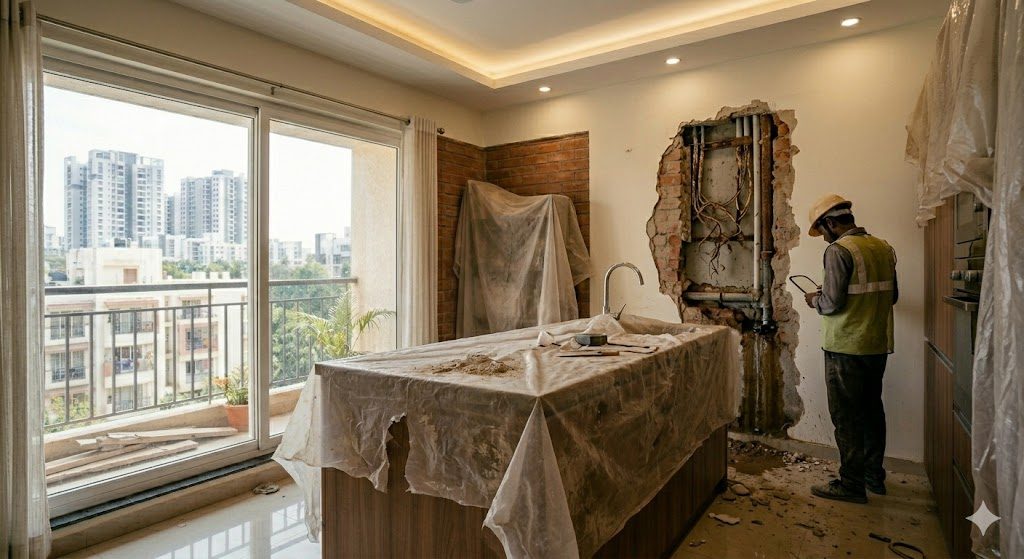
Anjali signed a clean renovation quote for her 1,200 sqft Pune flat: ₹12 lakh for new flooring, a re-done kitchen, fresh paint, and a couple of walls moved to open up the living room. The contractor was reputable, the BOQ looked thorough, and she had a 10% buffer in mind. Five months later the project closed at ₹17.6 lakh. Nothing was stolen, nothing was scammed — she simply discovered, item by painful item, all the costs that a renovation quote never contains because they are not the contractor's work to quote.
This guide is about those costs. Not the line items in a fit-out estimate, and not the headline rate-per-sqft of a renovation — those are covered elsewhere. This is specifically about the hidden costs that appear only because you are renovating an existing, lived-in or tenanted home rather than fitting out an empty new flat. The demolition. The damage you find when the wall opens. The rent while you live elsewhere. The society deposit. The making-good after every change. The escalation on a job that drags. These are renovation-specific, and they are the reason renovation budgets blow up far more reliably than new-fit-out budgets.
The core idea: a renovation quote prices the work the contractor will do; it does not price the consequences of disturbing a home that is already standing. Those consequences — demolition, discovery, disruption, and delay — routinely add 30% to 50% on top of the quote, which is why renovation needs a 15–20% contingency where a new build needs only 10%.
First, stay in your lane: what this guide is NOT
There is a lot of cost confusion online, so let us draw the boundary cleanly before spending a single rupee.
If you are doing a brand-new fit-out of an empty flat — bare shell, nothing to demolish, nobody living there — the hidden costs you face are design fees, AC, curtains, GST, society NOC, and so on. Those belong to our companion guide on hidden costs in new interiors. Many of them apply to renovation too, but they are not unique to renovation.
If you want the overall, headline cost of a renovation — the ₹/sqft bands, what a kitchen renovation runs, what a full-flat renovation runs — that is our home renovation cost guide. That tells you the size of the iceberg above the water.
This guide owns the part below the water: the costs that exist only because the home already exists and is occupied. Demolition has to happen because there is old work to remove. Damage gets discovered because there are walls to open. You pay rent because someone lives there. The society charges a deposit because the building is occupied by other families. None of this happens on a clean new fit-out.
A new fit-out has no past to undo. A renovation is half archaeology — you are paying to discover and reverse decisions made by builders and owners you never met.
The renovation-specific hidden-cost checklist
Here is the full list, with realistic 2026 bands for a representative 1,000–1,400 sqft metro flat, mid-spec. Treat these as planning ranges, not quotes — actual figures depend on city, building age, and scope.
| Hidden cost | What it is | Typical 2026 range | When it bites |
|---|---|---|---|
| Demolition + dismantling | Breaking old flooring, false ceilings, fixed furniture, partition walls | ₹25,000–₹90,000 | Day one, before any new work |
| Debris / malba removal | Carting rubble out; municipal debris fee in some cities | ₹15,000–₹60,000 | Throughout; ₹3,000–₹8,000 per tractor-trailer |
| Hidden damage repair | Old wiring, leaking concealed pipes, damp, weak plaster, termite, slab cracks | ₹50,000–₹2,50,000 | The moment a wall or floor opens |
| Making-good / patch-up | Re-plaster, re-paint, fill chases after moving a point or wall | ₹30,000–₹1,00,000 | After every electrical/plumbing change |
| Living-out rent or hotel | Staying elsewhere while work runs (2–3 months) | ₹60,000–₹2,40,000 | If the home is uninhabitable mid-work |
| Occupied-home premium | Labour slowdown + protection if you live in during work | 8–15% on labour | If you do NOT move out |
| Society / RWA charges | NOC, refundable deposit, lift + lobby protection, work-hour limits | ₹15,000–₹75,000 | Before work can legally begin |
| Dust protection + deep clean | Sheeting, sealing, and a professional deep-clean at the end | ₹12,000–₹40,000 | Start (protect) and end (clean) |
| Furniture shifting + storage | Moving and storing what you keep | ₹15,000–₹60,000 | Start and end of project |
| Utility disconnect/reconnect | Temporary power/water shifting, meter work, DG charges | ₹5,000–₹30,000 | Mid-work |
| Price escalation | Material/labour drift on a long job | 5–12% of remaining spend | Anything beyond ~3 months |
| Statutory / structural approval | Engineer certificate, municipal permission for structural change | ₹20,000–₹1,50,000 | If you touch beams, slabs, or facade |
| GST + labour cess | 18% GST on services; 1% labour welfare cess on larger works | 18% on labour-portion | On every invoice |
| Contingency consumed | The unknowable, drawn down by surprises | 15–20% of project | Continuously |
The total of the "usually applies" rows on a ₹12 lakh quote lands between ₹4 lakh and ₹6 lakh of additions — which is exactly how a ₹12 lakh quote becomes a ₹17–18 lakh reality.
For an interactive version of this exercise, run your numbers through the cost reality check tool, then size the base scope with the cost calculator.
1. Demolition and debris — the cost of clearing the past
On a new fit-out, the site arrives empty. On a renovation, you pay first to remove what is already there: old vitrified tiles chipped off the screed, a gypsum false ceiling pulled down, fixed wardrobes prised out, a brick partition knocked through.
Demolition labour for a mid-sized flat runs ₹25,000–₹90,000 depending on how much is coming out and whether you are lifting flooring (slow, dusty, expensive) or just stripping surface finishes.
Then comes debris — the part everyone forgets. A flat renovation generates several tonnes of rubble, and it cannot sit in the building. You pay for:
- Carting: ₹3,000–₹8,000 per tractor-trailer load; a full-flat renovation can produce 3–6 loads.
- Municipal debris / malba charges: Several cities now levy a construction-and-demolition (C&D) waste fee or require disposal at a designated C&D plant. Delhi, Mumbai, Bengaluru, and Pune all have C&D waste rules under the Construction and Demolition Waste Management Rules, 2016. Budget ₹500–₹1,000 per tonne where a tipping fee applies.
- Society penalties if rubble is dumped in common areas or the wrong bin — some RWAs fine ₹2,000–₹10,000.
A realistic all-in demolition-plus-debris figure for a full-flat renovation is ₹40,000–₹1,20,000. It is invisible on most quotes because the contractor assumes you will "handle disposal" — and you assumed it was included.
2. Hidden damage — the surprise behind the wall
This is the single most budget-destroying category in renovation, and it has no equivalent in a new fit-out. The instant a wall opens, a floor lifts, or a false ceiling comes down, you can find:
| Discovery | Why it happens in Indian homes | Typical fix |
|---|---|---|
| Old aluminium / undersized wiring | Pre-2005 flats often have aluminium or 1.5 sqmm copper unable to take modern loads | Rewire affected circuits ₹40,000–₹1,50,000 |
| Leaking concealed plumbing | Galvanised iron pipes corrode; CPVC was rare before ~2010 | Re-pipe wet areas ₹30,000–₹1,20,000 |
| Damp / seepage | Failed external waterproofing, bathroom leaks into adjacent walls | Chemical treatment + re-plaster ₹25,000–₹1,00,000 |
| Weak or hollow plaster | Decades-old plaster delaminates when disturbed | Hack + re-plaster ₹150–₹250/sqft |
| Termite | Common in older buildings, found behind skirting / wardrobes | Anti-termite treatment ₹15,000–₹50,000 |
| Structural surprises | Cracked beam, corroded reinforcement, unauthorised earlier alteration | Engineer + repair ₹50,000–₹3,00,000+ |
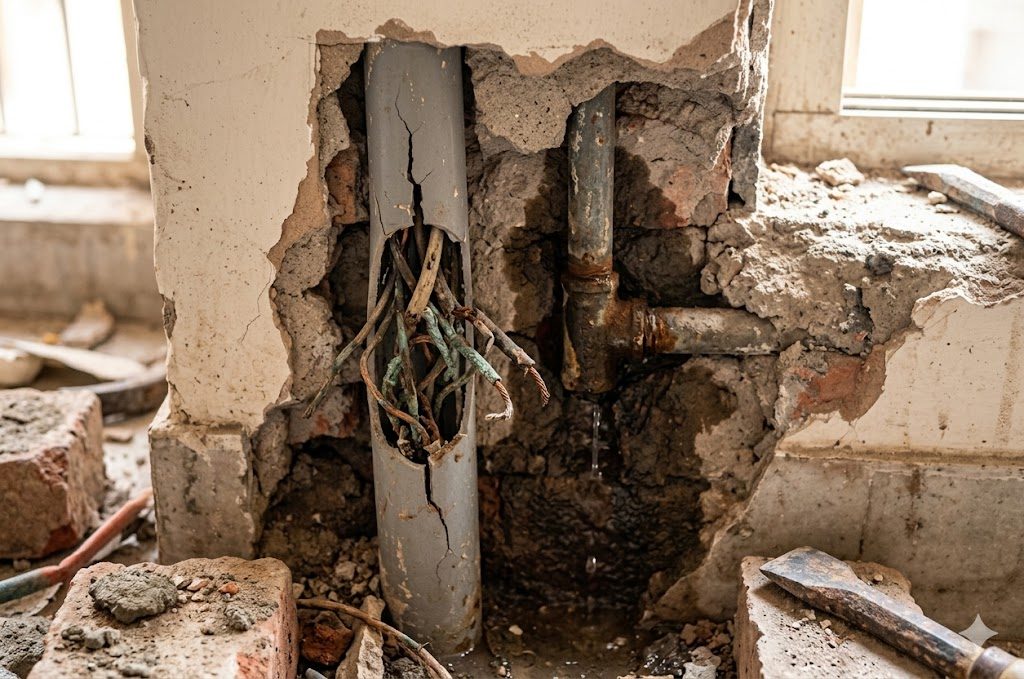
The trap is that you cannot scope these until you open up, so they sit outside the quote by definition. A good contractor will flag the risk and price a "provisional sum" for it; a weak one stays silent and hits you with a variation order at the worst moment. Our guide on renovation red flags covers how to read those signals before you sign.
This is precisely why renovation contingency must be larger than new-build contingency — the unknown is structurally bigger.
3. Making-good — every change leaves a wound
Move one electrical point and you cut a chase into the wall, run conduit, fill it, re-plaster, and re-paint a patch that never quite matches, so often the whole wall gets repainted. Shift a switchboard, relocate a plumbing point, take out an old AC sleeve — each leaves a scar that has to be made good.
On a new fit-out this barely exists because nothing was finished yet. On a renovation, making-good is a real line:
- Re-plastering chases and patches: ₹150–₹250/sqft of disturbed area.
- Repainting rooms touched by electrical/plumbing rework: even if you "weren't planning to paint that room," you now have to.
- Re-doing skirting, beading, and trims disturbed during work.
Budget ₹30,000–₹1,00,000 for making-good on a partial renovation. The cruel logic: the more you "optimise" by only changing a few points, the more disproportionate the making-good cost feels, because you are repainting a whole room to fix one chase.
4. Living-out cost — or the occupied-home premium
Here is a fork in the road that the quote never mentions, and either branch costs money.
Branch A — you move out. A full renovation with flooring, kitchen, and wet-area work is genuinely uninhabitable for 6–12 weeks. If you take a short-term rental or stay in a serviced apartment:
| City | 2BHK monthly rent (short-term) | 2.5-month living-out cost |
|---|---|---|
| Bengaluru | ₹35,000–₹60,000 | ₹88,000–₹1,50,000 |
| Mumbai | ₹60,000–₹1,20,000 | ₹1,50,000–₹3,00,000 |
| Delhi NCR | ₹30,000–₹55,000 | ₹75,000–₹1,38,000 |
| Pune / Hyderabad | ₹25,000–₹45,000 | ₹63,000–₹1,13,000 |
Add a deposit (often 1–2 months), a shifting cost both ways, and the fact that you are paying rent on an empty flat while also servicing your home loan EMI.
Branch B — you live in during work. You save the rent, but you pay an "occupied-home premium" that hides in the labour:
- Work proceeds room-by-room, so the job takes 30–50% longer — and longer means more escalation and more daily-wage labour days.
- Daily protection and pack-down: the team sheets up, works, and cleans a liveable zone every single day.
- Lower productivity in a cramped, partially-furnished space.
That premium typically adds 8–15% to the labour portion of the job. There is no free option — you either pay rent or pay the slowdown.
5. Society and RWA charges — the cost of being in a community
A new fit-out in a fresh building has light rules. A renovation in an occupied society is governed by the RWA / managing committee, and they protect the other families. Expect:
| Charge | Typical 2026 range | Notes |
|---|---|---|
| Renovation NOC / permission | ₹0–₹10,000 | Some societies charge an admin fee |
| Refundable security deposit | ₹15,000–₹50,000 | Returned if no damage to common areas |
| Lift / lobby protection | ₹5,000–₹20,000 | Sheeting, ply guards, dedicated service lift |
| Debris handling charge | ₹3,000–₹15,000 | Some societies arrange/charge for removal |
| Restricted work-hours | Indirect cost | Often 10am–5pm, no Sundays — slows the job |
The deposit is refundable, but it is cash blocked for months. The bigger hidden cost is the work-hour restriction: if your society only allows noisy work for five hours a day with weekends off, a job that could run in 6 weeks stretches to 10 — and every extra week carries escalation and supervision cost. Always read the society's renovation bye-laws before you finalise a timeline.
6. The "while we are at it" scope creep
The most expensive sentence in any renovation is "while we are at it." The wall is already open, the dust is already everywhere, so why not also redo the bathroom, replace the windows, add a false ceiling in the bedroom too?
Each is individually reasonable. Together they are how a ₹12 lakh job becomes ₹18 lakh. Scope creep in renovation is more dangerous than in new build because the marginal "while we are at it" feels almost free — the disruption is sunk, so only the material seems to cost. It does not: it adds labour, time, escalation, and more making-good.
The discipline is to lock scope before demolition, write down anything that tempts you mid-job onto a "Phase 2" list, and only release contingency for genuine discoveries, never for upgrades. For where to spend the money you do have, see smart budget allocation for Indian homes and the catalogue of regret in the most expensive interior mistakes.
7. The smaller leaks that add up
Individually minor, collectively a lakh:
- Dust protection + deep clean: Sealing doorways, taping vents, and a professional post-work deep-clean (renovation dust is everywhere). ₹12,000–₹40,000.
- Furniture shifting and storage: Moving what you keep into storage or one sealed room, then back. ₹15,000–₹60,000, more if you rent off-site storage.
- Utility disconnect/reconnect: Temporary power lines, water shifting, meter work, sometimes diesel-generator backup for tools. ₹5,000–₹30,000.
- Statutory / structural approval: Touching a beam, slab, or external wall needs a structural engineer's sign-off and, for facade or load-bearing changes, municipal permission. ₹20,000–₹1,50,000 — and skipping it risks demolition orders or insurance/resale problems later.
- GST and labour cess: 18% GST applies to renovation services; on larger contracts a 1% building-and-other-construction-workers (BOCW) welfare cess may apply. If your quote says "plus taxes," that 18% is a hidden ₹1.5–₹2 lakh on a ₹10 lakh labour bill.
Budget vs actual — the gap, illustrated
When you stack the renovation-specific hidden costs onto a clean quote, the systematic gap becomes visible. This is not a story of being cheated — it is a story of the quote pricing the work and the homeowner forgetting to price the consequences.
A representative full picture for a 1,200 sqft mid-spec metro renovation:
| Line | Quote assumed | Reality at handover | Gap |
|---|---|---|---|
| Core renovation work | ₹12.0 L | ₹12.0 L | — |
| Demolition + debris | included? | ₹0.9 L | +₹0.9 L |
| Hidden damage found | ₹0 | ₹1.4 L | +₹1.4 L |
| Making-good | ₹0 | ₹0.6 L | +₹0.6 L |
| Society NOC + deposit + protection | ₹0 | ₹0.5 L | +₹0.5 L |
| Living-out (2.5 months) | ₹0 | ₹1.1 L | +₹1.1 L |
| Shifting + storage + deep clean | ₹0 | ₹0.5 L | +₹0.5 L |
| Escalation on a 4.5-month job | ₹0 | ₹0.5 L | +₹0.5 L |
| TOTAL | ₹12.0 L | ₹17.5 L | +₹5.5 L (46%) |
GST is assumed inclusive here; if your quote is "ex-GST," add another ₹1.5–₹2 L and the gap widens further.
Sizing your contingency — why renovation needs 15–20%
A new build can run on a 10% contingency because the conditions are largely known: clean site, fresh materials, no surprises behind a wall that does not yet exist. Renovation flips that — the defining feature of the work is that you cannot fully scope it until you open it up. So the buffer must be bigger.
| Renovation type | Recommended contingency | Why |
|---|---|---|
| New build (reference) | 10% | Known site, clean slate |
| Cosmetic refresh (paint, flooring, no walls moved) | 12–15% | Few surprises, but old surfaces still hide damp/cracks |
| Partial renovation (kitchen/bath + some walls) | 15–18% | Plumbing and wiring opened = real discovery risk |
| Full gut / structural renovation | 18–25% | Maximum unknowns: structure, services, sequencing |
| Old / heritage building (30+ years) | 20–30% | Unknown construction, fragile services, statutory complexity |
Two rules make contingency actually work. First, ring-fence it as real money, not a number in a spreadsheet — keep it in a separate account so it is not quietly spent on upgrades. Second, only release it for genuine discoveries, never for "while we are at it" wishes. If you reach handover with contingency unspent, congratulations — that is your furniture and curtains budget. For the deeper mechanics of buffers, provisional sums, and who carries the risk, see our guide on contingency, provisional sums, and risk allocation.
How to budget a renovation, in order
1. Get the real base scope priced first — itemised, not lump-sum — and explicitly ask what is excluded (demolition, debris, making-good, GST). Use the cost calculator to sanity-check the per-sqft rate.
2. Add the renovation-specific line items from the checklist table above. Most contractors will not volunteer them; you add them yourself.
3. Decide the living-out vs occupied-home fork early and price whichever branch you choose — neither is free.
4. Clear society rules and budget the NOC, deposit, and protection before you commit to a timeline, because work-hour limits change the schedule and the cost.
5. Pressure-test the all-in number through the cost reality check so the hidden delta is on paper before, not after.
6. Size contingency by renovation type (15–20% for most, more for old buildings) and ring-fence it in a separate account.
7. Lock scope before demolition and push every "while we are at it" idea to a written Phase 2 list.
8. Track variations weekly — every discovery and change order goes on a running sheet so the budget never drifts in silence.
For how to split the base budget itself across rooms and finishes, compare with smart budget allocation before you commit.
DesignAI turns your floor plan and room list into an itemised BOQ and budget in minutes — and because it builds the estimate line by line, it forces the demolition, making-good, society, and contingency lines onto the page where a quick contractor quote leaves them off. It is the fastest way to see the whole iceberg before you sign anything.
References
1. Ministry of Housing and Urban Affairs (MoHUA), Construction and Demolition Waste Management Rules, 2016 — debris handling and disposal obligations.
2. CPWD, Delhi Analysis of Rates (DSR) 2023 — demolition, dismantling, and making-good labour rates used as a basis for renovation pricing.
3. Construction Industry Development Council (CIDC) — labour productivity benchmarks and escalation indices for building works in India.
4. National Building Code of India (NBC) 2016, Bureau of Indian Standards — structural alteration, services, and safety provisions for occupied buildings.
5. Real Estate (Regulation and Development) Act (RERA), 2016 — disclosure norms relevant to society approvals and structural changes in apartments.
6. Building and Other Construction Workers (BOCW) Welfare Cess Act, 1996 — 1% labour welfare cess applicable to larger renovation contracts.
7. Central Public Health and Environmental Engineering Organisation (CPHEEO) manuals — guidance on plumbing renewal and wet-area waterproofing in existing buildings.
Renovating? Read these next: hidden costs in new interiors, the full home renovation cost guide, renovation red flags to watch for, smart budget allocation for Indian homes, and the most expensive interior mistakes.
Export this guide
Related Guides — Deep-dive reading
The Complete Guide to Planning Your Home Before You Spend a Rupee
Why the cheapest, most powerful work happens on paper — a planning playbook for Indian homeowners before any money moves
Home PlanningThe Homeowner's Guide to Interior Design Budgets in India
Where the money really goes in an Indian fit-out — realistic 2026 ranges, cost-per-sqft truths, bang-for-buck upgrades, life-cycle costing and contracts
Home PlanningBathroom Planning for New Homes in India: Get It Right Before You Build
The bathroom decisions you cannot undo once the slab is cast — location and stacking, sunken vs non-sunken slabs, waterproofing, and the plumbing, electrical and ventilation you must coordinate with the civil work, stage by stage.
BathroomsRelated Tools — Try Free
Home Building & Interior Cost Calculator — 20 Cities
Construction + interior costs for 20 Indian cities across kitchen, wardrobes, flooring, painting, ceiling.
Cost CalculatorAcoustic Privacy (STC) Visualizer
Indian healthcare acoustic visualizer — compare wall assemblies and noise sources, see received SPL after STC attenuation, and check FGI 2018 / IS 1950 / NABH speech-privacy compliance with live dual-canvas waveform.
Acoustic ToolApartment Interior Planning Checklist
51-item checklist across structural, ceiling, lighting, furniture, storage, electrical, kitchen, bathroom.
Checklist