
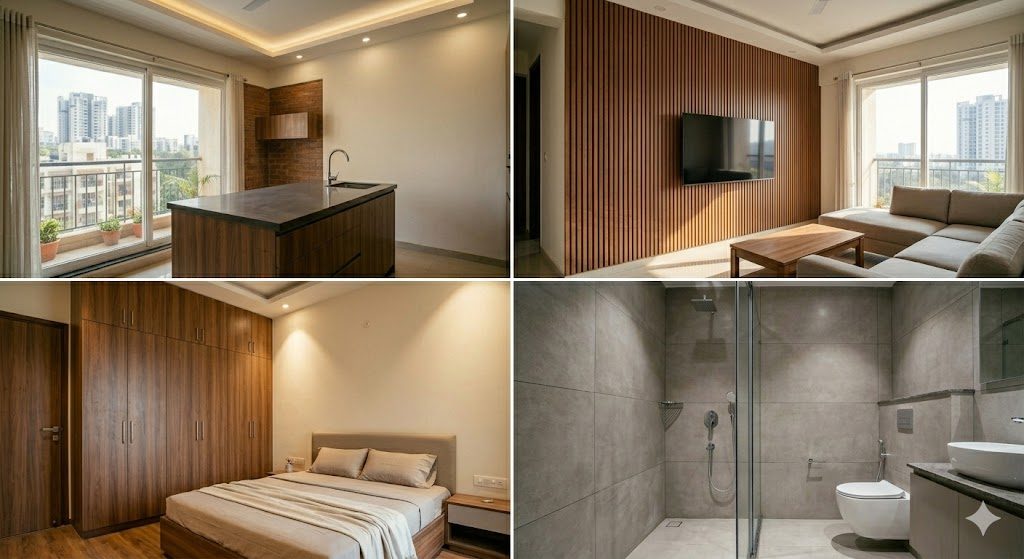
Interior Cost Breakdown, Room by Room
What each room of an Indian home actually costs to do up — kitchen to balcony
Priya and Karthik bought a 1,050 sqft 2BHK in Whitefield and sat down with a spreadsheet to plan the interiors. They had read that interiors cost "around ₹1,800 per sqft," multiplied it out, and budgeted ₹19 lakh. Six weeks into quotations, they were confused: the kitchen alone was eating ₹4.8 lakh, the master wardrobe another ₹2.6 lakh, and they had not yet priced a single bathroom. The per-sqft number had told them the size of the whole pie — but not how to slice it, or which slice to fight for.
This guide gives you the slices. Instead of one blended ₹/sqft figure for the whole flat, it walks room by room — kitchen, living, bedrooms, bathrooms, dining, foyer, pooja, balcony and study — and tells you what each room actually costs to do up in 2026, at three honest tiers, with the cost drivers and the highest-ROI spend in each. It is the companion to our per-sqft cost guide: use that one to size the total, and this one to allocate it.
The core idea: a home's interior budget is not spread evenly across its floor — it pools heavily in four rooms. The kitchen, master bedroom, living room and second bedroom typically absorb around 70% of a fit-out budget, while the foyer, pooja, balcony and utility together rarely cross 8%. Knowing the per-room shape is what lets you spend like a designer — premium where it shows and is used, lean where nobody notices.
Per-sqft vs per-room: two different questions
Both lenses are useful, and they answer different questions.
| Lens | Question it answers | Best for |
|---|---|---|
| Per-sqft (₹/sqft) | "How big is my total interior budget?" | Sizing the overall envelope, comparing flats, benchmarking a turnkey quote |
| Per-room (₹/room) | "Where should that budget go, and what do I cut first?" | Prioritising, phasing, deciding which rooms to splurge or skip |
A ₹1,800/sqft blended rate on a 1,050 sqft flat gives you roughly ₹19 lakh. That is the envelope. But the rate is an average of a ₹4,500/sqft kitchen and a ₹300/sqft balcony — averages hide exactly the decisions you need to make. The per-room view un-blends them, so you can choose to push the kitchen to premium and keep the pooja Essential without guessing.
Throughout, three tiers recur. Essential is clean, durable and functional — laminate finishes, BIS-grade hardware, sensible local brands. Comfort is the mainstream Indian fit-out — better finishes, soft-close everywhere, some design moments. Premium is bespoke joinery, imported stone, branded sanitaryware and designer FFE. All figures assume a roughly 1,000 sqft 2BHK in a Tier-1 city in 2026; adjust with the city deltas later in the guide.
Kitchen — the single most expensive room
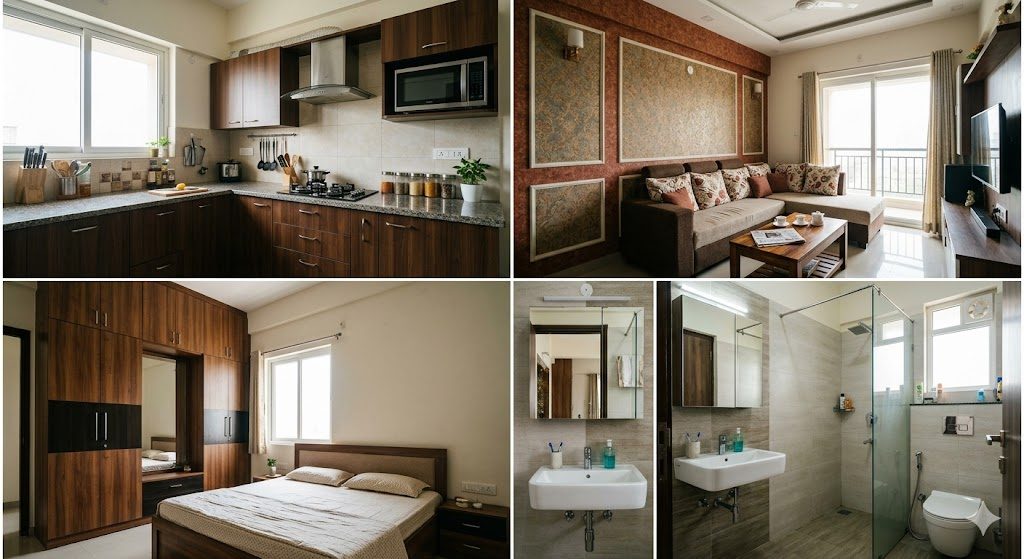
The kitchen is where the most money per square foot goes, because it stacks four costly systems into one small space: cabinetry, countertop, appliances and services (plumbing, electrical, exhaust).
What is included: modular base and wall units (carcass + shutters + hardware), countertop and sink, backsplash, chimney and hob, built-in or freestanding appliances, under-cabinet lighting, and the loose accessories (tall unit, pull-outs, corner solutions).
Cost drivers: shutter finish (laminate vs acrylic vs PU vs lacquered glass), carcass material (commercial ply vs BWP marine ply vs HDHMR), hardware brand (local vs Hettich/Blum), countertop stone (granite vs quartz vs sintered/Corian), and appliance brands. A run of tall units and a fancy chimney can each add ₹40,000–₹80,000 on their own.
| Kitchen line item | Essential | Comfort | Premium |
|---|---|---|---|
| Modular cabinetry (per running ft) | ₹1,400–1,900 | ₹2,200–3,200 | ₹4,000–7,000+ |
| Countertop | Granite ₹150–250/sqft | Quartz ₹350–600/sqft | Sintered/Corian ₹900–1,800/sqft |
| Backsplash | Ceramic ₹60–120/sqft | Glass/subway ₹150–300/sqft | Full-slab stone ₹400+/sqft |
| Chimney + hob | ₹18,000–28,000 | ₹35,000–55,000 | ₹70,000–1.5L |
| Accessories + tall unit | ₹25,000–45,000 | ₹60,000–1.1L | ₹1.5L+ |
| Typical room total | ₹2.0–3.0L | ₹3.5–5.5L | ₹7–12L+ |
Highest-ROI spend: good hardware (soft-close hinges and channels) and a hard-wearing countertop. These are the parts you touch fifty times a day; a ₹600/sqft quartz counter over a ₹200/sqft granite one is the single upgrade most owners say they would repeat. Save instead on exotic shutter finishes. Our budget modular kitchen planning guide breaks this down line by line, and the kitchen budget tool sizes it to your layout.
Living room — the impression room
The living room is the second-largest line for most homes, but its cost is far more elastic than the kitchen's — almost all of it is discretionary FFE and finishes rather than fixed services.
What is included: TV unit and feature wall, false ceiling with cove and lighting, sofa and loose furniture (FFE), curtains/blinds, accent wall or paneling, rug and decor.
Cost drivers: the feature wall is the swing factor — a painted accent wall costs ₹8,000, a fluted/veneer/stone-clad feature wall ₹60,000–₹1.5L. False ceiling area and design (plain peripheral cove vs full multi-level) and the sofa (local foam-and-fabric vs branded vs imported) move the total most.
| Living line item | Essential | Comfort | Premium |
|---|---|---|---|
| TV unit + feature wall | ₹25,000–45,000 | ₹55,000–1.0L | ₹1.5–3L+ |
| False ceiling + cove lighting | ₹30,000–55,000 | ₹55,000–90,000 | ₹1.2–2L |
| Sofa + loose FFE | ₹45,000–80,000 | ₹90,000–1.5L | ₹2.5–4L+ |
| Curtains, rug, decor | ₹20,000–35,000 | ₹40,000–70,000 | ₹1L+ |
| Typical room total | ₹1.2–1.8L | ₹2.2–3.2L | ₹5–9L+ |
Highest-ROI spend: lighting and the sofa. Layered lighting (cove + a few spots + one statement fixture) transforms a room for ₹25,000–₹40,000 and is what guests register first. A well-built sofa you sit on every evening is worth the spend; an elaborate gypsum ceiling is not. See our false ceiling cost guide before you commit to a multi-level design.
Spend on the surfaces your hands and eyes meet daily — the counter, the sofa, the bathroom mixer, the light. Save on the ones nobody touches — the ceiling profile, the pooja arch, the utility shelf. That single rule, applied room by room, is what separates a home that feels expensive from one that merely cost a lot.
Master bedroom — wardrobe-led
The master bedroom's cost is dominated by one item: the wardrobe. A full-height wardrobe is effectively a second piece of modular joinery, often as expensive per running foot as the kitchen.
What is included: wardrobe (often with loft), bed and side tables, headboard/back panel, false ceiling, lighting, dresser, curtains.
Cost drivers: wardrobe size and finish (a 10 ft sliding laminate wardrobe vs a 14 ft openable acrylic one with loft), internal fittings (basic shelves vs pull-out trays, soft-close drawers, lacquered-glass shutters), and whether the bed is bought loose or built as a platform with storage.
| Master line item | Essential | Comfort | Premium |
|---|---|---|---|
| Wardrobe (per running ft) | ₹1,300–1,800 | ₹2,000–2,800 | ₹3,500–6,000+ |
| Bed + side tables | ₹25,000–45,000 | ₹50,000–90,000 | ₹1.5L+ |
| Back panel + false ceiling | ₹25,000–45,000 | ₹50,000–85,000 | ₹1.2L+ |
| Lighting + dresser + curtains | ₹20,000–35,000 | ₹40,000–70,000 | ₹1L+ |
| Typical room total | ₹1.4–2.0L | ₹2.4–3.4L | ₹5–8L+ |
Highest-ROI spend: wardrobe internals and a good mattress (counted separately). Soft-close drawers, a pull-out trouser rack and full-height hanging are used daily for a decade — they earn their cost. A lacquered-glass shutter looks great in photos but adds little to daily life. The wardrobe cost guide and the wardrobe capacity calculator help you size and finish it without overspending.
Second / kids bedroom — the room to economise
The second bedroom carries the same items as the master but at smaller scale and lower spec — and it is usually the right room to take to Essential, because guests and growing children change its use within a few years.
What is included: a smaller wardrobe, a single or queen bed, study/work corner if it doubles as a workspace, basic false ceiling or just cornice, lighting.
Cost drivers: wardrobe length (often 7–9 ft vs the master's 12–14 ft), whether it gets a false ceiling at all, and whether a study table is built in.
| Second bedroom | Essential | Comfort | Premium |
|---|---|---|---|
| Wardrobe (7–9 ft) | ₹70,000–1.0L | ₹1.1–1.6L | ₹2–3L |
| Bed + storage | ₹20,000–35,000 | ₹40,000–65,000 | ₹1L+ |
| Ceiling, lighting, study nook | ₹20,000–40,000 | ₹35,000–70,000 | ₹1L+ |
| Typical room total | ₹1.0–1.4L | ₹1.6–2.4L | ₹3.5–5.5L |
Highest-ROI spend: flexible, modular pieces. A wardrobe with adjustable shelving and a loose desk you can reposition outlasts a fully built-in scheme that becomes wrong when a child grows or the room becomes a nursery or office. This is the room where "buy loose, build less" saves the most.
Bathrooms — priced per bath, deceptively costly
Each bathroom is a small room with a big per-sqft cost, because every surface is wet-area finished and every fitting is a separate purchase. A 2BHK has two; price each one.
What is included (per bath): wall and floor tiles, WC and wash basin, vanity, shower/diverter and mixers, health faucet, mirror and lighting, glass partition, exhaust, accessories. Concealed plumbing and waterproofing if you are renovating.
Cost drivers: tile size and quality (large-format and anti-skid cost more), sanitaryware brand (Hindware/Cera vs Jaquar vs Kohler/Grohe), vanity (loose vs built-in counter-top basin), and whether you add a glass shower partition.
| Bathroom (each) | Essential | Comfort | Premium |
|---|---|---|---|
| Tiles (wall + floor) | ₹25,000–40,000 | ₹45,000–70,000 | ₹90,000–1.5L |
| Sanitaryware (WC + basin) | ₹12,000–20,000 | ₹25,000–45,000 | ₹70,000–1.5L |
| CP fittings + mixers | ₹10,000–18,000 | ₹22,000–40,000 | ₹60,000–1.2L |
| Vanity, mirror, glass, lighting | ₹15,000–25,000 | ₹30,000–50,000 | ₹80,000+ |
| Typical room total (per bath) | ₹0.7–1.0L | ₹1.1–1.6L | ₹2.5–5L+ |
Highest-ROI spend: the CP fittings (taps, mixers, diverter) and waterproofing. A good-quality mixer is touched dozens of times a day and a cheap one leaks and corrodes within two years — this is the textbook case from our note on why cheap hardware destroys expensive interiors. Spend on the brass, economise on the decorative tile.
Dining — small spend, mostly FFE
In most Indian 2BHKs the dining sits in a corner of the living-dining and needs little built work — its cost is almost entirely the table set, plus an optional crockery unit or accent.
What is included: dining table and chairs, optional crockery/sideboard unit, a hanging light, a small accent wall or mirror.
Cost drivers: the table material (engineered wood vs solid wood vs marble/sintered top), number of seats, and whether a built-in crockery unit is added.
| Dining | Essential | Comfort | Premium |
|---|---|---|---|
| Table + chairs (4–6 seat) | ₹25,000–45,000 | ₹50,000–85,000 | ₹1.2–2.5L |
| Crockery unit / sideboard | ₹10,000–18,000 | ₹18,000–30,000 | ₹50,000+ |
| Pendant light + accent | ₹6,000–12,000 | ₹12,000–25,000 | ₹50,000+ |
| Typical room total | ₹0.4–0.7L | ₹0.7–1.1L | ₹1.5–3.5L |
Highest-ROI spend: a single good pendant light over the table and sturdy chairs. The table earns its keep at Comfort; a marble-top dining set is a want, not a need.
Foyer / entrance — first impression, last priority for budget
The foyer is tiny and high-visibility, which tempts overspend. Keep it crisp and cheap: a shoe cabinet, a console or seat, a mirror, and one good light do the whole job.
| Foyer | Essential | Comfort | Premium |
|---|---|---|---|
| Shoe cabinet / console | ₹12,000–22,000 | ₹25,000–40,000 | ₹70,000+ |
| Mirror, light, accent paneling | ₹8,000–18,000 | ₹15,000–25,000 | ₹50,000+ |
| Typical room total | ₹0.2–0.4L | ₹0.4–0.6L | ₹0.9–2L |
Highest-ROI spend: a shoe cabinet with a usable top and a single warm light. A fluted entrance feature wall is the easiest place to overspend for little daily value.
Pooja — emotional, not expensive
The pooja room or unit is emotionally important but rarely needs a large budget. A well-made wooden unit with a back panel, a small platform and warm lighting reads as reverent without bespoke carving.
| Pooja | Essential | Comfort | Premium |
|---|---|---|---|
| Pooja unit / mandir | ₹15,000–30,000 | ₹35,000–60,000 | ₹80,000–2L |
| Back panel, lighting, platform | ₹8,000–15,000 | ₹15,000–25,000 | ₹50,000+ |
| Typical room total | ₹0.2–0.4L | ₹0.4–0.7L | ₹1–2.5L |
Highest-ROI spend: warm, dimmable lighting and a clean back panel (jaali, marble or veneer). Hand-carved teak mandirs are a heritage choice, not a value one — fund them only if they matter to the family.
Balcony / utility — the leanest line
The balcony and utility area give the lowest return on interior spend, so keep them functional. Anti-skid deck tiles, a railing planter, one weatherproof seat, and in the utility a wall cabinet plus a sink. Resist building a "café balcony" until the rest of the home is done.
| Balcony / utility | Essential | Comfort | Premium |
|---|---|---|---|
| Deck tiles / flooring | ₹8,000–18,000 | ₹18,000–30,000 | ₹40,000+ |
| Seating, planters, utility cabinet | ₹6,000–14,000 | ₹14,000–25,000 | ₹60,000+ |
| Typical room total | ₹0.1–0.3L | ₹0.3–0.5L | ₹0.6–1.5L |
Highest-ROI spend: durable anti-skid flooring and a covered washing-machine/sink zone in the utility. Decorative balcony joinery weathers fast in Indian sun and rain — keep it minimal.
Study / home-office — the post-2020 line
Once a rarity, a dedicated work corner is now a real budget line. It can be a built-in desk-and-overhead in a bedroom or a small standalone room.
What is included: desk (built-in or loose), overhead/under-desk storage, a task chair, layered task lighting, cable management, a pinboard or back panel.
| Study / office | Essential | Comfort | Premium |
|---|---|---|---|
| Desk + storage | ₹18,000–35,000 | ₹40,000–70,000 | ₹1–2L |
| Task chair | ₹8,000–15,000 | ₹18,000–30,000 | ₹40,000+ |
| Lighting, panel, cable mgmt | ₹10,000–20,000 | ₹20,000–35,000 | ₹50,000+ |
| Typical room total | ₹0.5–0.8L | ₹0.8–1.3L | ₹1.8–3.5L |
Highest-ROI spend: a genuinely good task chair and proper task lighting. If you work from home, this chair affects your back daily for years — it is one of the highest-value single purchases in the entire flat, well above any decorative element.
The whole-home roll-up
Summing the rooms at each tier gives the total interior envelope. The table below assumes a 1,000 sqft 2BHK: one kitchen, one master, one second bedroom, two bathrooms, plus the common areas. (Bathrooms are counted twice.)
| Room | Essential | Comfort | Premium |
|---|---|---|---|
| Kitchen | ₹2.5L | ₹4.5L | ₹9.0L |
| Living room | ₹1.5L | ₹2.6L | ₹6.5L |
| Master bedroom | ₹1.7L | ₹2.8L | ₹6.0L |
| Second bedroom | ₹1.2L | ₹1.9L | ₹4.0L |
| Bathrooms (×2) | ₹1.7L | ₹2.6L | ₹6.0L |
| Dining | ₹0.5L | ₹0.8L | ₹2.0L |
| Foyer | ₹0.3L | ₹0.45L | ₹1.2L |
| Pooja | ₹0.3L | ₹0.5L | ₹1.5L |
| Balcony / utility | ₹0.2L | ₹0.35L | ₹0.9L |
| Study / office | ₹0.6L | ₹0.9L | ₹2.5L |
| Whole-home total | ≈₹10.5L | ≈₹17.4L | ≈₹39.6L |
| Blended ₹/sqft (1,000 sqft) | ≈₹1,050 | ≈₹1,740 | ≈₹3,960 |
Notice how the per-room totals reconcile back to a per-sqft figure — the Comfort roll-up lands near ₹1,740/sqft, which is exactly the blended rate our per-sqft guide quotes for a mid-spec Indian fit-out. The two views are the same money, seen from two angles. Validate your own version with the cost calculator and split it across rooms in the budget planner.
City deltas
| City band | Multiplier on the above | Notes |
|---|---|---|
| Mumbai, South Delhi, Gurugram prime | +8% to +15% | Higher labour, premium-brand bias, society restrictions |
| Bengaluru, Pune, Hyderabad, Chennai | Baseline | The bands above are calibrated here |
| Tier-2 (Indore, Coimbatore, Jaipur, Kochi) | −10% to −15% | Cheaper labour and local material sourcing |
Which rooms deserve the budget
If your envelope is fixed, this is the order in which a designer would defend each rupee. It maps onto the leverage chart below.
1. Kitchen (fund to Comfort or Premium). Highest daily use, biggest resale signal, hardest to redo later. This is the one room where Premium spend reliably pays back.
2. Living room (Comfort+). First impression, most-used social space. Spend on lighting and the sofa; economise on the ceiling.
3. Master bedroom (Comfort). Daily use; prioritise wardrobe internals over shutter finish.
4. Bathrooms (Comfort). Wet areas are expensive to redo, so do the concealed plumbing and waterproofing right once. Spend on fittings, save on decorative tile.
5. Second bedroom (Essential to Comfort). Flexible, modular, ready to change use. Safe to keep lean.
6. Study (Essential, but splurge on the chair). A small line with one high-value item.
7. Dining, foyer, pooja, balcony (Essential). Low return on interior spend; keep them clean and cheap, and redirect the saving to the kitchen and living room.
The discipline here mirrors our smart budget allocation guide: the win is not spending less everywhere, it is spending unevenly — heavy on the four rooms that earn it, light on the six that do not.
How to budget it, in order
1. Size the envelope first. Use the per-sqft view to set your total, then sanity-check it against your savings and any loan. Do not start with room quotes.
2. List your rooms and count your bathrooms. Bathrooms and bedrooms are per-unit costs; a 3BHK with three baths is a very different total from a 2BHK with two.
3. Assign a tier to each room, not one tier to the home. Kitchen Premium, second bedroom Essential, pooja Essential — this is the whole point of the per-room view.
4. Fill the high-ROI rooms first. Allocate to kitchen, living and master before anything else; let the leftover flow to the rest.
5. Hold a 10% contingency. Concealed plumbing, electrical re-routing and site surprises are real — see our note on hidden costs of renovation.
6. Phase what you can. Balcony, study and a second-bedroom upgrade can wait six months. Built-in wet-area work and the kitchen cannot — do those in phase one.
7. Get a room-wise BOQ, not a lump sum. A quote that says "interiors ₹18L" hides everything; insist on per-room, per-line pricing so you can trade off.
A room-wise BOQ is the document that turns all of this from theory into a contract you can hold a vendor to.
Planning room by room by hand is slow. DesignAI reads your floor plan, assigns realistic 2026 rupee bands to each room at your chosen tier, and drafts an itemised, room-wise BOQ and budget in minutes — so you can see instantly where the money pools and which rooms to push or trim before you ever call a vendor.
References
1. CIDC / CPWD — Plinth Area Rates and Schedule of Rates (latest revision), Central Public Works Department, Government of India.
2. National Building Code of India (NBC 2016), Bureau of Indian Standards — Part 8 (Building Services) and Part 9 (Plumbing).
3. BIS / IS 2202, IS 14856 and related standards — joinery, plywood and modular hardware specifications, Bureau of Indian Standards.
4. BMTPC — Cost-effective materials and construction technologies, Building Materials and Technology Promotion Council.
5. RERA (state authorities) — carpet-area definitions used to size interior areas consistently.
6. Industry rate cards (2026) — Hettich, Blum, Jaquar, Hindware, Cera, Kohler published price lists and modular-kitchen vendor quotations across Tier-1 cities.
For more, read our per-sqft interior cost guide, smart budget allocation for Indian homes, the false ceiling cost guide and the wardrobe cost guide.
Export this guide
Related Guides — Deep-dive reading
The Design Decisions With the Biggest Cost Consequences
A cost-leverage map of Indian home interiors — the handful of decisions that swing your total budget the most, so you spend your attention where a single choice has an outsized rupee impact.
Cost & MoneyThe Homeowner's Guide to Interior Design Budgets in India
Where the money really goes in an Indian fit-out — realistic 2026 ranges, cost-per-sqft truths, bang-for-buck upgrades, life-cycle costing and contracts
Home PlanningWardrobe Cost Guide (India 2026)
What a built-in wardrobe really costs per sqft — by type, material and finish
Cost & MoneyRelated Tools — Try Free
False Ceiling Cost Estimator
Live ₹/sqft across 8 ceiling types — POP, gypsum, designer, metal, PVC, wooden — with cove and spot lighting for 20 Indian cities.
Cost CalculatorHome Building & Interior Cost Calculator — 20 Cities
Construction + interior costs for 20 Indian cities across kitchen, wardrobes, flooring, painting, ceiling.
Cost CalculatorApartment Furniture Size Chart
Standard furniture dimensions for Indian apartments — sofas, beds, tables, dining, storage.
Reference Chart