
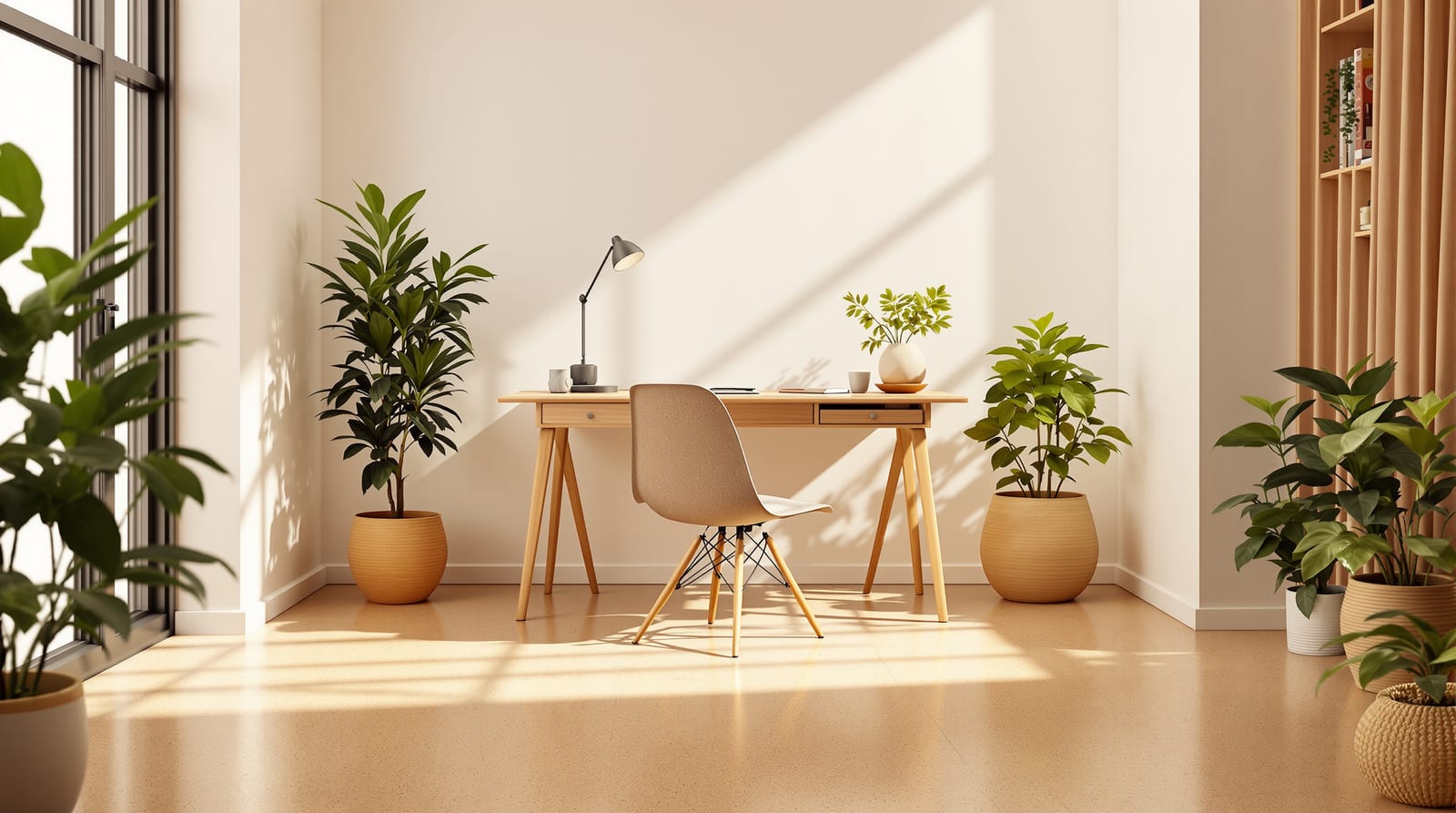
Cork Flooring in India: Warm, Quiet, Eco Floors for Bedrooms, Study & Kids' Rooms
Why cork is genuinely sustainable (bark is harvested while the tree lives on), the comfort and acoustic benefits, the natural look, ₹200-500/sq ft, click-floating vs glue-down tiles, sealing, and the dent, moisture and sun-fade caveats every Indian homeowner should know.
Cork is the rare floor that is soft when you stand on it, quiet when children run across it, warm under bare feet on a cold morning, and genuinely kind to the planet. It comes from the bark of the cork oak tree, which is peeled by hand every nine years while the tree keeps living and regrowing its bark for over a century. For Indian bedrooms, studies and kids' rooms, cork delivers a kind of comfort that hard tiles and stone simply cannot, with a few honest caveats around moisture, denting and sun-fade that you should plan for before you buy.
Why cork is one of the most sustainable floors you can lay
Most "eco" claims need a pinch of salt. Cork's does not. Cork is harvested by stripping the outer bark of the cork oak (Quercus suber), grown mainly in Portugal and Spain, without felling a single tree. A mature cork oak is first stripped at around 25 years of age, then re-harvested roughly every nine years for 150 to 200 years. The tree not only survives, it absorbs significantly more carbon dioxide while regrowing its bark, so well-managed cork forests are net carbon sinks.
The factory process is low-waste too. The bark is ground, the granules are bound and baked, and even the offcuts from wine-stopper production are reused to make flooring. The end product is a natural, renewable material with low embodied energy, naturally low VOC emissions (especially if you choose a water-based finish), and it is biodegradable at the end of its life. For homeowners chasing green-building points, cork is a "rapidly renewable material" under IGBC Green Homes, GRIHA and LEED India frameworks, and low-VOC cork can contribute to indoor-air-quality credits.
If sustainability is your main driver, read this guide alongside our broader pieces on eco-friendly flooring and sustainable flooring materials, and compare cork with the other two natural front-runners, bamboo flooring and linoleum flooring.
What makes cork feel so different underfoot
Cork's superpower is its cell structure. A single cubic centimetre of cork holds around 40 million tiny, sealed, air-filled cells. That trapped air is what makes cork behave like millions of microscopic cushions and insulators at once. The practical results are striking:
- Warm and soft underfoot. The air pockets resist heat flow, so cork never feels cold the way stone or vitrified tile does on a winter morning in Shimla or Dehradun. It also gives slightly when you step, easing pressure on knees, hips and backs.
- Quiet and sound-absorbing. Those same cells dampen impact and airborne sound. Cork noticeably softens footsteps, dropped toys and chair scrapes, and reduces sound transmission to the room below, which is a genuine relief in apartments and double-height study rooms.
- Comfortable to stand on for long stretches. This is why cork suits a child's play area, a study where someone stands and reads, a home office, or a senior citizen's bedroom where a fall on hard tile is a real risk.
- Naturally anti-microbial. Cork contains a waxy substance called suberin that resists mould, mildew and dust mites and discourages pests, which is helpful for allergy-prone households.
- Springy and forgiving. A dropped glass or phone is far more likely to survive a cork floor than a granite one.
The cork cell structure that does all the work
The diagram below shows, in simplified cross-section, how cork's honeycomb of sealed, air-filled cells gives it cushioning, warmth and quiet all at once.
The look: natural mottled or printed
Traditional cork has an unmistakable speckled, mottled grain, somewhere between honey and toffee in colour, made from visible cork granules. Many people love this organic, warm texture; some find it busy. Manufacturers now offer two broad looks:
- Natural / agglomerated cork, where the granule pattern is the design. Available in light blonde, golden, amber and darker stained tones.
- Printed cork, where a high-resolution photographic layer over a cork core mimics wood planks, stone or concrete, while you still get cork's softness and quiet. This is the way to get a wood-look floor that is warm and silent.
Cork suits relaxed, natural, Scandinavian and biophilic interiors especially well. If you are still deciding on a style and material, our overviews of flooring materials explained and how to choose flooring will help you place cork against the alternatives.
What cork flooring costs in India
Cork is a specialist, largely imported product in India, so prices sit above laminate but below good engineered wood. Expect the following indicative ranges (material only, exclusive of GST; install adds to this). All figures are indicative and vary by city, brand and import batch.
| Item | Indicative cost (₹/sq ft) | Notes |
|---|---|---|
| Glue-down cork tiles (basic) | 200-300 | Thin tiles, fixed to a level subfloor |
| Click-floating cork planks | 300-500 | Cork core with HDF/click locking system |
| Premium / printed / thick cork | 450-600+ | Wood or stone look, thicker wear layer |
| Cork underlay (separate product) | 40-120 | Used under other floors for acoustics |
| Floating-floor install labour | 25-50 | Per sq ft, depends on city and room size |
| Glue-down install labour | 35-70 | More skilled, needs a very flat base |
Add 18% GST. Because cork is mostly imported, lead times and prices can swing with the rupee and shipping, so always confirm a current quote. To budget the full job alongside other options, our eco-flooring selector helps you weigh cork against bamboo, linoleum and reclaimed wood for your specific room.
How cork flooring is installed
There are two common systems, and the right one depends on your product and your subfloor.
Click floating (most common for planks)
Click cork planks lock edge to edge and "float" over the subfloor without glue or nails, exactly like laminate or SPC. This is the DIY-friendly, removable, forgiving option.
- Get the subfloor flat, clean and dry. Cork floats, so it telegraphs bumps; correct dips with a self-leveling compound and prepare the base as covered in our subfloor preparation and underlayment and moisture barrier guides.
- Over concrete, lay a 200-micron polyethylene damp-proof membrane (DPM) first. This is non-negotiable in humid and ground-floor Indian rooms; cork dislikes rising moisture as much as wood does.
- Acclimatise the planks in the room, in their boxes, for at least 48 hours so they reach local temperature and humidity.
- Leave an 8-12 mm expansion gap at all walls, hidden later under the skirting, so the floating floor can move with seasonal humidity.
Glue-down tiles (most common for tiles)
Thin cork tiles are bonded directly to a smooth, level, fully dry base with a recommended adhesive. Glue-down feels more solid and is better for slightly damp-prone or high-traffic rooms, but it demands a near-perfect base and skilled labour, and it is harder to remove later. The base flatness and adhesive coverage rules are the same disciplines covered in how to lay floor tiles.
Whichever system you use, do not lay cork on green or damp concrete, and never skip the moisture barrier on a ground floor.
Sealing and finish: the step that decides longevity
Cork is porous. Its lifespan and stain resistance depend almost entirely on its surface finish.
- Most quality cork comes pre-finished with several factory coats of water-based polyurethane or a UV-cured lacquer. This is the easy, low-VOC route and is recommended for Indian homes.
- Wax or oil finishes give a softer, more natural look but need more frequent re-application and offer less spill protection.
- Whatever the finish, plan to re-coat a sealed cork floor roughly every 5 to 7 years in normal rooms, sooner in heavy-traffic areas, to refresh the protective layer. This is similar in spirit to the resealing discipline in our floor resealing guide.
A well-sealed cork floor shrugs off everyday spills if wiped promptly. An unsealed or worn floor will drink up water and stain.
Durability and the honest caveats
Cork is comfortable and eco, but it is a soft material, and pretending otherwise leads to disappointment. Plan around these limits:
- Denting. Sharp, heavy point loads, such as stiletto heels, dropped knives, or thin furniture legs, can dent cork. Cork is "elastic" and shallow dents from light furniture often recover over time, but deep gouges do not. Use wide felt pads and furniture coasters, and lift, never drag, heavy items.
- Moisture. Cork tolerates humidity better than solid wood thanks to suberin, but it is not waterproof. Standing water, leaks and prolonged damp will swell and damage it. It is not suitable for bathrooms, balconies, terraces or other genuinely wet areas; for those, see anti-slip flooring for wet areas.
- Sun-fade. Cork's natural tones fade and can yellow or lighten under strong, direct Indian sunlight over time. Use curtains or blinds on south and west-facing windows, and rotate rugs so the floor ages evenly.
- Sharp grit. Like any soft floor, grit acts like sandpaper. Use doormats and sweep regularly.
With sensible care, a quality sealed cork floor lasts comfortably 15 to 25 years, and longer in low-traffic bedrooms.
Caring for a cork floor
Cork is genuinely low-effort if you keep it dry and avoid harsh chemicals. The table below summarises the do's and don'ts; for general technique, our floor cleaning guide covers the basics.
| Do | Don't |
|---|---|
| Sweep or vacuum (soft brush head) regularly to remove grit | Don't flood-mop or leave standing water |
| Damp-mop with a well-wrung microfibre and a pH-neutral cleaner | Don't use vinegar, ammonia, abrasive powders or strong solvents |
| Wipe spills promptly | Don't drag furniture; lift it |
| Fit wide felt pads under all furniture legs | Don't use a steam mop |
| Use rugs in high-traffic paths and entries | Don't expose to long, direct sun without blinds |
| Re-coat the finish every 5-7 years | Don't lay cork in bathrooms or on terraces |
Where cork suits an Indian home
Cork shines in dry, comfort-first, indoor rooms and is at its weakest near water and harsh sun.
| Room / location | Cork suitability | Why |
|---|---|---|
| Bedrooms | Excellent | Warm, quiet, soft, low traffic |
| Kids' rooms and play areas | Excellent | Cushioned falls, sound-absorbing, anti-microbial |
| Study and home office | Excellent | Comfortable to stand, quiet, warm |
| Senior citizens' rooms | Very good | Soft, slip-friendly, easier on joints |
| Living and dining (low traffic) | Good | Cosy and quiet; protect from chair legs and sun |
| Hill-station homes | Excellent | Warm underfoot in the cold; pairs with our flooring for hill stations guide |
| Kitchens | Caution | Only sealed and away from the wet zone |
| Bathrooms, balconies, terraces | Avoid | Wet areas; cork is not waterproof |
In cold-climate Indian homes, cork is one of the warmest, most comfortable choices you can make, which is exactly why our flooring for hill stations guide ranks it alongside wood and laminate for the mountains.
Cork at a glance: pros and cons
| Pros | Cons |
|---|---|
| Genuinely renewable (bark harvested, tree lives on) | Largely imported, so pricier and lead-time prone |
| Warm and soft underfoot | Soft surface dents under heavy point loads |
| Excellent sound absorption | Not waterproof; unsuitable for wet areas |
| Naturally anti-microbial (suberin) | Natural tones fade in strong direct sun |
| Low-VOC with a water-based finish | Needs periodic re-coating every 5-7 years |
| Comfortable to stand on, easier on joints | Fewer Indian suppliers and patterns than tiles |
| Click-floating versions are DIY-friendly and removable | Limited colour range vs printed laminate |
Frequently asked questions
Is cork flooring a good choice for Indian homes?
Yes, in the right rooms. Cork is excellent for bedrooms, studies, kids' rooms and hill-station homes where you want warmth, quiet and comfort, and where there is no standing water. It is a poor choice for bathrooms, balconies, terraces and any genuinely wet area, and it needs protection from harsh direct sun.
How much does cork flooring cost in India?
Indicatively, glue-down cork tiles run about ₹200-300 per sq ft, click-floating cork planks ₹300-500, and premium printed or thick cork ₹450-600 and above, all before 18% GST and before install labour of roughly ₹25-70 per sq ft. Because cork is mostly imported, always confirm a current quote.
Does cork flooring dent easily?
Cork is soft, so sharp heavy point loads such as stiletto heels or thin metal furniture legs can dent it. The good news is cork is elastic, and many shallow dents from everyday furniture recover over time. Use wide felt pads, lift rather than drag heavy items, and you will avoid most permanent damage.
Is cork flooring waterproof?
No. Cork resists humidity and mould better than solid wood thanks to its natural suberin, but it is not waterproof. Standing water, leaks and prolonged damp will swell and stain it, so keep it out of bathrooms, balconies and terraces, and always lay a moisture barrier over concrete.
How is cork flooring more eco-friendly than wood or laminate?
The bark is harvested by hand without felling the cork oak, which keeps living and regrowing its bark for over a century while absorbing extra carbon dioxide. Cork has low embodied energy, is naturally low-VOC with a water-based finish, and is biodegradable, so it scores well for green-building credits under IGBC, GRIHA and LEED India. Compare it with bamboo and linoleum to find your best natural option.
Export this guide
Related Guides — Deep-dive reading
Eco Friendly Flooring in India: The Homeowner's Guide to Greener Floors, Low-VOC Choices and Lower Embodied Carbon
What actually makes a floor green — embodied carbon, recycled content, VOC emissions, renewability, recyclability, lifespan and local sourcing — and which Indian flooring choices are genuinely sustainable, from bamboo, cork and linoleum to local stone, fly-ash tiles and recycled-chip terrazzo.
Flooring & SurfacesDining Room Flooring in India: Spill-Proof Floors That Flow With Your Living Room
How to choose a dining-area floor that shrugs off food, drink and chair-scraping while flowing seamlessly with the adjacent living room and kitchen.
Flooring & SurfacesBest Bedroom Flooring in India: Warm, Quiet, Comfortable Choices
Bedrooms reward comfort over toughness — here is how to choose warm-underfoot, soft and quiet flooring for Indian homes, room by room, with 2026 costs and a Vastu note.
Flooring & SurfacesRelated Tools — Try Free
Cross-Ventilation Analyzer
Estimate airflow and air changes per hour (ACH) from room size, window areas, layout, and local wind — with NBC 2016 Part 8 compliance check.
Ventilation CalculatorWindow Treatment Selector
Curtains, blinds or a layered system? Answer five questions about your room and get a specific recommendation.
SelectorFlooring Cost Calculator
Estimate the all-in cost of a floor — material, laying, wastage, skirting and GST — by area and material.
Flooring Calculator