
Self Leveling Compound in India: A Dead-Flat Floor Before Wood, Laminate, Vinyl or Large Tiles
What SLC is, when you need it instead of a screed, max thickness per coat, coverage and bags, priming, mixing, pouring and spike-rolling, cure and traffic times, and ₹/kg — the practical guide to a perfectly level base.
Click vinyl that rocks, laminate joints that "peak", large-format tiles that go hollow at the corners — almost every one of these failures traces back to a base that was a few millimetres out of flat. A cement-sand screed corrects big level differences, but it is too coarse and too slow to deliver the glass-flat tolerance modern thin floors demand. That is the job of self-leveling compound (SLC): a pourable, fast-setting cementitious slurry that flows out, finds its own level under gravity, and leaves a smooth, hard surface in hours instead of days. This guide explains exactly when you need it, how much to buy, and how to pour it right the first time.
What self-leveling compound actually is
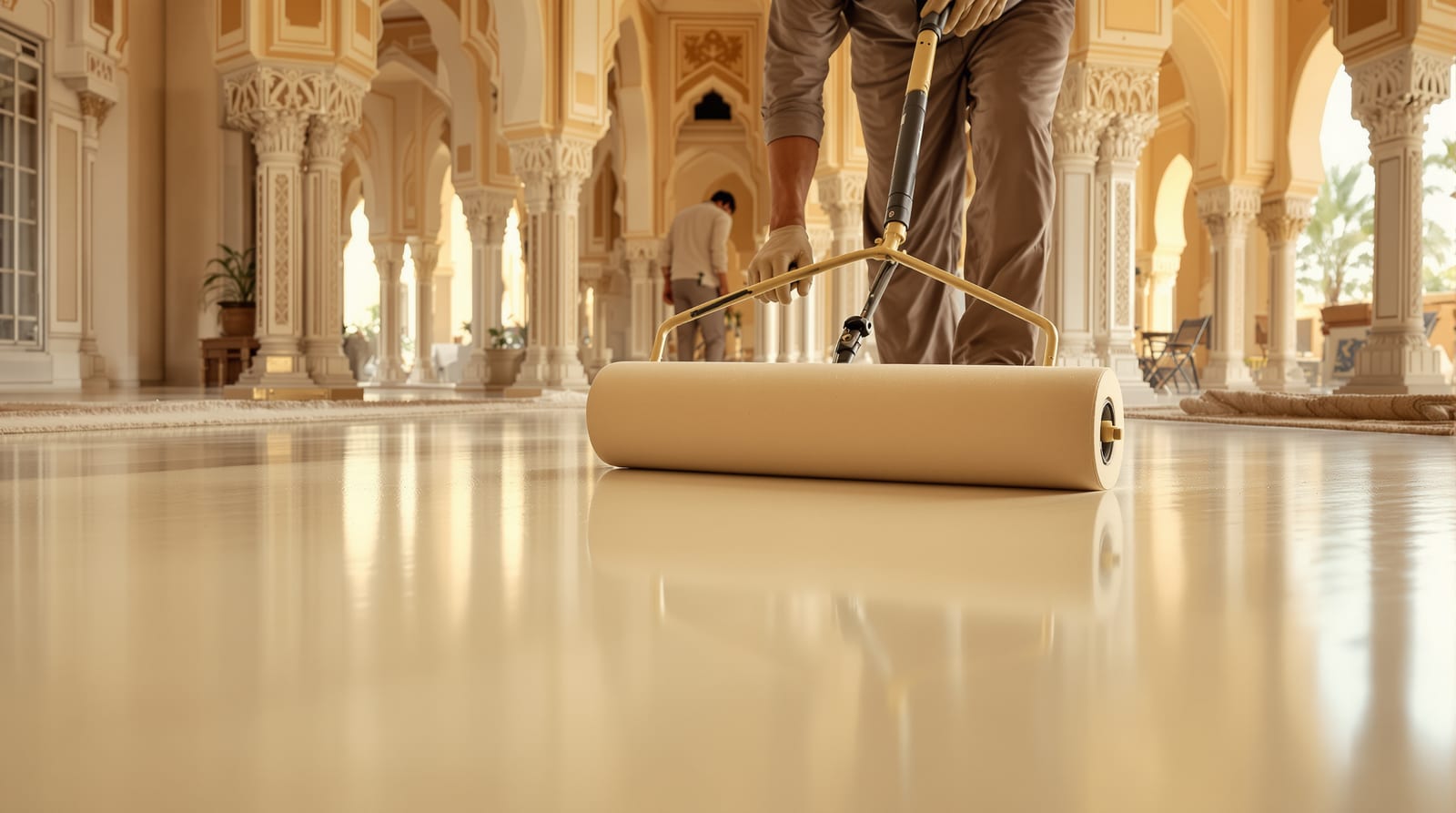
Self-leveling compound — sometimes sold as self-leveling underlayment, self-levelling cement or "floor leveler" — is a dry powder of special cements, fine graded sand, polymers and flow agents. You mix it with a measured amount of clean water into a thin, almost milkshake-like slurry, pour it onto a primed base, spread it roughly with a gauge rake, then pass a spiked roller over it. The polymer chemistry makes it flow out and release trapped air, so it settles into a flat, level plane far smoother than any hand-troweled cement.
It is not the same as a structural screed. SLC is a thin correction layer, typically 2-10 mm in a single pour, designed to take an already-sound but slightly wavy base and make it dead flat. It cannot bridge structural cracks, it cannot replace a thick build-up, and it is not meant to be a wearing surface on its own — it is the perfect canvas underneath your finished floor.
There are two broad families you will see in India:
- Cementitious SLC (the common type) — for interiors, under tiles, wood, laminate and vinyl. Brands include Roff, MYK Laticrete, Pidilite (Dr. Fixit / Fevicol family), Ardex Endura, Sika and Mapei.
- Calcium-sulphate / gypsum-based levelers — smoother flow but not for permanently wet areas; less common in Indian homes.
When you need SLC — and when a screed is enough
The choice between a self-leveling compound and a traditional cement-sand screed comes down to two questions: how much height do you need to make up, and how flat does the finished floor have to be?
| Situation | Use this | Why |
|---|---|---|
| Base out of level by 25-75 mm or more | Cement-sand screed (1:4) | SLC is too thin and far too expensive to fill big depths |
| Base is roughly level but wavy (gaps under a 2 m straightedge of 3-10 mm) | Self-leveling compound | Fast, flows dead flat, ready in hours |
| About to lay laminate, SPC/WPC vinyl click or engineered wood | SLC (or screed + SLC skim) | Thin floating floors telegraph every bump; they demand a flat base |
| Large-format / big vitrified tiles (600x600, 800x1600) | SLC if base is uneven | Reduces lippage and hollow corners; you still lay on C2 adhesive |
| Polished concrete or microcement to follow | Often skip SLC | Those finishes can sit on a steel-troweled slab |
| Deep depression plus fine waviness | Screed first, then SLC skim | Screed makes up height, SLC perfects the surface |
A simple field check: lay a 2 metre aluminium straightedge across the floor in several directions and slide a steel scale into the gaps. Most floating wood and vinyl makers ask for flatness within roughly 3 mm under a 2 m straightedge. If your slab is worse than that but the average level is acceptable, SLC is exactly the right tool. If whole rooms slope or you need to raise the floor by an inch, that is screed territory — see the companion guide on floor screed and mortar bed, and the broader checks in subfloor preparation.
Maximum thickness per coat
This is the number people most often get wrong. Most general-purpose self-leveling compounds are designed for a feather edge up to about 10 mm in a single pour — some economy products cap at 5-6 mm, premium ones reach 12-15 mm. Pour thicker than the rated maximum in one go and the compound can crack, curl at edges, or cure unevenly.
- Typical single-coat range: 2-10 mm
- Below 2 mm: use a "feather finish" / skim-grade product, not standard SLC
- Need more than the rated max: either bulk-fill with a cement screed first, or do a second SLC pour after the first has cured and been re-primed
Always read the bag — the maximum thickness, water ratio and pot life are printed there and vary by brand and grade.
Coverage and how many bags to buy
Coverage is driven by thickness. As a planning rule, cementitious SLC consumes roughly 1.5 to 1.7 kg of powder per square metre for every 1 mm of thickness (call it 1.6 kg/m²/mm for estimating). Multiply by your area and your average thickness, add about 10% for waste and for filling low spots deeper than average, then divide by the bag size (usually 20 kg, sometimes 25 kg).
The table below uses 1.6 kg/m²/mm and 20 kg bags, before the 10% waste allowance — add that on top.
| Room area | At 3 mm avg | At 5 mm avg | At 8 mm avg |
|---|---|---|---|
| 10 m² (about 108 sq ft) | 48 kg / 3 bags | 80 kg / 4 bags | 128 kg / 7 bags |
| 20 m² (about 215 sq ft) | 96 kg / 5 bags | 160 kg / 8 bags | 256 kg / 13 bags |
| 30 m² (about 323 sq ft) | 144 kg / 8 bags | 240 kg / 12 bags | 384 kg / 20 bags |
| 50 m² (about 538 sq ft) | 240 kg / 12 bags | 400 kg / 20 bags | 640 kg / 32 bags |
Notice how the quantity — and cost — climbs fast with thickness. That is the financial reason to bulk-fill big depths with cheaper screed and reserve SLC for the thin perfecting layer. For an instant estimate from your own area and depth, use the self-leveling compound calculator.
What it costs in India
Self-leveling compound runs about ₹40 to ₹120 per kg (roughly ₹800-2,400 for a 20 kg bag), depending on brand, grade and thickness rating; premium fast-set and high-build grades sit at the top. Add 18% GST. Material plus application labour together typically land around ₹40-90 per sq ft of floor at a few millimetres — modest against the cost of relaying a hollow or rocking finished floor.
How the pour works, step by step
SLC is unforgiving of bad prep and slow workers — its pot life is short (often only 15-20 minutes), so organise everything before you open the first bag.
1. Prepare and clean the base
The slab must be sound, structurally cracked areas repaired, fully cured and dry. Grind off paint, oil, curing-compound residue and laitance; vacuum away all dust. Fill any deep holes or cracks first with a patching mortar. A weak, dusty or contaminated base is the number-one cause of SLC delaminating.
2. Prime — never skip this
Concrete is porous and thirsty. Pour SLC onto bare, unprimed concrete and the slab sucks the water out instantly, killing the flow and the bond, leaving pinholes and a powdery surface. A primer (an acrylic SBR-type bonding primer, often diluted and brush- or roller-applied) seals the pores, controls suction and grips the compound. On very porous or old screed, two primer coats may be needed. Let the primer become tacky/dry per the bag before pouring — usually 30 minutes to a couple of hours.
3. Mix to the exact water ratio
Use the printed water quantity precisely. Add powder to water (not the reverse), and mix with a heavy-duty drill and paddle for 2-3 minutes to a lump-free, pourable slurry. Too much water and you lose strength and get surface dusting and cracks; too little and it will not flow or self-level. Mix only what you can pour within the pot life.
4. Pour, spread and spike-roll
Pour in ribbons across the floor and spread quickly with a gauge rake or trowel set to your target depth. While it is still fluid, walk over it on spiked shoes and pass a spiked roller through it in both directions. The spikes break the surface tension and release trapped air bubbles, letting the compound knit into one continuous, pinhole-free plane. Work back toward the door so you are never trapped. On larger floors, pour and roll in continuous bays, keeping a wet edge.
The simplified section below shows what is happening: SLC poured over a wavy base finds its own level under gravity, leaving a flat top surface.
Cure and traffic times
SLC sets fast but builds strength over time. As a rule of thumb, treat these as minimums and follow the bag, because temperature and humidity shift them:
| Stage | Typical timing |
|---|---|
| Initial set (touch-dry) | 1-3 hours |
| Light foot traffic | 4-6 hours |
| Ready to receive tile / vinyl / wood | After it is hard and dry — often 24-48 hours for thin pours; longer for thick or in humid weather |
| Full strength / heavy load | About 7 days |
The critical caveat is residual moisture. Wood, laminate, SPC/WPC and many resilient floors must go down only when the base is genuinely dry — measure it, do not guess, especially over fresh SLC or new concrete in the monsoon. Trapping moisture under a vinyl or wood floor causes cupping, lifting and adhesive failure. In humid and coastal conditions, allow extra drying and always lay your moisture barrier as covered in underlayment and moisture barrier.
What goes on top
A leveled, primed SLC base is ideal underneath the thin, fussy floors that depend on flatness:
- Laminate — floating click planks over foam underlay; see laminate flooring installation.
- SPC / WPC click vinyl — rigid click planks that magnify any bump; see SPC and vinyl click installation.
- Large-format vitrified tiles — laid on C2 flexible adhesive with full back-butter coverage; SLC removes the waviness that causes hollow corners and lippage.
For the bigger picture of getting any base right before any finish, start from subfloor preparation, and use floor screed and mortar bed when you need to make up real height before the SLC skim.
Common mistakes to avoid
- Skipping the primer — the single biggest cause of poor flow, pinholes, dusting and delamination.
- Eyeballing the water — over-watering weakens the compound and causes surface cracking; under-watering kills self-leveling.
- Pouring thicker than rated — leads to cracking and curling; bulk-fill with screed instead.
- No spike roller — trapped air leaves a bubbly, pitted surface.
- Working too slowly — short pot life means a poured batch goes off before you finish; mix small, work fast, plan your exit.
- Laying the finished floor too soon — residual moisture under wood or vinyl is a guaranteed failure; let it dry and measure.
Frequently asked questions
Do I always need self-leveling compound before tiles or wood?
No. If your slab is already flat within the finished floor's tolerance — within roughly 3 mm under a 2 m straightedge for most floating floors — you can skip it. SLC earns its keep when the base is sound but wavy, or before fussy thin floors like laminate, click vinyl and large-format tiles. A quick straightedge check tells you.
What is the maximum thickness I can pour in one go?
Most standard cementitious SLCs are rated for a single pour up to about 10 mm (some economy grades cap at 5-6 mm, premium high-build grades reach 12-15 mm). Always read the bag. For greater depth, bulk-fill with a cement screed first, then skim with SLC; or do a second pour after the first has cured and been re-primed.
How much self-leveling compound will I need?
Budget roughly 1.5-1.7 kg of powder per square metre for every 1 mm of thickness. For 20 m² at an average 5 mm that is about 160 kg, or eight 20 kg bags, plus around 10% for waste and low spots. The self-leveling compound calculator does the arithmetic for your exact area and depth.
Can I walk on it, and when can I lay the floor?
Light foot traffic is usually fine after about 4-6 hours, but it reaches full strength over roughly 7 days. You can normally lay tiles, vinyl or wood after the surface is hard and dry — commonly 24-48 hours for thin pours, longer for thick layers or humid weather. Crucially, confirm the base is dry by measurement before laying moisture-sensitive wood or vinyl.
Is SLC waterproof or suitable for bathrooms?
Cementitious SLC is water-resistant once cured but is not a waterproofing layer. In wet areas you still need a dedicated waterproofing membrane below, plus the correct fall to drains. Avoid gypsum-based levelers in permanently wet zones; use a cementitious grade and a proper waterproofing system.
Export this guide
Related Guides — Deep-dive reading
Subfloor Preparation in India: Get the Base Right Before Any Floor
Why the slab below decides whether your tiles go hollow or your wood cups — assessing, cleaning, repairing, leveling, moisture-testing, priming, screeding and laying over old tiles.
Flooring & SurfacesCementitious Waterproofing India: Coatings, Coats & Cost (2026)
How cement-based waterproofing coatings work in Indian bathrooms — one- vs two-component, polymer-modified slurries, surface prep, number of coats, curing, where they suit sunken slabs and wet areas, and where their low flexibility lets you down, with rupee costs.
BathroomsHow to Lay Floor Tiles in India: Complete Step-by-Step Guide
A practical, mason-grade walkthrough for tiling an Indian home floor — base check, dry layout, adhesive vs mortar bed, leveling, lippage and grouting.
Flooring & SurfacesRelated Tools — Try Free
Bathroom Waterproofing Calculator
Work out waterproofing material (kg/L) and cost for a bathroom by area, wall band, system type and coats — cementitious, acrylic, PU or SBR.
Bathroom CalculatorDoor Material Comparison Tool
Compare 2–4 door materials on cost, durability, maintenance, security and moisture resistance.
Comparison ToolInterior Budget Planner
Live room-wise and component-wise cost breakdown in ₹ with contingency, GST, and PDF summary.
Budget Calculator