
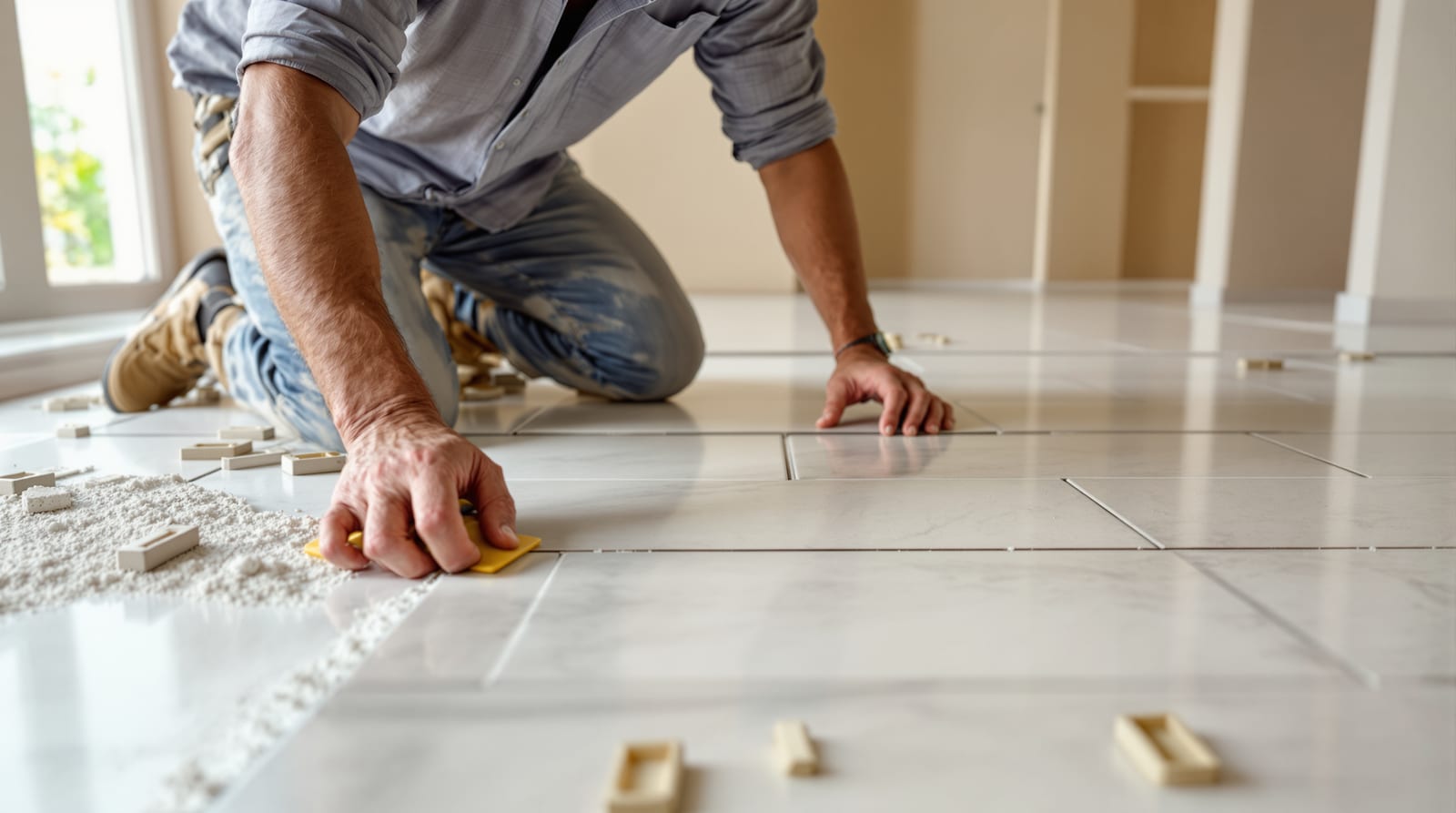
How to Lay Floor Tiles in India: Complete Step-by-Step Guide
A practical, mason-grade walkthrough for tiling an Indian home floor — base check, dry layout, adhesive vs mortar bed, leveling, lippage and grouting.
Laying floor tiles looks simple until the first tile sounds hollow when you tap it, or a row of joints drifts off-line and ends in a 30 mm sliver against the wall. A good tile floor is 70 percent planning and 30 percent troweling. This guide walks you through the complete sequence an experienced Indian mason follows — checking the base, setting out the room, choosing between tile adhesive and a cement-sand mortar bed, spreading and back-buttering, leveling out lippage, and grouting after the right cure time — so your floor stays flat, bonded and crack-free for decades.
Before you start: tools, materials and a reality check
Tiling is well within reach of a careful homeowner for a single room, but most Indian households hire a tiling mason (mestri) and a helper. Whether you do it yourself or supervise, knowing every step lets you catch the shortcuts that cause hollow, drummy or lippage-ridden floors later.
Keep these ready before the first tile goes down:
- Tiles plus 10 percent extra for cuts, breakage and a spare box from the same dye-lot (batch number) for future repairs.
- Tile adhesive (C1 standard or C2 flexible) or cement and sand for a mortar bed.
- Notched trowel (square 6-12 mm notch), rubber mallet, spirit level (600 mm and 1.2 m), chalk line, measuring tape, tile cutter or wet saw, sponge, buckets.
- Tile leveling system (clips and wedges) and 2-3 mm spacers.
- Grout (cement or epoxy), grout float, and an admixture or waterproofing membrane for wet areas.
A quick scope and cost reality check before the detailed steps:
| Item | Indicative India rate (2026) | Notes |
|---|---|---|
| Tile-laying labour (thin-set adhesive) | ₹15-35 / sq ft | Faster; mandatory for large-format and PGVT |
| Tile-laying labour (cement-sand mortar bed) | ₹25-60 / sq ft | Slower; forgiving on uneven base |
| Tile adhesive coverage | ~30-40 sq ft per 20 kg bag | At 3-4 mm bed thickness |
| Spare tiles to keep | 1 box minimum | Same batch, for future cracked-tile replacement |
All rates are indicative and vary by city, vendor and tile size; GST of 18 percent applies on materials. To estimate quantities precisely, use the Studio Matrx tile quantity calculator and the tile adhesive calculator before you buy.
Step 1: Check and prepare the subfloor
Everything depends on a sound, flat, dry base. A tile is only as good as what it sits on. Walk the slab and check three things:
- Soundness: the screed or concrete must be fully cured and crack-free. Tiling on green or damp concrete traps moisture and causes failures. Tap the existing surface — hollow areas mean the old screed is debonded and must be cut out.
- Flatness: lay a 1.2 m straightedge across the floor. For thin-set adhesive you want the base within roughly 3 mm under a 2 m straightedge. If it dips more, correct it first with a cement-sand screed (25-75 mm) or, for shallow corrections under 10 mm, a self-leveling compound.
- Cleanliness: the base must be free of dust, oil, paint and curing-compound residue, or the adhesive will not bond.
For the full base-prep routine — moisture testing, priming, crack treatment and screeding — see our subfloor preparation guide. If your floor needs leveling first, the self-leveling compound guide and the floor screed and mortar bed guide cover the build-up in detail.
This cross-section shows the layers your tile actually rests on, which is why each one has to be right before you start:
Step 2: Set out the room and do a dry layout
This is the step amateurs skip and regret. Never start tiling from a corner — you will almost always end with an ugly thin sliver against the far wall.
Instead, find the room's centre by snapping two chalk lines: measure the midpoints of opposite walls and snap a line between each pair, giving you a cross at the centre. Check the lines are square (a 3-4-5 triangle works). Then lay a full dry run of tiles along both centre lines, with spacers in place, all the way to the walls — no adhesive yet.
Now read the layout and adjust:
- Avoid thin slivers at walls. If the last tile against a wall would be cut to less than about half a tile (ideally never below 50-75 mm), shift the whole grid by half a tile so both opposite edges get a decent, balanced cut.
- Balance the cuts so opposite sides of the room mirror each other — this reads as deliberate, not accidental.
- Prioritise sight lines. Keep full tiles at the room entrance and the most-visible wall; push the cut tiles to the least-seen edge or under furniture.
- Plan around doorways and fixtures so you are not left cutting awkward tile corners around a WC or door frame.
Mark your starting position and adjusted grid lines. From here you tile in quadrants, working out from the centre cross toward the walls so you always step back onto laid tile, never onto wet adhesive.
Step 3: Choose your bedding — adhesive or mortar bed
Two systems dominate Indian sites, and picking right matters more than the brand:
| Factor | Thin-set tile adhesive | Cement-sand mortar bed |
|---|---|---|
| Bed thickness | 3-5 mm over leveled screed | 25-50 mm thick-bed |
| Mix | Pre-bagged C1 or C2 polymer-modified | 1:4 to 1:6 cement:sand on site |
| Best for | Large-format, PGVT, vitrified, over old tiles | Smaller ceramic, very uneven bases |
| Bond strength | High, consistent, low hollowness | Variable; risk of hollow tiles if rushed |
| Labour | ₹15-35 / sq ft, faster | ₹25-60 / sq ft, slower |
| Verdict | Default for modern large tiles | Traditional, still common, forgiving |
For large-format and polished glazed vitrified (PGVT) tiles, thin-set adhesive is effectively mandatory — a mortar bed under big tiles almost guarantees hollow, drummy patches that crack underfoot. Use a C2 flexible adhesive for tiles over 600 mm, for tiling over an old floor, or in exterior and wet areas; C1 standard is fine for normal interior ceramic. This is governed by tile and bonding practice under IS 15622. For a deeper comparison of both systems and where each wins, read the tile laying methods guide.
Step 4: Mix and spread the adhesive
Mix adhesive with clean water to the bag ratio using a slow paddle drill until it is a smooth, lump-free, peanut-butter consistency that holds ridges. Let it slake (rest) for 5 minutes, then remix. Mix only what you can use in about 20-30 minutes (its open time), or it skins over and stops bonding.
Spread it with a notched trowel:
1. Press the flat side onto the base to key in a thin scratch coat.
2. Comb on more adhesive and pull the notched edge through at a consistent 45-degree angle, leaving even parallel ridges. Notch size scales with tile size — roughly 6 mm notch for medium tiles, 10-12 mm for large format.
3. Cover only as much area as you can tile before the adhesive skins (a 1 m by 1 m patch at a time is safe in Indian heat).
The goal is at least 80 percent adhesive coverage under each tile (95 percent in wet areas). Less than that, and you get hollow tiles that sound drummy and crack under point loads — the single most common laying failure on Indian sites.
Step 5: Back-butter large-format tiles
For any tile larger than about 300 by 300 mm, and always for large-format and vitrified tiles, back-butter: spread a thin even layer of adhesive on the back of the tile as well, then set it. This fills voids, guarantees full coverage, and is the surest defence against hollowness. Skipping back-buttering on big tiles is exactly how those drummy, eventually-cracking tiles happen.
Step 6: Lay, bed and level the tiles
Place each tile down with a slight twist into the wet ridges, then tap firmly with a rubber mallet to collapse the ridges and bed it fully. Insert spacers (2 mm for rectified tiles, 2-3 mm for standard ceramic) at every joint as you go.
For a flush, lippage-free surface — essential with large-format tiles — use a tile leveling system: slot a clip under the edge of adjacent tiles and drive a wedge to pull them level with each other. Work tile by tile across your quadrant.
Constantly check as you lay:
- Level and flatness: lay your spirit level across multiple tiles, not just one.
- Lippage (one tile edge sitting proud of its neighbour) should be effectively zero with leveling clips. NBC and accessibility practice expect a flat, trip-free floor; thresholds at doorways should not exceed about 12 mm.
- Line: sight down every joint against your chalk lines — fix drift immediately, before the adhesive sets.
Wipe excess adhesive out of the joints with a damp sponge as you work — dried adhesive in a joint ruins the grout line. The mechanics of clips, wedges and spacer sizing are covered fully in the tile leveling and spacers guide.
Step 7: Leave expansion and movement joints
Do not tile wall-to-wall solid. Leave a roughly 8-10 mm perimeter gap at every wall (hidden later under the skirting), and provide movement joints across large floors — interior practice is one every 20-25 sq m or every 8-10 m run, plus at all doorways. These joints absorb thermal expansion. Omit them on a big vitrified floor and the tiles have nowhere to grow on a hot day, so they tent, arch and pop loose — a genuinely expensive failure. See the floor expansion joints guide for joint spacing, widths and sealant detail.
In bathrooms and utility areas, the bed below the tiles must be laid to a slope of about 1:80 to 1:100 toward the drain, over a waterproofing membrane — never lay a flat wet-area floor.
Step 8: Cure, then grout after 24 hours
Patience here protects all your work. Keep foot traffic off freshly laid tiles for 24-48 hours, and keep heavy loads off for about 7 days.
Grout only after 24 hours, once the adhesive has set, or you will disturb the tiles. Then:
1. Choose grout: cement grout is cheaper but yellows and stains over time and needs sealing; epoxy grout is stain-proof and waterproof — well worth it in kitchens, bathrooms and high-use floors.
2. Remove all spacers. Mix grout to a smooth paste.
3. Force it fully into the joints diagonally with a rubber grout float, packing each joint solid with no gaps.
4. After it firms up (10-20 minutes), wipe diagonally with a damp sponge to clean the tile faces and shape the joints. Rinse the sponge often.
5. Once dry, buff off the grout haze with a dry cloth.
Estimate grout quantity with the Studio Matrx grout quantity calculator, and follow the full method — including epoxy versus cement and joint sealing — in the tile grouting guide.
Step 9: Cure and first cleaning
Let the grout cure per the pack (cement grout typically a few days, longer before wetting in showers). For the first clean, use only plain water or a mild pH-neutral cleaner — avoid acids, which attack cement grout and etch natural stone. Reinstall skirting to hide the perimeter expansion gap. Keep that spare box of tiles labelled with the batch number for future repairs.
For ongoing care by material — and how to keep grout lines clean and white — see the floor cleaning guide. And to make sure you avoid the classic site errors covered above, the flooring installation mistakes guide is a useful final checklist before you begin.
Frequently asked questions
Should I lay tiles on adhesive or a cement-sand mortar bed?
For modern large-format and vitrified or PGVT tiles, use thin-set tile adhesive over a leveled screed — a mortar bed under big tiles risks hollow, drummy patches that crack. A traditional cement-sand mortar bed (1:4 to 1:6) still works well for smaller ceramic tiles or very uneven bases, and is more forgiving, but slower. See our tile laying methods guide for a full comparison.
Why do some tiles sound hollow when tapped?
Hollow or drummy tiles mean less than full adhesive contact underneath — usually under 80 percent coverage. The fixes are to comb adhesive evenly with the right notched trowel, tap each tile down firmly with a mallet, and always back-butter large-format and vitrified tiles. Hollow tiles eventually crack under load and should be lifted and re-fixed.
How long after laying tiles can I walk on them and grout?
Keep foot traffic off for 24-48 hours and avoid heavy loads for about a week. Grout the joints after 24 hours, once the adhesive has set; grouting sooner can shift the tiles and weaken the bond.
How do I avoid thin sliver tiles at the walls?
Set out from the centre of the room using two square chalk lines, then dry-lay tiles to both walls before fixing anything. If the edge cut would be smaller than about half a tile, shift the whole grid by half a tile so both opposite edges get a balanced, decent-sized cut.
What does tile-laying labour cost in India?
Indicatively in 2026, thin-set adhesive laying runs about ₹15-35 per sq ft and a cement-sand mortar bed about ₹25-60 per sq ft, plus materials and 18 percent GST — varying by city, tile size and vendor. Use the Studio Matrx tile quantity and tile adhesive calculators to budget materials accurately.
Export this guide
Related Guides — Deep-dive reading
Subfloor Preparation in India: Get the Base Right Before Any Floor
Why the slab below decides whether your tiles go hollow or your wood cups — assessing, cleaning, repairing, leveling, moisture-testing, priming, screeding and laying over old tiles.
Flooring & SurfacesTile Leveling System and Spacers in India: Dead-Flat Floors, Even Joints, No Lippage
How tile spacers set even 2-3 mm joints and a tile leveling system (clips plus wedges or caps) kills lippage on large-format and vitrified floors.
Flooring & SurfacesTile Laying Methods in India: Mortar Bed vs Tile Adhesive Compared
The two ways tiles are laid in India — traditional thick cement-sand mortar bed versus modern thin-set tile adhesive — compared head to head on thickness, base, cost, speed, hollowness risk and suitability.
Flooring & SurfacesRelated Tools — Try Free
Grout Quantity Calculator
Estimate grout in kg and cost by tile size, joint width and thickness — cement or epoxy grout.
Flooring CalculatorTile Adhesive Calculator
Estimate tile adhesive bags and cost by area and bed thickness, for floor or wall tiling jobs.
Flooring CalculatorBefore vs After — Cost Reality Check
Compare what you expected to pay vs what you actually paid, category by category.
Reality Check