
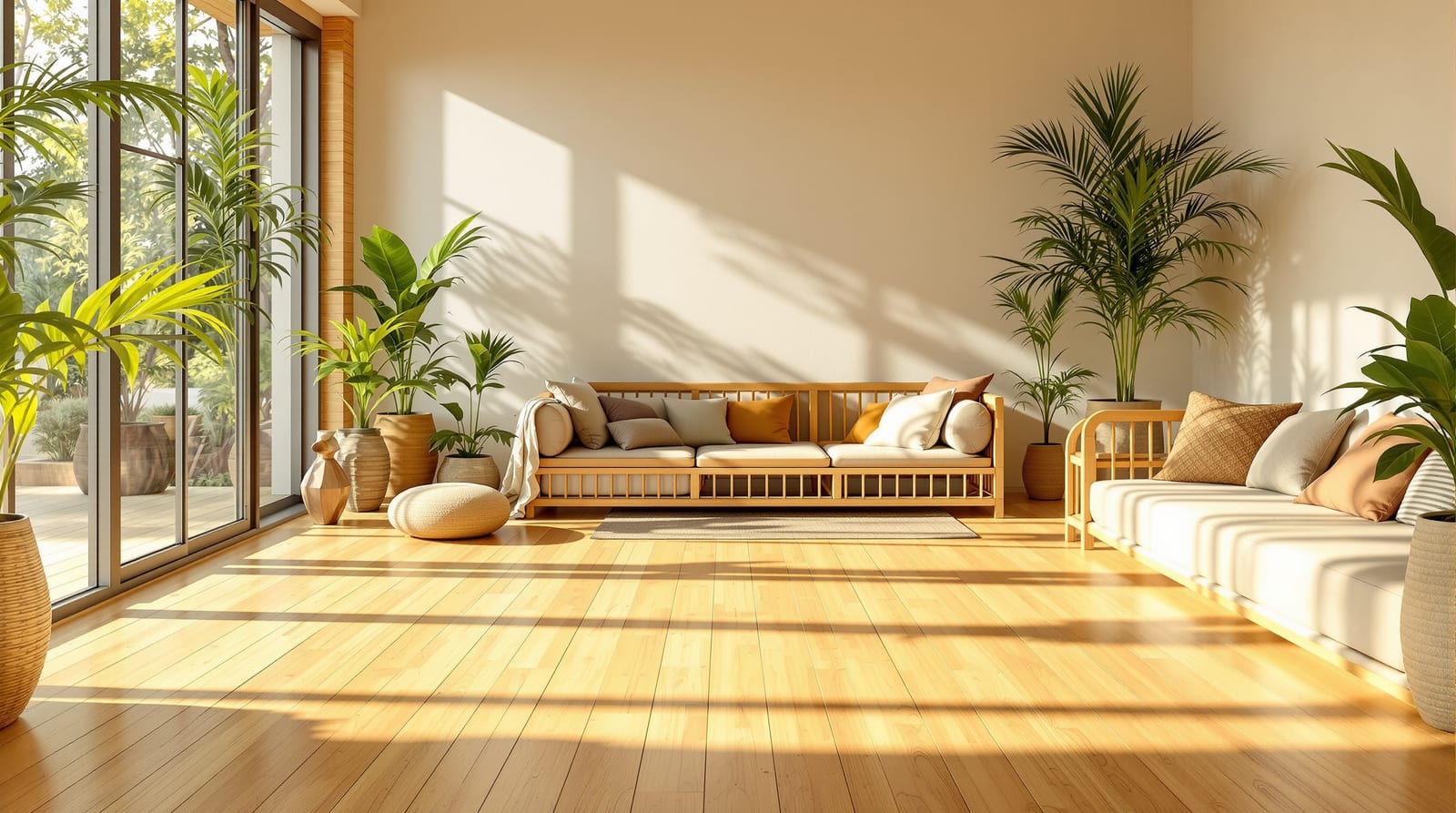
Eco Friendly Flooring in India: The Homeowner's Guide to Greener Floors, Low-VOC Choices and Lower Embodied Carbon
What actually makes a floor green — embodied carbon, recycled content, VOC emissions, renewability, recyclability, lifespan and local sourcing — and which Indian flooring choices are genuinely sustainable, from bamboo, cork and linoleum to local stone, fly-ash tiles and recycled-chip terrazzo.
A floor is one of the largest single surfaces in your home and one of the longest-lived, so the material you choose has a real environmental footprint — from the energy burned to make and ship it, to the chemicals it releases into your indoor air, to whether it can be recycled or just buried at the end of its life. "Eco-friendly flooring" gets used loosely by sellers, so this guide cuts through the marketing and explains what genuinely makes a floor green in Indian conditions, which materials are the strongest choices, which to be cautious about, and how to specify low-VOC adhesives so the floor you lay is as clean as the material you picked.
What actually makes a floor "green"
A floor is not green because a brochure says so. Sustainability is the sum of several measurable things, and a genuinely good choice scores well on most of them rather than perfectly on one.
- Embodied carbon — the total greenhouse-gas emissions to extract, process, manufacture and transport the material before it is even laid. Fired ceramic and vitrified tiles and imported stone carry high embodied carbon (kilns, energy, long shipping); local stone and plant-based materials carry much less.
- Recycled content — how much of the product is made from waste rather than virgin raw material. Fly-ash tiles, recycled-glass terrazzo, and recycled-content vitrified bodies divert industrial waste from landfill.
- VOC emissions — volatile organic compounds that off-gas into your indoor air, mainly from glues, sealers and the plastics in vinyl and laminate. High VOCs hurt indoor air quality and health, especially in closed, air-conditioned Indian homes.
- Renewability — how fast the raw material regrows. Bamboo (3-5 years) and cork (harvested bark, the tree lives on) are rapidly renewable; a slow-growing hardwood or a quarried stone is finite.
- Recyclability and end-of-life — can the floor be reused, recycled or composted, or does it become permanent landfill? Solid stone and reclaimed wood can be re-used; mixed-plastic vinyl and laminate are very hard to recycle.
- Durability and lifespan — a floor that lasts 50 years and is never replaced beats a "green" floor that needs replacing every 8 years. Lifespan spreads the embodied carbon across decades.
- Local sourcing — transport carbon. Granite from a quarry 200 km away or Kota stone from Rajasthan is far greener than Italian marble shipped from Carrara. Green-building rating systems reward materials sourced within roughly 400-800 km.
The honest takeaway: there is no single perfect floor. A bamboo plank is rapidly renewable but uses adhesives and may not last as long as stone; a local granite slab lasts a century with near-zero maintenance but is energy-intensive to quarry and cut. The greenest floor is the one that scores well across these metrics for your climate and gets used for decades.
The eco-comparison: how the main options stack up
The table below rates the common Indian flooring choices across the metrics that matter. Costs are indicative material rates per sq ft (2026, varies by city and vendor; add ~18% GST and laying).
| Material | Renewability | Recycled content | VOC level | Embodied carbon | Indicative cost | Eco verdict |
|---|---|---|---|---|---|---|
| Bamboo | Very high (3-5 yr regrowth) | Low | Low-moderate (adhesive in board) | Low-moderate | ₹150-450 | Strong — rapidly renewable, choose low-VOC binder |
| Cork | Very high (bark, tree survives) | Low | Low | Low | ₹200-500 | Strong — renewable, warm, low-impact |
| Linoleum (natural) | High (linseed, jute, cork) | Some | Very low | Low | ₹80-250 | Excellent — natural, biodegradable, often confused with vinyl |
| Reclaimed/salvaged wood | N/A (already exists) | 100% reuse | Low (with natural finish) | Lowest | varies, ₹250-900 | Excellent — no new material, character |
| Local stone (granite, Kota) | Finite but abundant locally | None | None | Moderate (quarry/cut) but low transport | ₹40-150 | Strong — very durable, local, lasts decades |
| Recycled-content / fly-ash tiles | Finite | High | Low | Lower than standard tile | ₹40-120 | Good — diverts industrial waste |
| Terrazzo with recycled chips | Finite | High (chips) | Low | Moderate | ₹120-400 | Good — long life, recycled aggregate |
| Standard vitrified/porcelain tile | Finite | Low-moderate | Low (tile) but cement grout | High (kiln-fired) | ₹40-120 | Mixed — durable but energy-heavy; pick recycled-content body |
| Engineered wood | Moderate (thin veneer over ply) | Low | Moderate (glues) | Moderate | ₹250-700 | Moderate — better than solid for wood use; check FSC + low-VOC |
| Imported Italian marble | Finite | None | None (stone) | Very high (long shipping) | ₹250-2000+ | Weak on carbon — beautiful but heavy transport footprint |
| Laminate | Low (HDF + plastic) | Low | Moderate-high (resins/glue) | Moderate-high | ₹70-200 | Weak — hard to recycle, VOC risk, shorter life |
| Vinyl / LVT / SPC | Very low (PVC plastic) | Low | Moderate-high (phthalates/VOCs in cheap grades) | High | ₹80-350 | Weakest on eco — plastic, near-impossible to recycle |
Read the table as a guide, not a verdict: a local granite floor and a bamboo floor are both genuinely sustainable for very different reasons, while cheap vinyl and laminate are the choices to think hardest about. For a deeper material-by-material breakdown, see Studio Matrx on sustainable flooring materials.
The greenest options, explained
Bamboo is the poster child of renewable flooring because it is technically a grass that regrows in 3-5 years versus 40-60 for a hardwood. Strand-woven bamboo is the hardest and most durable form. The catch is the adhesive that binds the strands — insist on a low-formaldehyde, low-VOC board — and bamboo's sensitivity to humidity, which matters in coastal India. Full details in the Studio Matrx bamboo flooring guide.
Cork comes from the bark of the cork oak, which is stripped without felling the tree and regrows, making it one of the few truly renewable hard floors. It is warm underfoot, sound-absorbing and naturally a little soft, which suits bedrooms and kids' rooms. See cork flooring for installation and care.
Linoleum is the most misunderstood eco floor in India because people confuse it with vinyl. Real linoleum is made from linseed oil, pine rosin, cork dust, wood flour and jute backing — entirely natural, biodegradable and naturally anti-bacterial, with very low VOCs. It is nothing like petroleum-based vinyl. The linoleum flooring guide covers the difference in depth.
Reclaimed and recycled flooring has the lowest embodied carbon of all because it reuses material that already exists — salvaged teak and Burma teak from old houses, recycled-content vitrified tiles from Morbi, fly-ash tiles that lock up power-plant waste, and terrazzo cast with recycled glass or stone chips. See reclaimed and recycled flooring.
Local natural stone — granite from South Indian quarries, Kota stone from Rajasthan, local Jaisalmer or Tandur — wins on transport carbon and on lifespan. A stone floor laid well lasts the life of the building and needs no replacement, which spreads its quarrying footprint across decades. The nuance is covered in natural stone sustainability.
The higher-impact choices to weigh carefully
Some popular floors carry a heavier footprint, and it is worth knowing why before you commit.
Imported Italian marble is quarried and cut with significant energy, then shipped thousands of kilometres by sea and road to India — that transport alone makes its embodied carbon far higher than a comparable Indian stone. It is genuinely beautiful and very durable, so if you choose it, value its longevity; but on a pure carbon basis, local marble or granite is the greener call.
Vinyl, LVT and SPC are plastic floors (PVC). Cheaper grades can off-gas phthalates and VOCs, the material is petroleum-derived, and it is extremely difficult to recycle at end of life, so most of it becomes landfill. Higher-quality, low-VOC, phthalate-free grades are better, but on renewability and recyclability vinyl sits at the bottom of the eco table.
Laminate is a high-density fibreboard core topped with a printed plastic layer, bonded with resins. It uses some wood waste, but the glues can carry VOCs, it cannot be refinished, and the mixed plastic-and-fibre construction is hard to recycle. It is a budget choice, not a green one.
None of these are forbidden — a low-VOC SPC in a flood-prone utility room can be the sensible practical answer. The point is to choose with eyes open and to insist on the cleanest grade.
A simple eco-scorecard you can use
When you compare two real floors, score each metric and add it up. The diagram below shows the seven factors and a worked example for local granite versus imported marble.
The lesson the scorecard makes visible: two durable stones can land far apart once you count transport and sourcing. Use the same seven rows to compare any two floors you are torn between.
Low-VOC adhesives, sealers and finishes
A green material laid with a solvent-heavy glue is no longer a green floor. The adhesives, grouts, sealers and coatings can be a bigger source of indoor air pollution than the flooring itself, so specify them as carefully as the material.
- Tile adhesive and grout — most cement-based tile adhesives (Roff, MYK Laticrete, Pidilite) are low-VOC by nature; choose them over solvent-based glues. Epoxy grout is stain-proof and durable (longer life = greener) but some epoxies have higher VOCs during cure, so ventilate well.
- Wood and bamboo glues — insist on water-based, low-formaldehyde adhesives for glue-down wood, bamboo and engineered boards. Avoid solvent-based contact adhesives indoors.
- Sealers and finishes — use water-based polyurethane and natural oil/wax finishes on wood and cork rather than solvent-based varnish. For stone, water-based penetrating sealers are low-odour.
- Certifications to look for — GREENGUARD or GREENGUARD Gold, low-emission or "low-VOC" labels, and FSC certification for wood. These are the credible signals among a lot of vague "eco" marketing.
- Ventilate during and after laying — even low-VOC products release some emissions while curing; keep windows open and let an air-conditioned room air out for a few days before heavy use.
For the full treatment of glues, sealers, certifications and air-quality, see the Studio Matrx low-VOC flooring guide, which pairs directly with this one.
How to choose a greener floor for your home
Work through it in this order rather than chasing a single label:
1. Start with lifespan and fit. The greenest floor is one you never replace. Choose a material that suits your room, climate and traffic so it lasts decades — durability outweighs almost every other metric.
2. Buy local where you can. Local granite, Kota and Indian marble beat imported stone on transport carbon and usually on price. Indian-made tiles beat imported ones.
3. Favour renewable or recycled raw material where the use suits — bamboo, cork or linoleum in bedrooms and low-water rooms; fly-ash or recycled-content tiles and recycled-chip terrazzo elsewhere.
4. Protect your air with low-VOC glues, sealers and finishes, and look for credible certifications.
5. Match the floor to the climate so it survives — solid wood and bamboo struggle in coastal humidity, while local stone and vitrified shine there. The Studio Matrx how to choose flooring for Indian weather guide helps here.
6. Use a selector to compare quickly. The Studio Matrx eco flooring selector lets you filter options by sustainability priorities, and the flooring material selector and flooring climate selector help narrow by room and region.
Green-building credits: when it counts officially
If you are building to a green standard, your flooring choices earn points. India's main systems — IGBC Green Homes, GRIHA, and LEED India — award credits for low-VOC materials, regional/local materials (sourced within roughly 400-800 km), recycled content, FSC-certified wood, and rapidly renewable materials like bamboo and cork. Even if you are not chasing a formal rating, these criteria are a reliable checklist for genuinely greener choices. The Studio Matrx green-building flooring credits guide explains exactly which floors earn which points, and flooring embodied carbon digs into the carbon numbers behind the scorecard.
Frequently asked questions
What is the most eco-friendly flooring for an Indian home?
There is no single winner — it depends on the room and climate. For renewability, bamboo, cork and natural linoleum lead. For lowest embodied carbon and longest life, local stone (granite, Kota) and reclaimed wood are excellent. For diverting waste, fly-ash and recycled-content tiles and recycled-chip terrazzo are strong. The greenest practical choice is usually a durable, locally sourced material laid with low-VOC adhesives.
Is vinyl or laminate flooring eco-friendly?
Generally no. Vinyl (LVT, SPC) is plastic (PVC), petroleum-derived, can off-gas VOCs in cheaper grades and is very hard to recycle. Laminate uses resin-bonded fibreboard with a plastic top layer, cannot be refinished, and is hard to recycle. Both can be acceptable practical choices in wet or budget situations if you pick low-VOC, phthalate-free grades, but neither is a green flooring choice in the way bamboo, cork, linoleum or local stone is.
Why is imported Italian marble considered less sustainable than Indian stone?
Because of transport carbon. Italian marble is quarried and cut with significant energy, then shipped thousands of kilometres to India, adding a large transport footprint that Indian granite or marble — quarried a few hundred kilometres away — does not carry. Both stones are durable and beautiful; on a pure environmental basis, local stone is the greener choice.
Do low-VOC adhesives really matter if my flooring material is natural?
Yes. The glue, grout, sealer and finish can release more indoor air pollution than the flooring itself. A natural bamboo or cork floor laid with a solvent-heavy adhesive is no longer a clean-air floor. Choose water-based, low-formaldehyde, low-VOC products, look for GREENGUARD certification, and ventilate the room while everything cures.
Does eco-friendly flooring cost more?
Not necessarily. Local stone, fly-ash tiles and recycled-content tiles are competitively priced or cheaper than premium imported options. Bamboo and cork sit in the mid-range, similar to laminate or engineered wood. Reclaimed wood varies with availability. The bigger saving is long-term: durable, low-maintenance green floors that you never replace cost less over the life of the home than cheap floors swapped every few years.
Export this guide
Related Guides — Deep-dive reading
Flooring Embodied Carbon in India: The Lifecycle Footprint of Every Floor, Explained
Embodied carbon is the total CO2 locked into a floor across extraction, manufacture, transport, installation, maintenance and disposal - and durability plus local sourcing matter far more than the label 'eco'. Compare bamboo, cork, linoleum, local stone, ceramic, vitrified, imported marble, vinyl and laminate on a true cradle-to-grave basis for Indian homes.
Flooring & SurfacesSustainable Flooring Materials in India: A Material-by-Material Eco Catalogue
A deep catalogue of the genuinely sustainable floors you can actually buy in India — bamboo, cork, natural linoleum, reclaimed and FSC-certified wood, local granite, Kota and sandstone, recycled-chip terrazzo, fly-ash and recycled-content vitrified, and rubber from old tyres — with their real eco credentials, durability, cost, look and best use.
Flooring & SurfacesGreen Building Materials Guide (India): Low-Carbon, Healthy & Sustainable Choices (2026)
What actually makes a building material green - low embodied carbon and energy, recycled and renewable content, local sourcing, durability, recyclability, low VOC and water efficiency - mapped honestly across the whole Indian building, with the lifecycle nuance no label can give you.
Building MaterialsRelated Tools — Try Free
Cross-Ventilation Analyzer
Estimate airflow and air changes per hour (ACH) from room size, window areas, layout, and local wind — with NBC 2016 Part 8 compliance check.
Ventilation CalculatorFlooring Cost Calculator
Estimate the all-in cost of a floor — material, laying, wastage, skirting and GST — by area and material.
Flooring CalculatorEco Flooring Selector
Find the most sustainable flooring for your needs, scored on renewability, recycled content, VOC and embodied carbon.
Flooring Tool