
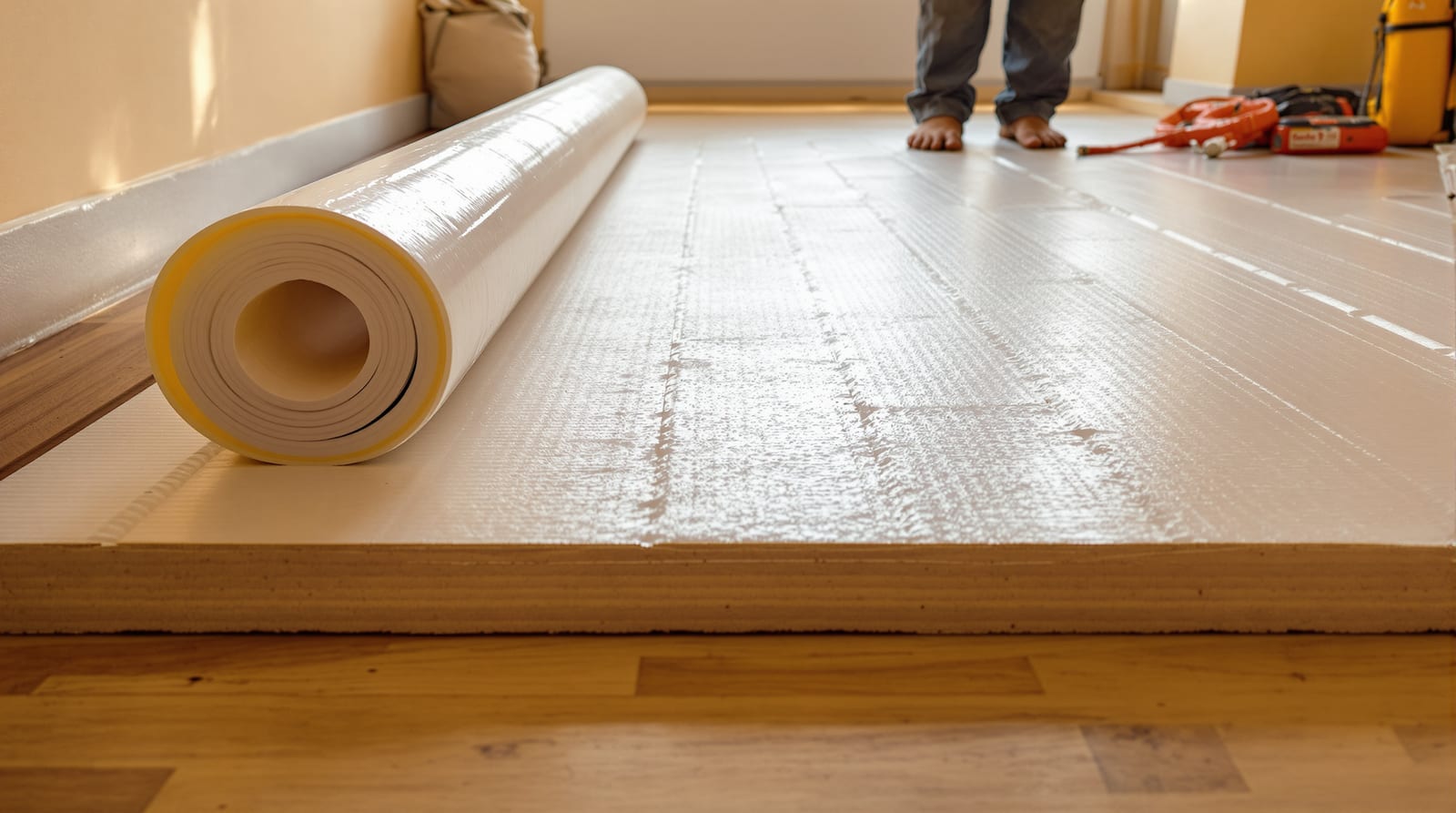
Flooring Underlayment & Moisture Barrier Guide for India (Floating Floors)
Why underlay and a damp-proof membrane make or break laminate, SPC and engineered floors over Indian concrete — types, the 200-micron PE DPM, when you can skip it, and how to lay it.
The thin grey sheet a fitter rolls out before the first plank goes down looks like the most skippable part of a floating floor. It is not. In Indian homes, underlay and a damp-proof membrane are the difference between a laminate or SPC floor that stays dead flat for a decade and one that cups, creaks, telegraphs every lump in the slab, and feels like a drum underfoot within one monsoon. Get these two layers right and almost everything else forgives itself.
This guide explains what underlay actually does, the types sold in India and what each costs, why a 200-micron polyethylene (PE) damp-proof membrane (DPM) over concrete is non-negotiable in humid and coastal homes, the one situation where you can leave it all out, and how to overlap and tape it so it works.
What underlay and a moisture barrier actually do
A floating floor (laminate, SPC, WPC, or click engineered wood) is not glued or nailed to the slab — the planks click to each other and "float" as one panel. That design relies on two thin layers underneath, and they do different jobs.
Underlay is the cushioning pad. It does four things at once:
- Cushioning and feel — it lets the floating panel sit comfortably and feel solid rather than hard and clattery underfoot.
- Minor levelling — it bridges tiny undulations in the slab (roughly up to 2-3 mm over a metre). It does NOT fix a wavy floor; that still needs a screed or self-leveling compound first.
- Acoustics — it absorbs the hollow click of footsteps. This matters most in apartments, where impact sound travels to the flat below.
- Warmth — foam and cork add a slight thermal break, so the floor feels less cold (relevant in hill homes, less so in the plains).
The moisture barrier (DPM / vapour barrier) is a separate job. A concrete slab is never truly dry — it wicks moisture vapour up from the ground and from the slab's own residual water, and in coastal and monsoon-humid air that vapour is relentless. Laminate's fibreboard core and engineered wood's veneer swell, cup and delaminate when that vapour reaches them. A 200-micron PE film sits between slab and underlay (or is built into a combo underlay) and stops the vapour cold. Skip it over concrete in Mumbai, Goa, Chennai, Kochi or any ground-floor room and you are betting your floor against the weather — a bet you lose.
Underlay types sold in India — and what they cost
Most Indian retailers stock four families plus combo products. Pick by your floor type, whether you are upstairs, and your humidity.
| Underlay type | Typical thickness | Best for | Has DPM? | Indicative cost |
|---|---|---|---|---|
| PE / EVA foam | 2-3 mm | Laminate, budget floating floors | No (buy separately) | ₹8-20 / sq ft |
| IXPE (cross-linked foam) | 1.5-3 mm | Laminate, engineered, SPC | Often integrated film | ₹15-35 / sq ft |
| Combo underlay (foam + attached DPM) | 2-3 mm | Laminate / engineered over concrete | Yes (built-in PE film) | ₹20-45 / sq ft |
| Cork (acoustic) | 2-6 mm | Apartments, sound control, warmth | No (add DPM separately) | ₹40-90 / sq ft |
| Rubber (recycled) | 2-5 mm | Heavy traffic, best acoustics | No (add DPM) | ₹50-120 / sq ft |
| 200-micron PE film (DPM only) | 0.2 mm | Moisture layer under any foam | It IS the DPM | ₹4-10 / sq ft |
Costs are indicative for 2026 and vary by city, brand and quantity; add 18% GST. A few notes that save money and grief:
- PE/EVA foam is the cheapest and fine for laminate in a dry first-floor bedroom — but it has no moisture protection, so over concrete you must add a separate DPM.
- IXPE is denser and more durable than plain foam, recovers better under furniture loads, and is the sweet spot for SPC and engineered floors. Many IXPE rolls come with a thin metallised or PE film already laminated on — read the spec sheet to confirm.
- Combo underlay (foam bonded to a PE moisture film) is the most foolproof choice over Indian concrete: one roll, one layer, moisture handled. For most homeowners laying laminate or click-engineered wood over a slab, this is the recommendation.
- Cork and rubber are premium acoustic upgrades. In a flat where you do not want footsteps heard below, cork (warm, renewable) or recycled rubber (toughest, quietest) is worth it — but neither stops vapour, so you still lay a 200-micron DPM beneath them on concrete.
The 200-micron PE DPM over concrete — the rule that saves floors
The single most important number in this guide: 200 micron (0.2 mm) polyethylene sheet, laid over concrete, under the underlay, in any humid or ground-contact room. This is the standard damp-proof membrane Indian fitters use, sold by the roll in any hardware or flooring shop.
Why 200 micron and not the flimsy 100-micron painter's sheet: thinner film tears under foot traffic during the lay and lets vapour through at the punctures. The 200-micron grade is robust enough to survive installation intact. Indian damp-proofing practice and IS 2645 (integral waterproofing) both point the same way — keep slab moisture out of the finished assembly.
You need a DPM over concrete when:
- The room is on the ground floor or over a basement / parking (ground vapour).
- You are in a coastal or monsoon-humid city — Mumbai, Goa, Chennai, Kochi, Vizag, Kolkata, coastal Kerala and Karnataka.
- The slab is new or recently poured (concrete keeps releasing water for weeks; never lay floating floors on green slab — wait, and test).
- You are simply unsure. The DPM is the cheapest layer in the whole floor; there is no good reason to gamble.
A quick site check before you lay: tape a 1 m square of clear plastic flat to the bare slab overnight. Condensation under it the next morning means the slab is releasing moisture — DPM is mandatory, and you may need to wait longer for the slab to dry. Floating-floor manufacturers typically want slab moisture below about 4% before laying.
Here is how the layers stack on a concrete slab — slab at the bottom, plank on top:
Note the two details the SVG flags: the expansion gap of 8-12 mm at every wall (the floating panel must be free to move — this is hidden by skirting later), and the DPM turning up about 50 mm at the perimeter so the moisture seal is continuous, trimmed flush once skirting goes on.
When you do NOT need a separate underlay
Not every floor needs you to roll out a separate layer — and doubling up can actually cause problems.
- Pre-attached pad. Many SPC, WPC and premium laminate planks ship with a factory-bonded IXPE or EVA pad on the underside. The plank already has its cushioning and acoustics built in. Adding another foam underlay on top of a pre-attached pad makes the assembly too soft and springy, over-flexes the click joints, and can cause them to fail or gap. So: pre-attached pad means no separate underlay — but you may still need a thin DPM under it if the slab is humid (a film-only sheet, not foam).
- Glue-down or nail-down floors. Solid hardwood nailed to plywood, or engineered wood fully glued to the slab, does not float and does not take a foam underlay — the adhesive bonds it solidly. Moisture control there is handled by the slab prep, primer and a moisture-barrier adhesive instead.
- Over an existing sound, dry, sealed floor (e.g. floating over old vitrified tiles indoors) the DPM job is partly done by the existing impervious surface, but a combo underlay is still cheap insurance.
The rule of thumb: cushioning is needed once, moisture protection is needed once. Provide each exactly once. Pre-attached pad gives you cushioning; a humid slab still demands moisture protection.
Overlap, taping and laying it right
Underlay and DPM only work if the layer is continuous — gaps and untaped seams are where vapour sneaks through and where planks find lumps.
| Step | What to do |
|---|---|
| Prep | Slab clean, dry, level (grind high spots, fill low spots with self-leveling compound). Vacuum dust. |
| Lay direction | Roll underlay perpendicular to the planned plank direction, or as the maker specifies. |
| Seams (foam underlay) | Butt edges together — do NOT overlap foam (overlapping creates a ridge you will feel). Tape the butt joint with the underlay's seam tape or wide cloth/PE tape. |
| Seams (DPM film) | OVERLAP the PE film 150-200 mm at every join (the opposite of foam) and tape the overlap continuously so it is vapour-tight. |
| Perimeter | Turn the DPM up the wall ~50 mm; leave the 8-12 mm expansion gap for the planks; both get hidden by skirting. |
| Combo underlay | The attached film usually has a lip / flap on one edge — overlap the next roll's foam onto that lip and tape, so foam butts but the film overlaps. Follow the printed guide on the product. |
| Acclimatise | Leave the flooring planks flat in the room, in their boxes, 48 hours before laying so they reach the home's temperature and humidity. |
A few field cautions from Indian sites: do not staple or pin DPM to the slab (every hole is a leak); keep the membrane off the day's dust; and never lay any floating floor on a slab that fails the overnight plastic-sheet test or that was poured in the last few weeks.
For quantities — how many rolls of underlay and DPM your room needs, allowing for overlaps and wastage — use the Studio Matrx underlayment calculator. Then read the install guides for your specific floor: laminate flooring installation, SPC vinyl click installation, and wooden floor installation. If you live by the sea or in a high-humidity belt, pair this with flooring for high humidity before you choose the floor at all.
Frequently asked questions
Do I really need a moisture barrier under laminate in India?
Over concrete, yes — almost always. Laminate's fibreboard core swells and cups when slab vapour reaches it, and Indian slabs (especially ground floor, new, or in coastal and monsoon-humid cities) release vapour continuously. A 200-micron PE DPM or a combo underlay with built-in film is cheap insurance. You can relax only on a dry upper-floor slab that passes the overnight plastic-sheet test — and even then, most fitters lay it anyway.
Can I use two layers of underlay for extra cushioning?
No. Stacking two foam underlays, or adding foam over a plank's pre-attached pad, makes the floor too soft and over-flexes the click joints, which then gap or break. Provide cushioning exactly once. If you want more acoustic performance, use a single thicker or denser underlay (cork or rubber), not two layers.
What is the difference between underlay and a DPM?
Underlay is the cushioning, levelling and acoustic pad. A DPM (damp-proof membrane / vapour barrier) is a thin PE film whose only job is to stop slab moisture reaching the floor. They are different jobs. Some products combine them (combo underlay), but a plain foam underlay does NOT stop moisture — you add a separate 200-micron film over concrete.
How thick should underlay be?
Most floating floors use 2-3 mm. Thicker is not automatically better — too thick (5 mm+) over-cushions and stresses the click joints. Use what the flooring maker specifies: typically 2-3 mm foam/IXPE for laminate and SPC, around 2 mm for engineered wood, and thicker cork or rubber only when acoustics are the priority.
Do foam seams overlap or butt together?
Foam underlay edges BUTT together and are taped — overlapping foam creates a ridge you will feel through the plank. The DPM film is the opposite: overlap the film 150-200 mm at joints and tape it so it is vapour-tight. With a combo underlay, the foam butts while the attached film flap overlaps.
Export this guide
Related Guides — Deep-dive reading
Engineered Wood Flooring in India: Layers, Wear Layer, Install & Cost (2026)
Engineered wood is a real-wood top veneer bonded over a cross-laminated plywood or HDF core, which makes it far more dimensionally stable than solid wood in Indian humidity — the practical way to get a genuine timber floor here. This guide covers the layer build-up, wear-layer thickness, click vs glue-down install, where it suits, ₹/sq ft, brands and maintenance.
Flooring & SurfacesWooden Floor Installation in India: Nail-Down, Glue-Down & Floating Methods
How solid and engineered wood floors are actually laid in Indian homes — acclimatising planks, moisture barriers, the three fixing methods, expansion gaps and labour rates that decide whether your floor stays flat or cups.
Flooring & SurfacesWooden Flooring in India: Solid, Engineered, Laminate & Wood-Look SPC Compared (2026)
The decision-oriented hub for wood floors in Indian homes — the three families plus wood-look SPC, the warm look, honest monsoon-and-termite caveats, where wood works, finishes, installation types, ₹/sq ft ranges and maintenance.
Flooring & SurfacesRelated Tools — Try Free
Wooden Flooring Cost Calculator
Estimate installed wood or wood-look floor cost — solid, engineered, laminate or SPC — with underlay and skirting.
Flooring CalculatorUnderlayment Calculator
Estimate underlay rolls, damp-proof membrane and cost for a floating wood, laminate or SPC floor.
Flooring CalculatorDoor Material Comparison Tool
Compare 2–4 door materials on cost, durability, maintenance, security and moisture resistance.
Comparison Tool