
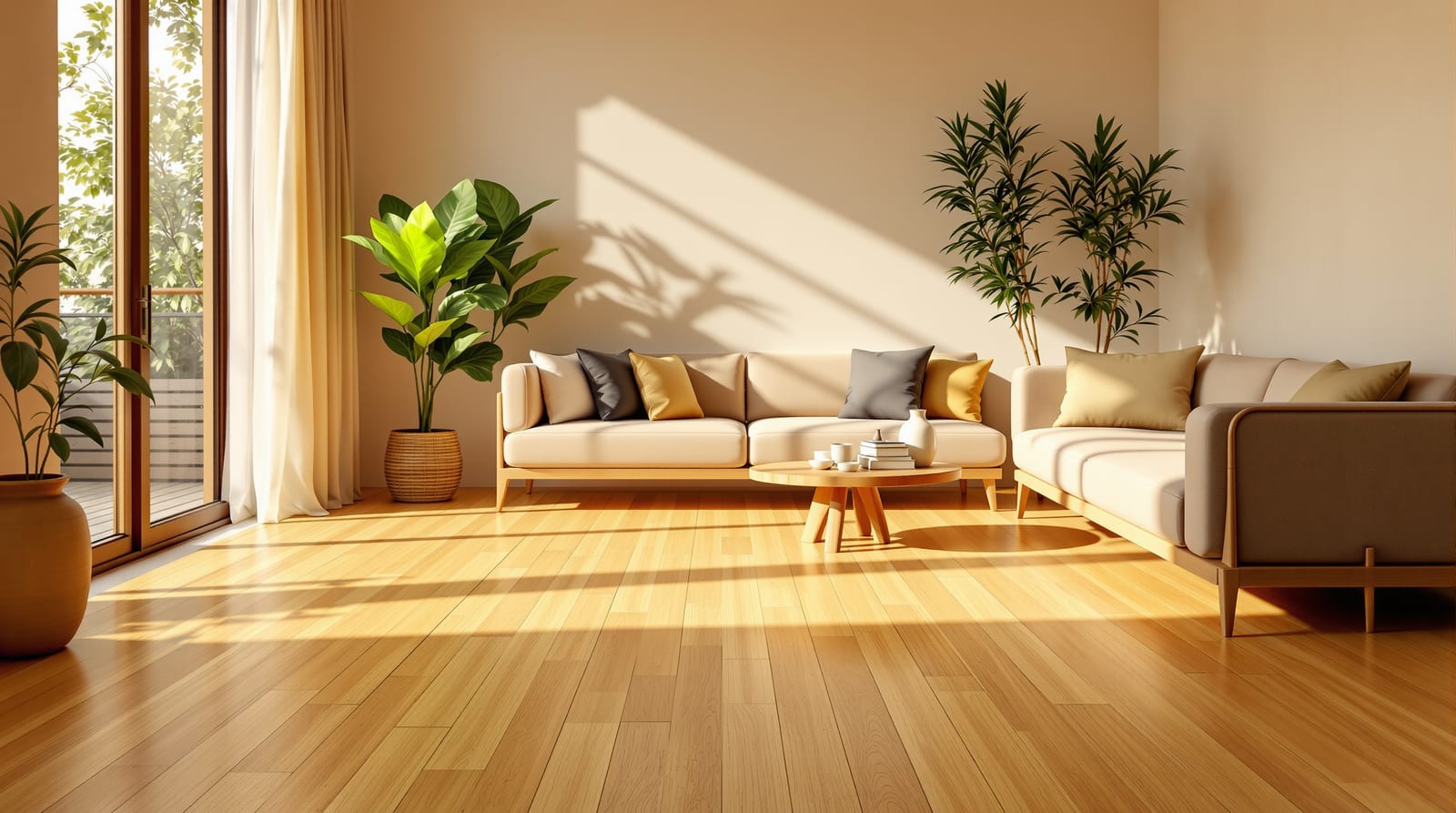
Bamboo Flooring in India: Types, Cost, Durability and the Humidity Caveat
Why bamboo is one of the most rapidly renewable floors you can lay, how horizontal, vertical and strand-woven differ, real ₹150-450/sq ft costs, Janka hardness, and the acclimatisation and humidity rules that decide whether it survives a coastal Indian summer.
Bamboo looks like timber, feels like timber and behaves a lot like timber underfoot, yet it is technically a grass that regrows in three to five years instead of the decades a hardwood tree needs. That single fact makes bamboo one of the most genuinely renewable floors you can lay in an Indian home. The catch is humidity: bamboo is dimensionally fussy, and in a coastal or monsoon-heavy city it will reward careful acclimatisation and punish a rushed installation. This guide explains the types, the real costs, how hard it actually is, and where bamboo belongs in an Indian house.
Why bamboo counts as eco flooring
Most hardwood used in premium Indian floors — teak, oak, walnut — comes from trees that take 25 to 60 years to mature. Bamboo (usually Moso, the species nearly all flooring is made from) reaches harvest maturity in about three to five years, and it regrows from the same root system after cutting, so you never replant. It also draws down carbon fast while growing and releases oxygen at a higher rate than equivalent stands of trees.
For green-building scorecards this matters in concrete ways. Bamboo is classed as a "rapidly renewable" material under rating systems such as IGBC Green Homes, GRIHA and LEED India, which award points for materials harvested on a roughly ten-year or shorter cycle. If the boards are also low-VOC certified and the adhesive in the board (and on site) is water-based rather than urea-formaldehyde, the eco case gets stronger still. We cover how those points are earned in the green-building flooring credits guide, and where bamboo sits against cork, linoleum and reclaimed timber in the broader sustainable flooring materials guide.
A few honest caveats keep the eco label fair. Most bamboo flooring is imported, usually from China, so transport carbon is real — local granite or Kota stone will always beat it on food-miles. And cheaper boards can use formaldehyde-based binders, so the "eco" claim only fully holds when you check the certification rather than the marketing.
The three types of bamboo flooring
Almost all confusion about bamboo comes from not knowing which of three constructions you are buying. They look broadly similar but behave very differently.
Horizontal bamboo is made by laying flattened bamboo strips wide-side up and gluing them in layers. You see the classic "bamboo node" knuckle pattern — the look most people picture. Vertical bamboo stands the strips on edge before pressing, giving a tighter, more uniform striped grain with the nodes far less visible. Both of these are pressed-strip products of similar hardness.
Strand-woven bamboo is the game-changer. Here the bamboo fibres are shredded, coated with resin and compressed under enormous pressure into a dense board. The result is dramatically harder than the other two — harder, in fact, than many traditional hardwoods including oak and most Indian timbers. If durability is your priority, strand-woven is the only construction worth considering for a busy Indian home with kids, chappals at the door and the occasional dragged chair.
There is also a colour choice running through all three. Natural bamboo is pale honey-blonde. Carbonised (or "caramel") bamboo is steamed under pressure to a warmer coffee tone — but be aware carbonising slightly softens the fibre, so a carbonised strand-woven board is a little less hard than a natural one.
| Bamboo type | Construction | Look | Relative hardness | Best for |
|---|---|---|---|---|
| Horizontal | Flat strips, glued in layers | Visible node "knuckle" pattern | Moderate (similar to softer oak) | Low-traffic bedrooms, study, period look |
| Vertical | Strips on edge, pressed | Tight uniform stripes, subtle nodes | Moderate | Bedrooms, formal rooms, clean modern look |
| Strand-woven (natural) | Shredded fibre + resin, high-pressure pressed | Marbled, dense grain | Very high — harder than most hardwoods | Living rooms, hallways, busy homes |
| Strand-woven (carbonised) | As above, steamed darker | Warm coffee tone, dense grain | High (slightly below natural) | Busy homes wanting a darker floor |
How hard is bamboo, really?
Hardness is measured on the Janka scale (resistance to denting). As a rough guide, ordinary horizontal and vertical bamboo lands in the same band as natural oak, while strand-woven bamboo is roughly twice as hard — comfortably above oak, teak and most Indian hardwoods. That density is exactly why strand-woven is the sensible default for Indian living rooms. Bear in mind no floor is dent-proof: a heavy object dropped on an edge will still mark even strand-woven, and high heels concentrate huge pressure on a tiny point.
The look and feel
Bamboo gives you a warm, wood-like floor at a price that usually undercuts solid hardwood and often engineered wood. The grain reads cleaner and more contemporary than oak — fewer knots, a more linear figure — which suits the minimalist and Japandi looks popular in Indian apartments right now. Underfoot it feels warm, like timber and unlike cool stone or tile, which is why it works well in bedrooms and in hill-station homes where a cold floor is unwelcome (see the hill-stations flooring guide).
Most boards come pre-finished with a tough factory UV-cured lacquer, so there is no on-site sanding or polishing and the floor is walkable the moment the click joints are down. Plank widths and lengths broadly match engineered wood, and many ranges offer a click-lock profile that floats over an underlay just like laminate.
Cost in India
Indicative 2026 supply rates, before the roughly 5 to 10 percent you should add for wastage and before installation. All figures vary by city, brand and import batch; add 18 percent GST.
| Item | Indicative cost | Notes |
|---|---|---|
| Horizontal / vertical bamboo board | ₹150-280 per sq ft | Entry to mid range; lighter-duty |
| Strand-woven bamboo board | ₹250-450 per sq ft | Premium; the durable choice |
| Foam / IXPE underlay | ₹15-40 per sq ft | For floating click installs |
| 200-micron PE damp-proof membrane | ₹8-20 per sq ft | Mandatory over concrete in humid zones |
| Floating click installation labour | ₹35-70 per sq ft | Faster, lower labour |
| Glue-down installation labour + adhesive | ₹60-120 per sq ft | More stable, better for large humid areas |
For a like-for-like comparison against oak, teak and engineered boards, the wooden flooring guide and the engineered wood flooring guide carry their own rate tables. To price a specific room, the wooden flooring cost calculator gives a quick estimate, and the eco flooring selector helps weigh bamboo against cork and linoleum on sustainability as well as cost.
Installation: click or glue
Bamboo installs by one of two methods, and the choice should be driven by your climate as much as your budget.
Floating click is the faster, cheaper route. Tongue-and-groove or click-lock planks lock together and float as one mat over a foam or IXPE underlay. Over a concrete slab you must lay a 200-micron polyethylene damp-proof membrane first, because rising moisture is bamboo's biggest enemy. Leave an 8 to 12 mm expansion gap at every wall and around every fixed object — pipes, columns, door frames — and hide it under skirting. Skip that gap and the floor has nowhere to go when it swells; it will lift or "tent" in the middle.
Glue-down bonds each plank directly to a clean, level, dry screed with a flexible flooring adhesive. It is more labour and more cost, but it holds the boards far more rigidly, which makes it the safer choice for large rooms and for humid coastal cities where seasonal movement is severe. Whichever method you use, the subfloor must be flat (use self-leveling compound to correct dips, as in the self-leveling compound guide) and genuinely dry — a damp slab will wreck a bamboo floor faster than anything else.
The non-negotiable step is acclimatisation. Bring the unopened or loosely opened boxes into the actual room where they will be laid and leave them at least 48 to 72 hours — longer in humid weather — so the bamboo reaches the home's own temperature and humidity before it is fixed. Laying boards straight off a hot delivery truck is the single most common cause of bamboo failure in India.
Floor build-up: floating click over concrete
The diagram below shows the correct stack for a floating bamboo floor on a concrete slab in a humid Indian city, and why the perimeter expansion gap matters.
The humidity caveat — read this before you buy
Bamboo is a hygroscopic natural material: it absorbs moisture from humid air and swells, then gives it back and shrinks in dry air. Push that cycle too hard and boards cup (edges rise), crown (centre rises), gap in winter or buckle in the monsoon. This is the make-or-break issue for bamboo in India.
In hot-dry interiors — Delhi, Rajasthan, Ahmedabad — bamboo is generally well behaved, the same as any wood floor, as long as the slab is dry. The risk climbs sharply in coastal and high-humidity zones — Mumbai, Goa, Chennai, Kochi, Vizag — where relative humidity sits high for months. There, treat bamboo with the same caution as solid hardwood: prefer dense strand-woven boards, prefer glue-down over floating, insist on a damp-proof membrane, run ceiling fans or dehumidification to keep indoor RH reasonably stable, and never let standing water sit on the floor. Our coastal and humid homes flooring guide and the high-humidity flooring guide go deeper on managing these conditions.
Three places to simply avoid bamboo: bathrooms and wet areas, where it has no business; ground floors with a history of damp or flooding; and any room where the concrete slab has not fully dried (a new slab needs months). For those rooms, vitrified or porcelain tile is the right answer — see the kitchen and bathroom flooring guidance in the wider cluster.
Maintenance
Day to day, bamboo is easy. Sweep or vacuum (hard-floor setting, no beater bar) to lift grit that would scratch the lacquer, and clean with a well-wrung, damp — never wet — microfibre mop. Use a pH-neutral wood or bamboo floor cleaner; skip vinegar, abrasive scourers, steam mops and anything that floods the surface, all of which damage the finish or drive moisture into the joints. Put felt pads under furniture legs, soft castors on chairs, and a doormat at the entrance so outdoor grit and water stay outside. Trim pet claws. Our floor cleaning guide covers wood-family floors in detail.
Pre-finished bamboo cannot usually be sanded and refinished the way thick solid hardwood can — the wear layer is thin — so protecting the factory finish is the whole game. Minor scratches can be disguised with a matching wax stick or touch-up pen. For a worn floating floor, individual planks can sometimes be lifted and swapped, which is one quiet advantage of click installation, so keep a spare box from the same dye-lot.
Where bamboo suits an Indian home
Bamboo earns its place in bedrooms, living rooms, studies, dressing rooms and home offices — anywhere you want the warmth and look of wood with a stronger eco story and, in strand-woven form, real toughness. It is excellent in hill-station and cooler-climate homes where its warmth underfoot is a genuine comfort. It is a sensible mid-budget alternative to oak or teak when you care about renewability.
Be more cautious in coastal and monsoon-heavy cities, where it needs the strand-woven-plus-glue-down-plus-DPM treatment to behave. And keep it out of kitchens with heavy spill risk, bathrooms, balconies and any damp ground floor. Used in the right rooms with proper acclimatisation, a strand-woven bamboo floor can give you fifteen to twenty-five years of warm, low-carbon, hard-wearing service. For a side-by-side eco comparison, the cork flooring guide, the linoleum flooring guide and the eco-friendly flooring guide round out the renewable options.
Frequently asked questions
Is bamboo flooring really more eco-friendly than wood?
Yes, on renewability. Bamboo regrows from its root system and is harvestable in three to five years versus decades for hardwood, and it qualifies as a rapidly renewable material under IGBC, GRIHA and LEED India. The two caveats are transport carbon (most bamboo is imported) and the binder — only low-VOC, formaldehyde-free boards fully earn the eco label, so check certification rather than the brochure.
Which bamboo type is hardest and most durable?
Strand-woven bamboo, by a wide margin. Its shredded-and-compressed construction makes it roughly twice as hard as horizontal or vertical bamboo and harder than most hardwoods including oak and teak. For Indian living rooms, hallways and homes with children, strand-woven is the type to buy. Natural (pale) strand-woven is marginally harder than carbonised (dark), because carbonising softens the fibre slightly.
Can I lay bamboo flooring in Mumbai or a coastal city?
You can, but treat it like solid wood in a high-humidity zone. Use dense strand-woven boards, prefer glue-down over floating, always lay a 200-micron damp-proof membrane over concrete, acclimatise the planks on site for at least 48 to 72 hours, leave proper expansion gaps, and keep indoor humidity reasonably steady with fans or dehumidification. Avoid it on damp ground floors and never in bathrooms.
How much does bamboo flooring cost in India?
Indicatively, horizontal and vertical boards run about ₹150-280 per sq ft and strand-woven about ₹250-450 per sq ft for supply, before underlay and installation, plus 18 percent GST. Floating click installation adds roughly ₹35-70 per sq ft and glue-down ₹60-120. Prices vary by city, brand and import batch, so treat these as starting benchmarks and get local quotes.
Can bamboo floors be refinished like hardwood?
Usually not. Most bamboo is pre-finished with a thin factory wear layer that does not allow repeated sand-and-refinish cycles the way thick solid hardwood does. Protect the original finish, use a wax stick for minor scratches, and keep a spare box from the same dye-lot so a damaged floating plank can be swapped out individually.
Export this guide
Related Guides — Deep-dive reading
Solid Hardwood Flooring in India: Species, Cost, Refinishing & the Humidity Caveats (2026)
Real solid timber planks of teak, oak, merbau or walnut give the deepest premium feel and can be sanded and refinished for decades — but in India's humidity they need acclimatisation, expansion gaps and the right rooms. Here is the honest homeowner's guide, with species, Janka hardness, ₹/sq ft and how it compares with engineered wood.
Flooring & SurfacesCork Flooring in India: Warm, Quiet, Eco Floors for Bedrooms, Study & Kids' Rooms
Why cork is genuinely sustainable (bark is harvested while the tree lives on), the comfort and acoustic benefits, the natural look, ₹200-500/sq ft, click-floating vs glue-down tiles, sealing, and the dent, moisture and sun-fade caveats every Indian homeowner should know.
Flooring & SurfacesWooden Flooring in India: Solid, Engineered, Laminate & Wood-Look SPC Compared (2026)
The decision-oriented hub for wood floors in Indian homes — the three families plus wood-look SPC, the warm look, honest monsoon-and-termite caveats, where wood works, finishes, installation types, ₹/sq ft ranges and maintenance.
Flooring & SurfacesRelated Tools — Try Free
Flooring Cost Calculator
Estimate the all-in cost of a floor — material, laying, wastage, skirting and GST — by area and material.
Flooring CalculatorHome Building & Interior Cost Calculator — 20 Cities
Construction + interior costs for 20 Indian cities across kitchen, wardrobes, flooring, painting, ceiling.
Cost CalculatorFalse Ceiling Cost Estimator
Live ₹/sqft across 8 ceiling types — POP, gypsum, designer, metal, PVC, wooden — with cove and spot lighting for 20 Indian cities.
Cost Calculator