
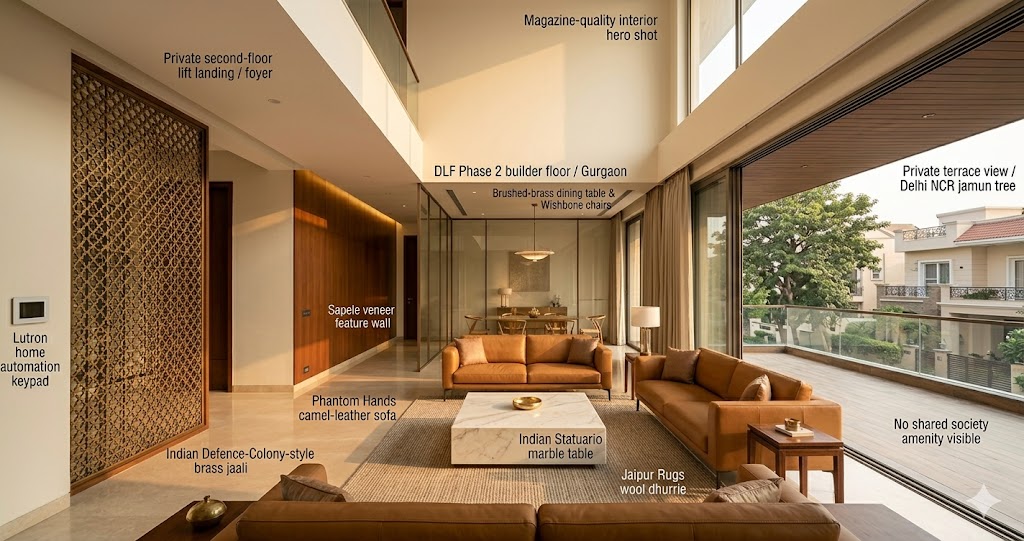
Builder Floor Interiors — The Delhi NCR G+3 Standalone Typology (2026)
South Delhi · Gurgaon DLF Phases · Per-floor ownership · ₹35 lakh DLF Phase 2 worked example
Builder floor interiors are the most misunderstood premium residential product in India. A builder floor is not an apartment, not a villa, and not a townhouse — it is a Delhi NCR-specific typology where a developer constructs a G+3 or G+4 low-rise on a single plot and sells one full floor per unit, often to members of the same extended family. The interior brief that follows is genuinely different from anything you would design for a high-rise tower or a freestanding bungalow, and most pan-India interior designers get it wrong on the first try.
If you own or are about to buy a builder floor in Vasant Vihar, Defence Colony, Greater Kailash, Saket, DLF Phases 1-4, Sushant Lok, Sectors 56-67 in Gurgaon, Sectors 14-21 in Faridabad, or Sectors 27, 30, 47 in Noida, the interior decisions you make are constrained by the building shell in ways that apartment owners and villa owners simply do not face. You inherit a fixed structural grid, fixed plumbing risers, a shared lift you fully fund, a terrace you fully maintain, and a parking allocation that has to absorb four cars without a society to absorb the overflow.
"A builder floor in Delhi NCR is the only residential product in India where you privately own the spatial equivalent of an apartment but privately fund the maintenance equivalent of a villa. The interior brief has to reconcile both realities."
For adjacent reading, see our companion guides on apartment interior planning in India, luxury villa architecture in India, premium apartment interiors, and urban home architecture in India. This guide refreshes every 12 months. Last verified: May 2026 · Next verify: May 2027.
What Builder Floor Interiors Actually Mean in 2026 India
A builder floor, in the strict Delhi NCR sense, is one full floor of a stand-alone low-rise building constructed by a developer on a single residential plot — typically 200 to 500 square yards in plot size — and sold as an independent dwelling unit with sub-division registration. The building usually goes G+3 (ground plus three upper floors) or G+4 where the bylaws permit, with one apartment per floor and a shared staircase plus a lift that serves all units. Total carpet area per floor ranges from 1800 to 3500 square feet, and capital cost in the prime NCR pockets sits between ₹4 crore and ₹12 crore as of May 2026.
Interior budgets, correspondingly, run between ₹25 lakh for a basic ground-floor refresh and ₹2 crore plus for a full top-floor combined with the terrace as a private penthouse. The middle of the market — what most second-floor and third-floor buyers actually spend — is ₹35 lakh to ₹70 lakh on a complete handover-to-move-in interior fit-out.
Five things a builder floor is NOT:
1. Not an apartment in a society. There is no RWA collecting maintenance, no shared club, no swimming pool, no security gate manned 24x7 by the society. Every amenity is either inside your floor or paid for privately by the four owners between themselves.
2. Not a villa. You do not own the land, the facade, or the roof in fee simple. You own the air rights of your floor plus an undivided share in the plot. Structural modifications need consent from the other floor owners.
3. Not a townhouse. A townhouse has its own street entry and usually its own staircase. A builder floor shares the lift, the staircase, and the entry porch with three or four other families.
4. Not a duplex. A duplex spans two levels with internal stairs. A standard builder floor is single-level, although the top-floor unit is sometimes sold with the terrace and converted into a duplex by the buyer.
5. Not a co-operative housing society flat. Builder floors in NCR are typically registered as sale deeds for individual units with proportionate undivided share in land, not as society shares. This affects how you take loans, how you sell, and how you handle disputes between floor owners.
This last point matters more than people realise during the interior brief. In a society apartment, if your neighbour above leaks water onto your false ceiling, the society's management committee handles it. In a builder floor, you knock on the door of the family above and negotiate directly — and if they refuse, your remedy is civil court.
Why Builder Floor Interiors Matter Now
The builder floor segment is roughly 8 to 10 per cent of total NCR residential transactions by value but punches above its weight in the premium interior services market because the average ticket size is so much higher than the apartment median. Knight Frank India's Q1 2026 Wealth Report estimates that approximately 14,000 builder floor units transact annually across Delhi, Gurgaon, Faridabad and Noida combined, with a median capital value of ₹5.8 crore. If you assume 70 per cent of buyers commission a full interior fit-out at an average spend of ₹40 lakh, that is a ₹3,900 crore annual interior market just for this single typology — larger than the total premium villa interior market for the entire NCR region.
Search interest is rising for three reasons. First, the joint-family-buying pattern has accelerated post-pandemic: a single Punjabi or Marwari family group buying all four floors of a builder floor as a vertical compound has become the modal transaction in pockets like Greater Kailash II and Sushant Lok Phase 1. Second, Delhi Master Plan 2041 and the corresponding MCD bylaw revisions of 2024 have made it easier to register sub-divided plots, which has expanded supply in areas like Chittaranjan Park, Hauz Khas, and Safdarjung Enclave. Third, the resale builder floor market in Gurgaon has been re-priced after the DLF resale uptick of 2025, pulling more high-net-worth buyers into this segment.
Who is actually buying? Three buyer profiles dominate. The first is the returning NRI from the Gulf, Singapore or the US who wants a Delhi address with parking but cannot tolerate the noise and density of a high-rise. The second is the Gurgaon corporate executive between 38 and 52 years old who has outgrown a 3BHK apartment and wants the equivalent of a 4500-square-foot independent space but cannot justify the ₹25 crore villa cost in Golf Course Road or DLF Phase 1. The third — and quantitatively the largest — is the joint Indian family buying multiple floors of the same building, where the patriarch funds the structure and each son inherits or finances his floor.
This last buyer profile is what shapes the interior brief in ways that pan-India designers underestimate. When the ground floor is parents, the first floor is the elder son's nuclear family, the second floor is the younger son's nuclear family, and the third floor is study plus guest plus driver, you are not designing four interiors — you are designing one connected compound that has to flow vertically while preserving the privacy of each nuclear unit. The lift is shared, the staircase is shared, the pooja room placement on one floor influences the structural feasibility of another floor, and the kitchen exhaust risers are physically continuous.
The Seven Defining Characteristics
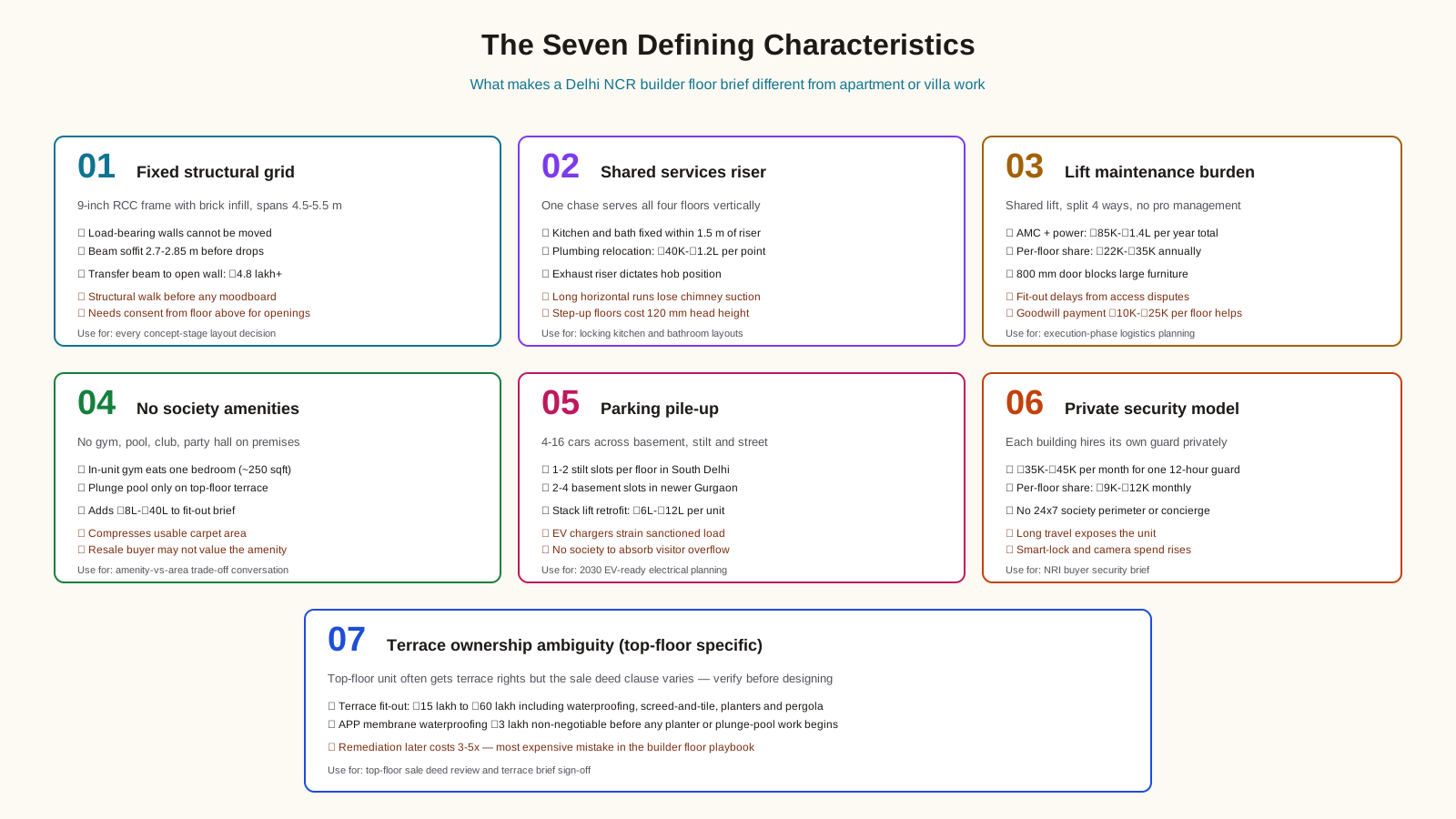
The interior brief for a builder floor differs from both apartment and villa briefs in measurable ways. The table below maps the seven characteristics that shape every design decision.
| Characteristic | What It Means | India-Specific Note | Typical Cost or Constraint |
|---|---|---|---|
| Fixed structural grid | Load-bearing walls and beams are fixed by the building drawing; you cannot move them | Most NCR builder floors use 9-inch RCC frame with brick infill; spans are 4.5 to 5.5 metres | Beam soffit usually 2.7 to 2.85 m — false ceiling drops to 2.55 m maximum |
| Shared services riser | Plumbing, electrical mains and sewer risers run through a fixed chase serving all four floors | Moving the kitchen or master bathroom by more than 1.5 m from the riser requires major plumbing rework | Plumbing relocation: ₹40K to ₹1.2 lakh per fixture point |
| Lift maintenance burden | Lift is shared but maintenance is split 4 ways with no professional management | A 6-person lift AMC plus electricity runs ₹85K to ₹1.4 lakh per year, split per floor | Per-floor lift cost: ₹25K to ₹40K annually |
| No society amenities | No gym, no pool, no clubhouse, no party hall | This shifts amenity into the unit itself: home gym, plunge pool on terrace, in-unit theatre | Adds ₹8 lakh to ₹40 lakh to fit-out depending on ambition |
| Parking pile-up | 4 to 16 cars need to park across basement, stilt and street | Basement stack parking is increasingly common in Gurgaon builder floors post-2023 | Basement stack lift: ₹6 lakh to ₹12 lakh per unit, often retro-fitted |
| Private security model | No society guard; each building hires its own | Typical NCR rate: ₹35K to ₹45K per month for one 12-hour guard, split 4 ways | Per-floor security cost: ₹9K to ₹12K monthly |
| Terrace ownership ambiguity | Top floor often gets terrace rights but legally this varies | Always check the sale deed for terrace rights clause; many disputes arise here | Terrace fit-out for top-floor unit: ₹15 lakh to ₹60 lakh |
The fixed structural grid is the single most expensive variable to fight. Unlike a high-rise apartment where the developer has often offered a soft-finished shell that you can heavily reconfigure within the unit, a builder floor in Delhi NCR is usually handed over with plastered walls, basic flooring and minimum finishes — but the walls you see are mostly load-bearing or shear-critical brick infill panels that cannot be removed. The first conversation with your interior designer should be a structural walk with the original building drawings, not a moodboard meeting.
A Worked Example
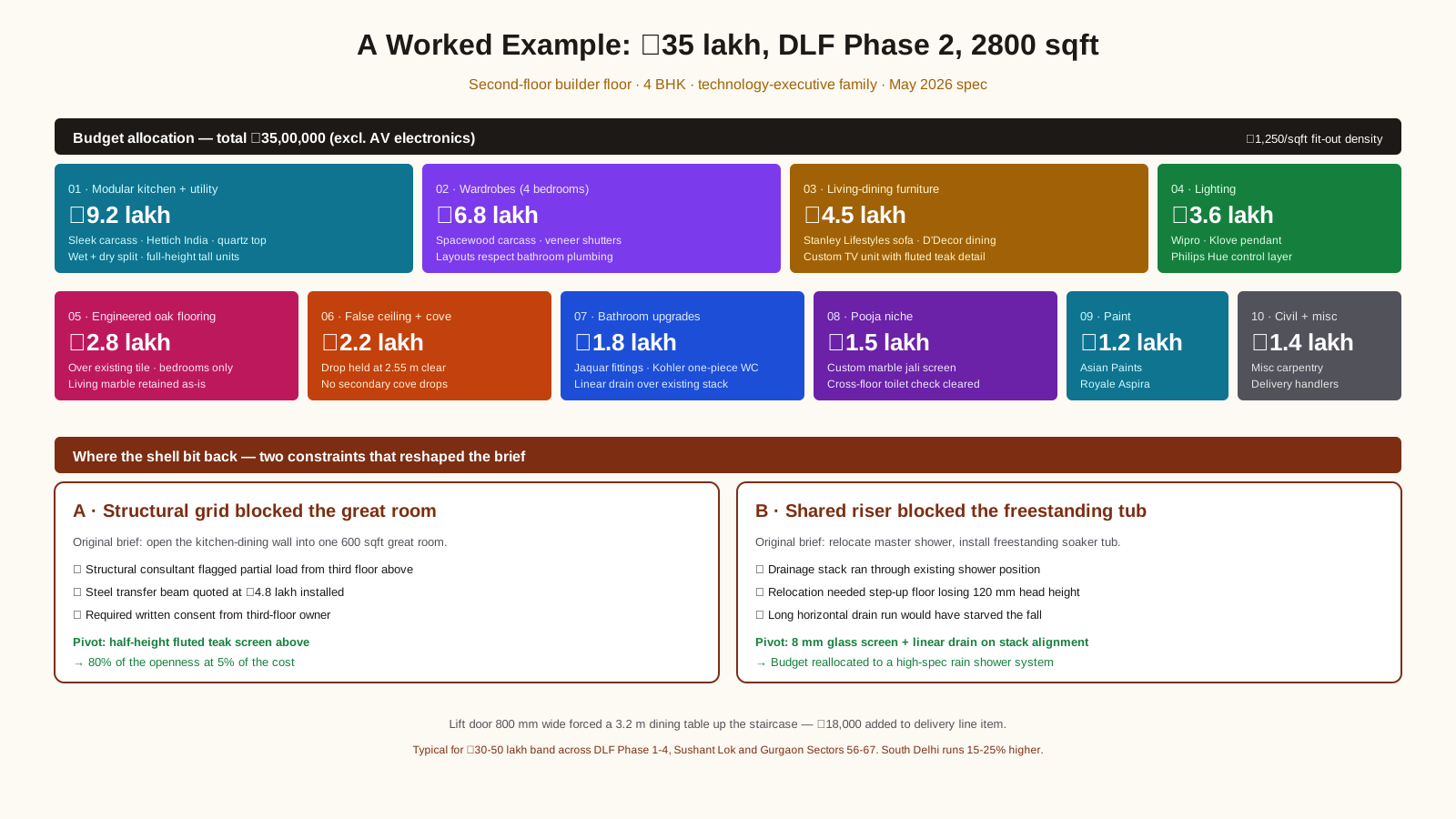
Consider a 2800-square-foot second-floor builder floor in DLF Phase 2, Gurgaon, on a 300-square-yard plot. The building is G+3 with basement parking. The unit was bought in March 2026 for ₹5.4 crore. The owner is a 44-year-old technology executive with two children aged 9 and 13, and the interior budget is ₹35 lakh including all furniture and lighting but excluding the home theatre electronics.
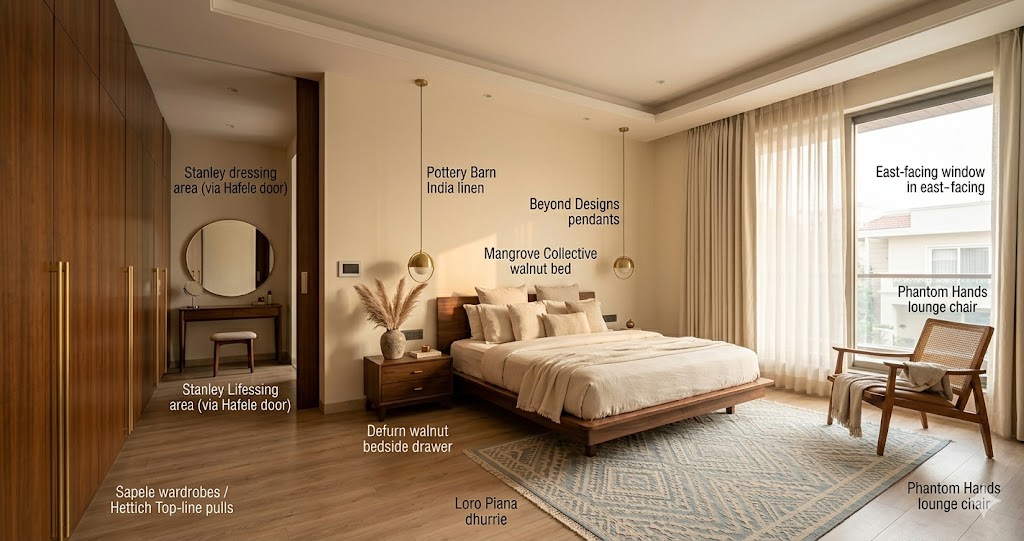
The shell. The unit has a 4.8 m by 5.2 m structural grid, beam soffit at 2.78 m, four bedrooms (one master with attached walk-in wardrobe and bathroom, two children's rooms, one guest), a 240-square-foot kitchen with attached utility, a 380-square-foot living-dining, a small pooja niche, and two balconies (one off the living, one off the master). The handover finish included Italian marble in the living-dining and ceramic tile in the bedrooms.
The brief. The owner wanted a warm-minimal aesthetic, no false ceiling drops below 2.55 m, a separate study corner for the elder child, a wet kitchen plus dry pantry split because the family cooks heavy Indian food daily, and a wardrobe layout that respected the existing bathroom plumbing positions.
The budget split. The ₹35 lakh broke down as follows: ₹9.2 lakh on the modular kitchen and utility (Sleek with Hettich India hardware, quartz counter, full-height tall units), ₹6.8 lakh on wardrobes across four bedrooms (Spacewood carcasses with veneer shutters), ₹4.5 lakh on the living-dining furniture (sofa from Stanley Lifestyles, dining from D'Decor, custom TV unit), ₹3.6 lakh on lighting (Wipro for general, Klove for one statement pendant, Philips Hue for control), ₹2.8 lakh on flooring touch-up (engineered oak in bedrooms over the existing tile, leaving the marble in the living), ₹2.2 lakh on the false ceiling and cove lighting, ₹1.8 lakh on bathroom upgrades (Jaquar fittings, Kohler one-piece WC in the master), ₹1.5 lakh on the pooja niche (custom marble jali screen), ₹1.2 lakh on paint and finishes (Asian Paints Royale Aspira), and ₹1.4 lakh on civil work and miscellaneous.
Where the structural grid bit back. The owner initially wanted to open the wall between the kitchen and dining to create a single 600-square-foot great room. The structural consultant flagged that the dividing wall carried a partial load from the floor above, and removal would require a steel transfer beam at ₹4.8 lakh installed plus consent from the third-floor owner. The owner pivoted to a half-height partition with a fluted teak screen above, which delivered 80 per cent of the openness at 5 per cent of the cost.
Where the shared riser bit back. The owner wanted to relocate the master bathroom shower to convert the wet area into a freestanding tub experience. The drainage stack ran through the existing shower position; relocating the shower would have required either a step-up floor (losing 120 mm of head height) or a horizontal drain run with a long fall to the existing stack. The chosen solution was a slim 8 mm glass screen with a linear drain along the existing stack alignment — the tub idea was dropped, and the budget reallocated to a high-spec rain shower system.
Where the lift sharing helped and hurt. The lift was due for annual maintenance, and the owner used this window to coordinate furniture deliveries through the lift before AMC servicing began. The lift door opening, however, was only 800 mm wide, which meant a 3.2 m by 1.1 m dining table had to be carried up the stairs by six handlers — adding ₹18,000 to the furniture delivery line item.
This example is typical for the ₹30 to ₹50 lakh band in DLF Phase 1 to 4, Sushant Lok, and the better parts of Sector 56 to 67 in Gurgaon. The South Delhi equivalent — Greater Kailash, Defence Colony, Vasant Vihar — runs 15 to 25 per cent higher because labour costs are higher and access constraints on small plots add to logistics overhead.
Builder Floor Interiors vs Adjacent Categories
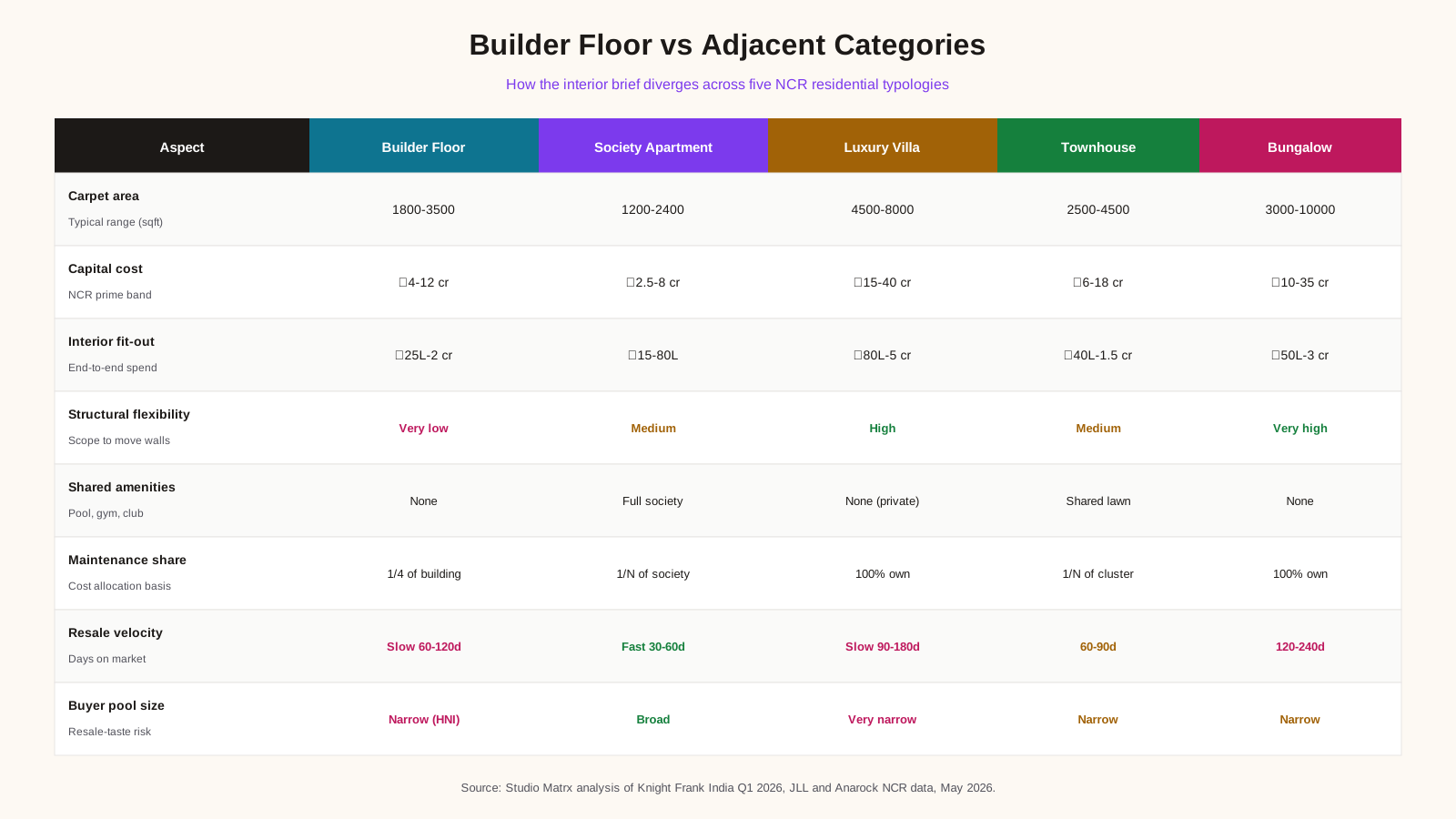
The interior brief diverges sharply from adjacent typologies. The table below shows where the deltas land.
| Aspect | Builder Floor | Society Apartment | Luxury Villa | Townhouse | Standalone Bungalow |
|---|---|---|---|---|---|
| Typical carpet area | 1800 to 3500 sqft | 1200 to 2400 sqft | 4500 to 8000 sqft | 2500 to 4500 sqft | 3000 to 10000 sqft |
| Capital cost (NCR prime) | ₹4 to ₹12 cr | ₹2.5 to ₹8 cr | ₹15 to ₹40 cr | ₹6 to ₹18 cr | ₹10 to ₹35 cr |
| Interior fit-out range | ₹25 lakh to ₹2 cr | ₹15 lakh to ₹80 lakh | ₹80 lakh to ₹5 cr | ₹40 lakh to ₹1.5 cr | ₹50 lakh to ₹3 cr |
| Structural flexibility | Very low (load-bearing fixed) | Medium (RCC frame, more openings) | High (own structure) | Medium | Very high |
| Shared amenities | None | Pool, gym, club, party hall | None (private) | Sometimes a shared lawn | None |
| Maintenance allocation | 1/4 of full building cost | 1/N of society pool | 100 per cent of own | 1/N of cluster | 100 per cent of own |
| Resale velocity | Slow (60 to 120 days) | Fast (30 to 60 days) | Slow (90 to 180 days) | Medium (60 to 90 days) | Slow (120 to 240 days) |
| Vastu modification scope | Limited (shared walls) | Limited (society rules) | Full | Limited | Full |
| Buyer pool size | Narrow (NCR HNI) | Broad (mid-income upward) | Very narrow (UHNI) | Narrow | Narrow |
"Taste-neutrality is the single most underrated value driver in builder floor interiors. The next buyer is not picked from a society of two hundred similar units — they have to walk into your specific floor and like it."
The "buyer pool size" row drives a non-obvious interior decision. Because builder floor resale is slow and the buyer pool is narrow, taste-neutrality matters more than in other typologies. A bold colour palette or a hyper-personalised layout depresses resale value more on a builder floor than on an apartment in a 200-unit society, simply because the next buyer cannot be found by filtering across thousands of similar units — the next buyer has to like your specific floor in your specific building. Pan-India designers who push very personalised schemes onto NCR builder floor clients without flagging this resale risk are doing the client a disservice.
Materials, Finishes and Brand Landscape
Builder floor budgets concentrate around the ₹35 lakh to ₹70 lakh fit-out band. At this level, material choices cluster around a recognisable set of Indian and imported brands. The table below maps the typical specification by room type.
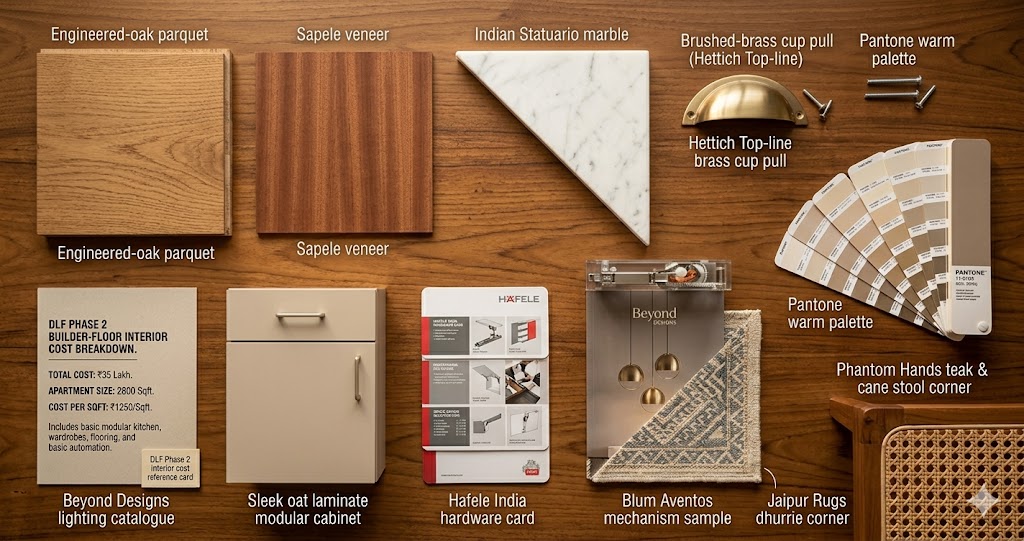
| Element | Entry tier (₹25-35L) | Mid tier (₹35-70L) | Premium tier (₹70L-1.5cr) |
|---|---|---|---|
| Kitchen carcass | Sleek, Hacker basic | Sleek Studio, Haus Studio | Veneta Cucine, Poggenpohl, Snaidero |
| Kitchen hardware | Hettich Standard, Ebco | Hettich Sensys, Hafele Salice | Blum Aventos, Hafele Free Fold |
| Counter | Quartz (Kalingastone), granite | Engineered quartz (Caesarstone India), Dekton | Calacatta marble, Neolith XL |
| Wardrobe carcass | Spacewood, GreenPly board | Sleek wardrobe range, Stanley | Poliform, Molteni, Lema |
| Wardrobe shutter | Laminate (Greenlam, Merino) | Veneer (Greenlam, Century Plyboards) | Solid timber (teak, walnut), back-painted glass |
| Flooring (living) | Inherited marble or Italian tile | Engineered wood (Pergo, Mikasa), Italian marble | Solid hardwood, large-format Italian marble (Bhandari Marble Group) |
| Flooring (bedrooms) | Vitrified tile (Kajaria, Somany) | Engineered oak, vinyl plank (Armstrong) | Solid oak, hand-knotted wool carpet |
| Bathroom fittings | Jaquar Continental, Hindware | Jaquar Artize, Kohler India | Kohler Components, Hansgrohe Axor, Gessi |
| Sanitaryware | Hindware Italian, Cera | Kohler Veil, Toto India | Duravit, Villeroy & Boch |
| Paint | Asian Paints Royale, Berger Silk | Asian Paints Royale Aspira, Nippon Odour-less | Farrow & Ball India, Little Greene |
| Lighting (general) | Wipro Garnet, Philips Essential | Wipro NextStream, Havells Lumeno | iGuzzini, Erco, Flos via Hermes Home |
| Lighting (feature) | Local fabricators | Klove Studio, Sage Living | Lasvit, Bocci, Cassina via Defurn |
| Soft furnishing | D'Decor, Spaces by Welspun | Good Earth, Sarita Handa | Sabyasachi for Hermes Home, Hermes textiles |
| AV and home automation | Basic Philips Hue | Lutron Caseta, Sonos | Lutron Homeworks, Crestron, Bang & Olufsen |
A few specifics worth flagging. Hettich India and Hafele India dominate the mid-tier kitchen and wardrobe hardware market in NCR, but the supply chain for some Blum SKUs has been intermittent through 2025 because of import duty changes; if your designer specifies Blum, confirm lead times before committing the kitchen layout. Asian Paints Royale Aspira has become the default for the mid-tier living-dining accent walls because of the wider colour gamut versus standard Royale, but it costs roughly 35 per cent more per litre — budget accordingly.
For the imported luxury tier, the supply route matters: Poliform, Molteni, Boffi and Minotti are routed in India through DefurnIndia, Beyond Designs, Sources Unlimited and similar curated dealers. Direct imports save 8 to 12 per cent but add 4 to 6 months of lead time and customs uncertainty — almost never worth it on a builder floor where the family wants to move in before the school year starts.
Eight Pitfalls Common in 2026 India
1. Ignoring the structural drawings during early concept. The single most common mistake is the designer producing a floor plan with relocated kitchen or bathroom walls before reviewing the building's RCC drawings. By the time the structural consultant says no, the client has emotionally committed to the layout. Fix this by making "structural walk" the first paid deliverable, before any moodboard. Use the setback visualizer if you also need to verify external addition constraints.
2. Underestimating shared lift coordination during execution. Furniture deliveries, marble slabs, and bulk material movement all use the same lift used by three other families. Many fit-out projects run 3 to 6 weeks over schedule because of lift access disputes. Mitigate by negotiating a lift-block window in writing with the other floor owners before starting, and pay a goodwill amount of ₹10,000 to ₹25,000 per floor for the disruption.
3. Ignoring the cumulative load on shared electricity meter and water tank. Adding a heavy AC load, an electric chimney, an EV charger and a home gym to one floor without checking the building's sanctioned load can trip the main MCB and inconvenience all four families. Always pull the original electrical load schedule and update it with the new equipment list before the electrical contractor starts work.
4. Designing the pooja room without checking the floor above and below. In a joint-family builder floor, the pooja room on the ground floor must not have a toilet directly above on the first floor, per Vastu and per most family conventions. Cross-floor coordination is needed before locking pooja placement. See our pooja room design in India guide for the broader placement logic.
5. False ceiling height collapse. With beam soffits at 2.78 m, a 230 mm false ceiling drop leaves 2.55 m clear, which is acceptable. But many designers add additional secondary drops for cove lighting and AC plenums, ending at 2.42 m, which feels oppressive in a 5 m wide living. Insist on a section drawing with all soffit heights before approving the false ceiling design.
6. Choosing a wet kitchen layout that fights the riser. The exhaust riser is fixed. Putting the hob 2.5 m away from the riser requires a long horizontal duct run that loses suction power, leading to greasy chimneys within 18 months. Always keep the hob within 1.5 m of the existing exhaust riser, or accept that you will need a high-CMH chimney rated 1500 plus.
7. Overinvesting in finishes that the next buyer will rip out. As discussed earlier, builder floor resale is narrow-buyer. A ₹12 lakh hand-painted mural or a ₹6 lakh custom marble pooja room often does not recover value at resale because the next buyer wants a clean slate. Reserve very personal finishes for elements that can be removed without civil work — art, soft furnishing, statement lighting.
8. Ignoring terrace water-proofing on the top floor. The top-floor unit often inherits terrace rights but also inherits the water-proofing liability. Indian monsoons are punishing; a ₹3 lakh APP membrane water-proofing plus screed-and-tile finish on the terrace is non-negotiable before any planter, pergola or plunge pool work begins. Skipping this is the most expensive mistake in the entire builder floor playbook because remediation later costs 3 to 5 times as much.
India-Specific Considerations
Builder floor interiors sit at the intersection of NBC 2016 (National Building Code of India), municipal bylaws (MCD, NDMC, DDA for Delhi; HUDA for Gurgaon; FMDA for Faridabad; NOIDA Authority for Noida), the Real Estate Regulation Act 2016, and increasingly the Digital Personal Data Protection Act 2023 once you introduce home automation that collects occupant data.
NBC and IS code touchpoints. The relevant chapters of NBC 2016 are Part 4 (Fire and Life Safety) for the staircase and lift, Part 8 (Building Services) for the water supply and drainage, and Part 11 (Approach to Sustainability) where you take it seriously. For interior fit-out, the IS codes you will hear most often are IS 875 for live and dead loads (relevant if you propose a heavy library or a stone-clad wall), IS 4671 for expanded polystyrene if you do thermal insulation, IS 12433 Part 2 for modular kitchens, and IS 3043 for earthing of all your fancy automation equipment.
Bylaw realities. Delhi MCD bylaws cap building height to 15 m on most residential plots, with FAR depending on plot size band. Gurgaon DTCP has a similar regime but allows G+4 on larger plots in specified colonies. None of these bylaws permit FAR variation post-construction, so any "balcony enclosure" or "loft addition" you contemplate during interiors must be checked against the sanctioned plan. Unauthorised enclosures attract penalty proceedings and can complicate resale.
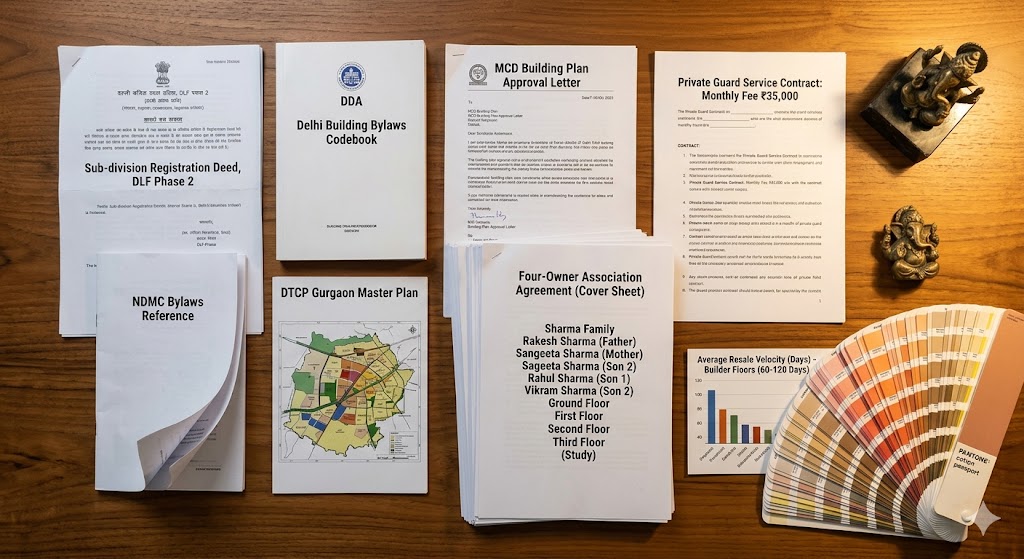
Sub-division registration. This is the unique builder floor wrinkle. For the unit to be sold independently, the plot must be sub-divided into separate dwelling unit registrations at the registrar's office. If the building was constructed before 2010 and the sub-division was not done, the sale deed may show "undivided share" only — which restricts independent mortgage and creates complications during interior loan financing. Always check this before signing the interior contract.
Vastu compatibility. Vastu in builder floors is more constrained than in villas because the entry door, the lift core position, the kitchen position and the bathroom positions are fixed by the building shell. Most NCR builder floor designs accept the Vastu constraints they can fix (entry threshold, pooja placement, sleeping orientation, colour palette by direction) and live with the ones they cannot (kitchen riser fixed in the south-west of the unit, which Vastu considers suboptimal). See our companion notes on Vastu for kitchen and Vastu for bedroom for room-level guidance.
RWA equivalent and floor-owner agreements. There is no RWA, but most well-run builder floors have a "four-owner agreement" or a simple memorandum signed between the floor owners covering lift AMC, security guard wages, water tank cleaning, sewerage line cleaning, and facade painting cycles. If the building you bought into does not have such an agreement, drafting one is a worthwhile early move before starting major interior work. Civil disputes between floor owners delay or derail interior projects regularly.
Climate zone. All of NCR sits in NBC Climate Zone 1 (Hot and Dry) per the 2016 classification, with composite tendencies in monsoon months. This shapes glazing choices (Saint-Gobain ClimaPlus or equivalent low-SHGC double glazing for west and south windows), insulation priorities (roof insulation for the top floor matters more than wall insulation for middle floors), and HVAC sizing (typically 1 tonne per 120 square feet for a building with no shaded faces).
Regional vendor differences. Within NCR, vendor sourcing differs between Delhi and Gurgaon-Faridabad-Noida. Kirti Nagar and Karol Bagh remain the dominant timber, veneer and plywood markets for Delhi-based contractors. Sadar Bazaar handles electrical and lighting. Gurgaon-based contractors increasingly source from the Pataudi Road wholesale corridor and from Sector 33 industrial. Imported finishes from Italy and Germany route through Defence Colony showrooms (BPL, Defurn, Beyond Designs) or DLF Galleria (Stanley Lifestyles, Sources Unlimited, Sodhi's).
The Budget Bands for 2026 India
Builder floor interior fit-outs concentrate around four tiers, each with a predictable specification envelope.
| Tier | Budget Range | Carpet Area Covered | What You Get | Indicative Brands |
|---|---|---|---|---|
| Entry | ₹18 to ₹30 lakh | 1800 to 2400 sqft | Modular kitchen + wardrobes + paint + basic lighting + minimum civil; no flooring change | Sleek, Spacewood, Wipro, Asian Paints, Jaquar Continental, Hindware |
| Mid | ₹30 to ₹70 lakh | 2400 to 3000 sqft | Full fit-out including engineered wood flooring in bedrooms, custom carpentry, lighting design, soft furnishing, basic automation | Sleek Studio, Stanley Lifestyles, Pergo/Mikasa, Klove, Asian Paints Royale Aspira, Jaquar Artize, Lutron Caseta |
| Premium | ₹70 lakh to ₹1.5 cr | 2800 to 3500 sqft | Imported kitchen, solid timber wardrobes, Italian marble, Kohler-tier bathrooms, designer lighting, full home automation, custom soft furnishing | Poggenpohl, Stanley, Pergo Heritage, Kohler Components, Sage Living, Sonos, Sarita Handa |
| Super-premium | ₹1.5 cr to ₹4 cr | 3000 to 3500 sqft plus terrace | Boffi/Poliform kitchen, Molteni wardrobes, hand-knotted wool carpets, B&B Italia/Minotti furniture, full Crestron/Lutron Homeworks, terrace plunge pool, in-floor home gym | Boffi, Molteni, Minotti via DefurnIndia, Lasvit, Hermes Home, Crestron, Klove for art lighting |
The 2026 inflation reality is roughly 7 to 9 per cent year-on-year on labour and 11 to 14 per cent on imported finishes, driven partly by the rupee weakening against the euro through 2025. Budget contingency of 12 to 15 per cent is sensible; designers who quote without contingency usually run over.
For benchmarking, the cost benchmark tool on Studio Matrx allows you to compare your line items against typical NCR builder floor projects in the same tier. Use it as a sanity check after you receive contractor quotes, not as a substitute for a proper quotation review.
When Builder Floor Interiors Are NOT the Right Fit
This typology — and the corresponding interior approach — does not suit everyone. Five honest scenarios where you should re-evaluate.
You expect 24x7 security and concierge. A builder floor cannot give you what a Lodha Park or DLF Camellias style tower gives you. If you travel internationally for weeks at a time and need a society-grade security perimeter, an apartment in a managed society is a better fit even at a smaller unit size.
You want pool, gym, club and party hall on-site. Builder floors do not offer these. Building them inside your floor compresses your usable space (a 250 sqft home gym eats a bedroom) and the plunge pool on a top-floor terrace is a fraction of a society pool. If amenity access matters more than total interior area, choose a society.
Your family is large and growing. A 3000 sqft builder floor is generous but it has a fixed footprint. You cannot extend it. A villa or a plotted-development bungalow gives you the option to add a room or a wing.
You want full Vastu compliance from scratch. A builder floor's shell determines kitchen, bathroom and entry positions. If full Vastu compliance — every room oriented by classical rules — is a deal-breaker, you need a plotted-development home where you design from scratch. Our North-facing house Vastu guide covers what you can and cannot adjust in fixed-shell properties.
You plan to resell within 3 years. Builder floor resale is slow. If your horizon is short and liquidity matters, an apartment in a high-velocity society compound is the safer choice from a resale perspective.
The 5-Year Trajectory: 2030 Outlook
Three shifts are likely to reshape builder floor interiors by 2030.
EV charging will become a structural design problem, not an electrical add-on. As EV penetration in NCR HNI households crosses 40 per cent (currently around 15 per cent per CRISIL's Q4 2025 EV outlook), four-car-per-floor builder floors will need 8 to 16 home chargers per building. The current single sanctioned electrical load cannot support this, and load enhancement applications take 6 to 12 months. By 2030, builder floors with retrofitted DC fast-charge basement parking will command a 12 to 18 per cent resale premium over those without.
Climate-resilient roof and terrace finishes will move from premium to mid-tier specification. Delhi's summer 2024 and 2025 saw 49°C peak temperatures. Top-floor builder floor owners are already specifying high-SRI (Solar Reflectance Index) terrace tiles and cool-roof coatings as standard, not luxury. By 2030, expect this to be table-stakes across all tiers, with the corresponding cost (₹250 to ₹450 per square foot of terrace area) rolled into the base fit-out estimate.
The joint-family pattern will partially fragment, changing the spatial brief. Demographic data from Census 2021 estimates and current Anarock buyer surveys suggest that the four-floors-to-one-family pattern is weakening as the next generation chooses nuclear setups. By 2030, more builder floors will be sold to four unrelated families rather than four related ones. This will increase demand for sound insulation between floors (currently underspecified, with most floor slabs achieving only 42 dB STC versus the 55 dB ideal for unrelated households) and may push the average interior budget upward as the family-level cost sharing breaks down.
By 2030, expect the median NCR builder floor interior budget to sit at ₹55 lakh in real 2026 rupees, up from approximately ₹40 lakh today, driven primarily by the EV, climate and acoustic shifts above.
Frequently Asked Questions
Is a builder floor a good investment for interior spending compared to an apartment?
For absolute interior spend, builder floors take more rupees because the carpet area is larger and the amenity-replacement spend inside the unit is real. For per-square-foot interior spend, builder floors and premium apartments are roughly comparable in the mid-tier (₹1,200 to ₹2,000 per sqft of fit-out). The investment case is stronger for owner-occupiers who value privacy and weaker for those optimising for liquidity.
Can I knock down a wall in my builder floor?
Possibly, but only after a structural consultant reviews the building drawings. Most NCR builder floors use 9-inch RCC frame with brick infill, and many internal walls are non-load-bearing — but the partitions facing the corridor and the lift core often are. Never trust a contractor's verbal opinion on this; pay for a 30-minute structural review.
Do I need permission from other floor owners before starting interior work?
For purely interior work that does not affect shared services, common areas, or the building exterior — technically no. Practically, yes. The lift, the staircase, the water tank, and the sewage will all be affected during your fit-out, so a written intimation to the other three families with the schedule is good practice. Many four-owner agreements in NCR now require this formally.
What is the parking allocation per floor in a typical builder floor?
Most NCR builder floors allocate 1 to 2 parking slots per floor, with the remainder absorbed by stilt or on-street. Newer Gurgaon builder floors with basement parking can accommodate 2 to 4 cars per floor. South Delhi builder floors with no basement often have 1 stilt slot per floor and depend on street parking for the rest.
How does the lift maintenance get billed?
Lift maintenance is typically split equally between the four floor owners. Annual AMC plus electricity runs ₹85,000 to ₹1.4 lakh, so each floor pays roughly ₹22,000 to ₹35,000 per year. The top-floor owner sometimes negotiates a slightly higher share because of higher usage, but this is rare.
What happens if one floor owner refuses to pay shared maintenance?
There is no RWA enforcement mechanism. Your remedy is civil court, which is slow and expensive. The practical mitigation is a four-owner agreement with a clear cost-allocation schedule and a deposit-based prepayment for major works. Buildings without such agreements see chronic disputes.
Is a top-floor builder floor worth the premium?
If the sale deed includes clear terrace rights and the terrace is structurally sound for additional load (planters, plunge pool, pergola), yes — the top floor can add 30 to 50 per cent of usable area at modest incremental fit-out cost. If terrace rights are ambiguous or the terrace is shared, the premium is harder to justify.
Can I install a private lift just for my floor?
Almost never. The lift shaft is a shared structural element. Installing a second lift requires consent from all owners and significant civil work. In practice, what owners do is upgrade the shared lift jointly (faster, quieter, larger cabin) at a shared cost of ₹8 to ₹15 lakh.
How do I handle home automation across a builder floor without society infrastructure?
Home automation in a builder floor is fully self-contained — your Lutron, Crestron, or Control4 system runs on your own Wi-Fi and your own controllers. You do not need any society-side integration. The DPDP Act 2023 implications kick in if your automation collects occupant data through cameras or biometrics; ensure your installer provides a data-handling note.
What is the realistic timeline for a full builder floor fit-out?
For a 2800-square-foot mid-tier fit-out (₹35 to ₹50 lakh), realistic timeline is 14 to 18 weeks from contract signing to handover, assuming no major civil work. For a premium tier with imported kitchen and wardrobes, 22 to 30 weeks because of lead times on Poliform, Boffi, or Molteni. Top-floor units with terrace work add 4 to 8 weeks.
References
1. Knight Frank India. India Real Estate: Residential and Office Market Q1 2026. Knight Frank Research, 2026. Available at knightfrank.co.in/research.
2. Knight Frank India. Wealth Report India 2026. Knight Frank Research, 2026.
3. JLL India. India Residential Market Insights Q1 2026. JLL Research, 2026.
4. CBRE South Asia. India Market Outlook 2026. CBRE Research, 2026.
5. Anarock Property Consultants. Indian Residential Real Estate: Quarterly Round-up Q1 2026. Anarock Research, 2026.
6. Magicbricks. PropIndex Report Q1 2026: Delhi NCR Edition. Magicbricks Research, 2026.
7. 99acres. Delhi NCR Residential Insite Report H2 2025. 99acres Research, 2025.
8. Bureau of Indian Standards. National Building Code of India 2016 (NBC 2016), Parts 4, 8 and 11. Bureau of Indian Standards, New Delhi, 2016.
9. Bureau of Indian Standards. IS 875 (Part 2): Code of Practice for Design Loads (Other than Earthquake) for Buildings and Structures — Imposed Loads. Bureau of Indian Standards, 1987 (reaffirmed).
10. Bureau of Indian Standards. IS 12433 (Part 2): Functional Requirements of Furniture — Modular Kitchen. Bureau of Indian Standards.
11. Ministry of Housing and Urban Affairs, Government of India. Real Estate (Regulation and Development) Act 2016 and subsequent rules. MoHUA, 2016 onwards.
12. Ministry of Electronics and Information Technology, Government of India. Digital Personal Data Protection Act 2023. MeitY, 2023.
13. Delhi Development Authority. Master Plan for Delhi 2041 (Draft as approved). DDA, 2024.
14. Town and Country Planning Department, Government of Haryana. Haryana Building Code 2017 (as amended through 2024). TCPD Haryana.
15. India Brand Equity Foundation. Real Estate Sector in India: Industry Report May 2026. IBEF, 2026.
16. CRISIL Research. EV Adoption in Indian Cities: Outlook Q4 2025. CRISIL Research, 2025.
17. Houzz India. India Renovation Trends Report 2025. Houzz India, 2025.
18. Census of India 2021 estimates, Office of the Registrar General and Census Commissioner.
Related Guides
- Apartment interior planning in India — the high-rise counterpart to the builder floor brief
- Luxury villa architecture in India — for buyers weighing the villa alternative
- Premium apartment interiors — material and brand benchmarks that overlap with builder floor mid-tier
- Urban home architecture in India — broader plot-and-form context that frames builder floor design
- Modular kitchen in India — kitchen-specific deep dive that complements the builder floor riser constraints
- Choosing an interior designer in India — how to brief a designer for a constrained typology like this one
Export this guide
Related Guides — Deep-dive reading
Penthouse Design — Top-Floor Luxury in Indian Towers (2026)
DLF Camellias / Lodha Altamount / Oberoi Sky Suites · Private terraces · ₹15-150 crore market
Design StylesPremium Apartment Interiors — The ₹15-40 Lakh Tier for Indian 3 BHKs (2026)
Above budget-luxury · Below super-luxury · Materials, brands, contractor-tier reality
Design StylesSmart Storage Interiors — A 2026 Working Reference for Indian Homes
Inventory-driven · Floor-to-ceiling · Hardware-engineered · Zone-mapped
Room PlanningRelated Tools — Try Free
Acoustic Privacy (STC) Visualizer
Indian healthcare acoustic visualizer — compare wall assemblies and noise sources, see received SPL after STC attenuation, and check FGI 2018 / IS 1950 / NABH speech-privacy compliance with live dual-canvas waveform.
Acoustic ToolCross-Ventilation Analyzer
Estimate airflow and air changes per hour (ACH) from room size, window areas, layout, and local wind — with NBC 2016 Part 8 compliance check.
Ventilation CalculatorRainwater Tank Sizer
How big should your rainwater tank be? Computes annual harvest, recommended tank capacity in litres, water-bill savings, and payback — for 10 Indian cities.
RWH Calculator