
Biometric Locks in India (2026): The Honest Umbrella Guide to Locks That Read Your Body
What a biometric lock really is, how fingerprint, face and the rarer palm-vein and iris types work, the DPDP privacy duties of storing a body trait, and whether your home even needs one.
There is something quietly futuristic about a door that knows you by your own body, no key to lose, no code to remember. That promise is why biometric locks now sit in almost every smart-lock showroom in India, from a budget fingerprint pad to a face-reading panel that opens as you walk up with full hands. But a lock that reads your body is a different kind of purchase from one that reads a key or a code, because a body trait is not just a convenience, it is sensitive personal data you become responsible for, and no body trait reads perfectly every time.
This is the umbrella guide to the whole family. It sits in the Studio Matrx Smart Locks and Access Control library under the complete guide to smart locks in India, and its job is the big picture: what "biometric" actually means, how the main types differ, the one story every biometric shares (a template, not a photo), why a backup credential is not optional, the privacy duties the DPDP Act puts on you, and the honest question most showrooms skip, does your home even need biometrics at all? The two mainstream types get their own deep guides, fingerprint locks and face-recognition locks; this page ties the family together rather than repeating them.
Scope and safety. This guide helps you understand and choose a biometric lock and coordinate its fitting; it is not a fitting manual. The lock hardware, any mains wiring, and any fire-alarm or fire-escape interlock are a coordinated licensed job (door-hardware trade plus electrician, and a fire-safety consultant wherever an escape door is involved). A lock on a door people escape through must never trap anyone; an escape door is governed by the National Building Code and fire code. On any home door, always keep a mechanical key override plus a backup credential such as a PIN, because sensors fail and batteries die. Biometric data is sensitive personal data under the DPDP Act, 2023. This is educational guidance, not legal advice.
What "biometric" actually means
Biometric simply means "measured from the body". A biometric lock identifies you by a physical trait that is hard to change and reasonably unique, rather than by something you carry (a key, a card, a phone) or something you know (a PIN). The appeal is obvious: your body is always with you, cannot be handed to a friend, and cannot be casually shoulder-surfed the way a code can.
The catch is equally simple: a body is not a machine part. A finger can be wet, worn or cut; a face can be masked, in shadow or turned away; and unlike a forgotten PIN you cannot simply "reset" a fingerprint. So every biometric lock is a trade of one set of frustrations (things to carry and remember) for another (traits that do not always read), plus a new duty (guarding data about someone's body). Understanding that trade is the whole point of this guide.
The types at a glance
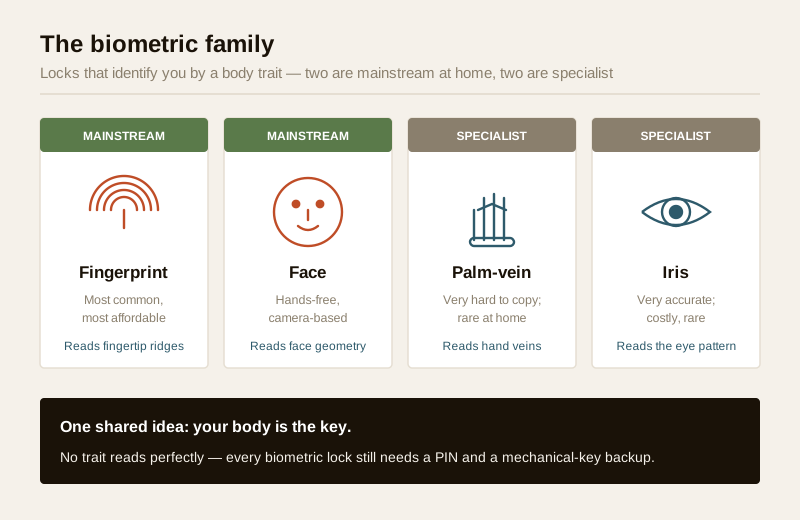
Four traits are used in door locks, but for an Indian home only two are mainstream. The rest are specialist, expensive and rare on residential doors, so this guide names them briefly and points onward rather than pretending they are everyday choices.
| Type | What it reads | Where it fits | Depth |
|---|---|---|---|
| Fingerprint | The ridge pattern on a fingertip | The default, cheapest and most common home biometric; fast and familiar | Full guide: fingerprint locks |
| Face | The geometry of your face, via a camera | Hands-free, opens as you approach; needs decent light and a good sensor | Full guide: face-recognition locks |
| Palm-vein | The vein pattern under the skin of a hand | Very hard to copy; rare and costly on home doors, seen more in offices and banks | Specialist; not covered in depth |
| Iris | The unique pattern of the coloured ring of the eye | Extremely accurate; costly, deliberate to use, rare in homes | Specialist; not covered in depth |
For the overwhelming majority of Indian homes, "biometric lock" means a fingerprint lock, with face as the growing hands-free alternative. Palm-vein and iris are worth knowing exist, but if a salesperson pushes them for a flat's main door, ask hard why, and what a PIN plus a good fingerprint would not do for far less money. To weigh models across credential types side by side, the smart lock selector lets you filter on biometric type, backup options and price, and the smart lock cost calculator helps sanity-check a quote.
The one story every biometric shares: a template, not a photo
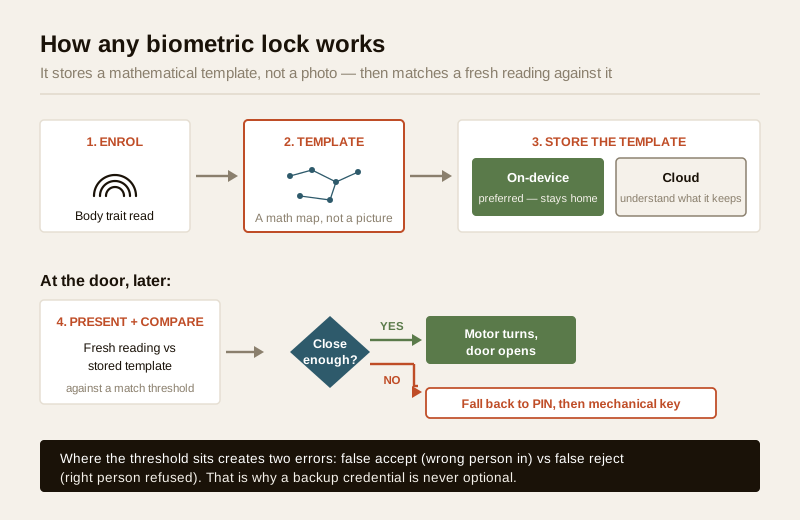
Here is the single most important fact, and it settles most of both the confusion and the privacy worry: a biometric lock does not store a picture of your finger, face or eye. It stores a template.
When you enrol, the sensor reads the trait and the software reduces it to a compact mathematical map of distinctive points, where fingerprint ridges end and split, or the relative geometry of facial features. That map is the template. It is not an image you could look at and recognise, and in a well-designed system you cannot rebuild the original trait from it. Later, when you present the trait to open the door, the lock reads it afresh, builds a new map, and asks one question: does this match an enrolled template closely enough? If yes, the motor turns and the door opens. If no, it refuses and you fall back to a PIN or key.
Two things about that template decide how safe and how private the lock is, and they are the same for fingerprint, face or any other trait:
1. How closely is "close enough"? The lock compares against a threshold, and where that threshold sits creates the two errors every biometric has (below).
2. Where does the template live? On the device itself, or in the maker's cloud? This is a privacy question as much as a technical one, and we return to it.
False accept vs false reject: why a backup is mandatory
No biometric is perfect, because it is matching a living, changing trait against a stored map with a threshold. Set the threshold loose and it lets the wrong person in more often; set it strict and it refuses the right person more often. That gives every biometric two errors, and understanding them is why a backup credential is non-negotiable.
| Term | What it means | Everyday consequence | If it is too high |
|---|---|---|---|
| False Accept Rate (FAR) | How often it wrongly accepts someone who should not be let in | A stranger's trait is mistaken for yours | A security hole; you want FAR very low |
| False Reject Rate (FRR) | How often it wrongly refuses a legitimate, enrolled person | You are locked out of your own door with full hands | Daily frustration; drives people to disable it |
The two pull against each other: pushing FAR down (more secure) tends to push FRR up (more refusals), and vice versa. Cheap sensors are worse on both. In Indian conditions the everyday pain is usually false rejection, a finger wet from washing or the monsoon, a worn manual-labour fingertip, a face in poor evening light, so the lock refuses someone who genuinely lives there.
The conclusion is not "avoid biometrics". It is a rule that holds for every type: a biometric must never be the only way in. A refused trait must always fall back gracefully to a PIN code and, on a home door, to a mechanical key. A good lock is layered by design: biometric for convenience, PIN as everyday backup, key as the final fallback. If a lock offers no non-biometric way in, that alone is a reason to reject it.
On-device vs cloud: where the template lives
This choice matters more than almost any feature on the box, because it decides who could ever be exposed to your family's body data.
| Storage | What it means | Privacy stance | Trade-off |
|---|---|---|---|
| On-device | The template stays inside the lock and never leaves your doorway | Safest default; cannot be breached from a company server | Some remote or multi-door convenience features may be limited |
| Cloud | Enrolment or matching involves the maker's servers | Must be justified: understand what is uploaded, where, for how long | Enables some app features, but adds a breach surface and cross-border questions |
A template that never leaves your front door cannot be leaked from a data centre in another country. So on-device storage is the privacy-safe default, and cloud storage of a biometric is something to justify, not assume. Before buying, read the maker's privacy terms plainly: is any biometric data uploaded, is it held in India or abroad, for how long, and can you delete it? If the answer is vague, prefer a lock that is clearly on-device only. This same logic runs through the camera-side treatment in the facial-recognition door phones guide, which is worth reading for the biometric-privacy parallel.
Privacy and the DPDP Act: the duty you take on
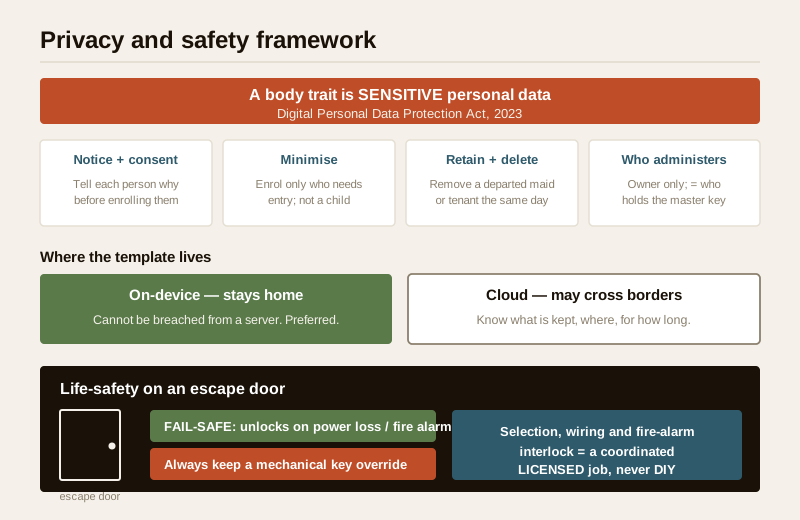
This is the section that makes a biometric lock genuinely different from a keypad, and it deserves real weight. A fingerprint, face-map or iris pattern is biometric data, and under India's Digital Personal Data Protection Act, 2023, biometric information is treated as sensitive personal data. When you enrol your family, and especially your household staff, you are collecting data about their bodies, and that carries duties. Access logs, the record of who opened the door and when, are personal data too.
The practical framework, the same for any biometric type:
- Notice and consent. Tell each person plainly what you are collecting and why (door access only) before you enrol them. A maid, cook, driver or tenant is a person whose biometric you are taking; ask and explain, do not just press their finger onto a sensor.
- Minimise. Enrol only who genuinely needs entry, and only the traits you need. Do not hoard enrolments "just in case".
- Retention and prompt deletion. Keep the user list current and delete a departed person the same day. When a maid, driver or tenant leaves, remove their biometric that day, exactly as you would take back a key. Buy a lock whose user list you can read, name and prune one person at a time; anonymous slots you cannot tell apart are a real shortcoming.
- Who administers. Keep the admin role to the owner or one or two trusted adults. Whoever can enrol a trait can grant access, so this is the equivalent of who holds the master key.
- A child's biometrics. Think twice before enrolling a young child. Their traits change as they grow (so they read poorly anyway), and a child cannot meaningfully consent to their body data being stored. A supervised PIN or entry is usually the kinder, safer choice.
- Cross-border cloud. If a lock stores templates in the cloud, that data may sit on servers outside India. That is precisely the kind of transfer the DPDP framework asks you to be aware of, and another reason on-device wins for a home.
The through-line: collect the minimum, keep it on the device where you can, tell people what you are doing, and delete when done.
Do you even need biometrics at home? An honest answer
Because biometrics are the glamorous end of the smart-lock shelf, it is worth saying plainly: for a great many Indian homes, a good PIN plus a mechanical key is plenty. A well-chosen PIN-code lock gives you keyless entry, per-person or temporary codes, and no body data to guard, for less money and less fuss. Biometrics earn their place only when their specific advantage matters to you.
Biometrics are genuinely worth it when:
- You truly value never touching a keypad, arriving with full hands, and a face lock opens as you walk up.
- Members of the household will not reliably remember or protect a code (though a fingerprint is the wrong primary credential for the very elderly or small children, whose traits read poorly).
- You want each person's access individually enrolled and revocable, and you are willing to take on the privacy duty that comes with it.
A PIN plus key is the smarter, simpler buy when:
- You are cost-conscious and want fewer things to go wrong.
- Household hands are often wet or worn (kitchen, garden, manual work), which makes fingerprints unreliable.
- You would rather not store anyone's body data at all, staff included.
There is no prize for having the most advanced credential. The best lock is the one your household will actually use every day without being locked out, and for many that is a simple code with a key in reserve.
Buying: what to insist on across any biometric type
Whatever the trait, the same short checklist protects you:
| What to insist on | Why it matters |
|---|---|
| On-device template storage | Body data never leaves your door; no server breach can expose it |
| A non-biometric backup | A PIN and a mechanical key so a refused trait or dead battery is never a lockout |
| Liveness / anti-spoof detection | A reputable sensor that checks for a live trait, not a flat copy; a reason not to buy the cheapest unbranded unit |
| Readable, prunable user list | You can name and delete one departed person without disturbing others |
| Reputable brand with firmware updates | Security fixes reach the lock over its life; app or Wi-Fi models are network devices too |
| Clear privacy terms | The maker states plainly what biometric data is stored, where, for how long, and how to delete it |
On spoofing, the responsible stance for a buyer is about choosing hardware that resists it, not methods: pick a reputable sensor with liveness detection and keep the layered backups. How any attack is performed is out of scope and not something a homeowner needs. And remember the Indian doorway: heat, monsoon damp and dust age any sensor, so a covered or recessed doorway extends the life of a biometric lock, and any app or Wi-Fi feature makes the lock a network device needing a strong unique account password, covered in the complete guide to smart locks.
When to bring in a professional. Choosing the lock, planning where credentials sit, and enrolling and removing users are yours to do. The actual fitting of the lock, any mains wiring, and any interlock with a fire alarm or building access system are a coordinated licensed job (door-hardware fitter plus electrician, and a fire-safety consultant wherever an escape or fire door is involved). An escape door must fail-safe, unlocking on power loss or fire alarm, and is governed by the National Building Code; getting that wrong can trap people. Route it through the trades and see the electrical hub for the wiring side. For shared-entry and society settings, the smart locks and access control sub-hub covers the coordination.
Key takeaways
- Biometric means measured from the body: fingerprint and face are the two mainstream home types (fingerprint the cheapest and most common), while palm-vein and iris are specialist and rare on home doors.
- Every biometric stores a template, not a photo, a compact mathematical map ideally kept on the device itself and never in the cloud, and never rebuildable into the original trait.
- Every biometric has two errors, false accept (lets the wrong person in) and false reject (refuses the right person), which is why a biometric must never be the only way in: always keep a PIN and a mechanical key.
- A body trait is sensitive personal data under the DPDP Act, 2023: give notice and take consent, minimise, delete a departed maid, tenant or employee the same day, think twice about a child's biometrics, and prefer on-device over cross-border cloud storage.
- Many homes do not need biometrics at all, a good PIN plus a mechanical key is plenty; buy a biometric only when its specific advantage matters to you, and even then insist on on-device storage, liveness detection, backups and a reputable brand.
References
- Digital Personal Data Protection Act, 2023 (India) — biometric information (fingerprint, face, iris, palm-vein) and access logs are sensitive personal data; observe notice, consent, minimisation, retention limits, the right to erasure, and awareness of cross-border transfers when enrolling family and household staff.
- Manufacturer specifications and privacy terms — verify the biometric type, false-accept and false-reject figures, liveness / anti-spoof claims, user capacity, backup credential options, and crucially whether templates are stored on-device or in the maker's cloud, on the maker's own datasheet before buying.
- National Building Code of India (SP 7), Bureau of Indian Standards, and local fire bye-laws for any escape-door, fail-safe and electrical aspect of a lock installation; verify the current edition via the BIS catalogue: https://www.services.bis.gov.in/
This is an educational overview, not legal advice. Lock fitting, mains wiring and any fire-egress interlock are qualified professional tasks; engage licensed trades, treat biometric data in line with the DPDP Act, and verify any standard's current status via the BIS catalogue before relying on it.
Export this guide
Related Guides — Deep-dive reading
Fingerprint Locks in India (2026): How Biometric Door Locks Really Work, and Their Honest Limits
How a fingerprint sensor reads a finger and matches it to enrolled templates, the genuine appeal of nothing to carry, and the wet-finger, elderly, privacy and backup realities every Indian buyer must weigh before choosing one.
SecurityBiometric Access Control in India (2026): Fingerprint, Face and Palm Systems Done Right
A professional's guide to networked biometric access control for buildings: fingerprint, face and palm readers on many doors, tied to attendance, planned around the DPDP Act, fire-egress fail-safe and honest field limits.
SecurityFace-Recognition Locks in India (2026): Proportionality, Privacy and the DPDP Act
How a smart lock that unlocks on a recognised face actually works, the genuine hands-free appeal, and the DPDP, accuracy and honest overkill caveats that must come first, for Indian homes.
SecurityRelated Tools — Try Free
Access-Control Battery-Backup Calculator
Size the standby battery so an access system keeps running through a power cut, with an egress life-safety note.
Battery BackupBiometric-Capacity Calculator
Whether a biometric reader can hold all the enrolments and how many devices you need, with a 1:N speed note.
Biometric CapacitySmart Lock Finder
Find the right smart lock — access methods, tier and must-haves like a mechanical override — for your door and budget.
Door Tool