
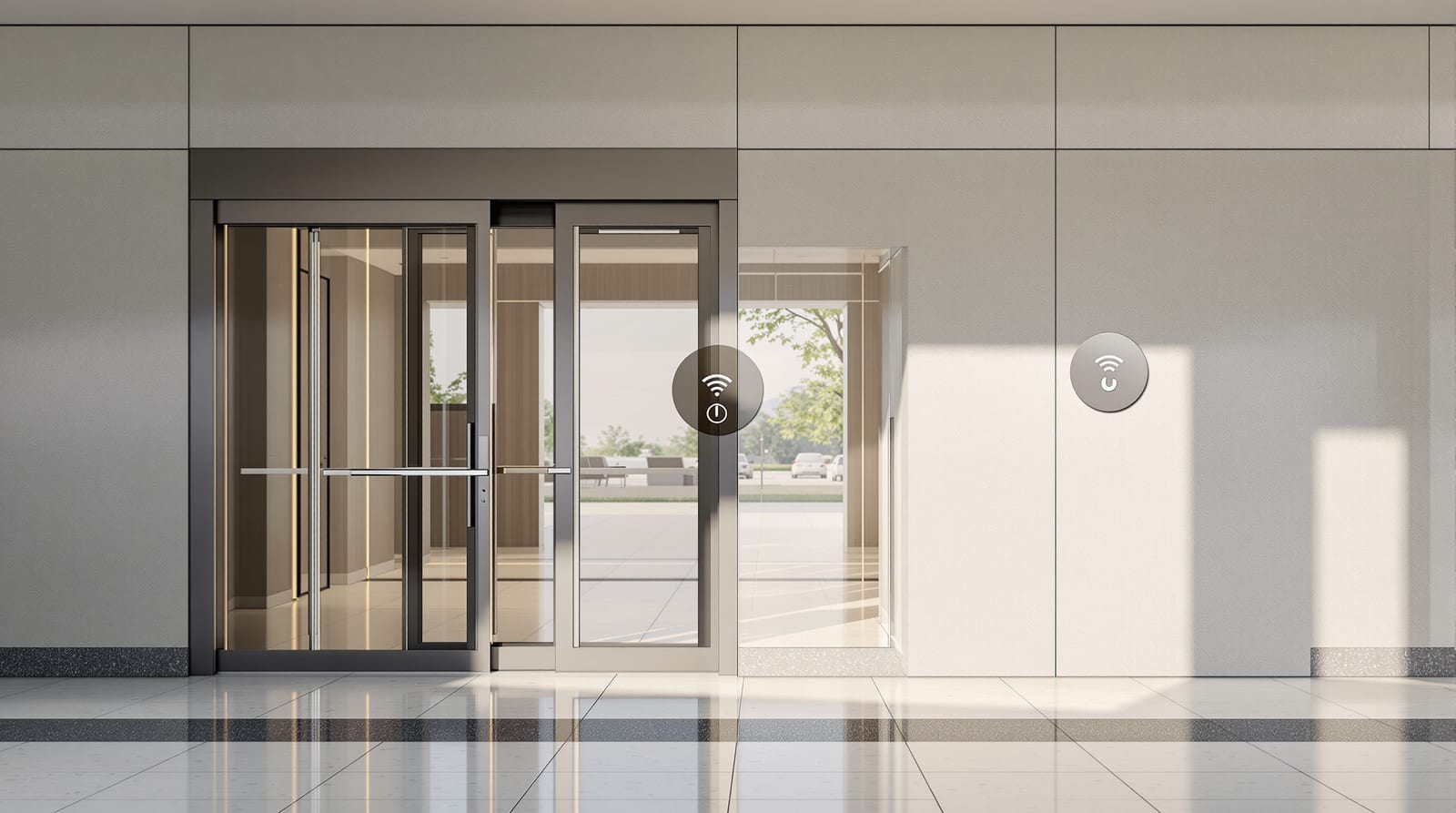
Low-Energy Door Operators for Accessibility in India 2026
Gentle, push-activated automatic operators that open doors safely for wheelchair users and the elderly without full safety-sensor arrays.
Low-energy door operators are the quiet workhorses of accessible building design: motorised units that open a door slowly and with limited force so they are inherently gentle, even if someone is standing in the swing path. Unlike a high-throughput shopping-mall entrance, a low-energy operator is sized for occupancy by people, not crowds, and it is almost always activated by a deliberate knowing act — a push-plate or a wave switch — rather than a continuous motion sensor. For India's accessibility obligations under the RPwD Act 2016 and the Harmonised Guidelines, the low-energy operator is the single most cost-effective way to make an existing swing door usable by wheelchair users, the elderly and patients without rebuilding the opening.
This guide is for architects, facility managers and integrators specifying accessibility upgrades. It explains how low-energy differs from full-energy automation, why the slower speed lets you skip the full safety-sensor array, where it fits in Indian accessibility law, and what it costs installed. For the consumer-facing button itself, pair this with our push-button door openers guide, and read it alongside accessible doors for the full opening design.
What "low-energy" actually means
The term is borrowed from accessibility standards (notably the US ANSI/BHMA A156.19, widely referenced by Indian integrators because no equivalent Indian operator standard is in force). "Low-energy" is defined by motion, not wattage. The operator must open the door slowly enough, and with little enough kinetic energy and clamping force, that contact with a person is unlikely to cause injury. In practice that means:
- Opening time: the door takes roughly 3 to 4 seconds to swing from closed to fully open (a 90-degree door opening to 80 degrees in not less than ~3-4 s, depending on door width and weight).
- Closing time: at least 3 seconds, often 5 or more, from open back to 10 degrees from latch — deliberately unhurried so a slow walker or wheelchair clears the threshold.
- Force: the static force needed to stop or reverse the door is capped low (a rule of thumb is the door can be held or pushed back by hand without strain).
Because the door moves this gently, the standard permits activation by a knowing act — the user chooses to operate it — and does not require the full presence- and motion-sensor array that a full-energy automatic door must carry. That single trade-off is the heart of the low-energy value proposition.
Full-energy vs low-energy door operators: the core difference
A full-energy (or "full-power") automatic operator is built for speed and continuous traffic: it opens fast, on automatic motion detection, and therefore must be protected by an active-infrared presence-sensor curtain on both faces, a motion sensor for approach, guide rails or guard surfaces, and signage. Remove the user's deliberate intent and you add the entire safety-sensor burden to prevent the fast-moving leaf from striking someone. A low-energy operator inverts this: slow the door down, require a knowing act, and the sensor array becomes optional.
| Attribute | Low-energy operator | Full-energy operator |
|---|---|---|
| Activation | Knowing act — push-plate, wave switch, fob | Automatic motion sensor (sometimes also knowing act) |
| Opening speed | Slow (~3-4 s to open) | Fast (~1.5-2.5 s) |
| Safety sensors | Not mandatory (gentle by design) | Mandatory presence + motion sensor curtains |
| Best for | Accessibility, offices, clinics, low-traffic | Malls, airports, high-footfall retail |
| Reference standard | ANSI/BHMA A156.19 (used in India) | ANSI/BHMA A156.10 |
| Typical cost installed | ₹35,000-1,10,000 per leaf | ₹60,000-2,80,000+ per opening |
| Egress on power loss | Manual push-open (operator declutches) | Break-out leaves / fail-safe required |
The practical reading: if your goal is accessibility — letting a wheelchair user, an elderly visitor or a patient operate a normal swing door — the low-energy operator is the right, cheaper tool. If your goal is throughput — moving crowds hands-free — you need a full-energy system with its full safety apparatus; the automatic door sensors guide covers that array, and the price split sits in automatic door cost.
The accessibility case in India
The legal and ethical driver is the Rights of Persons with Disabilities (RPwD) Act 2016, which makes accessibility of public buildings and services a statutory obligation, backed by the Harmonised Guidelines and Standards for Universal Accessibility in India (2021) issued by the Ministry of Housing and Urban Affairs. These guidelines call for entrance doors that can be operated with minimal force, clear unobstructed width (a minimum of 900 mm clear is the working rule for a wheelchair), level or ramped approach, and lever or automatic operation rather than knobs.
Manually opening a self-closing fire door or heavy timber leaf can demand 40-90 N of force — far beyond what many wheelchair users, frail elderly people or post-operative patients can apply seated. A low-energy operator removes that barrier: the user presses a wall plate at an accessible height (the Harmonised Guidelines place controls roughly 800-1100 mm above floor, reachable from a wheelchair and away from the swing) and the door opens itself.
Typical Indian settings where this is now expected:
- Hospitals and clinics — ward entrances, OPD doors, accessible toilets; staff push the wave switch with an elbow to keep hands clean.
- Government and public buildings — mandated accessible entrances under RPwD.
- Elderly and assisted living — gentle operation for residents with limited grip strength.
- Schools and campuses — accessible routes for students with disabilities.
- Offices and banks — at least one accessible entrance.
Knowing-act activation: how it is triggered
"Knowing act" simply means the door opens only because someone chose to operate it. That intent is what makes the slow door safe and the sensor array unnecessary. The common activators:
- Push-plate (hard-wired or wireless): a round or square stainless/plastic plate, often engraved with the wheelchair symbol and "Push to Open". Pressed by hand, elbow or wheelchair footrest.
- Wave / touchless switch: an active-infrared no-touch plate — wave a hand 50-150 mm away and it triggers. Hygienic; the default in hospitals post-pandemic. Covered with the push-button door openers options.
- Remote fob / RFID: a fob or access card releases and opens the door — useful where you want access control too; see rfid door access.
- Mobile app / BLE: smartphone activation, increasingly bundled with mobile app door access.
After activation the operator holds the door open for an adjustable dwell time (commonly 5-15 seconds, set longer for accessibility so a slow user clears the threshold) then closes gently.
System anatomy and wiring
A low-energy swing operator is a self-contained header unit above the door, driving the leaf through an arm linkage. Below is the typical layout and what each part costs in India.
| Component | What it does | Indicative ₹ (installed) |
|---|---|---|
| Low-energy header operator (per leaf) | Motor, controller, arm linkage | ₹30,000-90,000 |
| Push-plate (wired) | Knowing-act activation | ₹1,500-4,000 |
| Wave / touchless switch | Hygienic no-touch trigger | ₹2,500-6,000 |
| Wireless plate + receiver | Retrofit without chasing walls | ₹4,000-9,000 |
| Fire-alarm interface relay | Releases door on alarm (NBC) | ₹2,000-6,000 |
| UPS / battery backup | Operation through power cuts | ₹5,000-20,000 |
| Installation + commissioning | Mounting, wiring, force calibration | ₹8,000-25,000 |
Add 18% GST. A single accessible swing door typically lands at ₹40,000-90,000 all-in; a double door or one needing a UPS and fire interface runs higher. For a full bill of materials use our door automation cost calculator and confirm the operator choice with the automatic door operator selector.
Power cuts, free egress and the legal must
Two India-specific realities decide whether a low-energy install is safe and legal.
Power cuts. India's grid is improving but interruptions persist. A low-energy operator should declutch on power loss so the door becomes a normal manual push-open door — it must never trap a wheelchair user behind a dead motor. For settings where powered operation must continue (a hospital ward), specify a UPS sized for the operator. The door access power backup guide details battery planning.
Free egress — the legal must. Where the operator sits on an escape route, NBC 2016 fire and life-safety provisions require free, unimpeded egress: people must be able to leave without special knowledge, keys or a working power supply. If the operator is combined with any electric lock (a maglock or strike for access control), that lock must release on fire alarm and on power loss and the door must still push open manually. Never let an accessibility upgrade quietly become an egress trap. The release logic is covered in fail-safe vs fail-secure locks.
Specification checklist
Before you order, confirm:
- Door suits a low-energy operator — weight and width within the unit's rating; heavy or oversized leaves may need a full-energy unit (with its sensor array).
- Clear opening width stays at least 900 mm with the operator fitted.
- Activation height 800-1100 mm, reachable from a wheelchair and outside the swing path; a plate on the swing side must be positioned so the door cannot strike a waiting user.
- Dwell time set long enough for a slow user (10-15 s for accessibility).
- Opening/closing force and speed calibrated to the low-energy limits at commissioning, then re-checked at the annual door automation AMC.
- Fire-alarm release and manual push-open verified if any lock is present.
For the wider context of which automated door type to choose, see the door automation phase pillar and the master complete door guide.
Frequently asked questions
Why don't low-energy operators need full safety sensors?
Because the door moves slowly and with limited force, and only when a person deliberately activates it (a knowing act), the risk of injury from contact is low. The standard (ANSI/BHMA A156.19, used by Indian integrators) therefore permits omitting the presence- and motion-sensor curtains that a fast full-energy door must carry. You may still add a sensor for extra protection, but it is not mandatory.
Is a low-energy operator enough to meet RPwD accessibility rules?
It is a major part. The RPwD Act 2016 and Harmonised Guidelines require accessible entrances with minimal-force operation, adequate clear width (≥900 mm) and reachable controls. A low-energy operator with an accessible-height push-plate or wave switch satisfies the door-operation requirement, provided the approach, threshold and clear width are also compliant.
What happens during a power cut?
A well-specified low-energy operator declutches so the door works as a normal manual push door — no one is trapped. If continuous powered operation is needed (for example a hospital), fit a UPS or battery backup sized for the operator. Always verify the door still opens manually with the power off.
Can I add access control to a low-energy door?
Yes — pair the operator with an RFID, card or app trigger so the door opens only for authorised users. But if the door is on an escape route, any electric lock must release on fire alarm and power loss, and the door must still push open by hand for free egress under NBC 2016. Use an integrator and read electric strike locks.
How much does an accessible low-energy door cost in India?
As a rule of thumb, a single accessible swing door with a low-energy operator, push-plate and installation lands around ₹40,000-90,000 plus 18% GST. Adding a UPS, fire-alarm interface or a second leaf pushes it higher. Get a project quote from an integrator and estimate with our door automation cost calculator.
Export this guide
Related Guides — Deep-dive reading
Automatic Swing Door Operators: Retrofit Guide India 2026
How to retrofit a normal hinged door to open by itself — full-energy vs low-energy operators, activation, safety and cost for Indian buildings.
Home Doors & EntrancesFail-Safe vs Fail-Secure Locks: The Guide (India 2026)
Why fail-safe vs fail-secure is the single most important access-control decision, and how to get it right for every door.
Home Doors & EntrancesWheelchair Accessible Doors for Indian Homes: Clear Width, Thresholds & Hardware (2026)
The exact specs that make a door usable from a wheelchair - clear opening width, near-flush threshold, lever hardware, approach clearance and low-force or auto operation, mapped to the RPwD Harmonised Guidelines 2021.
Home Doors & EntrancesRelated Tools — Try Free
Access-Control Battery-Backup Calculator
Size the standby battery so an access system keeps running through a power cut, with an egress life-safety note.
Battery BackupAccessible Door Checker
Check a door against wheelchair-accessibility guidance — clear width, threshold, handle and closer force per RPwD 2021.
Compliance ToolEmergency-Egress Checker
A life-safety self-check that access-controlled doors on escape routes still let people out in an emergency.
Egress Check