
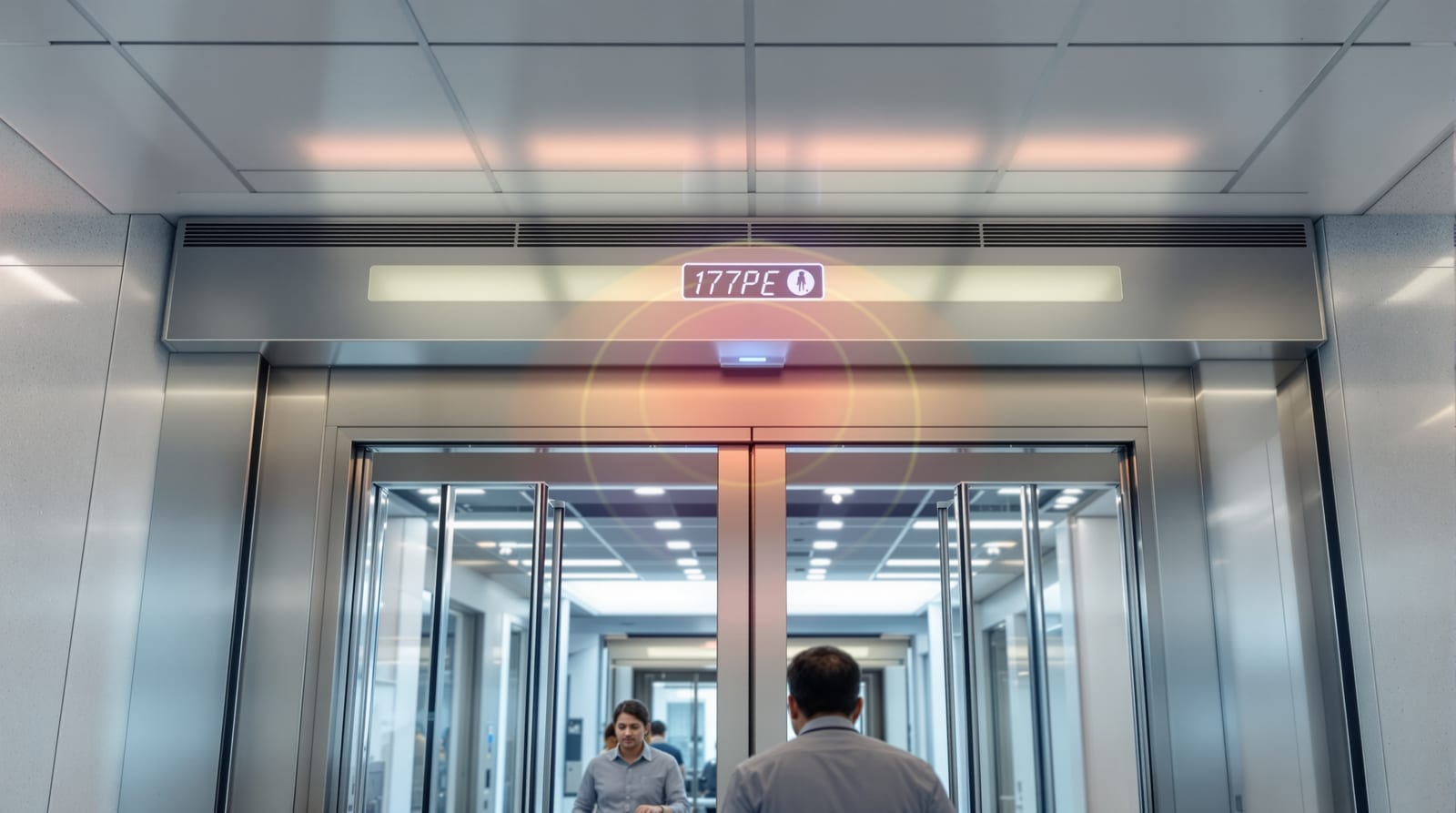
Automatic Door Sensors: Activation & Safety (India 2026)
How motion, presence and touchless sensors trigger automatic doors safely — placement, aiming and entrapment prevention for Indian projects.
The difference between an automatic door that feels effortless and one that traps a child's wrist or slams on a wheelchair user comes down to its sensors. Automatic door sensors split into two jobs: activation (telling the operator someone is approaching, so open) and safety (telling it something is still in the doorway, so do not close). Getting both right — the technology, the placement and the aiming — is the heart of a safe, reliable installation, and it is where most Indian retrofits go wrong. This guide is for integrators, facility managers and architects specifying or troubleshooting sensors on automatic swing and sliding doors.
Activation versus safety: two different sensor families
Never confuse the two. An activation sensor's failure mode is a door that does not open (annoying). A safety sensor's failure mode is a door that closes on a person (dangerous). They use different physics, sit in different positions, and are tuned for opposite priorities — activation tolerates a few false triggers; safety must never miss a presence. A complete automatic door normally carries both: an overhead activation sensor on each approach, plus presence-safety protection guarding the moving leaf and the opening.
The governing reference internationally is EN 16005 (safety in use of power-operated doors), widely adopted by Indian integrators and global brands as best practice. India has no single equivalent standard, but the NBC 2016 free-egress and fire-safety rules and the RPwD Act 2016 accessibility guidelines effectively demand the same outcomes: doors must not strike users, and accessible entrances need reliable, slow, safe operation. For the wider system see our door automation pillar and the complete door guide.
Activation sensors: microwave, PIR and combined
Microwave (radar) motion sensors
A microwave activation sensor emits a low-power Doppler radar field and detects movement toward the door. It is fast, ignores stationary objects (good — it will not hold an empty door open) and works through dust and the light, humidity and temperature swings of Indian entrances. The trade-off: it only fires on motion, so a person standing still in the field is invisible, and a poorly aimed unit catches passing traffic or swaying foliage outside.
Passive infrared (PIR / active-IR motion)
PIR detects the heat signature of a moving body. Pure PIR struggles in hot Indian summers when ambient and body temperature converge, reducing contrast — a real reliability issue from April to June. Many modern overhead heads instead use active infrared (AIR) for activation: they project IR spots onto the floor and watch for changes, detecting both motion and a stationary presence in the approach zone. AIR is less weather-dependent than PIR and adds a hold-open buffer right at the threshold.
Combined microwave + active-IR heads
The professional default today is a combined sensor: microwave for fast directional approach detection plus an active-IR curtain immediately in front of the door to hold it open while someone lingers in the threshold. This pairing fixes the classic faults of each alone — the microwave's blindness to a stationary person and the AIR's narrow range. Specify combined heads for any door with significant footfall.
| Activation sensor | How it works | Strength | Weakness | Indian-context note |
|---|---|---|---|---|
| Microwave (radar) | Doppler — detects motion | Fast, directional, weather-robust | Misses stationary people; over-range | Best primary activator; aim away from road traffic |
| PIR (passive IR) | Body heat contrast | Cheap, low power | Poor in hot months, no stationary hold | Avoid as sole activator in summer |
| Active infrared (AIR) | Projected IR floor spots | Detects motion + presence | Shorter range, dirt-sensitive | Good threshold hold-open buffer |
| Combined MW + AIR | Both, in one head | Reliable approach + threshold hold | Costlier | Recommended default for retail/hospital |
Safety sensors: presence detection and photocells
Safety sensors stop the door from closing or reversing onto a person. They must detect a stationary presence, not just motion.
Active-infrared presence curtains
Mounted on the door header or leaf, an AIR safety curtain projects a dense grid of IR beams down across the threshold and along the path of the moving leaf. If any beam is broken — a foot, a stick, a child standing still — the door holds open or reverses. EN 16005 expects continuous presence protection across the full opening with no significant gaps, especially the dangerous closing edge.
Photocells (through-beam photoelectric)
A photocell is a simple transmitter-receiver pair across the opening; break the beam and the door reverses. Cheap and reliable as a backup, but a single beam at one height leaves gaps — a low object or a small child below the beam can be missed. Use photocells to supplement, never to replace, a full presence curtain.
Safety on swing doors
Swing operators need extra care: the leaf sweeps an arc, so you need presence sensors on both the swing side (to stop hitting someone) and the approach side, plus a sensor that detects a person standing in the door's path. This is why automatic swing door operators often cost more to make compliant than sliding ones. For the closing mechanics see automatic sliding door mechanism.
| Safety sensor | Coverage | Detects stationary? | Role | Cost band (₹, installed) |
|---|---|---|---|---|
| Active-IR presence curtain | Full opening / leaf path | Yes | Primary safety | 4,000–15,000 |
| Photocell (through-beam) | Single/few beams | Yes (at beam height) | Backup / edge | 1,500–5,000 |
| Safety edge (pressure) | Leading edge | Yes (on contact) | Last-resort reverse | 2,000–6,000 |
| Floor mat (legacy) | Threshold zone | Yes | Older systems only | 3,000–8,000 |
Touchless and wave sensors
Since 2020, touchless wave sensors and push-plates have become standard in Indian hospitals, labs and premium offices for hygiene. A wave sensor is usually a short-range active-IR or microwave detector mounted at hand height beside the door; the user waves a hand 5–15 cm away to trigger it. They replace contact push-buttons without changing the safety logic — the door still needs its full presence protection. We cover the products in depth in touchless sensor doors; this guide focuses on how the wave trigger integrates with the operator. For accessibility-friendly hard-wired controls, see push-button door openers.
Placement, aiming and false triggers
Overhead activation aiming
- Mount the activation head centred over the door, typically 2.2–2.8 m high; higher mounting widens the detection field.
- Tilt the microwave field toward the approach, not outward to the street, to avoid triggering on passing vehicles, two-wheelers or pedestrians.
- Keep the field clear of swaying plants, ceiling fans, hanging signage and reflective glass — all classic Indian false-trigger sources.
Cross-talk and reflections
Two opposing doors with microwave heads can trigger each other (cross-talk); use frequency-staggered units or synchronisation. Polished granite and glass floors common in Indian lobbies reflect IR and can confuse AIR sensors — recalibrate to the actual floor finish at commissioning, not on the bench.
Threshold gaps and the closing edge
The single most common compliance failure is a presence-curtain gap at the threshold or a misaligned leading-edge beam. Walk the full opening with a test stick at ankle and knee height during commissioning. Re-test after any floor mat, signage stand or queue barrier is added near the door.
Integration with the operator and power
Sensors are only as good as the operator logic they feed. Activation outputs and safety inputs are wired to the operator control board; safety inputs are usually fail-safe (a broken sensor wire makes the door behave as if a presence is detected — it stays open). Set realistic hold-open times (longer for accessible and high-traffic doors, per low-energy door operators) and confirm the operator reverses, not just stops, on safety trigger.
Indian power reality matters: sensors and the operator should sit on a UPS or battery backup, and the door must have a defined power-fail mode (break-out or manual push) so it never becomes a trap or an egress block during a cut. On any escape route, NBC 2016 demands free egress — automation and access control must never prevent manual exit. See door access power backup and door automation wiring for the electrical detail, and isolate mains before working on the operator — this is electrician/integrator territory.
Choosing and commissioning: a quick decision matrix
| Door situation | Activation | Safety | Notes |
|---|---|---|---|
| Retail / mall sliding | Combined MW + AIR | Full presence curtain + photocell | High footfall, recalibrate to glossy floor |
| Hospital / hygiene | Touchless wave + AIR | Full curtain | Slow speed, long hold-open |
| Accessible entrance (RPwD) | Push-button + MW | Full curtain + edge | Low-energy operator, generous timing |
| Swing door, office | MW each side | Presence both swing & approach side | Pricier to make compliant |
| Low-traffic side door | PIR (non-summer) or MW | Photocell + edge | Budget option, test in heat |
For budgeting the sensor package within a full job, use the door automation cost calculator and the automatic door operator selector. For deeper safety practice and standards see automatic door safety and automatic door operators.
Frequently asked questions
What is the difference between an activation sensor and a safety sensor on an automatic door?
An activation sensor (usually microwave or combined microwave + active-IR overhead) detects someone approaching and tells the operator to open. A safety sensor (an active-IR presence curtain, photocell or safety edge) detects a person still in the doorway and stops the door closing on them. Every compliant automatic door needs both — they fail in opposite directions, so they are never interchangeable.
Why does my automatic door keep opening when no one is there?
False activation is almost always a microwave aiming problem: the field is catching passing road traffic, swaying plants, a ceiling fan, hanging signage or reflective glass. Re-aim the head toward the approach and away from the street, reduce sensitivity or range, and use frequency-staggered units if two opposing doors are triggering each other. Recalibrate to the actual floor finish, since polished granite and glass reflect IR.
Are touchless wave sensors as safe as the old push-buttons?
Functionally yes — a wave sensor simply replaces the contact trigger and is more hygienic, which is why Indian hospitals and labs adopted them. But the wave sensor only handles activation; the door's full presence-safety curtain and reversing logic must still be present and tested. Do not let a touchless retrofit remove or bypass the safety sensors.
What standard governs automatic door sensors in India?
There is no single Indian standard equivalent to the international EN 16005, which most integrators and global brands follow as best practice. In India the binding requirements come from NBC 2016 (free egress and fire-safety release on escape routes) and the RPwD Act 2016 with its harmonised accessibility guidelines (safe, slow, reliable operation on accessible entrances). Together they demand the same outcome: the door must never strike a user or block exit.
How do automatic door sensors behave during a power cut?
Safety sensor inputs are wired fail-safe, so a fault or power loss makes the door treat the opening as occupied — it stays open or reverses rather than closing on someone. The operator should sit on a UPS or battery backup with a defined power-fail mode (break-out leaf or manual push) so the door is never a trap. On any escape route, NBC 2016 requires free manual egress regardless of power state.
Can one combined sensor do everything?
No. A combined microwave + active-IR head is an excellent activation sensor and adds a threshold hold-open buffer, but it is not a substitute for a dedicated safety presence curtain guarding the full opening and the closing edge. Treat activation and safety as separate, both required, and commission each by walking the opening with a test stick at ankle and knee height.
Export this guide
Related Guides — Deep-dive reading
Automatic Swing Door Operators: Retrofit Guide India 2026
How to retrofit a normal hinged door to open by itself — full-energy vs low-energy operators, activation, safety and cost for Indian buildings.
Home Doors & EntrancesAccess Control Standards India 2026: Compliance Map
The which-rule-governs-what map for door automation and access control in India — NBC egress, RPwD accessibility, EN safety and the DPDP Act.
Home Doors & EntrancesTouchless Sensor Doors: Wave-to-Open Hygiene India 2026
How microwave-and-infrared sensor-activated doors work, get tuned and stay safe across hospitals, labs, food plants and offices in India.
Home Doors & EntrancesRelated Tools — Try Free
Access-Control Battery-Backup Calculator
Size the standby battery so an access system keeps running through a power cut, with an egress life-safety note.
Battery BackupMotorized Curtain Cost Calculator
Estimate the all-in cost to motorise curtains — motors, tracks, hub and installation.
Cost CalculatorAccessibility Compliance Calculator
Check a planned lift against the CPWD and RPwD accessible-lift benchmarks for a score.
Lift Checker