
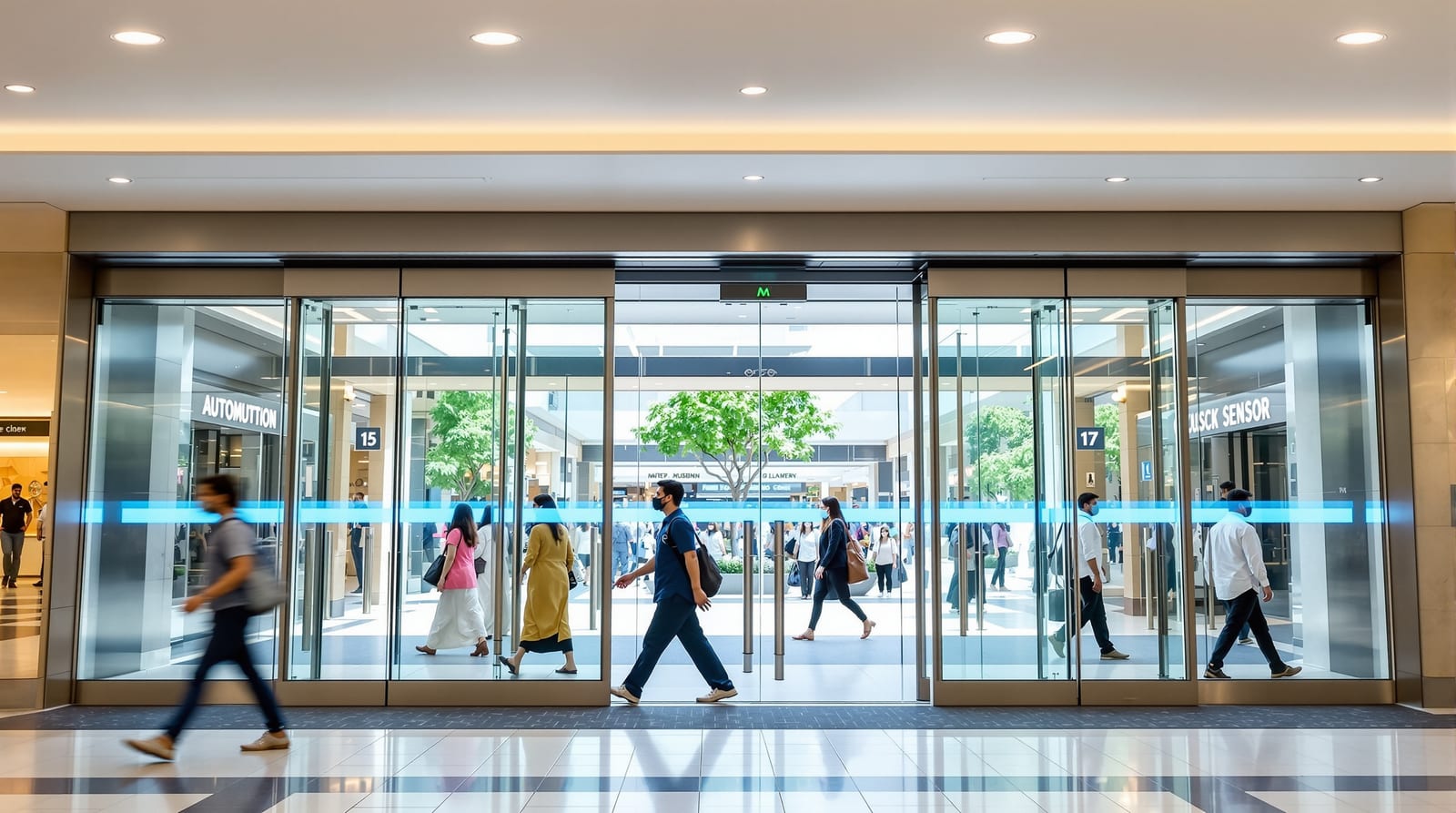
Automatic Door Safety & Compliance: Full Guide India 2026
Risks, sensors, force limits, break-out and free-egress rules that keep automatic doors safe and code-compliant in India.
An automatic door is a powered machine that people walk through, often without looking. That is exactly why automatic door safety is not an optional extra but the core of any specification. A poorly set sliding door can knock down a child; a swing operator can shear a hand against a wall; an access-controlled maglock can trap people behind a locked leaf during a fire. This guide is for specifiers, facility managers and integrators in India who must select, commission and maintain powered doors that are both safe in daily use and compliant with life-safety law. It covers the risks, the safeguards, the standards (EN 16005, EN 16361 and the Indian regulatory frame), and a practical inspection routine.
The four ways an automatic door hurts people
Most automatic-door incidents fall into four categories, and every safeguard you specify maps back to one of them.
- Impact (striking) — a moving leaf hits a person who is in its path. Common with fast sliding doors and swing operators in busy lobbies.
- Entrapment (trapping/crushing) — a person is caught between the closing leaf and the frame, or between two leaves, and the door keeps applying force.
- Shearing and drawing-in — fingers, clothing or mobility aids are pulled into the gap between a sliding leaf and the side screen, or between a swing leaf and an adjacent wall or hinge.
- Lock-out / failure to egress — the door cannot be opened to escape, usually an access-controlled or maglocked door that stays secure during a power fault or fire. This is the most serious because it can be fatal at scale.
The first three are mechanical hazards addressed by sensors, force and speed limits and physical clearances. The fourth is a life-safety and legal issue addressed by fail-safe hardware and free egress, covered below.
The safeguards: how each risk is controlled
Presence and activation sensing
A safe automatic door senses people in two ways. An activation sensor (typically microwave/radar) detects approach and opens the door. A presence (safety) sensor (typically active-infrared, mounted on the header or leaf) detects a person standing in the swing or slide path and holds the door open, preventing it from closing on them. The most common cause of injury is a presence sensor that is missing, mis-aimed, or has dead spots near the floor where a small child or wheelchair footplate sits. As a rule of thumb, presence detection must cover the full leaf travel from header height to within roughly 100-200 mm of the floor. Swing operators need presence sensing on both the swing side and the approach side, because a leaf that opens towards a waiting person is as dangerous as one that closes.
Force, speed and time limits
Where a moving edge could contact a person, kinetic energy must be limited. Low-energy operators (used for accessibility) move slowly enough that contact is tolerable, while full-power operators rely on sensors to clear people from the path before full speed is reached. Operators must also hold the door open long enough for slow users to pass — too short a hold-open time is a real entrapment risk for elderly and disabled users.
Safety distances and guarding
Mechanical guarding handles the gaps that sensors cannot. Finger-trap gaps between a swing leaf and the adjacent wall, and draw-in points where a sliding leaf passes a fixed screen, are designed out with minimum clearances or finger-protection profiles. For sliding doors, the side screens and pockets must not create a drawing-in shear point.
Break-out (emergency swing-out)
Many automatic sliding doors on escape routes have a break-out function: the sliding leaves (and side screens) can be pushed open manually in the escape direction, swinging flat against the wall to create a clear emergency exit even if power or the operator has failed. Break-out is essential where the sliding door also serves as a fire exit.
Signage and conspicuity
Glass automatic doors must be made visible with manifestation (markings at standard sightline heights) so people do not walk into closed or slow-moving glass. Warning signage ("Automatic Door", "Caution") and floor demarcation reduce both walk-into and crowding-at-the-threshold incidents.
The life-safety must: free egress and fire release
This is the rule that overrides cost, convenience and security. Under the National Building Code (NBC) 2016, doors on escape routes must permit free egress — anyone inside must be able to get out without a key, code, card or special knowledge, in the direction of escape, at all times. For powered and access-controlled doors this has two non-negotiable consequences:
1. Magnetic locks and access control on escape doors must be fail-safe and must release automatically on fire-alarm activation and on power loss. A maglock (typically 280 kg or 600 kg holding force) is fail-safe by nature — it unlocks when power is cut — and must be interlocked with the fire-alarm panel so the entire escape route unlocks the moment the alarm sounds. A manual green break-glass release should also be provided at the door.
2. The automatic operator must not be the only way out. Sliding doors on escape routes need break-out leaves; swing doors must remain manually openable.
Fail-secure devices (which lock on power loss) belong on doors that are not escape routes — a stockroom or server room — never on a means of escape. Choosing fail-safe versus fail-secure is the single most important life-safety decision on any access-controlled door; we cover it in depth in fail-safe vs fail-secure locks and the device options in magnetic door locks and electric strike locks.
India's power-cut reality makes this doubly important: design every escape-route door so that the default failure state is open, and provide UPS/battery backup for the operator and controller so doors fail predictably rather than randomly. See door access power backup for sizing.
Standards and where they apply
India has no single dedicated automatic-door product standard, so reputable specifiers default to the European norms manufacturers design to, read alongside Indian law:
| Standard / code | Scope | What it governs |
|---|---|---|
| EN 16005 | Power-operated pedestrian doorsets — safety in use | Force/speed limits, presence sensing, low-energy mode, risk assessment, signage |
| EN 16361 | Power-operated pedestrian doorsets — product standard | Performance, durability and safety requirements for the doorset as a product |
| NBC 2016 (India) | Building life safety | Free egress, fire-alarm release of locks, escape-route widths and door swing |
| RPwD Act 2016 + Harmonised Guidelines | Accessibility | Low-energy/accessible operators, push-button activation, clear hold-open time |
| DPDP Act 2023 | Data protection | Biometric/footage handling where the door is also access-controlled |
| Relevant IS standards | Electricals & installation | Wiring, earthing, isolation, IP ratings of devices |
EN 16005 is the practical workhorse: it requires a documented risk assessment per installation, mandates presence sensing in low-energy and full-power modes, and sets the limits that keep impact and entrapment forces below injury thresholds. Treat it as the de-facto benchmark and buy operators and sensors that declare EN 16005 / EN 16361 conformity.
Risk-to-safeguard matrix
| Hazard | Primary safeguard | Backup / secondary measure |
|---|---|---|
| Impact from moving leaf | Activation + presence sensors, speed limit | Reduced-energy mode in low-traffic hours |
| Entrapment / crushing | Presence hold-open, force limit, obstruction reversal | Pressure-sensitive edge, generous hold-open time |
| Shearing / draw-in | Minimum clearances, finger-guard profiles | Side-screen presence beams |
| Walk-into glass | Manifestation markings, signage | Floor demarcation, contrasting frame |
| Lock-out during fire / power-cut | Fail-safe maglock + fire-alarm release | Manual break-glass, break-out leaves, UPS |
| Accessibility (slow users) | Low-energy operator, push-button, long hold-open | Wave/push-plate at accessible height |
Routine safety checks (facility-manager checklist)
Automatic doors drift out of safe adjustment as floors wear, sensors loosen and seasons change ambient infrared. A documented inspection regime is part of compliance, not just good housekeeping.
- Daily (staff walk-by): door opens/closes smoothly, no unusual noise, glass and manifestation clean, no objects blocking the threshold.
- Monthly (trained person): presence sensor stops a closing/opening leaf when a test object is placed in each zone; activation range correct; hold-open time adequate for a slow walker; break-out (if fitted) operates with reasonable manual force.
- Fire-alarm interface test (with the fire drill): trigger the alarm and confirm every maglock/access-controlled escape door releases and the operator fails open; confirm the manual break-glass releases the lock.
- Annual (manufacturer/integrator AMC): full force/speed measurement against limits, sensor re-aim, mechanical guarding inspection, battery/UPS health, and a refreshed risk assessment. Keep dated records and signage of the last service.
Never defeat a sensor to "speed up" a slow door, and isolate power before any internal work — operators carry mains voltage and stored mechanical energy. Bundle this into an door automation AMC contract so the obligation has an owner.
Where this sits in the wider system
Safety is one layer of a powered-door system that also includes the operator, sensors, controls and any access control. For the mechanics of the drives, see automatic door operators; for the detection hardware, automatic door sensors; for accessibility-grade drives, low-energy door operators. The cluster pillar complete door guide and the phase pillar door automation tie the whole programme together. To size and budget a compliant installation, use the door automation cost calculator and, for the lock-failure decision, the fail-safe vs fail-secure selector.
Studio Matrx recommends that any automatic door on an escape route be specified, commissioned and signed off by a qualified integrator against a written EN 16005-style risk assessment, with the fire-alarm release tested and recorded.
Frequently asked questions
Are automatic doors legal as fire exits in India?
Yes, provided they permit free egress. Under NBC 2016, an automatic sliding door on an escape route should have break-out leaves that open manually in the escape direction, and any maglock or access control must be fail-safe and release on fire-alarm and power loss. A powered door that can only be opened by working electronics is not a compliant exit.
What is the difference between an activation sensor and a safety sensor?
An activation sensor (usually microwave/radar) detects someone approaching and tells the door to open. A safety (presence) sensor, usually active-infrared, detects someone in the door's travel path and stops it from closing or opening onto them. Both are required; a missing or mis-aimed presence sensor is the leading cause of injury.
Does India enforce EN 16005?
EN 16005 is a European standard and is not Indian law, but it is the recognised benchmark that quality operators and sensors are built to, and most reputable specifiers and integrators in India use it as the design reference. It must be read alongside binding Indian requirements: NBC 2016 for free egress and fire release, and the RPwD Act for accessibility.
What happens to an automatic door during a power cut?
It depends on design, which is why the failure mode must be specified deliberately. On escape routes, the operator and any maglock should fail open/unlocked (fail-safe), backed by a UPS or battery so behaviour is predictable. Sliding doors should also have manual break-out. Never leave an escape door in a state where a power cut traps people inside.
How often should automatic doors be safety-tested?
Do a quick visual check daily, a sensor and hold-open test monthly, a fire-alarm release test at every fire drill, and a full force/speed and mechanical inspection annually under a manufacturer or integrator AMC. Keep dated records — they are your evidence of compliance.
Who is responsible if an automatic door injures someone?
The building owner or occupier carries the duty of care for safe operation and maintenance, which is why a documented risk assessment, AMC and inspection log matter. The installer is responsible for compliant commissioning. Defeating a safety sensor or skipping the fire-release interlock shifts clear liability onto whoever did so.
Export this guide
Related Guides — Deep-dive reading
Fail-Safe vs Fail-Secure Locks: The Guide (India 2026)
Why fail-safe vs fail-secure is the single most important access-control decision, and how to get it right for every door.
Home Doors & EntrancesAccess Control Maintenance in India (2026): Readers, Locks and Fail-Safe Egress
How to keep a card, keypad, fingerprint or face access-control system reading reliably and locking securely — and, above everything, how to test that its doors still release on a fire alarm and on power loss, so an access-controlled door never becomes a life-safety trap.
SecurityAccess Control Standards India 2026: Compliance Map
The which-rule-governs-what map for door automation and access control in India — NBC egress, RPwD accessibility, EN safety and the DPDP Act.
Home Doors & EntrancesRelated Tools — Try Free
Emergency-Egress Checker
A life-safety self-check that access-controlled doors on escape routes still let people out in an emergency.
Egress CheckAccess-Control Battery-Backup Calculator
Size the standby battery so an access system keeps running through a power cut, with an egress life-safety note.
Battery BackupWindow Hardware Cost Calculator
Estimate window hardware cost — hinges, handles, locks, rollers and multipoint gears.
Window Calculator