
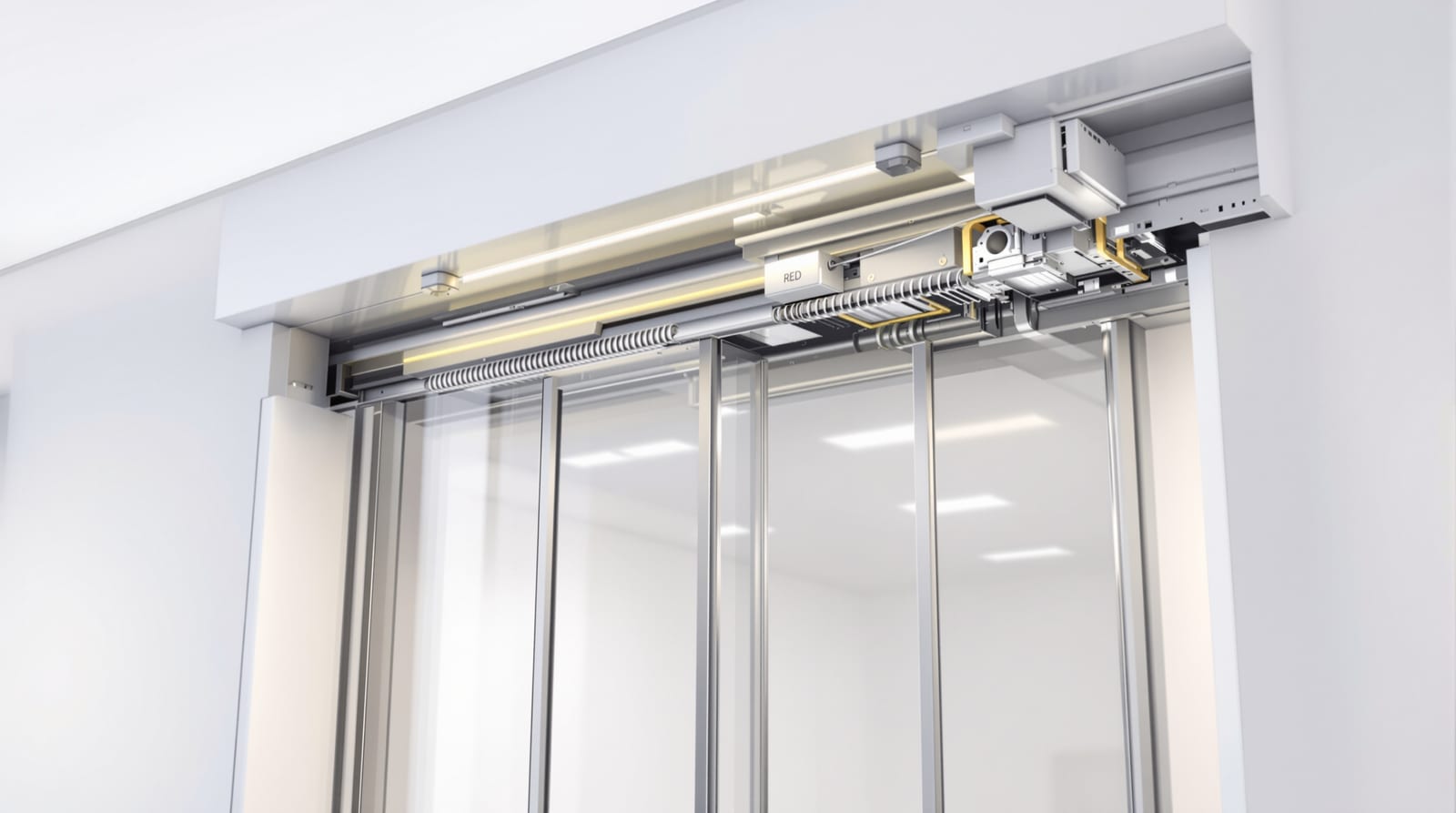
Automatic Sliding Door Mechanism Explained (India 2026)
Inside the operator kit, sensors, breakout and battery backup that make an automatic sliding door open, cushion and stay safe.
Walk through a clinic, showroom or office lobby in India and the doors part for you without a touch — but the magic lives inside a slim aluminium header above the glass. The automatic sliding door mechanism is a self-contained operator kit: a motor drives a toothed belt, the belt pulls a carriage of rollers along a track, and a control unit decides when to open, how fast to slide and when to stop. This guide is the mechanism deep-dive — if you want help choosing the door itself, start with automatic sliding doors. Here we open the header and explain every part, including the bits that matter most for safety in an Indian building: breakout for egress and battery-backup opening when the power cuts.
What sits inside the automatic sliding door mechanism
The operator is the engine room of the automatic sliding door mechanism. Strip the cover off a quality unit and you find a consistent set of components, whether the brand is global or Indian-assembled.
The operator kit, part by part
- Motor (drive unit): a brushless DC or geared motor, mounted in the header. It is small — door panels are light glass — and is rated for high cycle counts (a busy lobby door opens tens of thousands of times a year).
- Belt and pulleys: a toothed (timing) belt loops between the drive pulley on the motor and an idler pulley at the far end. The belt is the muscle that converts motor rotation into the linear push-pull of the panel.
- Carriage and rollers: each moving panel hangs from a carriage — a bracket riding on nylon or steel rollers. The rollers run silently along the track; the carriage clamps to the belt so the panel moves with it.
- Track (header rail): a precision aluminium extrusion the rollers run on, plus a floor guide channel or guide pin that keeps the panel from swinging.
- Control unit (controller/ECU): the brain. It reads the sensors, ramps the motor speed, sets hold-open time, learns the door's travel limits, and manages opening, cushioning and locking.
- Sensors: typically a microwave motion sensor to detect approach and an active-infrared safety/presence beam at the door line to stop a closing door on a person. See automatic door sensors and automatic door safety.
- Electric lock: an integrated lock bolt that secures the panel when closed and after-hours.
- Battery backup: a small sealed battery so the controller can complete a safe opening on a power cut.
How the door detects you and slides
The sequence is fast but ordered. Understanding it makes troubleshooting and commissioning far easier.
1. Detection: the microwave motion sensor sees movement in its field and signals the controller.
2. Open command and acceleration: the controller energises the motor, which ramps up smoothly (soft start) rather than jerking the glass.
3. Full open and hold: the panel reaches its learned open limit, decelerates and cushions, then holds open for a set time (commonly 1.5-6 seconds, adjustable).
4. Safe close: if the presence beam at the threshold is clear, the controller drives the panel closed, again decelerating into a cushioned stop, then engages the lock.
If the safety beam detects a person mid-close, the controller reverses or holds. This auto-reverse on obstruction is a core safety function — never bypass it.
Single-slide versus bi-parting
| Configuration | How it works | Typical clear opening | Best for |
|---|---|---|---|
| Single-slide | One panel slides to one side along a single belt run | Up to ~half the header width | Standard entries, narrower openings |
| Bi-parting (telescopic optional) | Two panels split from the centre; the belt is split or geared so both move symmetrically | Wider opening for the same header | Lobbies, showrooms, high-traffic mains |
| Telescopic (2 panels per side) | Panels nest and overlap to maximise opening in a short wall | Largest opening per running metre | Tight headers needing a wide pass |
Bi-parting splits the same operator logic across two carriages; the control unit synchronises them. It costs more but gives a balanced, wide opening — useful where wheelchair and trolley traffic is heavy.
Breakout — the egress mechanism that keeps it legal
This is the single most important safety feature, and the one most often misunderstood. Breakout (or anti-panic swing) lets the sliding panels swing outward like a normal door if someone pushes them, so people can escape even if the operator is dead, jammed or powered down. On any door on an escape route, the NBC 2016 free-egress rule is non-negotiable: people must be able to leave without a key, tool or special knowledge. A sliding automatic door on an exit must therefore either have full breakout panels or be paired with a compliant fail-safe arrangement and fire-alarm release. For the standards picture across systems, see access control standards and the wider fail-safe versus fail-secure decision.
Battery backup: opening on a power cut
India's power-cut reality shapes how these doors are specified. A good operator includes a battery backup that, on mains failure, does one of two programmable things: drive the door to a safe open position and hold it, or complete the current cycle and unlock. The default for an entry/escape door should be open-on-failure, so the building is never sealed shut. The battery is small and is not meant to run the door all day — it is there for a graceful, safe transition. Combine it with the building's UPS strategy; see door access power backup.
Brake, cushioning and the lock
Two motion behaviours protect both people and the hardware:
- Cushioning (soft stop): the controller decelerates the panel before each limit so glass and carriage do not slam. This is what makes a quality door feel smooth and last longer.
- Electronic brake / hold: when closed, the motor or an integrated electric lock holds the panel shut against wind and casual pushing. After hours, a night-lock or deadlocking strike secures the entry; pair it with the building's access control systems where the door is part of a managed perimeter.
Component and cost map (India 2026)
| Component | Indicative installed band (₹) | Notes |
|---|---|---|
| Sliding operator / kit (motor, belt, controller, track) | 25,000 - 80,000 | Per door; brand and duty-cycle dependent |
| Complete automatic sliding door (with glass panels) | 45,000 - 2,80,000 | Single vs bi-parting, glass spec |
| Sensors (microwave motion + active-IR safety) | 3,000 - 15,000 | Per door; safety beam is mandatory in spirit |
| Battery backup module | included - 12,000 | Spec open-on-failure for egress |
| Annual AMC | quote-driven | See note below |
Add GST at 18%. Automated kit is project-engineered and quote-driven — use an integrator. For budgeting, run the door automation cost calculator and the automatic door operator selector. Accessibility-rated units (low force, slow close) are covered in low-energy door operators, which align with RPwD Act 2016 guidance.
Maintenance points that decide reliability
Automatic sliding doors fail in predictable places. A periodic check — ideally under an AMC, see door automation AMC — should cover:
- Belt tension and wear: a slack or frayed belt causes jerky travel and missed limits.
- Rollers and track: clean grit from the bottom guide; worn rollers make the panel noisy and drag the motor.
- Sensor alignment and range: dust, monsoon condensation and knocks shift sensors; re-aim and clean lenses.
- Battery health: sealed batteries age; test the open-on-failure cycle, do not assume it.
- Breakout swing: physically test that panels swing free and re-latch correctly.
- Limit learning: if the door over-runs or stops short, re-run the controller's learning cycle.
When the door behaves erratically, work through automatic door troubleshooting before replacing parts. Always isolate mains power before opening the header — this is electrician/integrator territory. The full mechanism sits inside the broader door automation picture and the cluster complete door guide.
Frequently asked questions
How does an automatic sliding door open during a power cut?
A properly specified operator has a battery backup. On mains failure it should drive the panels to a safe open position (open-on-failure) and hold, so people can leave. Some setups complete the current cycle and unlock instead. For an entry or escape door, always specify open-on-failure and test it as part of maintenance.
What is breakout and why does it matter?
Breakout lets the sliding panels swing outward like a hinged door if pushed, giving free escape even when the operator is dead or jammed. On any door on an escape route it is essential for NBC 2016 free-egress compliance. Never disable it.
What is the difference between single-slide and bi-parting operators?
A single-slide operator moves one panel to one side. A bi-parting operator splits two panels from the centre and synchronises them through one controller, giving a wider, balanced opening for the same header width — better for high-traffic lobbies and accessible routes.
Which sensors does the mechanism need?
Two: a microwave motion sensor to detect approach and trigger opening, and an active-infrared presence/safety beam at the door line to stop or reverse a closing panel on a person. The safety beam is the function that prevents the door closing on someone — keep it clean and aligned.
How often should an automatic sliding door be serviced?
Under typical Indian commercial traffic, plan quarterly checks of belt tension, rollers, track, sensors, battery and breakout, with a fuller annual service. An AMC with the integrator is the practical route, since the work involves live mains and the controller's learning cycle.
Can the operator be retrofitted to an existing manual sliding door?
Sometimes, if the opening, header space and panel weight suit an operator kit, and if egress/breakout can be satisfied. It is project-specific — an integrator must assess the structure, glass and escape-route status before quoting. Use the automatic door operator selector to scope options.
Export this guide
Related Guides — Deep-dive reading
Automatic Swing Door Operators: Retrofit Guide India 2026
How to retrofit a normal hinged door to open by itself — full-energy vs low-energy operators, activation, safety and cost for Indian buildings.
Home Doors & EntrancesFail-Safe vs Fail-Secure Locks: The Guide (India 2026)
Why fail-safe vs fail-secure is the single most important access-control decision, and how to get it right for every door.
Home Doors & EntrancesAutomatic Door Safety & Compliance: Full Guide India 2026
Risks, sensors, force limits, break-out and free-egress rules that keep automatic doors safe and code-compliant in India.
Home Doors & EntrancesRelated Tools — Try Free
Access-Control Battery-Backup Calculator
Size the standby battery so an access system keeps running through a power cut, with an egress life-safety note.
Battery BackupAcoustic Privacy (STC) Visualizer
Indian healthcare acoustic visualizer — compare wall assemblies and noise sources, see received SPL after STC attenuation, and check FGI 2018 / IS 1950 / NABH speech-privacy compliance with live dual-canvas waveform.
Acoustic ToolAccessibility Compliance Calculator
Check a planned lift against the CPWD and RPwD accessible-lift benchmarks for a score.
Lift Checker