
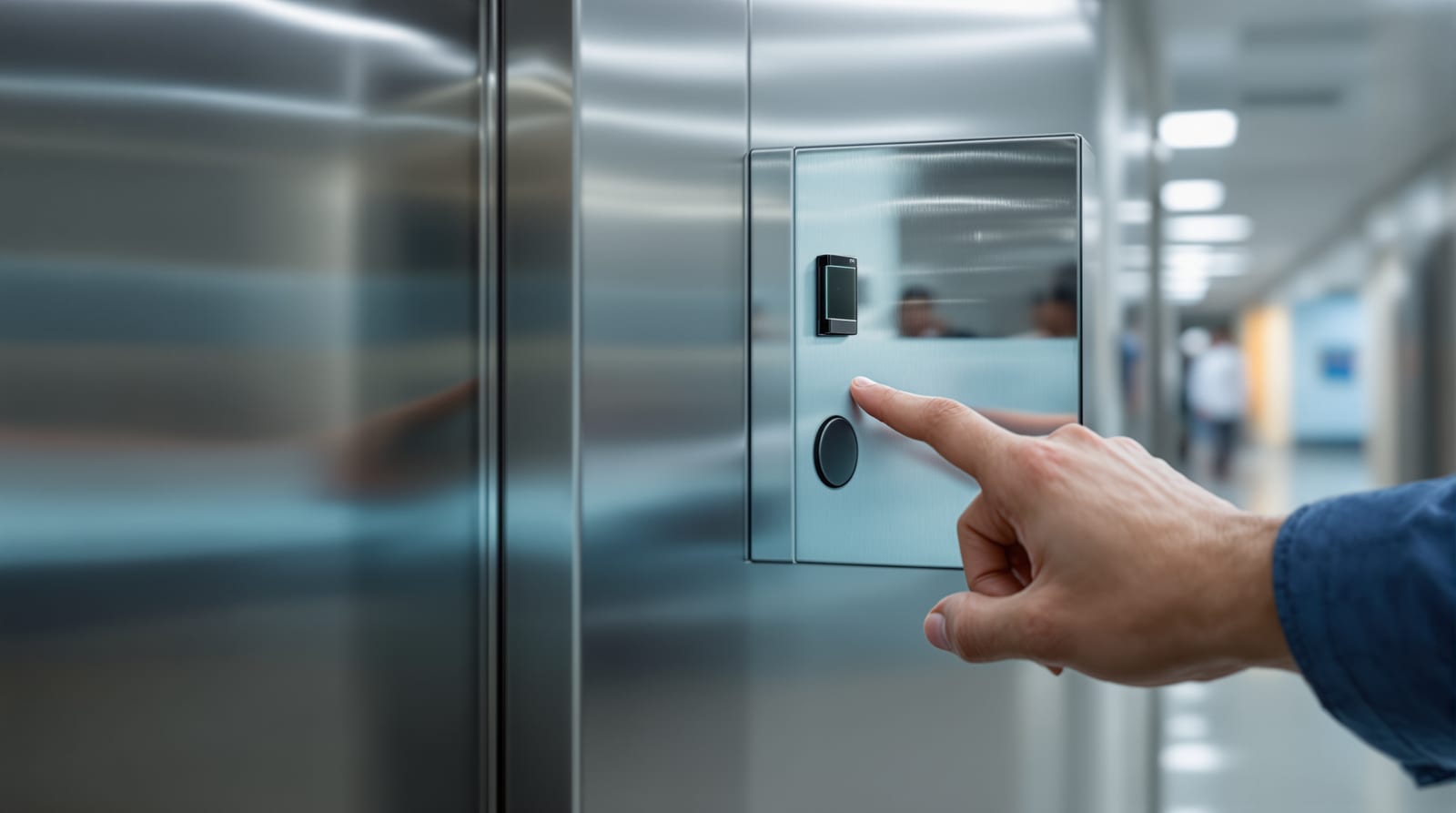
Push-Button Door Openers in India 2026: Wave & Plate Guide
Wall push-plates, touchless wave sensors, jamb switches and remote fobs that trigger a low-energy operator for hands-free, accessible doors.
Push-button door openers are the small, deliberate switches that tell a low-energy door operator to open: a stainless wall plate you press with a palm or elbow, a touchless wave sensor you sweep a hand near, a jamb switch by the frame, or a remote fob in a pocket. They are the human-friendly face of an automatic swing door operator, turning a powered door into something a wheelchair user, a nurse with full hands, or an elderly parent can open without pulling a heavy leaf. In India, where accessibility under the RPwD Act 2016 is moving from optional to expected, push-button openers are often the most cost-effective way to make an existing door usable by everyone. This guide walks through the types, mounting heights, wiring, costs and the safety rules that matter.
What a push-button door opener actually does
A push-button opener is an actuator — it does not move the door itself. It sends a low-voltage signal to a low-energy door operator, which then opens the leaf slowly and holds it open for a set dwell time (typically 5-10 seconds) before closing gently. The operator does the work; the button just triggers it.
This separation matters. A push-plate is cheap and dumb; the intelligence and the safety logic live in the operator and its door sensors. You can add a button to almost any low-energy operator, and you can have several buttons (inside, outside, at the reception desk) all triggering the same door. Because the operator opens slowly with low force, push-button doors are classed as knowing-act doors — the user knowingly triggers them — which means they need less guarding than a full-speed automatic, though presence safety is still strongly advised.
Types of push-button door openers
Push-button door openers come in four broad families, each suited to different reach, hygiene and access needs.
Wall push-plates (knowing-act actuators)
The classic round or square stainless plate, usually engraved with the wheelchair symbol and "Push to Open". Pressed by palm, elbow or even a hip, it is the most common accessibility actuator in Indian hospitals, banks and government buildings. Robust, weatherproof variants suit exterior use.
Touchless wave / IR sensors
A no-contact actuator: you wave a hand 50-150 mm in front of an infrared sensor and the door opens. These exploded in popularity post-2020 for hygiene reasons and are now standard in hospitals, labs, clean-rooms and washrooms. They pair naturally with touchless sensor doors and avoid the contamination of a shared surface. Range and field are adjustable to prevent false triggers from passers-by.
Jamb / frame switches and key switches
Small buttons mounted on the door jamb or an adjacent wall, sometimes key-operated so only staff can trigger the door (useful for controlled-access rooms). A key switch also doubles as an override.
Remote fobs and wireless transmitters
A handheld RF fob (like a car remote) or a wireless transmitter lets a user open the door from a distance — valuable for someone wheeling toward the door who cannot reach a plate in time. Wireless wall plates also exist, communicating to a receiver at the operator to avoid chasing cable through a finished wall.
| Actuator type | How triggered | Best for | Hygiene | Indicative installed cost (₹) |
|---|---|---|---|---|
| Wall push-plate (wired) | Palm/elbow press | General accessibility, entrances | Shared surface | 1,500-4,000 |
| Wave / touchless IR | Hand wave, no contact | Hospitals, labs, washrooms | Excellent | 2,500-7,000 |
| Jamb / key switch | Press or key turn | Staff-controlled rooms | Moderate | 2,000-6,000 |
| Remote fob / RF | Button on handheld | Mobility users, distance opening | N/A | 2,000-8,000 (kit) |
| Wireless wall plate | Press, RF to receiver | Retrofit, no chasing | Shared surface | 4,000-9,000 |
Prices are for the actuator and its wiring/receiver only, excluding the operator. Add 18% GST. The operator itself is the larger cost — see the automatic door cost guide.
Mounting heights and placement (RPwD)
Getting the height and position right is what makes a push-button opener genuinely accessible rather than a token gesture. The RPwD Act 2016 Harmonised Guidelines and accessible-design practice in India converge on the following as a rule of thumb.
| Parameter | Recommended | Notes |
|---|---|---|
| Plate centre height | 900-1100 mm from floor | Reachable seated or standing; ~1000 mm is a safe target |
| Distance from door swing | Beyond the leaf's arc | User must not be struck by the opening door |
| Set-back from inside corner | >=500 mm | Clear approach for a wheelchair |
| Plate size (accessibility) | >=100 mm dia / square | Large target for limited dexterity |
| Wave sensor height | 900-1100 mm | Same reach logic; adjustable field |
| Two plates (push/pull side) | Both sides of opening | One to enter, one to exit |
The single most common installation error is placing the plate within the door's swing, so the opening leaf knocks the user back. Always position it on the wall such that the door swings away from the person. Pair every push-button door with wheelchair-accessible door clear-width and threshold detailing so the whole approach works, not just the trigger.
How it wires together
Wired plates and switches run a two-core low-voltage cable back to the operator's actuator input — a simple dry contact, easy for an electrician to terminate. Wave sensors usually need a third core for power. Wireless plates and fobs talk to a small RF receiver wired to the same input, which is the practical choice when you do not want to chase cable through finished walls. See the door automation wiring guide for cable runs, and isolate mains before any work — a qualified electrician should make the 230V connection at the operator.
Power-cuts and the India reality
A push-button door is only as available as its operator's power. During an outage the operator typically defaults to a manual push-to-open mode, but the powered convenience — and the accessibility it provides — is gone unless there is battery or UPS backup. For any door that must stay accessible (a hospital ward entrance, a clinic), specify backup as covered in door access power backup. On an escape route, the door must allow free manual egress when dead.
Where push-button openers earn their keep
- Hospitals and clinics: wave sensors keep ward and theatre doors hands-free for staff carrying instruments or pushing trolleys, and cut surface contamination.
- Banks, government offices, malls: push-plates make main entrances usable by wheelchair users and parents with prams, supporting RPwD compliance.
- Homes with elderly or disabled residents: a low-energy operator plus a plate or fob turns a heavy main door into a one-touch door — far cheaper than a full sliding-door retrofit.
- Washrooms and accessible toilets: wave or large plate actuators avoid grappling with handles.
Buying and installation checklist
1. Confirm the operator supports an external actuator input (almost all low-energy units do).
2. Choose wired for new construction; wireless to retrofit without damaging walls.
3. For hygiene-critical spaces, choose touchless wave over a shared plate.
4. Set plate/sensor centre at ~1000 mm and clear of the door's swing arc.
5. Add a presence safety sensor — knowing-act reduces but does not eliminate the need.
6. Specify battery/UPS backup if the door must stay accessible in a power-cut.
7. Verify the door still permits free manual egress if it sits on an escape route (NBC 2016).
Estimate the full job — operator plus actuators — with the door automation cost calculator, and size the operator with the automatic door operator selector. For the broader picture, return to the complete door guide and the door automation pillar.
Frequently asked questions
Does a push-button opener move the door by itself?
No. The button is only an actuator that signals a low-energy operator, which does the actual opening. You need both; the button alone will not move a leaf.
What height should an accessibility push-plate be mounted at?
Around 900-1100 mm from the floor, centred near 1000 mm, so it is reachable both seated and standing — and always positioned clear of the door's swing so the opening leaf cannot strike the user. This follows RPwD Act 2016 Harmonised Guidelines practice.
Are touchless wave sensors better than push-plates?
For hygiene-critical places like hospitals and washrooms, yes — no shared surface to touch. Push-plates are cheaper, more robust outdoors, and need no power core. Many sites use plates at general entrances and wave sensors where contamination matters.
What happens to a push-button door during a power-cut?
Without backup, the powered opening stops and the operator usually reverts to manual push-to-open, so accessibility is lost. Specify a battery or UPS for doors that must stay accessible. On an escape route the door must always allow free manual egress, per NBC 2016.
Can I add a push-button opener to my existing automatic door?
Usually yes, if it has a low-energy operator with a spare actuator input. A wired plate or a wireless receiver connects to that input. A technician should confirm compatibility and make the connection with the mains isolated.
Export this guide
Related Guides — Deep-dive reading
Automatic Swing Door Operators: Retrofit Guide India 2026
How to retrofit a normal hinged door to open by itself — full-energy vs low-energy operators, activation, safety and cost for Indian buildings.
Home Doors & EntrancesLow-Energy Door Operators for Accessibility in India 2026
Gentle, push-activated automatic operators that open doors safely for wheelchair users and the elderly without full safety-sensor arrays.
Home Doors & EntrancesUniversal Design Doors for Indian Homes: Inclusive Doors That Work for Everyone (2026)
How to design and specify doors that serve children, the elderly, pregnant women, the injured and wheelchair users by default - generous width, lever handles, near-flush thresholds, low-force closing, contrast and good lighting - without your home ever looking medical.
Home Doors & EntrancesRelated Tools — Try Free
Access-Control Battery-Backup Calculator
Size the standby battery so an access system keeps running through a power cut, with an egress life-safety note.
Battery BackupAccessibility Compliance Calculator
Check a planned lift against the CPWD and RPwD accessible-lift benchmarks for a score.
Lift CheckerAccessible Door Checker
Check a door against wheelchair-accessibility guidance — clear width, threshold, handle and closer force per RPwD 2021.
Compliance Tool