
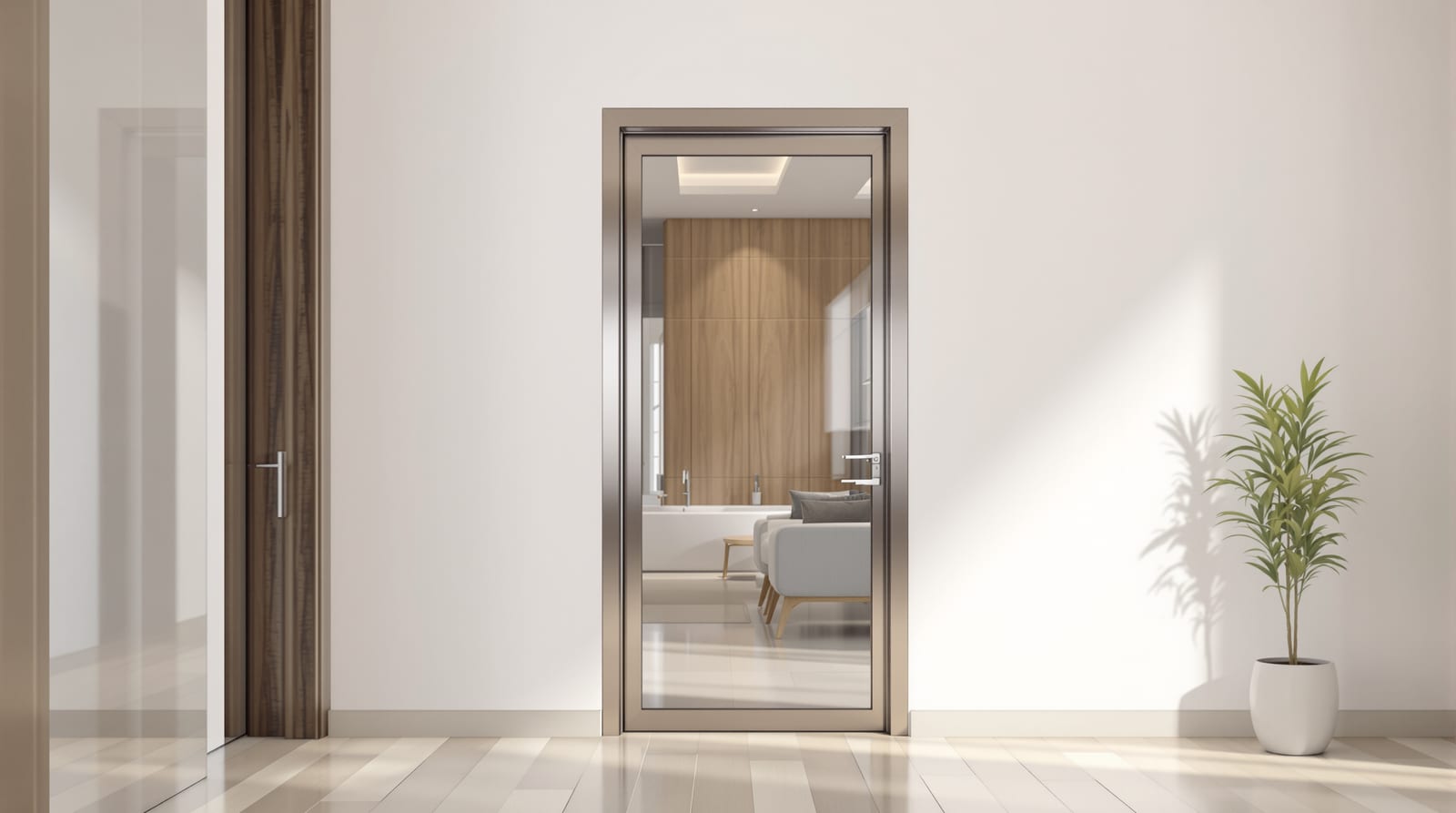
Aluminium Door Frames in India: Profiles & Cost (India 2026)
How anodised and powder-coated aluminium frames work for glass and aluminium doors — thermal break, slim sightlines and corrosion resistance.
Aluminium door frames are the workhorse of modern glass and aluminium doors in India — the slim, factory-finished profiles you see around sliding balcony doors, French-style glass doors, shopfronts and increasingly internal flush-door openings in apartments. Unlike a timber chowkhat that a carpenter cuts and joins on site, an aluminium frame is an extruded section (a hollow, multi-chamber profile) cut to length, joined at the corners and glazed or hung with the leaf. The appeal is honest: it does not warp, rot, attract termites or swell in the monsoon, it carries a baked-on finish that lasts years, and it can be drawn very slim so the glass — not the frame — does the talking. This guide explains the profiles, the anodised-versus-powder-coated finish choice, thermal break, where aluminium frames make sense, what they cost in 2026 and their honest trade-offs.
Why choose aluminium door frames
Aluminium sits between timber and uPVC in the frame family. Where a wooden door frame brings warmth and a WPC frame brings cheap waterproofing, aluminium brings strength-to-weight and slimness. A thin aluminium section can carry a heavy glass leaf or a wide sliding panel that a slender timber section never could, which is why almost every large glazed opening — balcony sliders, corner glass doors, terrace French doors — uses it.
The headline strengths:
- Corrosion resistance — the metal forms a natural oxide skin, and the anodising or powder-coat seals it further. This matters in coastal Mumbai, Chennai, Kochi and Goa where salt air rusts an unprotected steel door frame within a season.
- Slim sightlines — frame faces can be 40-60mm where a timber door frame profile needs 75-100mm, so you get more glass and a lighter look.
- Dimensional stability — no swelling, warping or shrinking with humidity, so gaps and reveals stay even all year. Pair this with correct door clearances and tolerances and the leaf keeps latching cleanly.
- Low maintenance — wipe-clean; no painting or polishing cycle like timber.
- Recyclability — aluminium is endlessly recyclable, a genuine sustainability tick.
The honest weaknesses: bare aluminium conducts heat and cold (it gets hot in summer, cold in winter, and can sweat/condense), it can dent, a plain mill finish looks utilitarian, and a quality system with a thermal break costs more than uPVC or basic timber.
Where aluminium frames are used
| Door type | Frame role | Typical setting |
|---|---|---|
| Sliding glass / balcony door | Track + jamb profiles carry rollers | Apartments, terraces |
| Aluminium glazed (French/casement) | Frame + glazing beads hold glass | Living rooms, balconies |
| Shopfront / commercial entrance | Heavy structural sections + closer | Offices, retail |
| Flush door (some) | Slim aluminium jamb in lieu of timber | Modern apartment internals |
| Folding / bi-fold glass | Hinged aluminium leaves + track | Patios, café fronts |
| Wet-area / bathroom door | Corrosion-proof jamb | Bathrooms (vs timber) |
For a typical Indian home, aluminium frames are most common on external glazed openings and increasingly on bathroom doors where damp would destroy timber. For a solid timber or flush leaf on an internal opening, many still prefer a timber chowkhat for the feel — but a slim aluminium jamb is a valid modern choice.
Profiles, finishes and thermal break
Anodised vs powder-coated
The two mainstream finishes behave differently and this is the single most important spec to get right.
| Feature | Anodised | Powder-coated |
|---|---|---|
| What it is | Electro-chemical oxide layer grown into the metal | Polyester paint baked onto the surface |
| Coating measure | Microns of anodic film (aim 15-25 micron) | Film thickness (aim 60-80 micron) |
| Colours | Metallics — silver, champagne, bronze, black | Any RAL colour, matt/gloss/textured |
| Wear behaviour | Very hard, scratch-resistant; ages gracefully | Can chip at edges if struck; touch-up needed |
| Coastal/UV | Excellent | Good (use a quality marine-grade powder) |
| Cost | Slightly higher | Slightly lower, more colour freedom |
As a rule of thumb: choose anodised for coastal, high-traffic or where you want a metallic finish; choose powder-coated when you want a specific colour to match joinery (deep matt black and bronze are popular). Insist on the coating thickness in writing — thin coatings are where cheap frames fail.
Thermal break
A thermal break is a polyamide (nylon) strip inserted between the inner and outer halves of the aluminium profile, so heat cannot bridge straight through the metal. In India's climate it does two useful things: it reduces heat gain in summer (helpful for AC bills) and it cuts condensation on the inner face in air-conditioned or hill-station rooms. A non-thermal-break ('plain') section is cheaper and fine for a dry, non-AC balcony; specify a thermal-break profile for AC living rooms, master bedrooms and any room you cool seriously. This pairs with good door seals and weatherstripping and a proper weather bar on external sills.
Anatomy of an aluminium frame
Key terms: the profile is the extruded hollow section; chambers are the internal voids (more chambers = stiffer, better insulated); the glazing channel/bead holds the glass; the EPDM gasket seals the leaf to the frame; rollers sit in the track on sliders. Aluminium frames are joined at corners by mechanical cleats/screws or welding, not the mortise-and-tenon joinery of timber.
Sizes, sections and cost (₹) 2026
Aluminium frames are priced by the running foot (rft) of profile plus glass, hardware and labour — or sometimes per square foot of the finished door. Sections are described by face width and wall thickness; thicker walls (1.5-2.0mm) are stronger and worth paying for on doors.
| Item | Indicative band (₹) | Notes |
|---|---|---|
| Plain mill-finish profile | 200-350 / rft | Cheapest; not recommended exposed |
| Anodised profile | 300-550 / rft | Specify 15-25 micron |
| Powder-coated profile | 280-500 / rft | Specify 60-80 micron film |
| Thermal-break profile | 550-1,100 / rft | Premium; for AC rooms |
| Full aluminium glazed door (frame+glass+fitting) | 550-1,400 / sq ft | Glass and hardware drive cost |
| Sliding balcony door system | 700-1,600 / sq ft | Track, rollers, mesh extra |
Add GST 18% on hardware and fabrication. Standard door openings follow the same frame sizes as timber — main 900-1200 × 2100mm, internal 750-825 × 2000-2100mm, bathroom 600-750mm wide — and the same rough opening rule applies: frame outer size plus roughly 10-12mm packing each side, over an RCC lintel.
For a like-for-like price comparison against timber, WPC and steel before you commit, run the door frame material selector and the door frame cost calculator.
Installing an aluminium frame
The sequence mirrors the general door frame installation flow but with metal-specific care:
1. Check the opening — measure width and height at three points, check diagonals for square and the jambs for plumb (see measuring for a door).
2. Set the frame plumb, level and square using packers/shims; do not force a true frame into a bowed opening.
3. Anchor with stainless or zinc-plated screws into rawl plugs / fasteners through the frame web into masonry — typically three fixings per jamb. Use a DPC/sealant separation where aluminium meets fresh cement, because wet cement (alkaline) can corrode bare aluminium — this 'bimetallic/cement contact' rule is the one most site teams forget.
4. Gap-fill with low-expansion PU foam or backer rod, not over-foamed (it can bow a slim section).
5. Seal the frame-to-wall junction with silicone outside/wet areas and acrylic caulk inside.
6. Glaze/hang the leaf, set rollers and anti-jump on sliders, check even reveals and smooth swing.
A skilled aluminium fabricator (not a general carpenter) should cut and corner-join the profiles; on-site fitting of a factory-made frame is straightforward but the cut/join must be square or the leaf will bind. For thresholds, aluminium suits a slim threshold strip with a brush or rubber seal, and it is the natural choice for a zero-threshold accessible door because the strip can be kept flush — remember the RPwD / Harmonised Guidelines limit of ≤12-13mm, bevelled if over 6mm, with a drainage channel on external flush sills.
Aluminium vs the alternatives
- vs uPVC — see the uPVC door frame guide: uPVC insulates better and costs less, but aluminium is far stronger and slimmer for big glass.
- vs steel — aluminium will not rust like a steel frame; steel is cheaper and more secure for fire/strong-room doors.
- vs timber/WPC — aluminium has no termite or rot risk, but lacks the warmth of wooden frames.
Weigh these against your opening size, climate and budget. For the full cross-material picture and the rest of the door system, see the complete door guide and the phase pillar on door frames.
Frequently asked questions
Are aluminium door frames good for coastal homes?
Yes — they are one of the best choices for Mumbai, Chennai, Kochi and Goa because aluminium does not rust like steel. Specify a quality anodised finish (15-25 micron) or marine-grade powder coat, use stainless fixings, and keep bare aluminium off fresh cement to avoid alkali corrosion.
What is a thermal break and do I need one?
A thermal break is a nylon strip between the inner and outer halves of the profile that stops heat conducting through the metal. Specify it for air-conditioned rooms and hill stations — it cuts heat gain and condensation. For a dry, non-AC balcony, a cheaper plain profile is acceptable.
Anodised or powder-coated — which lasts longer?
Both last years if specified properly. Anodised is harder and scratch-resistant and ages gracefully, ideal coastal/high-traffic. Powder-coating offers any colour (matt black, bronze are popular) but can chip at edges. Insist on the coating thickness in writing — thin coatings are where cheap frames fail.
How much does an aluminium door frame cost in India?
As a rule of thumb in 2026: anodised or powder-coated profile ₹280-550 per running foot; thermal-break profile ₹550-1,100/rft; a finished aluminium glazed door ₹550-1,400 per sq ft including glass and fitting, plus 18% GST. Glass and hardware drive most of the cost.
Can aluminium frames be used for bathroom and internal doors?
Yes. Aluminium is corrosion-proof, making it excellent for bathroom jambs where timber would rot. Slim aluminium jambs are increasingly used on modern apartment internal flush doors too, though many homeowners still prefer a timber chowkhat indoors for warmth.
Do aluminium frames conduct heat and sweat?
Bare aluminium conducts heat and can condense (sweat) on the cold inner face in AC or cold-climate rooms. A thermal-break profile largely solves this. Good EPDM gaskets and weatherstripping also help control air leakage and condensation.
Export this guide
Related Guides — Deep-dive reading
Aluminium Doors in India: Profiles, Glazing, Cost & uPVC vs Steel (2026)
Framed glazed aluminium doors — sliding, openable and French-style — for balconies, utility and modern facades: powder-coat vs anodised vs wood-finish profiles, IS 733/1285 sections, thermal-break options and ₹/sq ft costs.
Home Doors & EntrancesAluminium Door Cost in India 2026: ₹/Sq Ft by Profile Grade, Finish, Glazing & Hardware
A focused 2026 cost guide for aluminium doors in India — ₹ per sq ft of opening by profile grade (economy domal vs branded system sections vs thermal-break), powder-coat vs anodised vs wood-finish surcharge, glazing, rollers/locks/handles, sliding vs openable, fitting and GST, with a worked balcony/utility example.
Home Doors & EntrancesZero Threshold Doors in India: Level Access (India 2026)
How to detail a flush, step-free door threshold for wheelchairs and ageing-in-place while still keeping monsoon water out.
Home Doors & EntrancesRelated Tools — Try Free
Monsoon-Readiness Checklist
Pre-rain home audit across 9 categories — terrace, drains, waterproofing, electrical, HVAC, pest, vehicles, documents.
Seasonal AuditDoor Frame Cost Calculator
Estimate door frame (chowkat) cost from the opening size and frame material — sal, teak, WPC, steel, RCC or granite.
Door CalculatorBathroom Sealant Calculator
How many tubes of silicone sealant a bathroom needs and the cost — by joints to seal, lengths and bead size, with an anti-fungal note.
Bathroom Calculator