
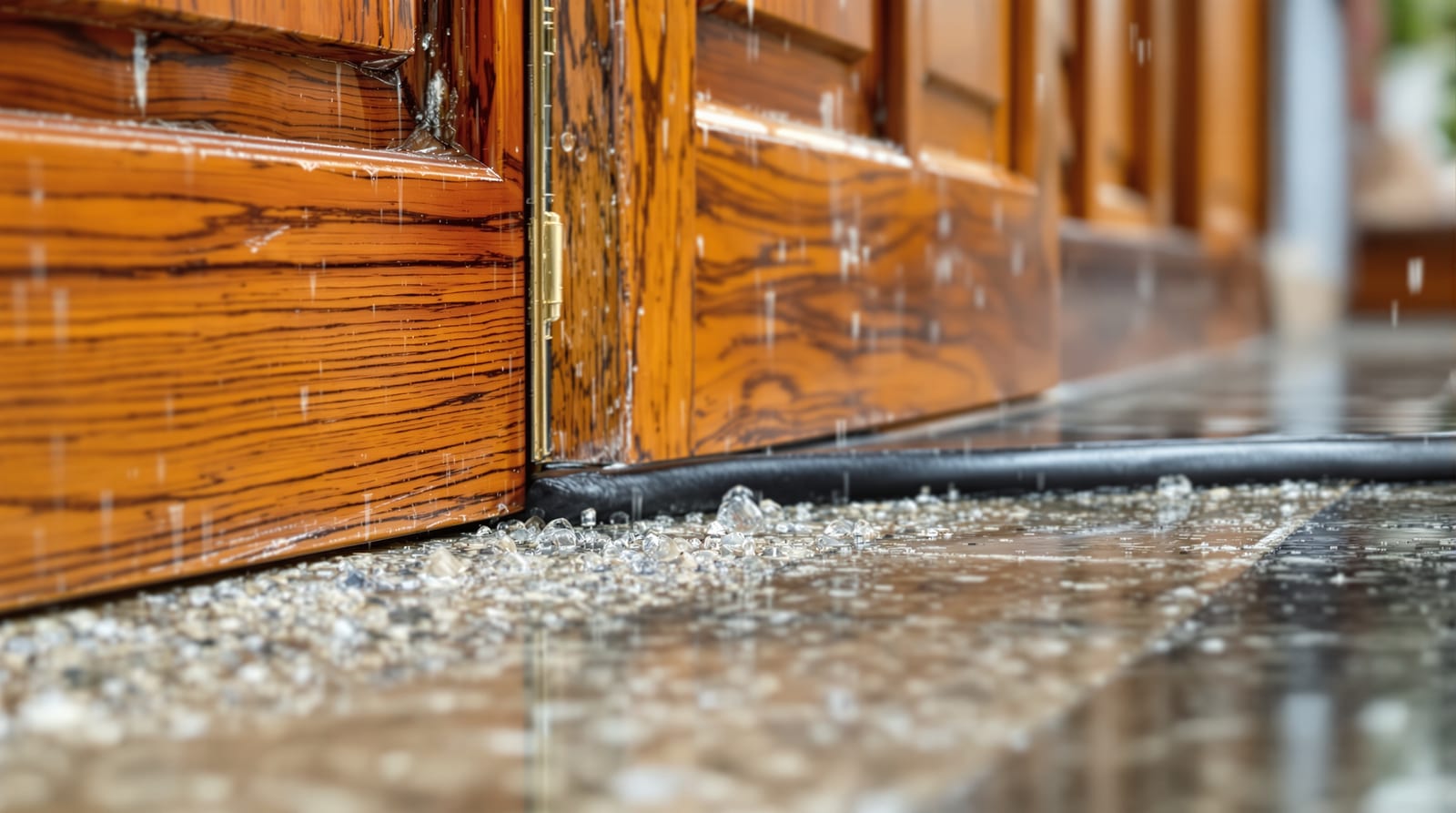
Door Weather Bar & Drip Bar Fitting Guide (India 2026)
How a weather bar at the leaf base and a drip groove under the sill throw monsoon rain clear — the deflector-plus-threshold-seal combo that stops water ingress on external doors.
The door weather bar is the small angled deflector at the base of an external door leaf that does an outsized job: it catches rain running down the face of the shutter and throws it clear of the threshold before it can creep under the door. Pair it with a sloped sill, a drip groove (throating) underneath, and a threshold seal at the bottom of the leaf, and you have the complete water-ingress defence that an Indian external door needs to survive a monsoon. Skip it and you get the familiar puddle inside the door, a swollen leaf bottom, a rotting frame foot and stained flooring within a season or two. This guide explains how the door weather bar and drip bar work together, the materials and sizes used in India, how the combo is fitted, and the accessibility and threshold realities you have to balance against it.
What a weather bar is — and what a drip bar is
The two terms are often used loosely, so it helps to separate them.
A weather bar (also called a weatherbar, rain bar or water bar) is a shaped strip — usually aluminium, sometimes timber or brass — fixed across the outside face of the leaf near the bottom, projecting forward and angled down. Rain running down the door face hits the bar and is shed forward, dripping clear of the threshold instead of tracking down to the gap under the door. On some doors the weather bar is fixed instead to the frame sill so the closed leaf sits behind it; both arrangements work, and the choice depends on swing direction.
A drip bar or drip groove (the trade calls it throating) is a continuous groove cut into the underside of a projecting sill or threshold nosing. Water creeping back along the underside of the sill — by surface tension — reaches the groove, can travel no further, and drips off. Without throating, water wraps right round the sill nosing and runs back to the wall. A stone or aluminium sill that projects past the wall face should always carry a drip groove.
Together the weather bar (sheds water off the leaf face) and the drip groove (stops water wrapping under the sill) form the two halves of the same job: keeping the threshold line dry. The third piece is a threshold seal — a brush, fin or rubber gasket at the very bottom of the leaf — that closes the residual gap against wind-driven rain and draughts.
Why Indian external doors need all three
A short monsoon cloudburst can drive water horizontally against a door for hours. Three failure paths let it inside:
- Down the leaf face to the bottom gap — stopped by the weather bar.
- Back under a projecting sill to the wall — stopped by the drip groove.
- Through the gap under the closed leaf — stopped by the threshold seal and a sloped sill that drains outward.
A main door or balcony door with none of these will wick water in every heavy shower. In India the damage compounds fast: the leaf bottom rail swells and the veneer or polish lifts; an untreated timber frame foot rots where it meets a wet floor; termites find the softened timber; and the floor inside stains. The fix is cheap to design in and expensive to retrofit, so it belongs in the original sill and leaf detail.
The weather-bar and threshold-seal combo — section
Materials and types
The weather bar and the threshold pieces come in a handful of standard materials, each suited to a different door and budget.
Weather bar / drip bar materials
| Type | Where it fits | Material | Indicative ₹ band | Notes |
|---|---|---|---|---|
| Aluminium angled weather bar | Outside face, leaf bottom | Anodised / powder-coated aluminium | ₹120-350 per door | Most common; rust-proof, screws on |
| Brass / bronze weather bar | Premium timber main doors | Brass | ₹400-900 per door | Decorative, durable, polishes |
| Timber water bar | Traditional teak doors | Seasoned hardwood | ₹150-400 per door | Needs polish/oil; can swell |
| Self-adhesive rain deflector | Retrofit, light doors | uPVC / rubber-faced | ₹150-300 per door | Quick fix, shorter life |
| Finned aluminium threshold (with seal) | Frame sill, combo unit | Aluminium + EPDM/brush | ₹350-1,200 per door | Bar + seal + sill in one extrusion |
Threshold seal at the leaf bottom
| Seal type | Best for | Gap suited | Indicative ₹ band |
|---|---|---|---|
| Brush / nylon strip (surface or drop) | Most external doors, dust + rain | 6-12mm | ₹150-500 per door |
| EPDM / rubber fin (automatic drop seal) | Tight weatherproofing, acoustic | 4-10mm | ₹600-2,000 per door |
| Silicone fin strip on threshold | Aluminium / uPVC doors | factory profile | included in unit |
| Compression bottom gasket | Out-swing doors against a stop | 3-8mm | ₹300-900 per door |
For a fuller treatment of seals and weatherstripping across the whole door, see door seals and weatherstripping.
Fitting the combo — sequence and tips
The pieces go on in a set order, and the leaf undercut has to be set to suit the seal.
1. Set the sill to drain. The external sill — usually granite in India — must slope outward (a 1:15 to 1:20 fall) so standing water runs away, not back to the wall. Bed it in sealant on a DPC.
2. Cut the drip groove. If the sill or threshold nosing projects past the wall face, ensure a continuous throating groove (~6-10mm wide, ~5mm deep, set in ~15-20mm from the front edge) runs the full length on the underside. On a granite sill the fabricator grooves it; on an aluminium sill the profile carries it.
3. Set the leaf undercut. Leave the right gap under the leaf for the chosen seal — typically 6-12mm over the finished sill. A surface brush wants less; a drop seal wants the gap it is rated for. See door undercut clearance.
4. Fix the threshold seal to the bottom rail or the sill, mortising a drop seal into the leaf bottom if used.
5. Fit the weather bar to the outside face of the leaf (or the frame sill) so it sits just above the sill when closed, angled to throw water forward. Drill, screw, and bed the back in a thin line of silicone so water can't get behind the bar.
6. Seal the junctions — silicone the sill-to-wall and frame-to-wall joints externally so the whole base is watertight.
Get the handing and swing right first, because it decides whether the weather bar sits on the leaf or the frame and which way it deflects — an out-swing door sheds water more naturally than an in-swing one. See door handing and swing.
Weather bar vs accessibility — the trade-off
A raised weather bar and a stepped sill keep water out, but they also create a trip and a barrier to wheelchairs and prams. The RPwD Act 2016 and the Harmonised Guidelines call for accessible thresholds ≤12-13mm, bevelled if over 6mm, and preferably flush. You can have both: use a low-profile finned aluminium threshold that keeps the height within the accessible limit, pair it with a drainage channel and an outward slope just outside the door, and let a drop-down brush seal close the gap only when the door is shut. For a fully level entrance, see zero-threshold doors and waterproofing door thresholds, which cover draining a flush threshold properly. In India, a modestly raised stone umbara at the main door is also traditional and considered auspicious in Vastu — see main door threshold Vastu — so balance custom, weatherproofing and access for your household.
Where the weather bar fits in the bigger picture
The weather bar is one detail in the door thresholds and door sill design layer, which sits inside the complete door guide. To choose the right threshold for your situation, try the door threshold selector; to check whether a flush, accessible threshold can be drained at your entrance, use the zero-threshold feasibility checker. For external timber doors, protect the frame foot too — see door frame damp-proofing.
Frequently asked questions
What is the difference between a weather bar and a drip bar?
A weather bar is the angled strip on the outside face of the leaf near the bottom that throws rain running down the door clear of the threshold. A drip bar — really a drip groove or throating — is a groove cut into the underside of a projecting sill that stops water wrapping back under the sill to the wall. They tackle two different water paths; an external door wants both, plus a threshold seal.
Will a weather bar alone stop monsoon water coming in?
Not on its own. It sheds water off the leaf face, but wind-driven rain still reaches the gap under the door and water can wrap under the sill. You need the combo: weather bar, a sloped sill with a drip groove, and a threshold seal at the bottom of the leaf. Together they keep the threshold line dry through a heavy shower.
Can I retrofit a weather bar to an existing door?
Yes. A surface-mounted aluminium weather bar screws onto the outside face of the leaf in minutes, and a brush or drop threshold seal can be added at the bottom. The harder part to retrofit is a drip groove in an existing sill and a proper outward slope — if your sill drains back toward the wall, that is the real fix.
How high should the weather bar sit above the sill?
It should sit just above the closed sill line — close enough to deflect water onto the sill but with enough clearance that the leaf still swings freely and any threshold seal can do its job. On an in-swing door the bar usually goes on the frame sill; on an out-swing door it goes on the leaf face. Getting the swing and undercut right first decides the exact height.
Does a raised weather bar break accessibility rules?
A tall stepped threshold can. The RPwD Act and Harmonised Guidelines want thresholds at or below ~12mm, bevelled or flush. Use a low-profile finned aluminium threshold within that limit, add an external drainage channel and outward slope, and let a drop-down seal close the gap only when shut — that keeps water out while staying accessible.
What material is best for a weather bar in India?
Anodised or powder-coated aluminium is the practical default — rust-proof, cheap and easy to fix. Brass suits premium teak main doors and looks the part. Untreated timber water bars can swell and need oiling, so they are best on traditional doors that are well maintained. Whatever the bar, bed its back in silicone so water can't track behind it.
Export this guide
Related Guides — Deep-dive reading
Door Threshold Standards for Indian Homes: Sill, Weather Bar & Accessibility (2026)
What the strip under your door actually does - water, dust, draft and insect barrier, level transition and trip-safe accessibility - with the right material, the 12 mm accessibility limit, weather-bar and drip-groove detailing for external doors, and the wet-bathroom threshold.
Home Doors & EntrancesZero Threshold Doors in India: Level Access (India 2026)
How to detail a flush, step-free door threshold for wheelchairs and ageing-in-place while still keeping monsoon water out.
Home Doors & EntrancesWaterproofing Door Thresholds in India (India 2026)
Stopping water tracking under bathroom and external door frames with a raised kerb, granite saddle and a membrane that turns up into the threshold.
Home Doors & EntrancesRelated Tools — Try Free
Door Cost Calculator
Estimate the all-in cost of a door — leaf, frame, hardware, fitting and GST — by type, material and size.
Door CalculatorDoor Material Comparison Tool
Compare 2–4 door materials on cost, durability, maintenance, security and moisture resistance.
Comparison ToolMonsoon-Readiness Checklist
Pre-rain home audit across 9 categories — terrace, drains, waterproofing, electrical, HVAC, pest, vehicles, documents.
Seasonal Audit