
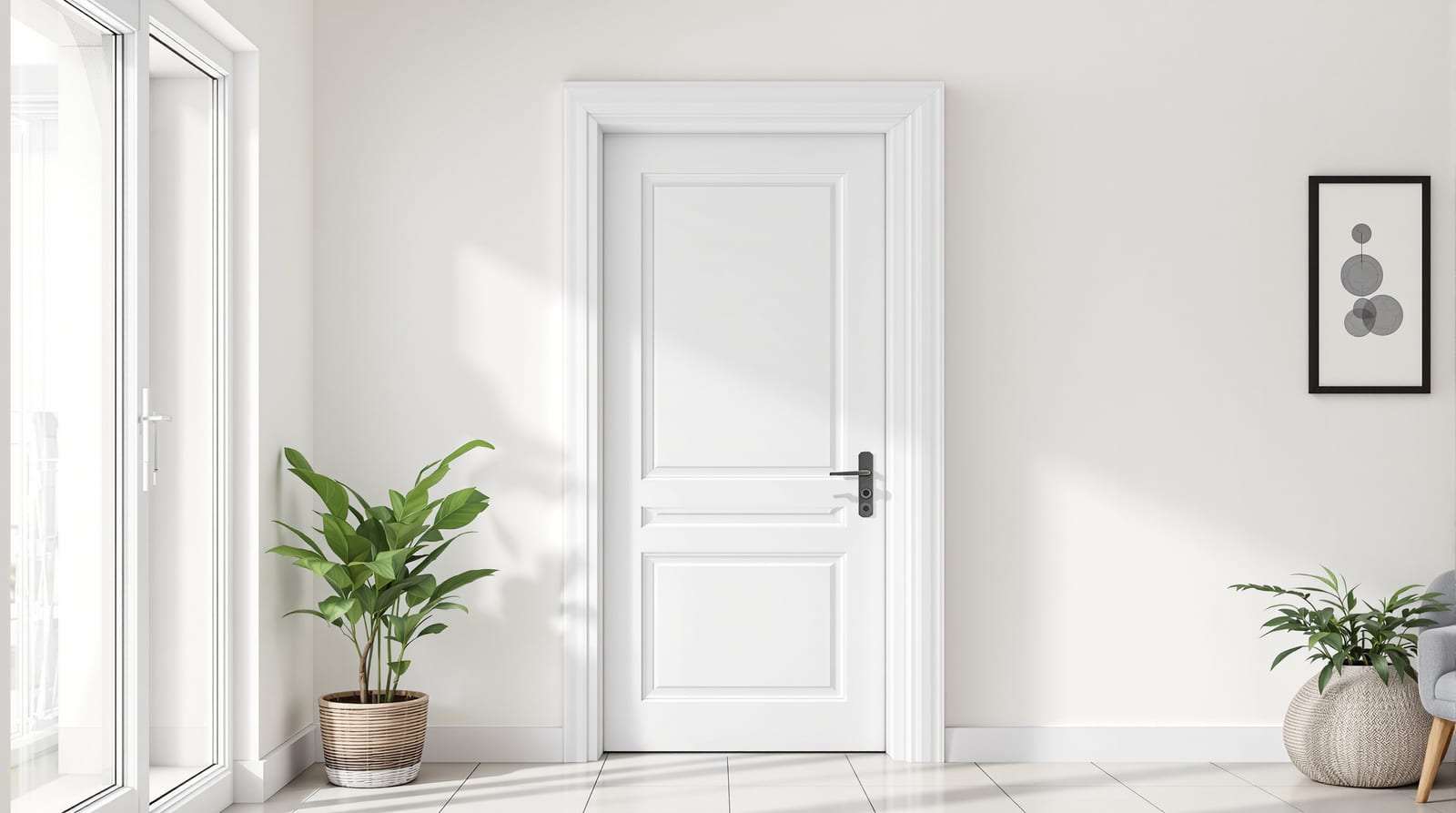
uPVC Door Frames in India: Buyer's Guide (India 2026)
How multi-chamber, steel-reinforced uPVC chowkhats handle India's monsoon, coast and termites — anatomy, sizes, cost bands and fitting.
uPVC door frames are increasingly the default choice wherever water, salt air or termites defeat timber — bathrooms, coastal homes, balconies and the rain-lashed external openings of a monsoon climate. Unlike a solid timber chowkhat, a uPVC door frame is a hollow multi-chamber extruded profile, stiffened with a galvanised-steel reinforcement inside its main chamber, with corners welded into a single sealed loop and an EPDM rubber gasket running in the rebate. The result is a frame that does not rot, swell, warp, corrode or feed termites, and that carries its own weather-seal — a genuinely low-maintenance answer to the conditions that punish ordinary frames across most of India.
This guide explains how the profile is built, what sizes and sections to specify, indicative ₹ cost bands, where uPVC genuinely beats timber and WPC, and how the frame goes into the wall. For the broader picture, see the complete door guide and the phase pillar on door frames.
What a uPVC door frame actually is
"uPVC" is unplasticised polyvinyl chloride — a rigid, weather-stable plastic, the same family used for white window frames. A uPVC door frame is not a solid plank; it is a precision-extruded hollow profile with several internal walls dividing it into chambers (typically 2 to 5). Those chambers do three jobs: they trap still air (which improves thermal and acoustic performance), they create a drainage/pressure-equalisation path so wind-driven rain is shed outward, and the largest central chamber houses a U- or box-section galvanised steel insert that gives the frame its real stiffness. uPVC on its own is too flexible for a door that gets slammed and leaned on — the steel is what stops the jamb bowing and keeps screws holding.
Anatomy of the profile
The frame still has the classic chowkhat members — a head (top), two jambs/posts (verticals) and, for external and wet-area openings, a sill or threshold. The recess the leaf shuts into is the rebate, and on a good external profile there are usually two gasket lines: an EPDM bubble-seal on the rebate face and a wiper or fin near the leaf edge, so the door closes onto rubber, not bare plastic. Corners are heat-welded (the profile ends are fused) rather than mortise-and-tenoned like timber, giving a continuous waterproof joint with no end-grain to soak up moisture.
uPVC vs timber, WPC and the alternatives
uPVC sits in a crowded frame market. The honest position: it is outstanding for wet, coastal and weather-exposed openings, but it is not the cheapest, and for a dry internal teak-finish doorway a timber or WPC frame is usually the better value. The table below sets the realistic trade-offs.
| Frame type | Water/rot | Termite | Stiffness | Where it wins | Indicative ₹ |
|---|---|---|---|---|---|
| uPVC (multi-chamber, steel-reinforced) | Excellent | Immune | Good (via steel) | Bathrooms, coast, external, monsoon | Frame for a standard opening, see below |
| Seasoned hardwood / teak | Poor unless sealed | Vulnerable | Excellent | Dry internal, premium look | ₹250-1,200/rft |
| WPC | Very good | Immune | Moderate | Bathrooms, mid-range wet areas | ₹180-400/rft |
| Aluminium | Excellent | Immune | Excellent | Glass/sliding, large external | Profile-priced |
| RCC / precast cement | Excellent | Immune | Brittle | Budget wet areas | ₹600-1,500/frame |
Against WPC, uPVC's edge is the integral weatherseal and welded watertight corners, which matter most on external doors; WPC is cheaper and takes screws more like timber. Against aluminium, uPVC insulates far better (aluminium conducts heat) and is quieter, but aluminium is stiffer for very large openings. See the side-by-side detail in WPC door frames and the full overview in door frame materials.
Coastal, monsoon and bathroom suitability
This is where uPVC earns its premium. On the coast, salt-laden air corrodes mild-steel frames and accelerates timber decay; uPVC is chemically inert to salt and the steel reinforcement is fully enclosed and galvanised, so it never sees the air. In the monsoon, the multi-chamber design drains and pressure-equalises — water that gets past the outer line is shed back out rather than driven inward, and the EPDM gasket keeps the closed door sealed against wind-driven rain. In bathrooms, uPVC simply does not absorb water, so there is no swelling at the foot of the jamb, the classic failure point of an untreated timber frame standing on a wet floor.
Even so, fit it correctly. A uPVC frame base should still sit on a DPC and, in wet areas, the threshold must integrate with the waterproofing membrane and slope away — see waterproofing door thresholds. For external sills, throating and a weather bar still apply: read door weather bar.
Thermal and acoustic benefit
The trapped air in the chambers and the rubber gaskets give uPVC frames a real, if modest, performance bonus over a bare metal or single-skin frame. Thermally, the chambers slow heat transfer — useful on a sun-baked western external door where an aluminium frame would conduct heat straight in. Acoustically, the gasket-sealed gap kills the whistling draught-line that a loose timber frame leaves, which cuts both noise and dust. The benefit is largest when the frame is paired with a sealed leaf and a threshold seal; an open undercut undoes much of it. uPVC is not a substitute for an acoustic door, but it removes the easy leakage paths.
Sizes, profiles and what to specify
uPVC frames suit standard Indian door openings. Specify the leaf size and let the profile depth match the wall, then add the packing gap. Common nominal sizes:
| Opening | Leaf W x H (mm) | Typical use |
|---|---|---|
| Main door | 900-1000 x 2100 | Entry (less common in uPVC; usually a uPVC door system) |
| Internal | 750-825 x 2000-2100 | Bedroom, study |
| Bathroom | 600-750 x 1980-2100 | Wet area — uPVC's sweet spot |
| Balcony / utility | 750-900 x 2100 | External, monsoon-exposed |
When ordering, check three things: the chamber count (more chambers = better sealing/insulation; 3+ for external), that there is a steel reinforcement in the lock and hinge jambs (ask to see the section — a hollow frame with no steel will bow), and the gasket (EPDM lasts; cheap PVC seals harden and crack). Profiles come in white as standard, with laminated woodgrain finishes available to match the leaf. The structural opening is the frame outer size plus roughly 10-12mm packing each side — size it with the door rough opening calculator, and check standard leaf sizes against door frame sizes.
There is no single dedicated Indian standard for uPVC door frames; specify steel-reinforced multi-chamber profiles to the maker's section drawing, and read across from IS 4021 (timber frames) and NBC 2016 for minimum opening widths and egress. For wheelchair access keep the threshold ≤12-13mm (bevelled if over 6mm, ideally flush with a drainage channel) per the RPwD Harmonised Guidelines.
Cost bands (India 2026, indicative)
uPVC frames are usually quoted per frame for a standard opening, fitted, because the profile and steel come as a system rather than loose timber by the foot. As a rule of thumb:
| Item | Indicative ₹ band | Note |
|---|---|---|
| uPVC frame, internal/bathroom standard opening (supply) | ₹2,500-6,000 | Profile + steel + gaskets; size-dependent |
| uPVC frame, external/balcony with double seal | ₹4,000-9,000 | Heavier section, more chambers |
| Woodgrain laminated finish (extra) | +15-30% | Over plain white |
| Fitting / installation labour | ₹600-1,500 per frame | Plumb, fix, foam, seal |
| Gap-fill PU foam + sealant | ₹150-400 | One 750ml can ≈ 2-3 perimeters |
Add GST 18% on the hardware/profile. uPVC costs more than WPC and basic timber up front, but for a coastal or bathroom door the saved replacements over a decade usually justify it. Cross-check with door frame cost and the door frame cost calculator, and pick between materials with the door frame material selector.
Fitting a uPVC frame
The sequence mirrors any frame, with two differences: do not over-tighten fixings (you can crush the chamber — fix through the steel-reinforced jamb, with packers behind the hinge and lock points so the load goes to the steel, not the plastic), and use low-expansion PU foam, not cement mortar, to fill the gap — high-expansion foam can bow a hollow profile. Set the frame plumb, level and square with wedges, screw through the steel into the masonry with frame fasteners, foam the perimeter, trim the foam, then seal the frame-wall junction with silicone externally (paintable acrylic caulk is fine internally). For the general method see door frame installation, and check even reveals with the door clearance checker.
Pros and cons at a glance
Pros: rot-proof, termite-proof, salt/corrosion-proof, integral weatherseal, low maintenance (just wipe), good thermal/acoustic sealing, dimensionally stable, no painting. Cons: dearer than WPC/basic timber, the look is plastic-white unless laminated, quality varies wildly (insist on steel + EPDM), not ideal for very heavy security main doors on its own, and a poorly welded corner or thin section is a weak point.
Frequently asked questions
Are uPVC door frames good for bathrooms in India?
Yes — bathrooms are their strongest case. uPVC does not absorb water, rot or feed termites, so there is no swelling at the foot of the jamb that ruins untreated timber frames. Still sit the frame on a DPC and integrate the threshold with the floor waterproofing.
Do uPVC door frames need steel reinforcement?
For a door, yes. uPVC alone is too flexible — the galvanised-steel insert in the central chamber gives the frame its stiffness, stops the jamb bowing, and holds screws at the hinge and lock. A hollow profile with no steel will flex and the leaf will not latch reliably. Always ask to see the section.
How much does a uPVC door frame cost?
As a rule of thumb, expect roughly ₹2,500-6,000 for a standard internal or bathroom frame (supply) and ₹4,000-9,000 for a heavier external/balcony profile, plus ₹600-1,500 fitting and 18% GST. Woodgrain laminate adds 15-30%. Prices vary by size, chamber count and brand.
uPVC or WPC frame — which should I choose?
For external and weather-exposed doors, uPVC's welded watertight corners and integral EPDM weatherseal give it the edge. For a budget bathroom or mid-range wet area, WPC is cheaper and screws more like timber. Both are rot- and termite-proof, so it often comes down to exposure and budget.
Can a uPVC frame be used for a main entrance door?
It can, but uPVC frames are usually specified as part of a full uPVC door system rather than carrying a heavy timber or metal security leaf alone. For a high-security main door, a steel or hardwood frame is more common; use uPVC mainly for internal, bathroom, balcony and utility openings.
How are uPVC frame corners joined?
The profile ends are heat-welded — fused into a single continuous loop — rather than mortise-and-tenoned like timber. This leaves no end-grain to absorb water and gives a waterproof corner, which is a key reason uPVC handles monsoon and coastal exposure so well.
Export this guide
Related Guides — Deep-dive reading
Zero Threshold Doors in India: Level Access (India 2026)
How to detail a flush, step-free door threshold for wheelchairs and ageing-in-place while still keeping monsoon water out.
Home Doors & EntrancesuPVC Doors for Indian Homes: Profiles, Cost, Bathrooms & Buying Guide
Why uPVC wins in bathrooms, utilities, balconies and coastal homes - profiles and steel reinforcement, waterproof and termite-proof performance, multipoint locks, glazing options and 2026 ₹ costs, plus how it compares with WPC and aluminium.
Home Doors & EntrancesDoor Frame Rebate Explained: Depth, Width & Seal (India 2026)
What the rebate (check) in a chowkhat actually is, how deep and wide it should be, and why it decides whether your door draught-proofs, sound-proofs and locks securely.
Home Doors & EntrancesRelated Tools — Try Free
Window Maintenance Cost Calculator
Estimate annual window upkeep by frame material — yearly, per-window and 5-year cost.
Window CalculatorWindow Cost Calculator
Estimate window price plus installation by type, frame material, size, glass and quantity.
Window CalculatorBathroom Door Material Selector
Get the best wet-area door material — WPC, FRP, PVC, marine ply or aluminium — ranked for your bathroom or utility.
Material Selector