
What Is Landscape Architecture? A Plain-English Guide for India
From the Mughal charbagh to ISOLA-era practice — what landscape architects actually design, and why it matters now.
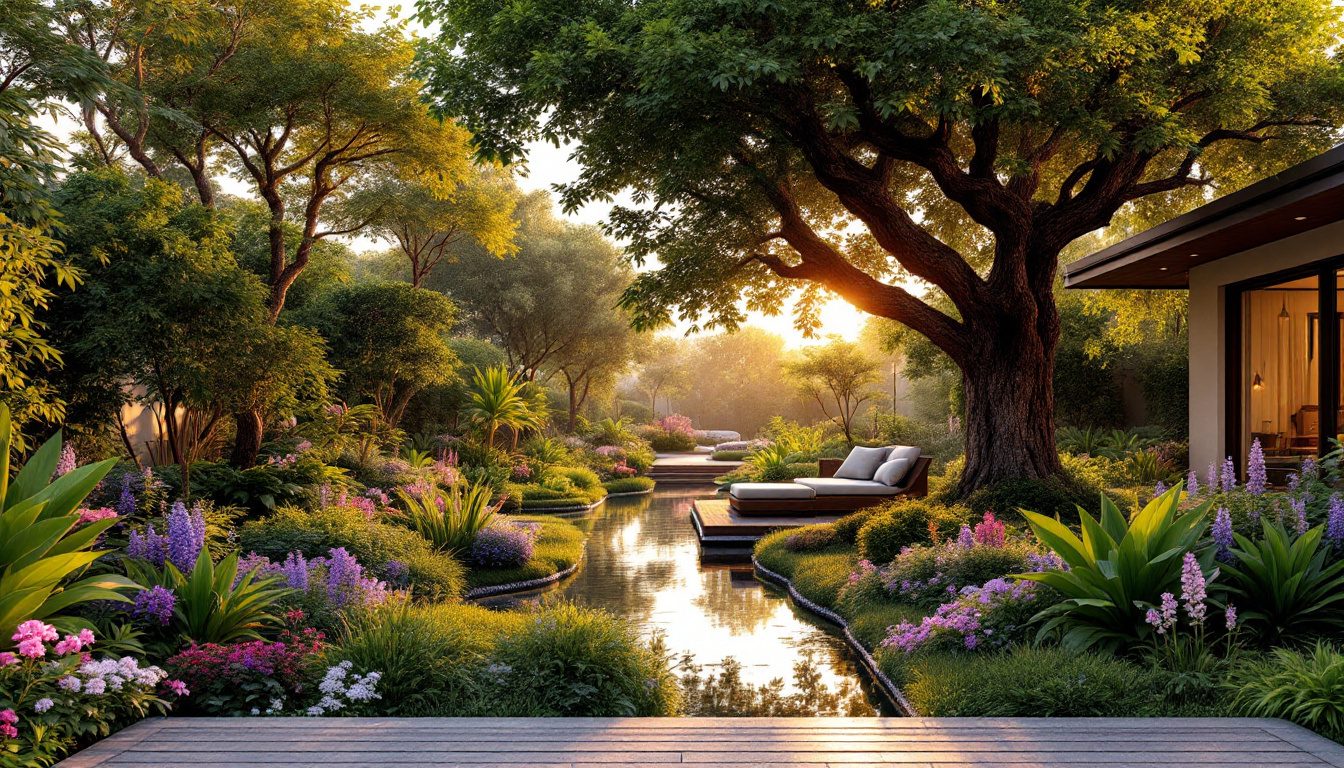
Stand in a Mughal garden at dawn — Nishat Bagh on the shoulder of the Dal Lake, or the long water-channel at Pinjore — and you are standing inside a designed landscape that is four centuries old and still works. The water still cools the air. The terraces still pull your eye up the hillside. The plane trees still throw shade exactly where a tired walker wants it. None of this is accident. Someone chose the slope, the axis, the species, the sound of the water, and the precise moment the view opens. That someone was doing landscape architecture, even though the phrase had not been invented yet.
Most Indians meet the word "landscape" as a noun — the scenery out of a train window. But landscape architecture is a verb. It is the deliberate shaping of outdoor space so that land, water, plants, climate and people fit together and stay healthy over decades. It sits quietly behind the parks your children play in, the campus you studied on, the riverfront you walk on a Sunday, and the cool green courtyard that makes a hot-city home bearable.
Landscape architecture is the design of outdoor environments at every scale — from a single courtyard to an entire river basin — where living systems (soil, water, plants, climate) are the primary material and human well-being is the goal. It is not gardening, not horticulture, and not a softer version of architecture: it is a distinct, licensable design profession that treats the ground itself, and everything growing on it, as the thing being designed. This guide is the plain-English introduction for homeowners and the curious. If you want it specifically as a career, read our companion guide on landscape architecture in India; if you want to meet the people who shaped the field, visit the landscape masters.
What landscape architecture actually is (and isn't)
The simplest working definition comes from the global professional body, the International Federation of Landscape Architects (IFLA): landscape architecture is the design of outdoor and public spaces to achieve environmental, social and aesthetic outcomes. In India the discipline is represented by ISOLA — the Indian Society of Landscape Architects, founded in 1989, which defines the landscape architect as a professional trained to plan, design and manage the built and natural environment together.
The key word is together. An architect designs a building and stops at the wall. A horticulturist grows a plant beautifully. A gardener maintains what exists. The landscape architect designs the relationships — how the building meets the ground, how rainwater leaves the site without flooding the neighbour, how a row of trees lowers the temperature on a west wall by several degrees, how a path makes you slow down before a temple. The material is alive and seasonal, so the design must work not on opening day but across twenty monsoons.
It helps to say plainly what landscape architecture is not. It is not decoration added at the end ("let's get some plants in"). It is not the same as a nursery selling you saplings. It is not interior planting. And it is not the lawn — in fact a good Indian landscape architect today will often argue against the thirsty lawn, as our guide on climate-responsive landscape design explains.
| Question the public asks | Short answer |
|---|---|
| Is it just gardening? | No. Gardening maintains; landscape architecture designs and plans the whole site system. |
| Is it the same as horticulture? | No. Horticulture is the science of growing plants; LA uses that science but designs space. |
| Is it part of architecture? | Related but distinct — a separate degree, separate body (ISOLA), separate licence path. |
| Do I need it for a small home? | Often yes for the brief and the bones; a nursery can plant once the design is set. |
| Is it expensive? | Fees scale with project size — see our landscape cost guide. |
The scope: from a courtyard to a river basin
The single most surprising thing about the profession is its range of scale. The same discipline that designs a 200-square-foot terrace garden also designs the master plan for a 2,000-hectare new town's open space. Landscape architects think in nested scales, each one setting the rules for the one inside it.
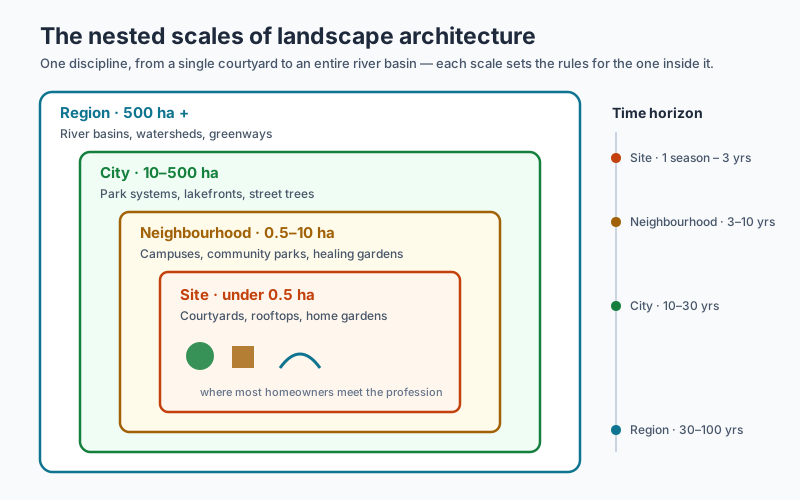
At the site scale, the landscape architect works on a single plot — a home garden, a courtyard, a rooftop, a small office forecourt. This is where most homeowners meet the profession, and where guides like courtyard landscape design and rooftop garden design live.
At the neighbourhood scale, the work is the shared realm — a residential community's parks and streets, a school campus, a hospital's healing garden, a tech park. Here the landscape architect coordinates with the building architect and the services engineer.
At the city scale, the discipline becomes urban: parks systems, lake rejuvenation, street-tree masterplans, the public plaza. India's recent Smart Cities Mission and AMRUT urban-renewal programmes have made city-scale landscape work far more visible.
At the regional scale, landscape architecture merges with planning and ecology: river-basin restoration, watershed management, greenway networks, climate-adaptation corridors. This is the scale at which the Sabarmati Riverfront in Ahmedabad or the proposed Yamuna restoration in Delhi operate.
| Scale | Typical project | Who else is involved | Time horizon |
|---|---|---|---|
| Site (under 0.5 ha) | Home garden, courtyard, terrace | Homeowner, nursery, architect | 1 season to 3 years |
| Neighbourhood (0.5–10 ha) | Community park, campus, healing garden | Architect, MEP engineer, developer | 3–10 years |
| City (10–500 ha) | Park system, lakefront, street trees | Urban local body, planners | 10–30 years |
| Region (500 ha+) | River basin, watershed, greenway | Government, ecologists, hydrologists | 30–100 years |
A short history: charbagh to ISOLA
India did not import landscape design; it has practised it for a very long time. The Mughal charbagh — the four-fold paradise garden divided by water channels, perfected at the Taj Mahal, Shalimar Bagh and Humayun's Tomb — is one of the world's great landscape traditions, organising water, geometry, shade and scent into a coherent experience. Before and alongside it, the temple tank, the sacred grove, the stepwell (baoli) and the village commons were sophisticated water-and-shade landscapes that doubled as social infrastructure.
The modern, Western-style profession arrived with Edwin Lutyens and the planning of New Delhi (1911–31), whose hexagonal avenues, garden roundabouts and the great vista of Rajpath set a template of tree-lined ceremonial landscape — much of it planted with species selected for the climate by horticulturists of the day. After Independence, Chandigarh gave India a Corbusian city with a deliberate landscape framework, including the celebrated, unofficial Rock Garden built by Nek Chand.
The discipline professionalised slowly. The first formal landscape-architecture education in India began at the School of Planning and Architecture (SPA), New Delhi, and matured into a full Master of Landscape Architecture programme; CEPT University, Ahmedabad followed as the other great centre. ISOLA was founded in 1989, giving the profession a national voice. A generation of practitioners — among them Mohammad Shaheer, who reinterpreted the Mughal garden for modern India and designed Delhi's Garden of Five Senses and the Sanskriti campus, Prabhakar B. Bhagwat and his Ahmedabad practice, Ravindra Bhan, and M. Shaheer's contemporaries — turned a craft into a discipline with its own theory. You can read fuller portraits at the landscape masters.
| Era | Landmark | What it taught Indian landscape design |
|---|---|---|
| 16th–17th c. | Mughal charbagh (Taj, Shalimar) | Water, geometry, shade and scent as one ordered experience |
| Pre-colonial, ongoing | Stepwells, temple tanks, sacred groves | Landscape as water infrastructure and social space |
| 1911–31 | Lutyens' New Delhi | Tree-lined ceremonial avenues and garden urbanism |
| 1950s–60s | Chandigarh, Rock Garden | Planned modern city with a landscape framework |
| 1989–present | ISOLA, SPA & CEPT programmes | A licensable, theory-led national profession |
What landscape architects actually do
On a normal week a landscape architect is rarely planting. The hands-on work is mostly thinking, analysing and drawing. The core competencies are surprisingly technical:
- Site analysis and survey — reading the slope, soil, drainage, sun path, wind, existing trees and views before drawing a single line.
- Grading and drainage — shaping the ground so water moves where it should; this is the invisible engineering that separates a professional from an amateur, and it connects directly to sustainable water management in the landscape.
- Planting design — choosing species that survive the local climate, soil and water budget, and arranging them for shade, structure and succession over time. Our guide to the best trees for Indian homes is a homeowner's version of this thinking.
- Hardscape and materials — paths, paving, walls, steps, water features, specified for the climate and for the way people will actually move.
- Microclimate and ecology — using planting and water to cool the air, support biodiversity and reduce the urban heat-island effect, the heart of biophilic landscape design.
- Coordination and management — working with architects, structural and MEP engineers, contractors and the local body, and supervising the site through construction and the critical first establishment monsoon.
Why does the feeling of a place matter so much in this list? Because, as our pillar guide on why some gardens feel peaceful argues, the measurable outcomes (cooler air, less flooding, more birds) and the emotional ones (calm, refuge, delight) come from the same set of decisions.
The design process: how a landscape comes to be
A professional landscape project follows a recognisable sequence, broadly mirrored in the Council of Architecture and CPWD scope-of-work conventions that many Indian landscape commissions borrow. The same six steps apply whether the site is a courtyard or a campus — only the depth changes.
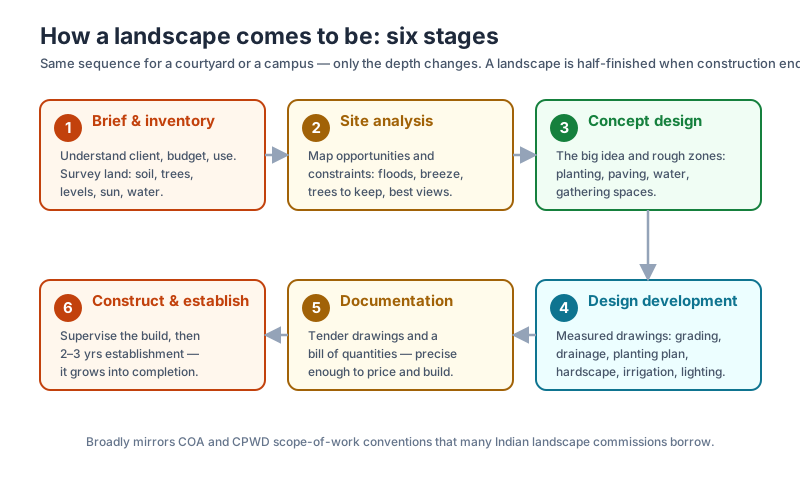
1. Brief and inventory. Understand the client, the budget, the use, and then survey the land — soil tests, tree survey, levels, sun and water.
2. Site analysis. Synthesise the survey into a map of opportunities and constraints: where it floods, where the breeze comes from, which trees must stay, where the good views are.
3. Concept design. The big idea and the rough zones — where the planting masses, the paving, the water and the gathering spaces go. This is the stage where homeowners and AI mood images are most useful as a direction, not a buildable plan.
4. Design development. The concept hardens into measured drawings: grading and drainage plans, a planting plan with species and quantities, hardscape details, an irrigation layout, a lighting plan.
5. Documentation and tender. Drawings and a bill of quantities precise enough for a contractor to price and build, often phased to spread cost across budget cycles.
6. Construction and establishment. Supervision on site, then the crucial first two-to-three years of establishment — because a landscape, unlike a building, is only half-finished when construction ends. It grows into completion.
| Stage | Main deliverable | Who signs off |
|---|---|---|
| Brief & inventory | Site survey, tree survey, soil report | Client, surveyor |
| Site analysis | Opportunities/constraints map | Landscape architect |
| Concept design | Concept plan, mood direction | Client |
| Design development | Grading, planting, hardscape, irrigation plans | LA + engineers |
| Documentation | Tender drawings + bill of quantities | LA |
| Construction & establishment | Built landscape, 2–3 yr establishment | Contractor, LA |
How it differs from gardening, horticulture and architecture
The clearest way to understand a profession is to see it next to its neighbours. The four roles below overlap and depend on each other — a good garden needs all of them — but they are genuinely different disciplines with different training and different questions.
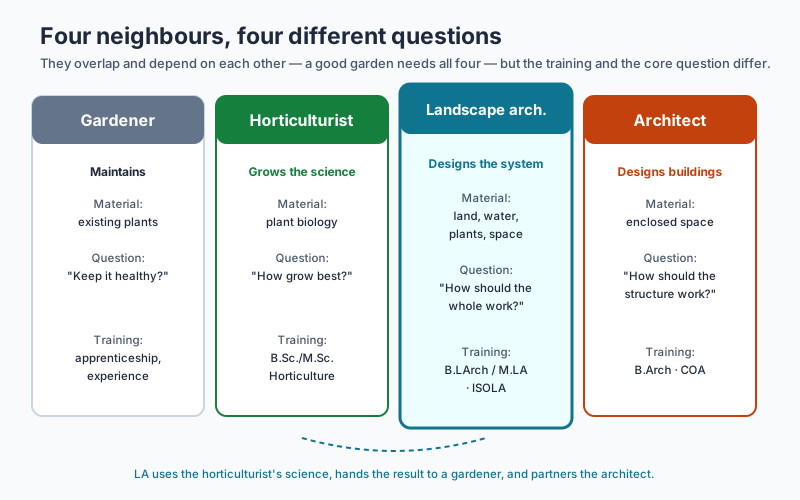
The gardener maintains and tends: pruning, weeding, watering, seasonal planting. The horticulturist is a plant scientist: propagation, soil chemistry, pest and disease management, the biology of growing. The landscape architect designs and plans space and systems, using the horticulturist's science and handing the result to a gardener to maintain. The architect designs buildings and enclosed space, and on larger projects works alongside the landscape architect so building and ground are conceived together.
| Role | Primary material | Core question | Typical training |
|---|---|---|---|
| Gardener | Existing plants | How do I keep this healthy? | Apprenticeship, experience |
| Horticulturist | Plant biology | How does this plant grow best? | B.Sc./M.Sc. Horticulture |
| Landscape architect | Land, water, plants, space | How should the whole outdoor system work? | B.LArch / M.LA, ISOLA |
| Architect | Buildings, enclosed space | How should the structure work? | B.Arch, COA registration |
Education and licensing in India
In India you become a landscape architect by one of two routes. The direct route is the five-year Bachelor of Landscape Architecture (B.LArch) — offered at a small number of institutions. The postgraduate route, which is more common, is to first complete a B.Arch (or in some cases a relevant degree) and then a two-year Master of Landscape Architecture (M.LA), the flagship being the programme at SPA Delhi, with strong programmes at CEPT Ahmedabad, SPA Bhopal, IIT Kharagpur and a handful of others.
Licensing is the subtle part. Unlike "architect" — a title legally protected by the Council of Architecture under the Architects Act, 1972 — the title "landscape architect" is not yet separately statutory in India. ISOLA provides professional membership, ethics and standards and has long advocated for formal statutory recognition, but at present many practising landscape architects are COA-registered architects who specialise, or M.LA holders working under a firm. For the full career picture — fees, firms, job roles and how to enter — see our dedicated guide on landscape architecture as a career in India.
| Pathway | Duration | Where (examples) | Entry |
|---|---|---|---|
| B.LArch (direct) | 5 years | Select institutions | 10+2, aptitude test |
| B.Arch + M.LA | 5 + 2 years | SPA Delhi, CEPT, SPA Bhopal, IIT KGP | B.Arch degree |
| Architect specialising | Varies | Practice + CPD | COA registration |
| Membership body | — | ISOLA (since 1989) | Qualification-based |
Why it matters now
The case for landscape architecture in India has never been stronger, and it is no longer aesthetic. Indian cities are warming faster than the countryside through the urban heat-island effect; the India Meteorological Department has recorded steadily rising urban summer temperatures, and tree cover and water bodies are among the few proven, low-cost ways to cool a city. Studies of green space and health, echoed by the WHO's recommendations on urban nature, link access to parks with lower stress, better cardiovascular and mental health, and more physical activity.
Water is the other driver. Many Indian cities now face seasonal shortages, and the National Building Code (NBC) 2016 and IGBC green-building ratings push for rainwater harvesting, permeable surfaces and reduced lawn. The landscape architect is precisely the professional trained to slow, store and clean rainwater on site rather than flush it into an overwhelmed drain. As climate adaptation moves from slogan to budget line, the discipline that designs cool, absorbent, biodiverse ground moves from luxury to necessity.
For a homeowner, the practical upshot is simple: a thoughtfully designed landscape is not a decorative afterthought but part of how your home stays cool, dry and calm — and how your street, in aggregate, stays liveable.
Where to go next
If this introduction has done its job, the word "landscape" should feel less like scenery and more like a design decision. The next steps depend on what you want. To understand the feel of good outdoor space, start with why some gardens feel peaceful. For climate logic, read climate-responsive landscape design. For the people and the profession, meet the landscape masters, and browse the full landscape guide hub. The four-century-old garden at dawn was designed by someone who thought this way. So can the green space around your own home.
References
- International Federation of Landscape Architects (IFLA) — definition and scope of landscape architecture.
- Indian Society of Landscape Architects (ISOLA), founded 1989 — professional standards and advocacy for statutory recognition.
- Council of Architecture, Architects Act 1972 — on the protected title "architect" and scope conventions.
- National Building Code of India (NBC) 2016, Bureau of Indian Standards — rainwater, drainage and site provisions.
- Indian Green Building Council (IGBC) — green-building criteria for water and landscape.
- World Health Organization — Urban green spaces and health (evidence review).
- India Meteorological Department — urban temperature and heat-island observations.
- Writings on and by Mohammad Shaheer, Prabhakar B. Bhagwat and Ravindra Bhan on the modern Indian landscape tradition.
- School of Planning and Architecture (SPA Delhi) and CEPT University — B.LArch and M.LA curricula.
Part of the Studio Matrx Landscape Fundamentals series. Continue with landscape architecture as a career, why some gardens feel peaceful, and the full landscape hub.
Export this guide
Related Guides — Deep-dive reading
Understanding Site Planning for Residential Projects
A homeowner's landscape guide to reading your plot's sun, wind, water, soil and trees before zoning and building the grounds.
LandscapeWhy Landscape Architecture Matters More Than the Building
How the green around, above and beyond your home out-cools, out-drains and out-appreciates the structure itself — at every scale from balcony to city.
LandscapeSite Analysis for Homeowners: How to Read a Plot Before You Build
The master guide to reading your land — its legal envelope, sun, wind, slope, soil, access, neighbours, views, services and microclimate — before you buy a plot or draw a plan.
Site PlanningRelated Tools — Try Free
Rainwater Tank Sizer
How big should your rainwater tank be? Computes annual harvest, recommended tank capacity in litres, water-bill savings, and payback — for 10 Indian cities.
RWH CalculatorCross-Ventilation Analyzer
Estimate airflow and air changes per hour (ACH) from room size, window areas, layout, and local wind — with NBC 2016 Part 8 compliance check.
Ventilation CalculatorGarden Planning Toolkit
Get a tailored garden plan — planting layers, Indian species, features and a checklist — from your climate, space, sun and goals.
Planner