
Why Some Gardens Feel Peaceful — The Science and Art of Restorative Outdoor Space
How environmental psychology explains the calm of a great garden, and how to design it into an Indian balcony, courtyard or plot
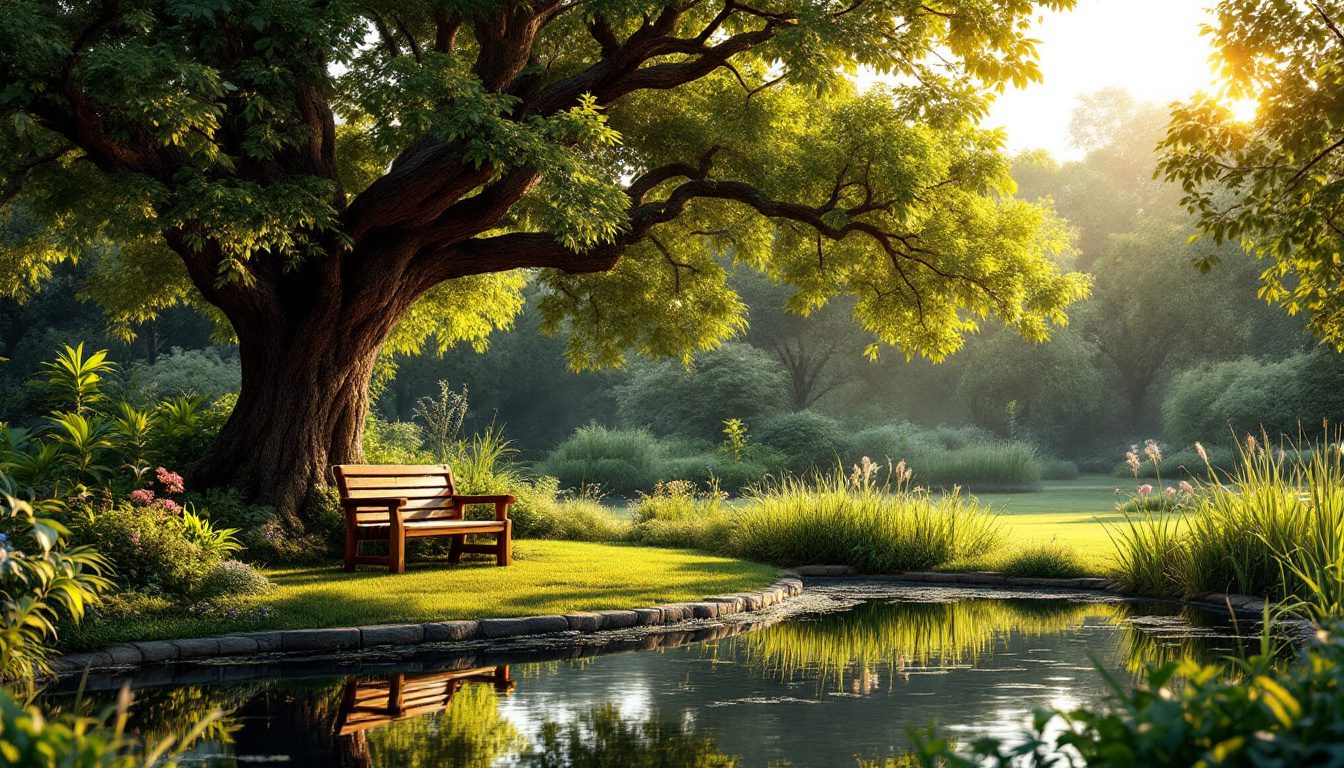
There is a particular silence that settles over you in certain gardens. Step off a roaring Indian arterial road into the deep shade of a banyan, or into the still water-court of a temple tank, or onto a wet morning lawn ringed by frangipani, and within a minute or two your shoulders drop, your jaw unclenches, your breathing slows. You did nothing deliberate. The garden did it to you. A few streets away, a different garden — all paving, glare, a clipped hedge and a parked car — leaves you exactly as tense as you arrived. Both are "gardens." Only one is restorative.
This guide is about that difference: why some outdoor spaces calm the nervous system while others merely occupy land. It is not mysticism. Over four decades, environmental psychologists have measured the effect — in blood pressure, cortisol, recovery time after surgery, scores on attention tests — and traced it to a handful of repeatable design conditions. Once you can name them, you can design for them, in a Bengaluru balcony or a Kerala courtyard or a half-acre in the Aravallis. This is the pillar of our Landscape cluster: the why beneath every other guide we link below.
A peaceful garden is not a decorated garden — it is a garden engineered, consciously or by tradition, to give the human mind exactly what it evolved to find restful: refuge with a view, gentle fascination instead of demand, abundant green over hard surface, and the removal of the stressors the city pours over us all day. Master those moves and a small Indian plot can out-calm a grand one.
The evidence: nature measurably repairs us
The modern science of restorative landscape begins with a single, almost accidental dataset. In 1984 the environmental psychologist Roger Ulrich published a study in Science that has since been cited thousands of times. He examined the recovery records of gallbladder-surgery patients in a Pennsylvania hospital. The wards were identical but for one thing: some rooms looked out on a small stand of deciduous trees, others on a brick wall. Patients with the tree view recovered faster — they were discharged on average about one day sooner, needed fewer and weaker painkillers, and were noted by nurses as less distressed. Nothing had changed except what was framed in the window.
Ulrich built this into Stress Recovery Theory (SRT): because humans evolved in natural settings, certain natural scenes — greenery, water, spatial openness with some shelter — trigger a fast, largely unconscious shift away from the stress response. Within minutes of viewing such a scene, sympathetic "fight or flight" arousal eases, the parasympathetic "rest and digest" system takes over, and physiological markers fall. The restoration is rapid and pre-cognitive; you do not have to think the garden is beautiful for your body to relax.
Working in parallel, the psychologists Rachel and Stephen Kaplan approached the same phenomenon from the side of attention. Their book The Experience of Nature (1989) set out Attention Restoration Theory (ART). The city demands what they call directed attention — the effortful focus you use to ignore a horn, track traffic, answer a screen. It is a finite resource, and when it is spent we feel the irritable, scattered state of mental fatigue. Nature, the Kaplans argued, lets directed attention rest by engaging instead a gentle, involuntary kind of attention they called soft fascination — the way clouds, water, leaves and birds hold the eye without taxing it. A truly restorative setting, in their model, has four properties, and a peaceful garden is one that delivers all four.
| ART property | What it means | How a garden provides it |
|---|---|---|
| Being away | A sense of escape from the everyday and its demands | Enclosure, a threshold, screening out the road and the to-do list |
| Fascination | Effortless, undemanding interest | Moving water, swaying grasses, dappled light, birds, opening flowers |
| Extent | A coherent "whole world" the mind can wander in | Layered planting, paths, a sense the space continues beyond the visible |
| Compatibility | The setting fits what you want to do there | Places to sit, walk, eat, garden — not just to look |
A third strand comes from Frances Kuo and her colleagues at the University of Illinois, who studied real residents of inner-city Chicago housing whose only difference was the amount of greenery outside their buildings. Across a series of studies they found that residents with greener, tree-lined surroundings showed measurably better attention and self-discipline, less mental fatigue and aggression, lower reported violence, and even significantly lower rates of crime in the greener blocks. Greenery was not a luxury overlay on wellbeing; it was load-bearing.
All of this rests on a larger idea named by the biologist E. O. Wilson and developed for design by Stephen Kellert: biophilia, the proposition that humans carry an innate affiliation with living systems, because for almost all of our evolutionary history our survival depended on reading them. A garden that feels peaceful is, on this view, simply a garden that speaks our oldest language back to us. Our biophilic landscape design guide develops these principles into a full design method; here we stay with the underlying why.
"Nature is not a place to visit. It is home — and the deepest restoration happens when we let a little of it back into the spaces where we actually live."

The numbers: how much, and how fast
The effect is not vague. Across the literature, exposures as short as a few minutes move physiological markers, and the green itself does measurable physical work on the microclimate — which in hot Indian cities is part of why a leafy space feels safe to relax in.
| Finding | Approximate magnitude | Source |
|---|---|---|
| Faster post-surgical recovery with a tree view | ~1 day shorter stay, fewer strong analgesics | Ulrich, Science (1984) |
| Stress recovery from viewing nature vs urban scenes | Faster drop in blood pressure, muscle tension, skin conductance within ~4–6 minutes | Ulrich et al., J. Environmental Psychology (1991) |
| Cortisol reduction from time in green space | ~21% lower salivary cortisol per hour of nature contact | Hunter et al., Frontiers in Psychology (2019) |
| Attention / working-memory gain after a nature walk | ~20% improvement on backward-digit-span vs an urban walk | Berman, Jonides & Kaplan, Psychological Science (2008) |
| Threshold "dose" of nature for wellbeing | ~120 minutes per week associated with good health/wellbeing | White et al., Scientific Reports (2019) |
| Air temperature cut under a mature tree canopy | ~2–4°C cooler air; up to 10–15°C cooler surfaces in shade | Urban-heat-island & i-Tree studies |
| Particulate capture by urban vegetation | Measurable PM2.5/PM10 reduction near dense canopy | TERI / i-Tree ecosystem-services work |
Read that table as a designer, not a statistician. The "dose" findings say a garden need not be large or visited for long — a few minutes, repeatedly, is enough to matter, which is the entire case for the small daily garden over the grand occasional one. The microclimate rows say that in India the restorative and the thermal are the same project: the canopy that calms the mind is the canopy that drops the air 3°C, and a space that is physically cooler is one the body reads as safe to slow down in. Our climate-responsive landscape guide and best trees for Indian homes turn these numbers into species and shade strategy.
Move one: prospect and refuge
The oldest restorative pattern is older than gardens. The geographer Jay Appleton, in The Experience of Landscape (1975), proposed that we find a scene most satisfying when it offers prospect — an open outlook, the ability to see — together with refuge — a place of shelter, the ability to be unseen and protected. To our ancestors this was the difference between safety and danger: a vantage with your back covered. We still read it instantly. It is why the most-occupied seat in any garden is the one against a wall or under a canopy, facing the open view, and why the bench marooned in the middle of a lawn stays empty.
Designing for it is concrete. Give every place to sit a sense of back — a wall, a hedge, a pergola, the trunk of a tree, the edge of a verandah — and an outlook over something open and green. A Kerala thinnai (the raised verandah seat), the deep plinth of a Chettinad house, the corner of an aangan under the eave: all are refuges looking onto prospect, which is precisely why they feel so good to sit in. On a balcony, the refuge can be as small as a screened back wall and a planted rail; the prospect, a slice of sky and a tree across the road. The principle scales all the way down.
Move two: soft fascination over hard demand
A restorative garden gives the eye gentle, undemanding things to follow. This is the Kaplans' fascination, and it has a texture: it is movement and pattern that does not require a decision. Designers reach for a reliable set of sources.
- Water — the single most effective element. Even a small still tank gives reflection and sky; a slow trickle or a fountain on a timer gives sound that masks traffic. The temple tank, the stepwell, the Mughal chadar (water chute) all knew this.
- Grasses and fine foliage that move in the lightest breeze — fountain grass, Pennisetum, bamboo, the trembling leaf of Ficus religiosa. Movement is fascination you cannot predict and so never tire of.
- Dappled light through a canopy — the shifting mosaic of sun and shade under a tree is the visual definition of soft fascination, and it changes all day.
- Living movement — birds, butterflies, dragonflies, fish. A garden planted to attract them adds a layer of fascination no hard landscape can buy.
The opposite — hard fascination — is the screen, the flashing sign, the thing that grabs and holds by force. Restorative design removes hard fascination and curates soft. This is why a clutter of statuary, mismatched pots and a glaring white path can leave a "lush" garden feeling agitating: it demands attention instead of releasing it.
Move three: green over hardscape, in layers
The simplest predictor of how restful a garden feels is how much of it is alive. Hardscape — paving, walls, decking — has its place for use and access, but a space that reads as mostly green, and green in layers (canopy tree, understorey shrub, groundcover and climber), consistently scores higher for restoration and does the cooling, dust-trapping, bird-supporting work the data above describes. A useful discipline for Indian plots, where the instinct is often to pave for low maintenance, is to set a deliberate green-to-hard ratio and protect it.
| Ground treatment | Restorative value | Microclimate / cost | Best use |
|---|---|---|---|
| Layered planting (tree + shrub + ground) | Highest | Coolest, best air, supports wildlife | The heart of any restorative space |
| Lawn / soft groundcover | High | Cool, evaporative, but thirsty | Open prospect, play, gathering |
| Gravel / permeable paving | Medium | Drains well, low water, warms in sun | Paths, drought-prone or low-water zones |
| Solid paving / concrete | Low | Hot, glaring, sheds runoff | Only where wheels or heavy use demand it |
The layering also creates the Kaplans' extent — the sense of a small world that continues beyond what you can see — and the biophilic-score tool lets you check how strongly a given space delivers these qualities. For costing the green you choose, our landscape cost guide puts real Indian rupee figures against each layer.
Move four: sensory layering — scent, sound, touch
Restoration is not only visual. The traditional Indian garden has always been a multi-sensory instrument, and the most peaceful modern gardens recover that. Engage more senses and the being away deepens, because the city is shut out on every channel at once.
| Sense | Restorative source | Indian examples |
|---|---|---|
| Scent | Night- and rain-released fragrance | Raat ki rani (Cestrum nocturnum), jasmine/mogra, parijat, champa, the smell of wet earth (petrichor) |
| Sound | Masking noise, adding gentle | Trickling water, rustling bamboo, birdsong, wind in casuarina |
| Touch | Inviting contact | Soft lawn underfoot, smooth river pebble, the cool of a stone bench, herbs you brush past |
| Taste / tending | The compatibility of doing | Tulsi, curry leaf, lemongrass, a small kitchen-herb bed |
Birdsong deserves its own note: studies have found natural sounds, and birdsong especially, are strongly associated with stress recovery and improved mood — part of why a garden planted to feed and shelter birds feels calmer than one merely planted to be looked at. Sound design is half subtraction (block the road) and half addition (water, leaves, wings).
Move five: enclosure and the garden room
A field is pleasant; a room is restful. Enclosure — a sense of edge and shelter overhead or around — is what converts open ground into a place the nervous system reads as safe to settle in. This is the design logic of the courtyard, perhaps the most enduring restorative form in Indian and Islamic architecture: a green, often water-centred void held by built edges, open to the sky, screened from the world. The Kaplans' being away and Appleton's refuge both live in enclosure.
You create it with hedges, walls, pergolas, a canopy of trees meeting overhead, a change of level, or a threshold you pass through. Dividing even a small garden into two or three loosely enclosed "rooms" — a shaded seating court, a sunny lawn, a productive corner — makes it feel larger and far more restful than one undifferentiated patch, because each room is its own complete world. Our courtyard landscape guide takes this form deep, and on a roof the same instinct of enclosure-against-exposure governs everything in the rooftop garden guide.
Move six: complexity with order — the fractal middle
A restorative scene is neither barren nor chaotic. The architect-theorist Nikos Salingaros, and a line of research on fractal patterns, point to a sweet spot: humans prefer and relax fastest in scenes of moderate complexity with underlying order — roughly the statistical texture of natural foliage, branching trees and a savanna's mid-range detail. Too little (a blank wall, a lawn and nothing else) bores; too much, with no organising logic (a jumble of clashing pots, colours and styles), agitates.
The design reading is to plant and compose with a sense of repetition-with-variation: drifts of the same grass rather than one of everything; a limited palette repeated; a clear structure of paths and edges holding a rich interior. This is the difference between a garden that is "lush" and one that is peaceful — both are full, but only the ordered one rests the eye. It is the same principle that makes a forest calming and a cluttered desk stressful.
Move seven: remove the stressors
Half of restorative design is subtraction. The most carefully planted garden fails if it is loud, glaring, hot or cluttered, because the stress response overrides the restoration. Before adding beauty, strip out what the nervous system flags as threat or demand.
- Noise. Screen and mask traffic with dense planting, a boundary wall, and added soft sound (water, leaves). Road noise is one of the most reliable stressors and the first thing a peaceful garden removes.
- Glare and heat. Shade with canopy and pergola; avoid large expanses of white paving and reflective surfaces that bounce harsh light and bake the space. Glare is read by the body as harsh.
- Visual clutter. Edit ruthlessly — fewer species in larger drifts, hidden utilities (the AC compressor, the water tank, the bins), a coherent palette. Clutter is hard fascination in disguise.
- Discomfort. A garden you cannot comfortably sit in is not restorative. Provide shade, a back to the seat, protection from wind, and freedom from mosquitoes (moving water and the right planting both help).
For the Indian monsoon and the dry months alike, this subtraction is also a water and maintenance decision — handled in depth in our sustainable water-management guide.
The Indian inheritance: charbagh, tank, aangan, Lunuganga
India did not need these studies; it built restorative gardens for two thousand years and encoded the principles in tradition. Reading our heritage through the lens above is one of the most useful things an Indian homeowner can do, because the moves are already proven in our climate.
| Tradition | Restorative principle embodied | What to borrow today |
|---|---|---|
| Mughal charbagh (e.g. the bagh form, Humayun's Tomb gardens) | Order, water, enclosure, the fourfold paradise plan | Axial water, geometric calm, the garden as paradise-within-walls |
| Temple tank / kund and stepwell | Still water, descent, coolness, reflection, ritual pause | A water body as the cool, contemplative heart |
| Courtyard / aangan / Kerala nadumuttam | Enclosure, sky-openness, refuge, family life around green | The garden room; a private green void |
| Sacred groves (devarakadu, kavu) | Untouched native ecology, awe, the value of leaving things wild | A wild, native, low-intervention corner |
| Tulsi vrindavan | The garden as daily devotion and tending (compatibility) | A small, cared-for, scented, ritual plant at the threshold |
| Geoffrey Bawa's Lunuganga (Sri Lanka) | Framed views, prospect-refuge, borrowed landscape, restraint | Edit the view; let the existing land and trees lead |
Geoffrey Bawa, whose Lunuganga is the great tropical-Asian lesson in restorative landscape, worked almost entirely by framing and subtraction — opening a view here, removing a tree there, letting the existing land speak. The Indian landscape architect Mohammad Shaheer, who shaped the modern reading of the Mughal garden and designed Sanskriti and the Garden of Five Senses, argued for exactly this marriage of inherited form and ecological sense. The tropical planting palette that suits most of India is the subject of our tropical landscape design guide, and the broader profession behind all of it is mapped in landscape architecture in India.
The garden in the dense Indian city
For most readers the plot is small, overlooked, hot and loud — a balcony, a setback, a rooftop, a strip beside the compound wall. This is precisely where restorative design matters most, because the deficit it repairs — mental fatigue, heat, noise, the absence of green — is most acute. The science is encouraging here: the "dose" is small (minutes, daily), the effect of even a single tree or a green wall is measurable, and the prospect-refuge and enclosure moves work at any scale.
The priorities for a city plot are clear. Buy shade first — one well-chosen canopy tree does more for restoration and temperature than any amount of paving or furniture. Make one good refuge — a single sheltered seat with a green outlook beats scattered seating with none. Add water and birds for soft fascination and sound-masking. Screen the stressors — the road, the neighbour's wall, the clutter. And green every plane — rail, wall, and overhead — when the ground is too small. These are the foundations the rest of the cluster builds on: healing gardens for hospitals and homes, outdoor wellness spaces, and the role of AI in landscape design in visualising it all before you plant.
What this means for your garden
1. Decide the feeling first. Before plants, name the job: a place to recover from the day. Every later choice answers to that.
2. Give yourself prospect and refuge. Put your main seat against something solid, looking out over green. Never marooned in the open.
3. Spend on shade and water before furniture. A canopy tree and a small water feature buy more peace, and more degrees of cooling, than any other purchase.
4. Choose green over hard, in layers. Set a green-to-hardscape ratio and defend it; layer canopy, shrub and ground.
5. Engage four senses, not one. Scent at the threshold, sound from water and birds, texture underfoot, the calm of tended green.
6. Make rooms, not a patch. Enclose and divide even a small space; each loosely held room feels larger and more restful.
7. Subtract the stressors. Block noise, kill glare, hide utilities, edit clutter — restoration is as much removal as addition.
8. Borrow from our own traditions. The charbagh, the tank, the aangan and the tulsi vrindavan already solve this for our climate.
How Studio Matrx helps
Knowing the principles is one thing; seeing your own balcony, courtyard or plot transformed by them is another. DesignAI lets you visualise a restorative garden on your actual space — testing canopy and shade, water and seating, planting layers and the prospect-refuge of a real seat — before you spend on a single sapling or paver. Pair it with the biophilic-score tool to measure how strongly a layout delivers the restorative qualities this guide describes, and work through the linked cluster guides to turn the science into the specific, climate-right, rupee-costed choices for your home.
References
1. Ulrich, R. S. (1984). "View through a window may influence recovery from surgery." Science, 224(4647), 420–421. (The hospital-window study; foundation of Stress Recovery Theory.)
2. Ulrich, R. S., Simons, R. F., Losito, B. D., Fiorito, E., Miles, M. A., & Zelson, M. (1991). "Stress recovery during exposure to natural and urban environments." Journal of Environmental Psychology, 11(3), 201–230.
3. Kaplan, R., & Kaplan, S. (1989). The Experience of Nature: A Psychological Perspective. Cambridge University Press. (Attention Restoration Theory.)
4. Kaplan, S. (1995). "The restorative benefits of nature: Toward an integrative framework." Journal of Environmental Psychology, 15(3), 169–182.
5. Kuo, F. E., & Sullivan, W. C. (2001). "Environment and crime in the inner city: Does vegetation reduce crime?" Environment and Behavior, 33(3), 343–367; and Kuo, Taylor et al. on greenery, attention and aggression.
6. Wilson, E. O. (1984). Biophilia. Harvard University Press; and Kellert, S. R. & Wilson, E. O. (eds.) (1993). The Biophilia Hypothesis.
7. Appleton, J. (1975). The Experience of Landscape. Wiley. (Prospect-refuge theory.)
8. Berman, M. G., Jonides, J., & Kaplan, S. (2008). "The cognitive benefits of interacting with nature." Psychological Science, 19(12), 1207–1212.
9. Hunter, M. R., Gillespie, B. W., & Chen, S. Y.-P. (2019). "Urban nature experiences reduce stress in the context of daily life." Frontiers in Psychology, 10:722. (~21% cortisol reduction per nature hour.)
10. White, M. P., et al. (2019). "Spending at least 120 minutes a week in nature is associated with good health and wellbeing." Scientific Reports, 9:7730.
11. Clare Cooper Marcus & Marni Barnes (1999). Healing Gardens: Therapeutic Benefits and Design Recommendations. Wiley.
12. Salingaros, N. A. A Theory of Architecture and work on fractal complexity and biophilic patterns; with Pradip Krishen, Trees of Delhi (2006) for native species and FRLHT databases for regional flora.
Part of the Studio Matrx Landscape series. Continue with biophilic landscape design, tropical landscape design for India, best trees for Indian homes, healing gardens in India, courtyard landscape design, rooftop garden design, climate-responsive landscape design, sustainable water management in the landscape, outdoor wellness spaces, the landscape cost guide, and AI in landscape design.
Export this guide
Related Guides — Deep-dive reading
Biophilic & Healing Environments for Healthcare in India
An Architect's Working Reference — Roger Ulrich's Restorative Theory, Stephen Kellert's 14 Patterns of Biophilic Design, Therapeutic Gardens, Hospital Courtyards, Patient-Room Nature Views, End-of-Life Space, Indian Planting Palette, and the Biophilic Healthcare Toolkit
Healthcare ArchitectureThe Best Trees for Indian Homes
A research-grade guide to choosing and placing trees around an Indian home — the real cooling and clean-air numbers, the right species for shade, flowers, fragrance and fruit, and the placement science that keeps roots out of your walls and drains.
LandscapeHealing Gardens: Designing Restorative Outdoor Space for Home
The evidence-based restorative garden for the Indian home — Ulrich's supportive-garden theory, attention restoration, the cortisol data, and a medicinal-aromatic plant palette of tulsi, jasmine, vetiver, brahmi and ashwagandha
LandscapeRelated Tools — Try Free
Healing View Impact Calculator
Evidence-Based Design dashboard quantifying the recovery impact of nature view + daylight factor on analgesic use, length of stay, and HCAHPS patient-experience uplift. Calibrated against Ulrich 1984 (Science), Park & Mattson 2008, and the CHD EBD evidence base.
EBD CalculatorRainwater Tank Sizer
How big should your rainwater tank be? Computes annual harvest, recommended tank capacity in litres, water-bill savings, and payback — for 10 Indian cities.
RWH CalculatorCross-Ventilation Analyzer
Estimate airflow and air changes per hour (ACH) from room size, window areas, layout, and local wind — with NBC 2016 Part 8 compliance check.
Ventilation Calculator