
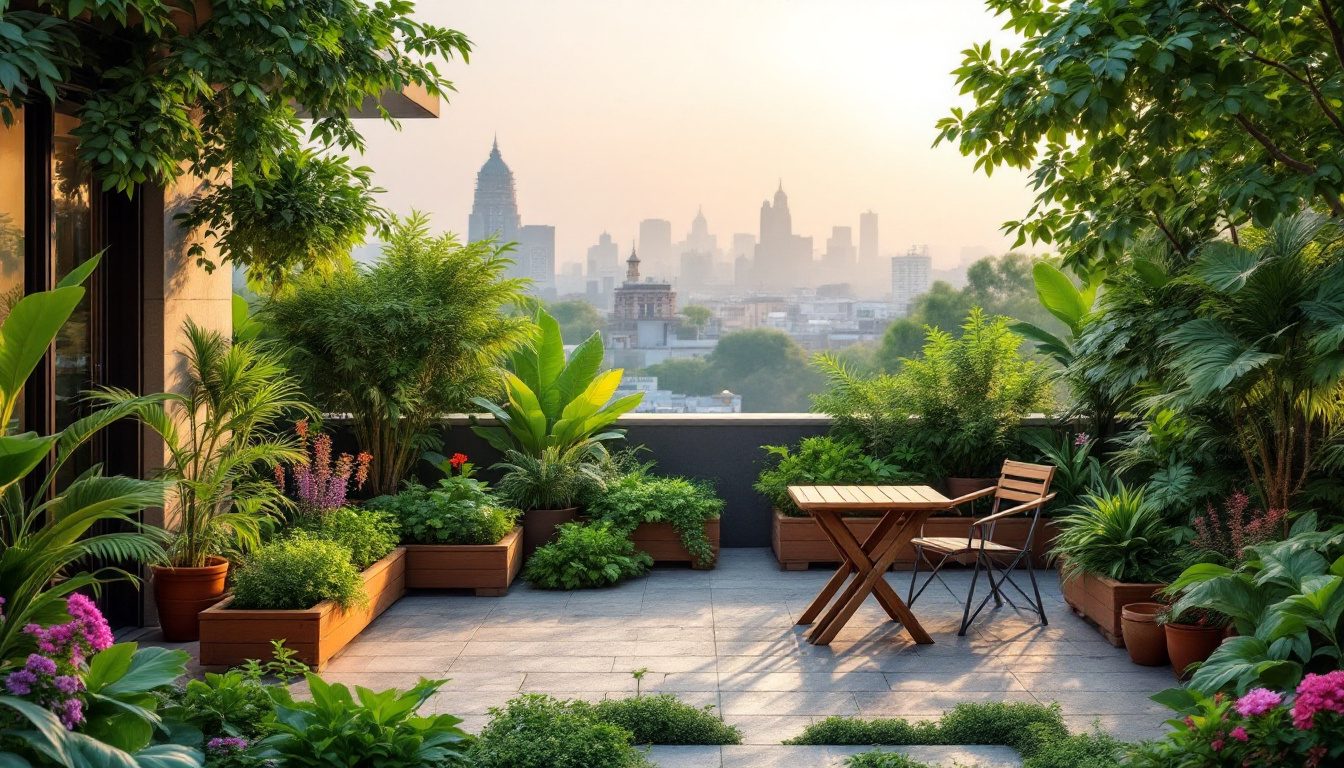
Rooftop Garden Design for Indian Homes
Turning a punishing concrete terrace into a green roof: the load, waterproofing and drainage that make or break it, lightweight media, hardy plants and the cooling, food and stormwater payoff
There is a moment on an Indian summer afternoon when you climb to your terrace and the bare concrete slab radiates heat back at you like the inside of an oven — 55, 60, even 65 degrees Celsius at the surface, hot enough to push the temperature of the room directly below it up by several degrees. That same slab, covered with thirty centimetres of growing media and a carpet of hardy succulents and grasses, could read closer to 30 degrees on the same afternoon, and the bedroom under it would sleep cooler all summer. The difference is not magic. It is a green roof — a working layer of soil and plants doing the oldest job in architecture, putting something living between you and the sky.
This guide is about turning the most punished surface of your home into its most productive one. Not the layout of a terrace — where the swing goes, how to screen the water tank, that is the job of our companion guide on terrace planning — but the green itself: the planting, the growing media, the irrigation, and above all the unglamorous engineering that decides whether a rooftop garden is a thirty-year asset or a leaking, cracking regret. Here is the truth that separates a real rooftop garden from a few pots that die by May: it is a piece of building science before it is horticulture, and the soil-and-plant part is the easy half.
A rooftop garden lives or dies on three numbers and one detail: the load your slab can carry, the temperature your roof reaches, the water your plants need — and the waterproofing membrane that, if it fails, takes the whole thing down with it. Get the engineering right and the planting almost looks after itself; get the planting right and ignore the engineering and you will be chiselling out a dead garden to chase a leak.
Why grow a garden on the roof
For most of India's history the roof was a place to dry papad, sleep in the heat, and fly kites. Turning it green is one of the highest-leverage moves a dense Indian city can make, and the benefits stack up at the scale of both your home and the street.
Cooling, for you and the city. A bare concrete or bitumen roof is the single hottest surface most buildings own. Field studies of green roofs in tropical climates record roof-surface temperature reductions of 15 to 25 degrees Celsius under the planted layer compared with an exposed slab, and indoor ceiling-surface reductions of 1.5 to 4 degrees in the topmost room. Multiplied across a neighbourhood, green roofs blunt the urban heat island — the effect by which dense, paved Indian cities run several degrees hotter than their surroundings, a gap the IPCC expects to widen as both climate and cities heat up.
Energy and money. Cooler ceilings mean lower air-conditioning bills. Studies report top-floor cooling-energy savings of 10 to 30 per cent in hot climates, with the largest gains where the roof was previously uninsulated — which describes most Indian terraces. The media and plants act as a thermal blanket in summer and, in the hills, a modest insulating layer in winter.
Food and self-reliance. India has a living tradition of terrace kitchen gardens, and a productive rooftop returns a genuine harvest — leafy greens, tomatoes, chillies, gourds, herbs, even dwarf fruit. Organic terrace farming is now a serious urban movement in Bengaluru, Pune, Hyderabad and Chennai.
Stormwater and the monsoon. A planted roof absorbs and slows rain. Green roofs typically retain 40 to 70 per cent of annual rainfall and delay the rest, easing the flash-flood loading that overwhelms drains in cities like Mumbai, Bengaluru and Chennai during cloudbursts.
Biodiversity and wellbeing. A green roof becomes habitat — for sunbirds, butterflies, bees and the small life a sterile slab excludes — and a restorative place for the people who use it. The wellbeing case for contact with nature, set out in our pillar guide on why some gardens feel peaceful, applies just as strongly forty feet up: the rooftop garden is often the only patch of green an apartment dweller can call their own.
| Benefit | Typical measured effect | Source / basis |
|---|---|---|
| Roof-surface cooling | 15–25 degrees C lower under planted layer | Tropical green-roof field studies |
| Indoor ceiling cooling (top floor) | 1.5–4 degrees C lower | Building-science measurements |
| Top-floor cooling energy | 10–30 per cent saving | Green-roof energy studies, hot climates |
| Rainwater retained | 40–70 per cent of annual rainfall | Green-roof hydrology research |
| Stormwater peak delay | Runoff slowed and spread over hours | Urban drainage studies |
| Food | 20–40 plus kg/season from a small intensive plot | Indian terrace-farming practice |
The engineering you cannot skip: load, water and roots
Read this section twice. Everything beautiful about a rooftop garden rests on building science, and the failures are expensive, slow and hidden. There are three non-negotiables.
1. Structural load — get a real check. Soil is heavy, and saturated soil is much heavier. You must know what your slab can carry before you put a kilogram on it. A green roof's load is the sum of dead load (the permanent build-up — media, drainage, plants at maturity) and live load (people, furniture, pots, water), and the figure that matters is the saturated dead load, because media can nearly double in weight after a monsoon downpour. A thin extensive roof adds roughly 60 to 150 kg per square metre saturated; an intensive garden with deep beds, shrubs and people can reach 300 to over 750 kg per square metre. For comparison, an ordinary Indian residential slab is typically designed for a live load of about 150 to 200 kg per square metre (1.5 to 2.0 kN/m² under IS 875). The arithmetic is unforgiving: an intensive garden can demand several times the load a standard slab was built for. Before anything else, have a structural engineer assess your specific slab. This is not optional, and it is cheap relative to being wrong.
2. Waterproofing and drainage — the make-or-break. If load decides whether you can build, waterproofing decides whether you should. A green roof traps moisture against the slab permanently, so the membrane below must be flawless and durable, because replacing it means demolishing the garden above. The professional standard is a high-quality membrane — reinforced bitumen, EPDM, TPO or a liquid-applied polyurethane system — laid over a sound, sloped slab, with all upstands, drains and parapets detailed and a flood test held before anything goes on top. Indian practice draws on IS 3067 (damp-proofing and waterproofing) and related BIS guidance; the membrane must carry a manufacturer's warranty, which you should keep. Drainage is its partner: water the media cannot hold must move freely to the roof drains through a dedicated drainage/reservoir layer, never ponding against the slab. A slab graded to fall (typically 1 in 100 or steeper) toward accessible outlets is the difference between a healthy garden and a swamp that rots roots and stresses the membrane.
3. Root barriers and protection. Roots seek water and probe any weakness in a membrane for years until they find it. Above the waterproofing sits a dedicated root barrier (a tough HDPE sheet, or a certified root-resistant membrane), and above that a protection layer — thick geotextile or board — to shield everything below from the abrasion of installation, foot traffic and stones. Skip the root barrier to save a few rupees per square metre and you have built a slow-motion leak.
| Layer (bottom to top) | What it does | Why it matters |
|---|---|---|
| Structural slab (sloped to fall) | Carries everything; sheds water to drains | Must be checked for the saturated load |
| Waterproofing membrane | Keeps water out of the building, permanently | Failure means demolishing the garden to repair |
| Root barrier | Stops roots penetrating the membrane | Roots will find any weakness over years |
| Protection layer (geotextile / board) | Shields membrane from abrasion and traffic | Cheap insurance for the costliest layer |
| Drainage / reservoir layer | Moves excess water out, stores some for plants | Prevents ponding and root rot |
| Filter fabric | Stops fine media clogging the drainage | Keeps the drainage layer working for decades |
| Growing media (lightweight) | Roots, water and nutrient store | Light, free-draining, structurally sized |
| Planting | The living layer; cooling, food, habitat | The visible half — and the easy half |
Extensive or intensive: two very different gardens
Green roofs split into two families, and choosing between them is mostly a question of how much load your slab can take and how much you want to use the space.
An extensive green roof is thin (typically 50 to 150 mm of media), light, low-maintenance and not designed to be walked on except for upkeep. It is a living carpet of drought-hardy, shallow-rooted plants — succulents, sedums, hardy grasses, groundcovers — surviving on rain and occasional irrigation. It is the right answer when the slab cannot take much weight, when the goal is cooling and stormwater rather than recreation, and when you want to set it and largely forget it.
An intensive green roof is a true roof garden — deeper media (200 mm to over a metre), able to support shrubs, vegetables, small trees and people, with paths, seating and beds. It needs strong structure, real irrigation and regular maintenance, and rewards all three with a usable outdoor room. A semi-intensive roof sits between the two.
| Attribute | Extensive | Semi-intensive | Intensive |
|---|---|---|---|
| Media depth | 50–150 mm | 120–250 mm | 250 mm – 1 m+ |
| Saturated load | 60–150 kg/m² | 150–300 kg/m² | 300–750+ kg/m² |
| Plants | Succulents, grasses, groundcovers | Above plus small shrubs, veg | Shrubs, veg, small trees |
| Walk on it | No (maintenance only) | Limited | Yes, designed for use |
| Irrigation | Minimal / rain-fed | Drip, periodic | Full automated system |
| Maintenance | Low | Moderate | High (like any garden) |
| Best for | Cooling, stormwater, light slabs | Balance of cooling and use | Living space, food, strong slabs |
Load and the temperature payoff, by the numbers
Two charts make the trade-offs concrete: the load budget that constrains every decision, and the cooling payoff that justifies the whole exercise.

The load chart carries the central lesson: an extensive roof generally lives within the load an ordinary slab was built for, while an intensive garden usually needs either a slab designed for it or a structural upgrade. This is why the structural check comes before plant selection, not after.
The cooling chart is the reward. A surface that was punishing the slab at 55 to 65 degrees drops to roughly ambient or below under a living layer, translating into a measurably cooler top floor and a lighter air-conditioning bill through the worst months. Where summer roof heat is the dominant comfort problem of the top floor, that is not a marginal gain.
Growing media: not garden soil
The most common error after skipping the waterproofing is filling beds with ordinary garden soil or black cotton soil. On a roof this is a double mistake: it is far too heavy when saturated, and it compacts into an airless, poorly draining mass that drowns roots and stresses the slab.
Rooftop growing media is engineered to be light, stable and free-draining. A typical mix combines a lightweight aggregate (perlite, expanded clay, or in India often crushed brick, cinder or LECA), compost or vermicompost for nutrition, coco peat (an India-abundant, lightweight, water-retentive coir by-product), and a little structured soil or sand for body. The goal is a media that holds enough water and nutrient while shedding excess fast and weighing a fraction of garden soil when wet. Depth follows the plant: 100 to 150 mm suits groundcovers, grasses and herbs; 200 to 300 mm suits most vegetables and small shrubs; deeper contained beds are needed for anything woody.
| Component | Role | Note |
|---|---|---|
| Coco peat / coir | Lightweight water retention | Cheap and abundant in India |
| Perlite / LECA / expanded clay | Aeration and drainage, very light | Keeps the mix porous |
| Crushed brick / cinder | Lightweight mineral bulk | Common low-cost Indian substitute |
| Compost / vermicompost | Nutrition and biology | The fertility engine; top up yearly |
| Coarse sand / structured soil | Body and stability | Use sparingly — adds weight |
The right plants for a brutal place
A rooftop is the harshest garden in your home: full unfiltered sun, drying wind, a swing between scorching pre-monsoon heat and waterlogged downpours, and a shallow, fast-draining root run. Plants that thrive here are the tough, the frugal and the wind-firm — not the pampered ornamentals of a shaded courtyard. Choose for survival first and beauty follows.
For an extensive or low-water roof, lean on succulents and xerophytes (Portulaca / table rose, Kalanchoe, Aloe vera, Sansevieria / snake plant) and hardy grasses (Cymbopogon / lemongrass, fountain grass, vetiver — Chrysopogon zizanioides, whose deep fibrous roots also bind media). For an intensive, irrigated roof, add the workhorses of the Indian terrace garden — tomatoes, chillies, brinjal, okra, gourds and leafy greens, herbs like tulsi (Ocimum sanctum), mint, curry leaf (Murraya koenigii) and coriander — plus hardy flowering shrubs (hibiscus, bougainvillea, ixora) and dwarf or container fruit (lemon, guava, pomegranate, papaya, dwarf banana) where the structure allows.
| Plant group | Examples (common / botanical) | Where it works | Why it survives the roof |
|---|---|---|---|
| Succulents | Aloe vera, snake plant (Sansevieria), Portulaca, Kalanchoe | Extensive, containers | Store water, thrive in heat and sun |
| Hardy grasses | Lemongrass (Cymbopogon), vetiver (Chrysopogon), fountain grass | Extensive, edges, windbreak | Deep roots, wind-firm, drought-tough |
| Leafy vegetables | Spinach, amaranth, methi, lettuce | Intensive beds, drip | Fast, shallow-rooted, high yield |
| Fruiting veg | Tomato, chilli, brinjal, okra, gourds | Intensive beds, big pots | Productive with sun, feed and water |
| Herbs | Tulsi, mint, curry leaf, coriander | Containers, raised beds | Compact, useful, mostly hardy |
| Flowering shrubs | Hibiscus, bougainvillea, ixora | Deep planters | Sun-loving, drought-tolerant once set |
| Container fruit | Lemon, guava, pomegranate, papaya, dwarf banana | Deep built-up beds, strong slab | Productive where load allows |
Containers, raised beds and built-up beds each suit a different ambition. Containers and grow bags are the lightest and most forgiving start — easy to move, easy to control, and the safest choice on an unverified slab. Raised beds (timber, brick or planter boxes) give vegetables a deeper root run while keeping load defined. Full built-up beds — a continuous waterproofed, drained planting zone integral to the green-roof build-up — give the richest planting and best cooling but demand the most engineering and the strongest slab. Many successful Indian rooftop gardens mix the three: a built-up or raised core for the kitchen garden, containers for flexibility.
Water, wind, access and keeping it alive
Irrigation. A rooftop dries faster than any ground bed, and hand-watering a full roof in May is a chore that gets abandoned. Drip irrigation on an automated timer is the standard answer: it delivers water straight to the roots, wastes little to evaporation, and keeps shallow media evenly moist. Pair it with a terrace water source (a tap, a small tank, or harvested rainwater) and ideally a moisture-aware controller. Capturing the roof's own runoff for irrigation closes the loop; for sizing a tank to your roof area and rainfall, our rainwater tank sizer does the arithmetic, and the wider strategy sits in our guide on sustainable water management in the landscape.
Wind and microclimate. Height means wind, and wind desiccates plants, topples tall pots and stresses young growth. Tough, low, wind-firm species at the exposed edges, windbreak planting (vetiver, grasses, a hardy hedge in deep planters) and heavy or anchored containers all help. Read your roof's microclimate — the sun-baked south and west, the sheltered lee of the stair block — and place tender plants where the roof protects them.
Access and safety. A rooftop garden you cannot reach safely will not be tended, and a roof people use must be safe. Ensure proper access, and check the parapet: most codes and common sense call for a parapet or railing of at least about one metre where people gather. Keep heavy beds and gatherings near load-bearing walls and beams rather than mid-span, plan how you will carry media and tools up, and never let pots or furniture sit where they could blow or be knocked over an edge.
Maintenance and the warranty. Even an extensive roof needs a few visits a year — weeding, topping up compost, clearing drains (a blocked drain in the monsoon is how ponding and leaks begin), checking the irrigation, replacing the odd casualty. Intensive gardens need the steady attention any vegetable garden does. Protect the membrane warranty: keep the paperwork, follow the maker's care conditions, and never let an untrained hand drive a stake, screw or spade through the planted zone into the layers below.
The roof is the one surface of the house that faces the sky with nothing in between. Put a living layer there and it stops fighting the climate and starts working with it — but only if the membrane beneath it is as well made as the garden above.
What this means for your home
1. Start with the slab, not the seed. Commission a structural assessment before you buy a single plant. The saturated load — not the dry load — decides whether you build extensive, intensive, or upgrade first.
2. Treat waterproofing as the foundation. Specify a warrantied membrane (EPDM, TPO, reinforced bitumen or liquid-applied PU) over a slab graded to fall, with a flood test before the build-up, a root barrier and a protection layer. This is where the money belongs.
3. Match ambition to load. Light slab, cooling goal: go extensive — succulents, grasses, groundcovers, minimal irrigation. Strong slab, want a usable garden and food: go intensive with proper beds and drip.
4. Use engineered lightweight media, never garden soil. Coco peat, perlite or crushed brick, compost — light when wet, free-draining, sized to the plant.
5. Plan irrigation and drainage as one system. Automated drip in, free-flowing drains out, harvested rainwater closing the loop where you can.
6. Respect the wind, parapet and access. Anchor and shelter at the edges, keep a safe railing, and make the garden easy to reach so it gets tended.
7. Keep the easy half easy. Choose hardy, climate-fit plants and the planting largely looks after itself — leaving you a cooler home, a lighter bill, and a green room in the sky.
For layout and use of the terrace as a space, see our companion guide on terrace planning, which this guide deliberately does not repeat.
How Studio Matrx helps
Designing a rooftop garden means holding load limits, waterproofing layers, plant palettes and microclimate in your head at once — and most homeowners only learn what they got wrong after the first monsoon. DesignAI lets you visualise your terrace as a green roof before you commit: test an extensive carpet against an intensive garden, see how beds, containers and planting read against your real parapet and stair block, and arrive at your structural engineer and waterproofing contractor with a clear, costed intent. The engineering still has to be done properly — but you will know what you are building toward.
References
1. Ulrich, R. S. (1984). "View Through a Window May Influence Recovery from Surgery." Science, 224(4647), 420–421. (Foundational evidence for the wellbeing value of contact with greenery.)
2. Kaplan, R. & Kaplan, S. (1989). The Experience of Nature: A Psychological Perspective. Cambridge University Press. (Attention Restoration Theory.)
3. Kellert, S. R. & Wilson, E. O. (1993). The Biophilia Hypothesis. Island Press. (The human affinity for living systems.)
4. Bureau of Indian Standards. IS 875 (Part 2): Code of Practice for Design Loads (Other than Earthquake) for Buildings and Structures — Imposed Loads. (Residential slab live-load basis.)
5. Bureau of Indian Standards. IS 3067: Code of Practice for General Design Details and Preparatory Work for Damp-Proofing and Waterproofing of Buildings.
6. Bureau of Indian Standards. National Building Code of India 2016 (NBC 2016), Part 3 — parapet, access and general building requirements.
7. Wong, N. H. et al. (2003). "The Effects of Rooftop Garden on Energy Consumption of a Commercial Building in Singapore." Energy and Buildings, 35(4), 353–364. (Tropical green-roof cooling and energy savings.)
8. Saadatian, O. et al. (2013). "A Review of Energy Aspects of Green Roofs." Renewable and Sustainable Energy Reviews, 23, 155–168. (Surface-temperature and energy-saving ranges.)
9. Berndtsson, J. C. (2010). "Green Roof Performance Towards Management of Runoff Water Quantity and Quality: A Review." Ecological Engineering, 36(4), 351–360. (Stormwater retention figures.)
10. FLL (Forschungsgesellschaft Landschaftsentwicklung Landschaftsbau). Guidelines for the Planning, Construction and Maintenance of Green Roofs. (The international green-roof build-up and root-barrier standard.)
11. IPCC (2021/2023). Sixth Assessment Report — urban heat island and climate-warming projections for South Asia.
12. India Meteorological Department (IMD). Climate of India and urban temperature records (heat-island and summer roof-temperature context).
Part of the Studio Matrx Landscape series. Continue with why some gardens feel peaceful, terrace planning for Indian homes, and sustainable water management in the landscape. Size your storage with the rainwater tank sizer.
Export this guide
Related Guides — Deep-dive reading
Designing a Naturally Energy-Efficient Indian Home
Comfort first, gadgets last — passive design, orientation, insulation, ventilation and the climate wisdom that cuts Indian energy bills
SustainabilityThe Green Roof Guide
How to turn a hot, dead Indian rooftop into a cool living layer — what a green roof actually is, extensive versus intensive versus semi-intensive, the layered build-up (waterproofing, root barrier, drainage, filter, growing media, plants), the structural load that decides everything, plants and irrigation for our climate, real benefits and costs, and whether an existing roof can carry one. Plain language, India-grounded.
RoofingThe Best Trees for Indian Homes
A research-grade guide to choosing and placing trees around an Indian home — the real cooling and clean-air numbers, the right species for shade, flowers, fragrance and fruit, and the placement science that keeps roots out of your walls and drains.
LandscapeRelated Tools — Try Free
Rainwater Tank Sizer
How big should your rainwater tank be? Computes annual harvest, recommended tank capacity in litres, water-bill savings, and payback — for 10 Indian cities.
RWH CalculatorCross-Ventilation Analyzer
Estimate airflow and air changes per hour (ACH) from room size, window areas, layout, and local wind — with NBC 2016 Part 8 compliance check.
Ventilation CalculatorMonsoon-Readiness Checklist
Pre-rain home audit across 9 categories — terrace, drains, waterproofing, electrical, HVAC, pest, vehicles, documents.
Seasonal Audit