
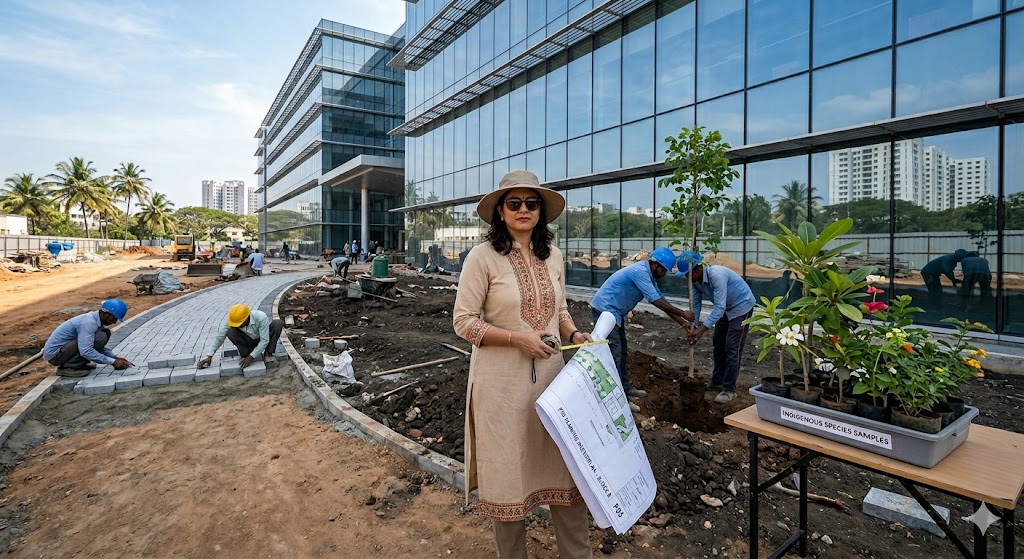
Landscape Architecture in India — A Student's Working Reference
The Land-Design Discipline · Six Core Competencies · B.LArch vs M.LA · Eight Practitioners · Career Pathways
Landscape architecture designs the LAND. Public parks, plazas, gardens, ecological restoration, urban greening, climate adaptation, water-sensitive design — everything outside the building envelope, at scales from a private garden to a regional watershed.
This guide is the working reference for Indian B.Arch students considering landscape architecture as a specialisation. It covers what LA is, six core competencies, eight Indian practitioners, education pathways, project types, and career pathways.
Landscape architecture is the discipline India needs most for climate adaptation in 2026 and beyond. There are perhaps 200-400 active LAs serving 1.4 billion people — and Smart Cities + climate adaptation work is driving demand fast. If you think about plants, water, ecology, climate more than buildings, this is your discipline.
For complementary depth see Architecture Thesis Topics (Family 6 = sustainability + climate), Urban Design Concepts (adjacent discipline), Site Analysis for Architecture, Career Pathways After B.Arch.
This is an evergreen guide — discipline fundamentals are stable. Last verified: May 2026 · Next verify: May 2028.
What Landscape Architecture Is
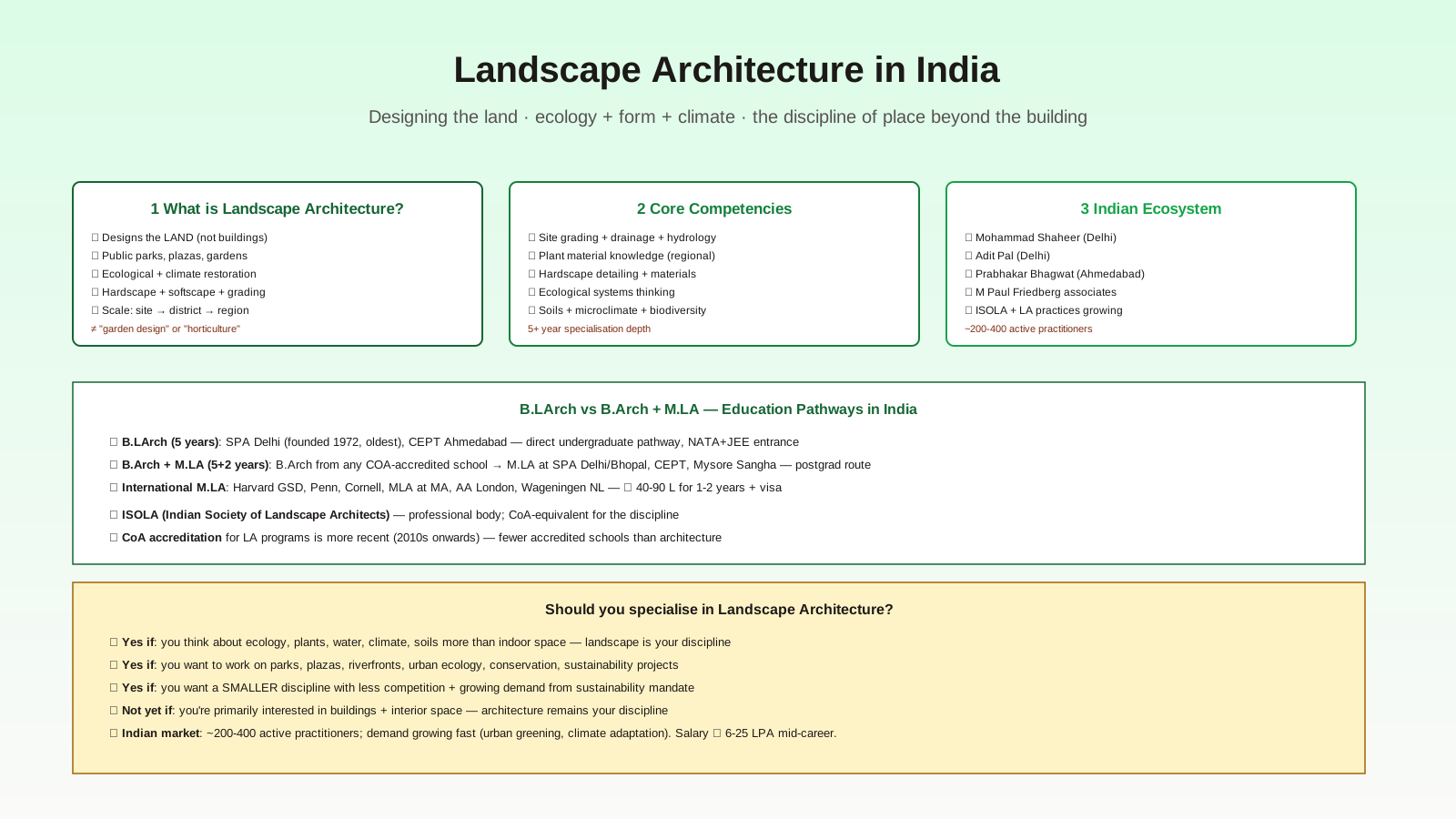
LA designs the LAND, not buildings:
- Public parks, plazas, gardens — the outdoor public realm
- Ecological + climate restoration — biodiversity, water, soil systems
- Hardscape + softscape + grading — paving, walls, water features, plants, contours
- Scale: site → district → region (1,000 sft - 1,000+ acres)
What LA is NOT
- "Garden design" — that's horticulture, much narrower
- "Site planning" by architects — that's a small part of LA
- Cosmetic plant arrangement after a building is built — LA is structural to site design from day one
Educational pathway
| Route | Duration | Where in India |
|---|---|---|
| B.LArch (direct undergraduate) | 5 years | SPA Delhi (since 1972), CEPT Ahmedabad |
| B.Arch + M.LA (postgrad route) | 5+2 years | M.LA at SPA Delhi, SPA Bhopal, CEPT, IIT Kharagpur, Mysore Sangha |
| International M.LA | 1-2 years (after B.Arch / B.LArch) | Harvard GSD, Penn, Cornell, AA London, TU Delft, Wageningen NL |
ISOLA (Indian Society of Landscape Architects) is the professional body. ~400 members. Annual conferences + journal.
Six Core Competencies
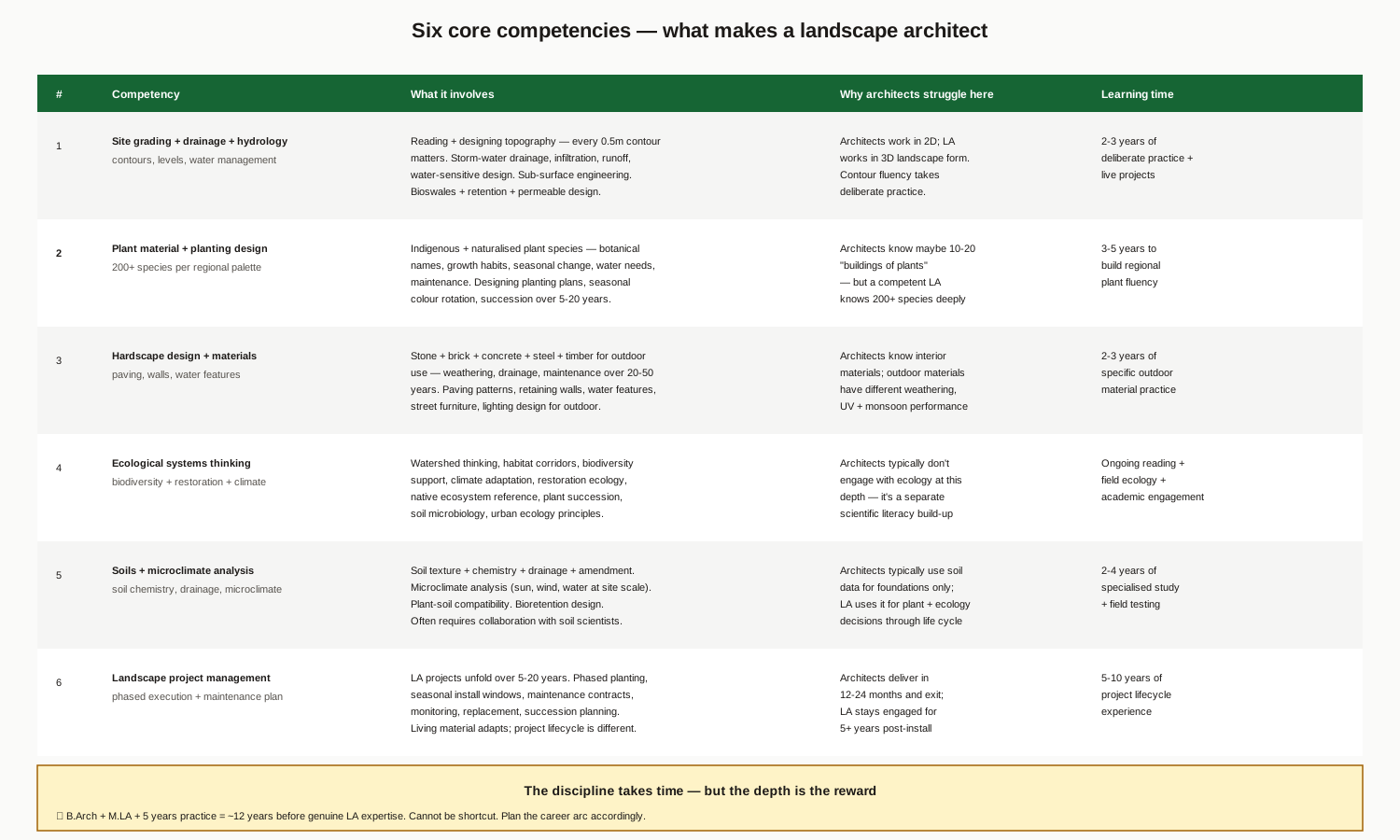
These six competencies differentiate the discipline. A B.Arch graduate has surface-level exposure; a B.LArch / M.LA practitioner has deep skill in all six.
1. Site grading + drainage + hydrology — Reading + designing topography (every 0.5m contour matters), storm-water drainage, water-sensitive design, sub-surface engineering. 2-3 years deliberate practice + live projects.
2. Plant material + planting design — 200+ indigenous + naturalised species per regional palette; botanical names, growth habits, seasonal change, water needs, maintenance, succession over 5-20 years. 3-5 years to build regional plant fluency.
3. Hardscape design + materials — Stone, brick, concrete, steel, timber for outdoor use — weathering, drainage, maintenance over 20-50 years. Paving patterns, retaining walls, water features, street furniture, outdoor lighting. 2-3 years of specific outdoor material practice.
4. Ecological systems thinking — Watershed thinking, habitat corridors, biodiversity support, climate adaptation, restoration ecology, native ecosystem reference, plant succession, soil microbiology, urban ecology. Ongoing reading + field ecology.
5. Soils + microclimate analysis — Soil texture + chemistry + drainage + amendment, microclimate analysis (sun, wind, water at site scale), plant-soil compatibility, bioretention design. 2-4 years specialised study + field testing.
6. Landscape project management — LA projects unfold over 5-20 years. Phased planting, seasonal install windows, maintenance contracts, monitoring, replacement, succession planning. Living material adapts; project lifecycle is different from architecture. 5-10 years project lifecycle experience.
The discipline takes time — B.Arch + M.LA + 5 years practice = ~12 years before genuine LA expertise. Cannot be shortcut. Plan the career arc accordingly.
Eight Indian Practitioners to Know
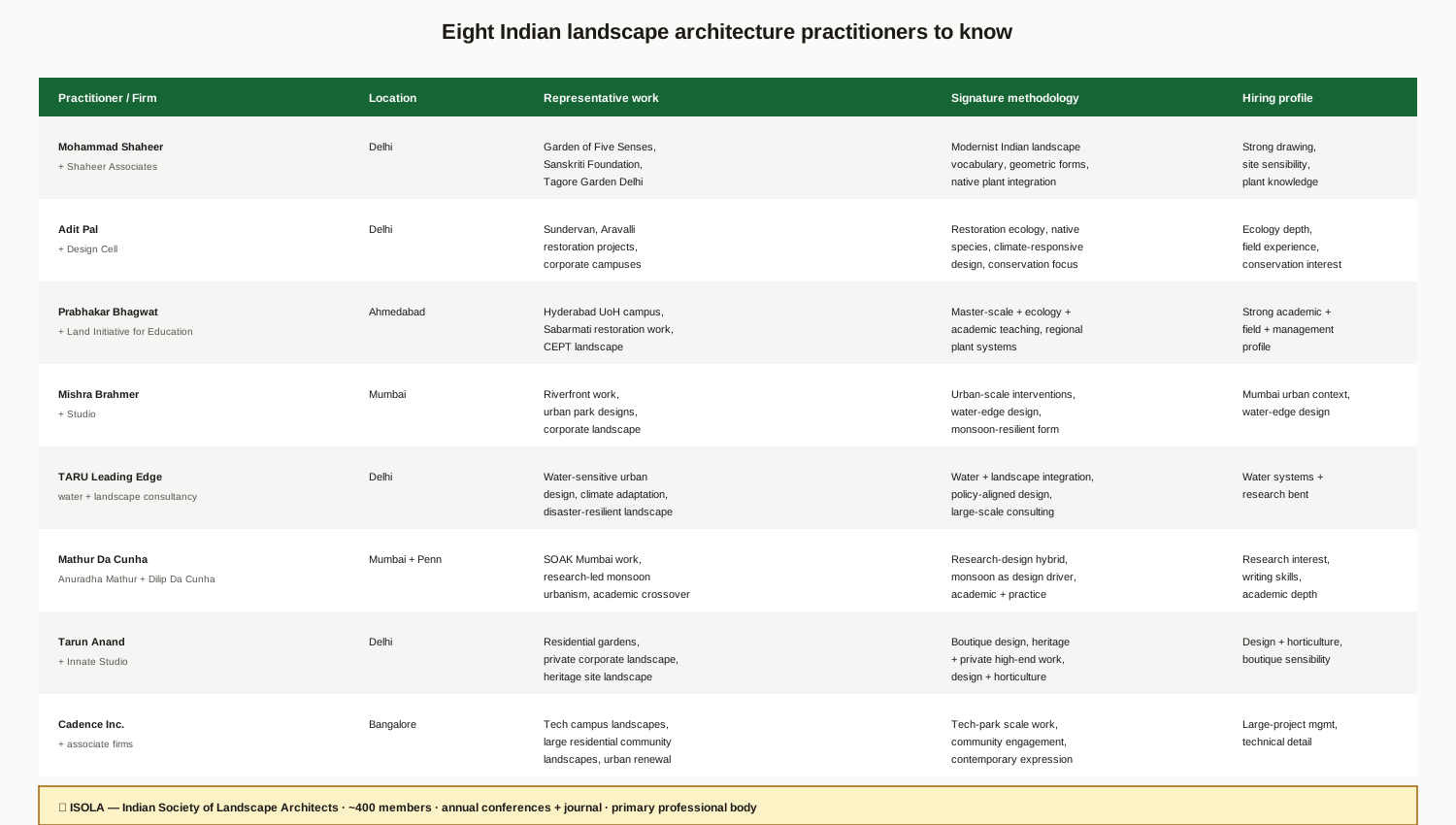
1. Mohammad Shaheer + Shaheer Associates (Delhi) — Garden of Five Senses, Sanskriti Foundation, Tagore Garden. Modernist Indian landscape vocabulary, geometric forms, native plant integration.
2. Adit Pal + Design Cell (Delhi) — Sundervan, Aravalli restoration projects. Restoration ecology, native species, climate-responsive design, conservation focus.
3. Prabhakar Bhagwat + Land Initiative for Education (Ahmedabad) — Hyderabad UoH campus, Sabarmati restoration, CEPT landscape. Master-scale + ecology + academic teaching.
4. Mishra Brahmer Studio (Mumbai) — Riverfront work, urban park designs, corporate landscape. Urban-scale + water-edge + monsoon-resilient.
5. TARU Leading Edge (Delhi) — Water + landscape consultancy. Water-sensitive urban design, climate adaptation, disaster-resilient landscape.
6. Mathur Da Cunha (Mumbai + Penn) — Anuradha Mathur + Dilip Da Cunha — SOAK Mumbai. Research-led monsoon urbanism, academic-practice crossover.
7. Tarun Anand + Innate Studio (Delhi) — Residential gardens, private corporate landscape, heritage site landscape. Boutique design.
8. Cadence Inc. (Bangalore) — Tech campus landscapes, large residential community landscapes, urban renewal.
Education Pathways — Detail
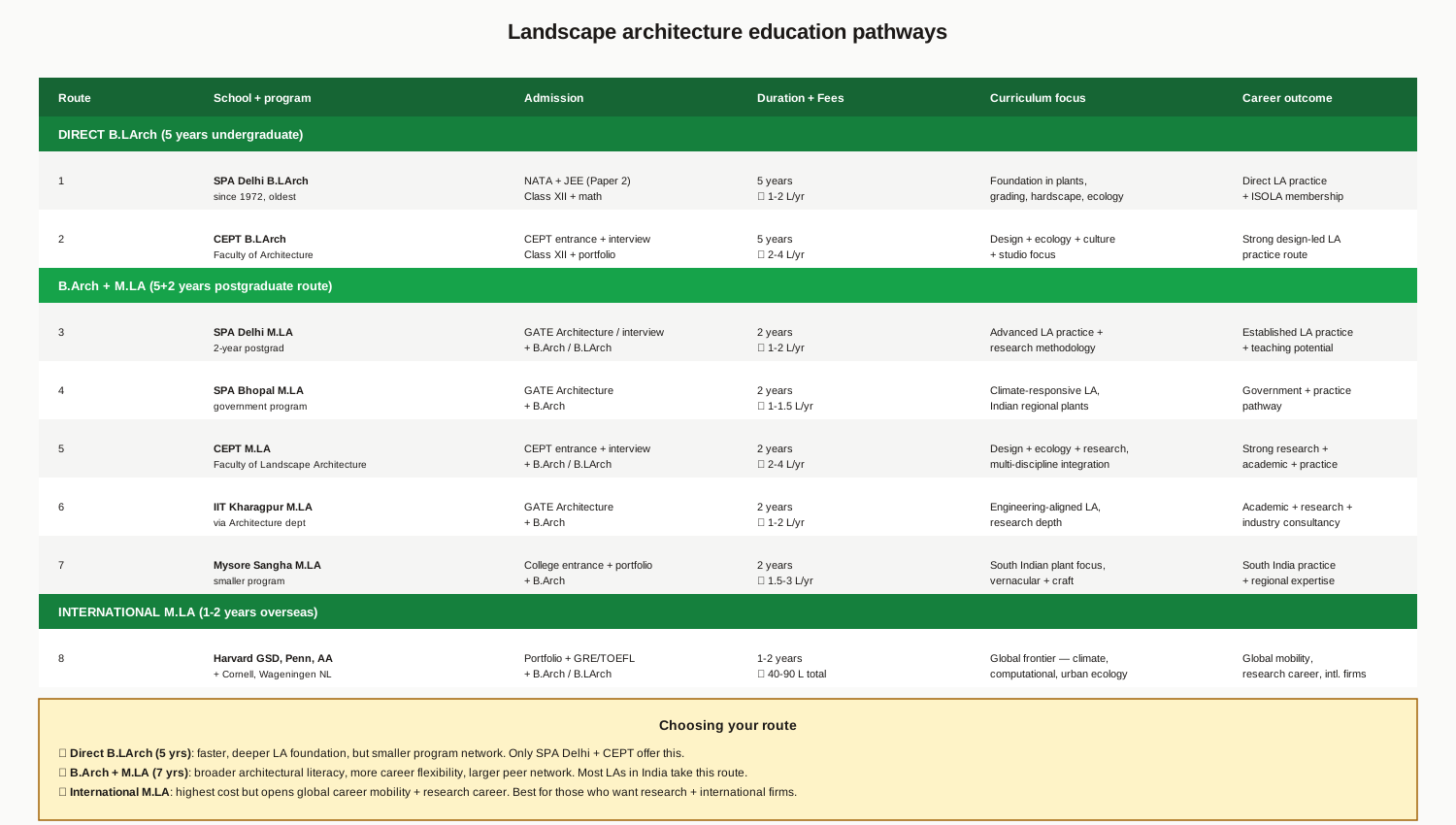
Direct B.LArch (5 years undergraduate)
1. SPA Delhi B.LArch (since 1972, oldest in India) — NATA + JEE Paper 2 admission · ₹ 1-2 L/yr · Foundation in plants, grading, hardscape, ecology · Direct LA practice + ISOLA membership
2. CEPT B.LArch — CEPT entrance + interview + portfolio · ₹ 2-4 L/yr · Design + ecology + culture + studio focus · Strong design-led LA practice route
B.Arch + M.LA (postgraduate route)
3. SPA Delhi M.LA — GATE Architecture / interview · 2 years · ₹ 1-2 L/yr · Advanced LA practice + research methodology
4. SPA Bhopal M.LA — GATE Architecture · 2 years · ₹ 1-1.5 L/yr · Climate-responsive LA, Indian regional plants
5. CEPT M.LA — CEPT entrance + interview · 2 years · ₹ 2-4 L/yr · Design + ecology + research, multi-discipline integration
6. IIT Kharagpur M.LA — GATE Architecture · 2 years · ₹ 1-2 L/yr · Engineering-aligned LA, research depth
7. Mysore Sangha M.LA — College entrance + portfolio · 2 years · ₹ 1.5-3 L/yr · South Indian plant focus, vernacular + craft
International M.LA (1-2 years overseas)
8. Harvard GSD, Penn, AA London, TU Delft, Wageningen NL — Portfolio + GRE/TOEFL + B.Arch / B.LArch · 1-2 years · ₹ 40-90 L total · Climate, computational, urban ecology frontier · Global mobility + research career
Choosing your route
- Direct B.LArch (5 yrs) is faster + deeper LA foundation but smaller program network. Only SPA Delhi + CEPT.
- B.Arch + M.LA (7 yrs) offers broader architectural literacy, more career flexibility. Most Indian LAs take this route.
- International M.LA is highest cost but opens global career mobility + research career.
Eight Project Types — Full Scale Range
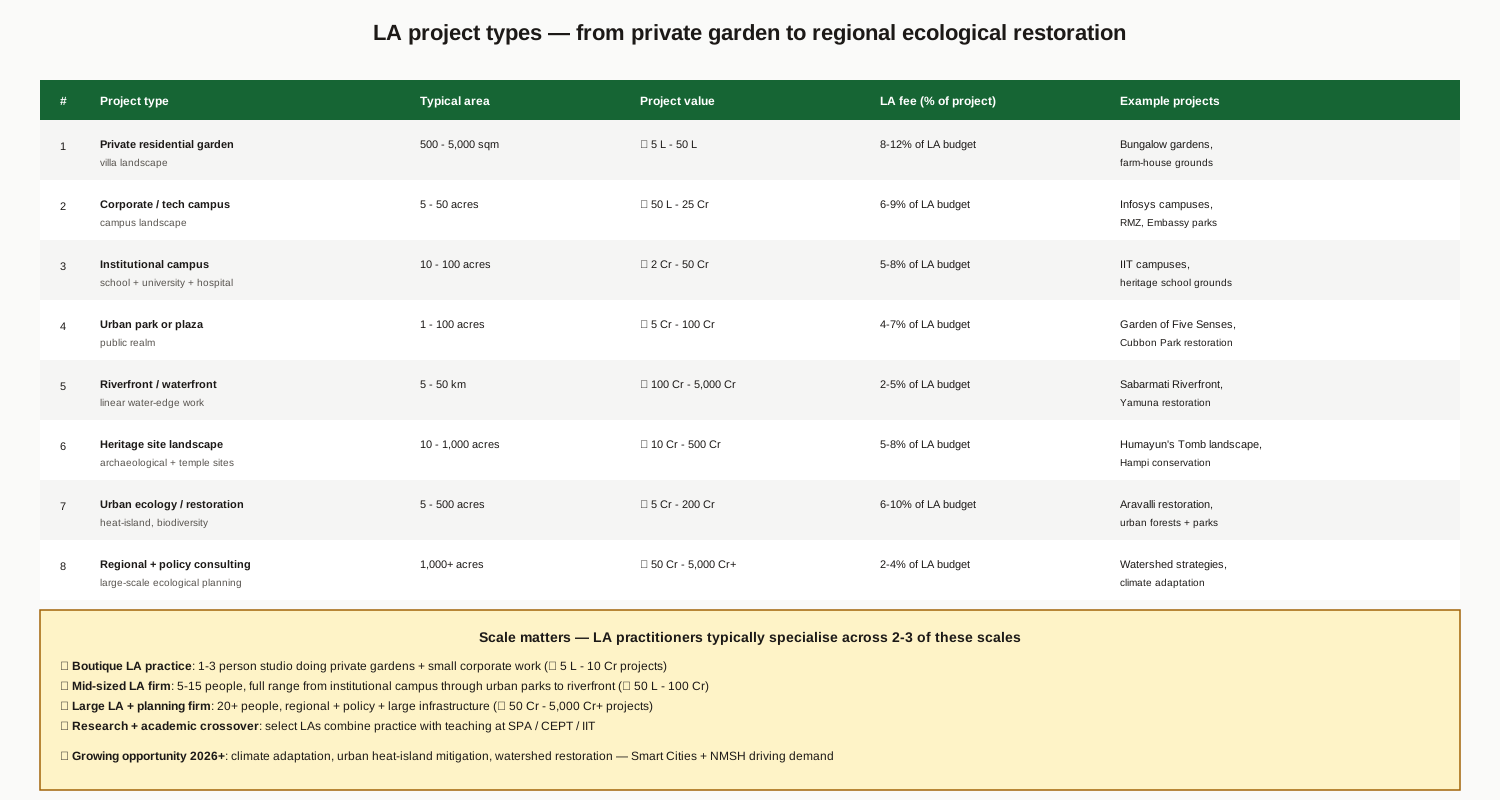
| # | Project type | Area | Project value | LA fee |
|---|---|---|---|---|
| 1 | Private residential garden | 500 - 5,000 sqm | ₹ 5 L - 50 L | 8-12% |
| 2 | Corporate / tech campus | 5 - 50 acres | ₹ 50 L - 25 Cr | 6-9% |
| 3 | Institutional campus | 10 - 100 acres | ₹ 2 Cr - 50 Cr | 5-8% |
| 4 | Urban park / plaza | 1 - 100 acres | ₹ 5 Cr - 100 Cr | 4-7% |
| 5 | Riverfront / waterfront | 5 - 50 km linear | ₹ 100 Cr - 5,000 Cr | 2-5% |
| 6 | Heritage site landscape | 10 - 1,000 acres | ₹ 10 Cr - 500 Cr | 5-8% |
| 7 | Urban ecology / restoration | 5 - 500 acres | ₹ 5 Cr - 200 Cr | 6-10% |
| 8 | Regional + policy consulting | 1,000+ acres | ₹ 50 Cr - 5,000 Cr+ | 2-4% |
Practitioner scale specialisation
- Boutique LA practice (1-3 person): private gardens + small corporate (₹ 5 L - 10 Cr projects)
- Mid-sized LA firm (5-15 people): full range from campus through parks to riverfront (₹ 50 L - 100 Cr)
- Large LA + planning firm (20+ people): regional + policy + large infrastructure (₹ 50 Cr - 5,000 Cr+)
- Research + academic crossover: practice + teaching at SPA / CEPT / IIT
Growing opportunity 2026+: climate adaptation, urban heat-island mitigation, watershed restoration — Smart Cities + NMSH driving demand.
Five Career Pathways
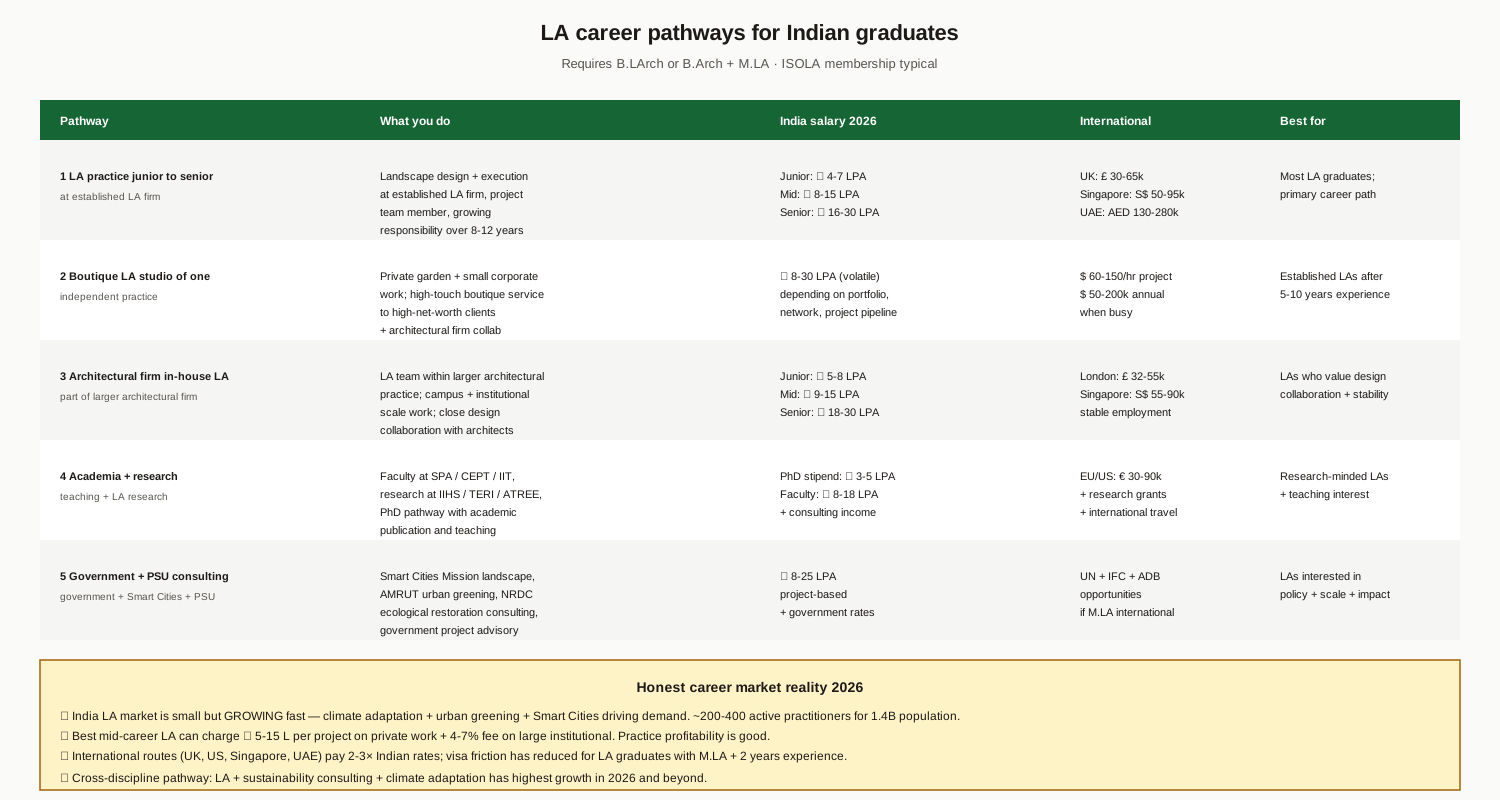
| Pathway | India salary (2026) | International |
|---|---|---|
| 1 LA practice junior to senior | ₹ 4-30 LPA | UK £30-65k, Singapore S$50-95k, UAE AED 130-280k |
| 2 Boutique LA studio of one | ₹ 8-30 LPA (volatile) | $60-150/hr; $50-200k annual when busy |
| 3 Architectural firm in-house LA | ₹ 5-30 LPA | London £32-55k, Singapore S$55-90k |
| 4 Academia + research | PhD ₹3-5L; Faculty ₹8-18 LPA + consulting | EU/US € 30-90k + research grants |
| 5 Government + PSU consulting | ₹ 8-25 LPA project-based | UN + IFC + ADB opportunities |
Career trajectory
Most LA graduates start at Pathway 1 (LA practice at established firm), build 5-10 years of experience, then choose Pathway 2 (boutique studio) or stay senior at Pathway 1/3. Pathway 4 (academia) requires PhD pursuit. Pathway 5 (government) requires PSC / direct recruitment.
India + international
- India LA market is small but GROWING fast — climate adaptation + urban greening + Smart Cities driving demand
- Best mid-career LA can charge ₹ 5-15 L per project on private work + 4-7% fee on large institutional
- International routes (UK, US, Singapore, UAE) pay 2-3× Indian rates
- Cross-discipline pathway: LA + sustainability consulting + climate adaptation has highest growth in 2026 and beyond
Pre-Specialisation Checklist
1. Aptitude check — do you think about plants, water, ecology more than indoor space? Field-test by reading 2-3 LA books and visiting 2-3 Indian LA project sites
2. Studio project in landscape scope — at least one B.Arch studio with landscape emphasis to confirm interest
3. Plant + ecology basics — start learning 30-50 native plants of your region; visit botanical gardens
4. Software stack — QGIS + AutoCAD + InDesign + basic plant database tool (Plants Map, iNaturalist)
5. Internship at LA firm — 3-6 months internship at one of the named LA practices confirms fit
6. Reading list — at minimum read Bhagwat, Shaheer monographs + one international LA classic (Olin, Olmstead, Latz)
7. ISOLA student membership — gives access to network + conferences + journal
8. Education plan — B.LArch (if undergraduate decision) OR M.LA (after B.Arch) committed to
Where to Go Next
- For thesis topics in sustainability + climate: Architecture Thesis Topics Family 6
- For urban design (adjacent discipline): Urban Design Concepts in India
- For site analysis: Site Analysis for Architecture in India
- For sustainability framework: Sustainable Home Design in India, Green Building Certifications
- For career planning: Career Pathways After B.Arch
- For climate-zone depth: Designing for Indian Climate, Cross-Ventilation in Indian Homes
References
1. ISOLA (Indian Society of Landscape Architects). Profession body, journal, conferences. isola.org.in
2. Olin, L. (2009). Across the Open Field — Essays Drawn from English Landscapes. University of Pennsylvania.
3. Booth, N. & Hiss, J. (2018). Residential Landscape Architecture — Design Process for the Private Residence. Pearson.
4. Reid, G. W. (2007). Landscape Graphics — Plan, Section, and Perspective Drawing. Watson-Guptill.
5. Krishen, P. (2006). Trees of Delhi — A Field Guide. Penguin India.
6. Krishen, P. (2014). Jungle Trees of Central India. Penguin India.
7. Mathur, A. & Da Cunha, D. (2009). SOAK — Mumbai in an Estuary. Rupa Publications.
8. Bhagwat, P. & Bhagwat, A. (eds, ongoing). Land Initiative for Education publications.
9. Indian Botanical Liaison Officer (IBLO) + BSI. Flora of India multi-volume series.
10. Olmstead, F. L. (1865, reprint 1996). Olmsted — Designing the American Landscape. Rizzoli.
Author's note: Landscape architecture is the most overlooked discipline in Indian architectural education + practice — and the one with the strongest tailwinds in 2026 (climate adaptation, urban greening, biodiversity, water management). Practitioners are rare; demand is growing; international mobility is good. If you have aptitude — if you find yourself sketching tree canopies more than building elevations — pursue it. The educational route is long (5-7 years undergraduate + master + practice), the disciplinary depth is real (12 years to expertise), but the career arc is durable, meaningful, and increasingly valuable as Indian cities grapple with climate adaptation.
Disclaimer: LA methodology and education are largely stable; this guide refreshes every 24 months. Indian education programmes (SPA Delhi, CEPT, SPA Bhopal, IIT Kharagpur) update curriculum periodically — verify current programme structure with institutions. International programmes evolve faster. Career salary benchmarks are 2026 indicative. Studio Matrx, its authors and contributors are not responsible for educational or career decisions based on this guide.
Interactive · Climate-zone planting palette
Temperate · Bengaluru, Pune, Hyderabad · 5 species
Jacaranda
Jacaranda mimosifolia
Lilac avenue tree; Bengaluru signature.
Silver oak
Grevillea robusta
Originally a coffee-shade tree; fern-like foliage.
Rose
Rosa × hybrida
Cool nights suit hybrid teas; mainstay of Bengaluru gardens.
Heliconia
Heliconia psittacorum
Tropical structure for plinth borders.
Mexican grass
Bouteloua gracilis
Drought-tolerant lawn alternative.
Lists are starter palettes — combine 2-3 shade trees, 3-5 ornamentals, 5-7 shrubs/groundcovers for a balanced civic or residential landscape. Verify against the IGBC plant list for green-rated projects.
Export this guide
Related Guides — Deep-dive reading
B.Des Interior Design — The Student Track
The 2026 Reference for the Indian B.Des Interior Aspirant — How It Differs from B.Arch, the Top Schools (NID · Pearl · Symbiosis · NIFT · Sushant), the Four-Year Curriculum, the Software Stack, FF&E and Materials Vocabulary, Studio Discipline, Portfolio Building, Internship Pathways, Career Trajectories, and the Long-Horizon Practice Map
Student FoundationsIndian Architecture Schools — A Working Shortlist
The 2026 Reference for B.Arch Aspirants — COA-Approved Institutions, Tier Map, Cost-of-Attendance Ranges, Pedagogy Profiles, Faculty Strengths, Geographic Distribution, Application Deadlines, and the Decision Framework for Choosing the School That Fits You
Student FoundationsUrban Design — A Student's Working Reference
Between Architecture and Planning · Five Foundational Concepts · Indian Exemplars · Career Pathways
Student FoundationsRelated Tools — Try Free
Cross-Ventilation Analyzer
Estimate airflow and air changes per hour (ACH) from room size, window areas, layout, and local wind — with NBC 2016 Part 8 compliance check.
Ventilation CalculatorGarden Planning Toolkit
Get a tailored garden plan — planting layers, Indian species, features and a checklist — from your climate, space, sun and goals.
PlannerMonsoon-Readiness Checklist
Pre-rain home audit across 9 categories — terrace, drains, waterproofing, electrical, HVAC, pest, vehicles, documents.
Seasonal Audit