
Landscape Cost Guide India: What a Garden Really Costs
A transparent, table-rich 2026 costing guide for home landscaping in India — every component priced, with the maintenance cost everyone forgets
Everyone budgets for the house and forgets the ground it stands on. The slab, the walls, the kitchen, the wardrobes — all costed to the rupee — and then the plot around the building becomes a "we'll plant something later" line that quietly turns into a muddy strip of weeds, a cracked path and a lawn that dies every May. The garden, the one part of a home you see from every window, is the part nobody prices honestly.
This guide prices it honestly — every component of a home garden: design fees, site preparation, the hardscape of paving and pergolas and walls, the softscape of trees and shrubs and lawn, irrigation, lighting, drainage — and then the cost almost every homeowner underestimates: the ongoing one, the gardener and the water and the replacement of things that died. All figures below are indicative 2026 ranges for Indian residential work, separated into metro and tier-2 where the gap is real, and labelled by quality tier so you can locate yourself.
A garden is not a one-time purchase; it is a system you build once and then run forever — and the families who are happy with theirs are the ones who priced the running, not just the building.
What a garden actually costs: the honest range
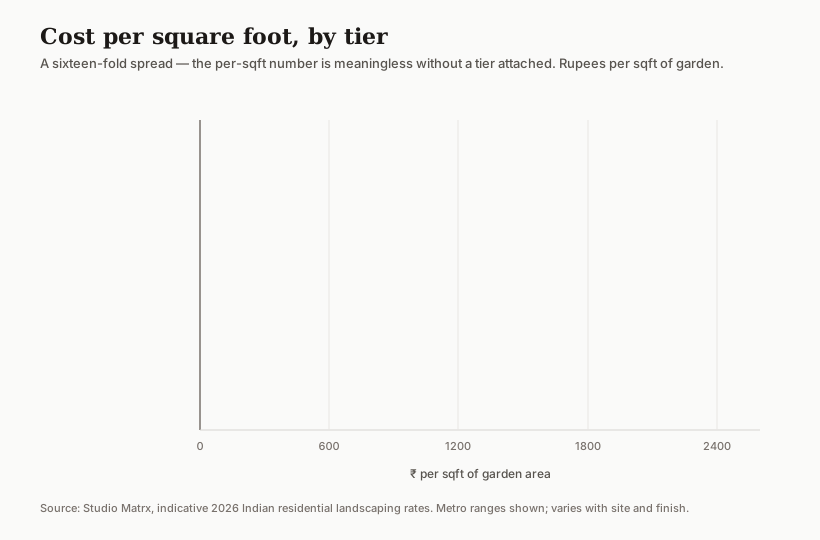
Across Indian residential landscaping, a finished garden lands somewhere between ₹150 and ₹2,500 per square foot of garden area — a sixteen-fold spread that tells you the per-sqft figure alone is almost meaningless without a tier attached. A basic garden (levelled soil, a simple path, hardy native shrubs, a small lawn or groundcover) sits at the bottom; a premium garden (architect-designed, with quality stone paving, a pergola, a water body, automated drip irrigation and accent lighting) sits at the top.
The spread is so wide because landscaping is the most optional part of a home. You cannot build half a roof, but you can build a garden in ten different ways, each defensible. The discipline is to decide which tier each zone of your plot deserves rather than averaging one number across the site — the entrance court and seating terrace earn premium spend; the side setback and service yard do not.
| Tier | What it includes | Indicative ₹/sqft of garden | Typical share of build |
|---|---|---|---|
| Basic | Grading, one simple path, native shrubs, lawn or groundcover, manual hose | ₹150–₹400 | DIY or local mali |
| Mid | Designed layout, decent paving, mixed planting, drip irrigation, basic lighting | ₹450–₹1,000 | Landscape contractor |
| Premium | Architect-designed, stone hardscape, pergola, water feature, automation, lighting scheme | ₹1,100–₹2,500+ | Landscape architect + contractor |
A useful sanity check: a thoughtful mid-tier home garden in an Indian metro typically runs 3 to 8 percent of the cost of the house it surrounds. Spend much less and the grounds let the building down; spend much more and you are usually buying a water feature or imported stone the maintenance budget cannot sustain. Before you commit, model your plot against these tiers with the cost calculator so the conversation with a contractor starts from a number you chose.
Where the money goes: the budget split
Once you stop thinking in a single rate and start thinking in components, the budget becomes controllable. For a typical mid-tier Indian home garden, the spend divides roughly as below. Hardscape — anything hard and built, from paving to walls to a pergola — almost always dominates, because stone, concrete and skilled masonry are expensive, while plants are cheap to buy and costly only to keep alive.
| Component | Share of a mid-tier garden budget | Why |
|---|---|---|
| Hardscape (paving, walls, pergola, steps) | 45–60% | Material + skilled labour heavy |
| Softscape (trees, shrubs, lawn, soil) | 15–25% | Plants cheap; soil and large trees add up |
| Irrigation (drip, sprinkler, automation) | 5–12% | Pipework + controller + pump |
| Lighting (fixtures, cabling, transformer) | 5–12% | Fixtures and weatherproof wiring |
| Drainage and site prep | 8–15% | Invisible but non-negotiable |
| Design fees | 5–12% | Scales with complexity |
The commonest costing mistake is to fall in love with the softscape — the trees, the flowers, the lawn — and discover the hardscape it sits in has eaten two-thirds of the money before a single plant arrives. Knowing the split in advance lets you flip it on purpose: a garden that leans soft (more planting, less paving) is cheaper to build, greener, cooler and kinder to groundwater, and the design literature has long argued it is also the more restorative one to live with.
Design fees and site preparation: the parts you cannot see
Design fees. A garden you plan on paper costs less to build than one you improvise on site, because mistakes in mud are cheaper to erase with an eraser than with a JCB. Landscape designers in India typically charge one of three ways: a per-square-foot design fee of ₹15–₹80/sqft, a percentage of build cost of 8–15%, or a lump sum for a defined scope. A planting-only consultation might be ₹10,000–₹40,000; a full landscape-architect engagement with drawings, planting, lighting and irrigation layouts for a sizeable villa plot can run ₹1.5–₹6 lakh or more. The fee feels like overhead until you have torn out a path laid in the wrong place.
Site preparation, grading and soil. This is the line that destroys budgets — invisible, unglamorous and therefore under-quoted. Before anything grows or is paved, the site usually needs clearing of construction debris (Indian plots are routinely left with broken brick and slurry), cutting and filling for usable levels and drainage falls, and — critically — good soil. Builder's backfill is dead, compacted and often alkaline; almost every Indian garden needs imported topsoil and organic matter to grow anything well. Reckon ₹25–₹120 per sqft for grading plus a soil layer, depending on how much earth must move and how deep the beds go. Skimp here and every plant above it underperforms for years.
| Preparatory item | Indicative cost | Note |
|---|---|---|
| Site clearing and debris removal | ₹10–₹40/sqft | Worse on post-construction plots |
| Cut/fill grading and levelling | ₹15–₹60/sqft | Depends on slope and access |
| Imported topsoil + compost (150–300 mm) | ₹30–₹90/sqft of bed | Non-negotiable for healthy planting |
| Soil testing (pH, drainage, salinity) | ₹2,000–₹8,000 | Cheap insurance against plant death |
Hardscape versus softscape: the great cost divide
The deepest cost decision in any garden is the ratio of hard to soft. Hardscape is durable, low-maintenance and expensive up front; softscape is cheap up front, grows in value, but demands water, weeding and time. The right ratio for an Indian home is usually 30–45% hardscape to 55–70% softscape — enough paving to use the garden in the monsoon and enough planting to cool it, green it and let rain soak in. Plots that flip toward concrete are cheaper to maintain but hotter, harsher and worse for the water table, and forfeit the documented restorative benefit of greenery.
Hardscape costs. Typical installed rates, material and labour included. Natural stone has risen sharply; cast concrete, kota or fly-ash blocks are far kinder.
| Hardscape element | Basic | Mid | Premium |
|---|---|---|---|
| Paving (per sqft, installed) | ₹80–₹160 (concrete, kota) | ₹180–₹400 (granite, sandstone) | ₹450–₹1,200 (imported, cobble) |
| Boundary wall (per running ft) | ₹600–₹1,200 | ₹1,300–₹2,500 | ₹2,600–₹6,000+ |
| Pergola (per sqft of cover) | ₹350–₹700 (MS/wood) | ₹800–₹1,600 | ₹1,800–₹4,000 (teak, automated) |
| Water feature (each) | ₹15,000–₹50,000 | ₹60,000–₹2,00,000 | ₹2,50,000–₹10,00,000+ |
| Outdoor kitchen / BBQ counter | ₹40,000–₹1,00,000 | ₹1,20,000–₹3,50,000 | ₹4,00,000+ |
| Steps, edging, retaining | ₹120–₹350/sqft | ₹300–₹700/sqft | ₹750–₹1,800/sqft |
Softscape costs. Plants are the bargain of the garden — until you count the large specimen trees (priced like furniture) and the lawn (priced like a subscription).
| Softscape element | Indicative cost | Note |
|---|---|---|
| Lawn — Bermuda/Mexican grass (laid) | ₹25–₹60/sqft | Plus year-round upkeep |
| Groundcover (wedelia, mondo grass) | ₹15–₹40/sqft | Cheaper, tougher than lawn |
| Shrubs (1–2 ft, per plant) | ₹60–₹400 | Native species cheapest |
| Large specimen tree (8–12 ft) | ₹2,500–₹25,000 | Gulmohar, frangipani, neem |
| Climbers and creepers (per plant) | ₹80–₹500 | For pergola, screens |
| Pots and planters | ₹300–₹15,000 each | Terracotta cheapest |
A note on native species, which is also a cost note: plants native or naturalised to your climate zone — neem, gulmohar, frangipani (champa), curry leaf, ixora, bougainvillea, and grasses suited to your region — are cheaper to buy, far cheaper to keep alive, and they support local birds and pollinators that an imported lawn never will. The FRLHT databases and Pradip Krishen's field guides (Trees of Delhi, Jungle Trees of Central India) help here: the right plant in the right place is the single biggest lever on lifetime cost.
Irrigation, lighting and drainage: the systems
Irrigation. A hose is free to install and ruinous over time — it wastes water, demands daily labour, waters unevenly. A drip system is the opposite: more up front, far less forever. Drip irrigation typically costs ₹15–₹45 per sqft of planted area installed, lawn sprinklers ₹25–₹60 per sqft, and a timer or smart controller ₹3,000–₹25,000. Drip delivers water at the root, cutting consumption by up to 50–60% versus surface watering — in a water-stressed country, the most important efficiency a garden can have. It pairs directly with the rainwater and greywater strategies in sustainable water management in landscapes.
Lighting. Garden lighting makes the space usable after dark and is routinely value-engineered to nothing, then bolted on badly later. Budget ₹8–₹40 per sqft for a proper low-voltage scheme, or per-fixture: path/bollard ₹800–₹6,000 each, spike/spotlights ₹500–₹4,000, step lights ₹1,200–₹5,000, plus transformer and weatherproof cabling. LED throughout is now standard and slashes running cost. A handful of well-aimed uplights on one good tree does more than a dozen scattered fittings.
Drainage. The least glamorous and most consequential line. India's monsoon is brutal on a garden that cannot shed water: lawns drown, paths heave, walls undercut, and the house itself is at risk if water pools against the plinth. Surface and sub-surface drainage typically adds ₹20–₹70 per sqft by soil and slope, and it is the one item you must never cut. Done well, drainage and the soak-aways that feed groundwater overlap with rainwater harvesting — water you direct into the ground in July is water your plants draw on in May.
| System | Basic | Mid | Premium |
|---|---|---|---|
| Irrigation (drip, per planted sqft) | manual hose | ₹15–₹30 | ₹35–₹45 + automation |
| Sprinkler (lawn, per sqft) | — | ₹25–₹40 | ₹45–₹60 + controller |
| Lighting (per sqft of garden) | ₹8–₹15 | ₹16–₹28 | ₹30–₹40+ |
| Drainage (per sqft) | ₹20–₹35 | ₹35–₹55 | ₹55–₹70 |
A sample budget for a typical plot
Tables are abstract until they add up. Consider a 1,500 sqft garden around a metro home (the open area of a typical 2,400 sqft plot), built mid-tier with one seating terrace, a pergola, mixed native planting, a modest lawn, drip irrigation, basic lighting and proper drainage.
| Line item | Quantity / basis | Indicative cost |
|---|---|---|
| Design fee | 8% of build | ₹95,000 |
| Site prep, grading, topsoil | 1,500 sqft @ ₹60 | ₹90,000 |
| Drainage | 1,500 sqft @ ₹45 | ₹67,500 |
| Paving (terrace + paths) | 400 sqft @ ₹280 | ₹1,12,000 |
| Pergola | 120 sqft @ ₹1,100 | ₹1,32,000 |
| Boundary planting + screen wall | partial | ₹85,000 |
| Lawn | 350 sqft @ ₹45 | ₹15,750 |
| Shrubs, trees, climbers, pots | mixed native | ₹1,10,000 |
| Drip irrigation + timer | 750 planted sqft @ ₹30 + controller | ₹32,500 |
| Lighting | 1,500 sqft @ ₹22 | ₹33,000 |
| Water feature (small) | one | ₹70,000 |
| Contingency | ~8% | ₹75,000 |
| Total build | — | ≈ ₹10.2 lakh |
That is roughly ₹680 per sqft of garden, squarely mid-tier. In a tier-2 city the same garden lands nearer ₹7.5–₹8.5 lakh, mostly on cheaper labour and local stone. Strip the water feature and pergola and you drop to a basic garden around ₹6 lakh; add stone paving, automation and a larger water body and you climb toward ₹18–₹22 lakh of premium. The structure stays the same; the tier of each line moves.
A word on GST and the labour-versus-material split. Landscaping is a works contract: GST is generally 18% on the contracted value, and you should ask whether quotes are inclusive or exclusive — the difference on a ₹10 lakh garden is ₹1.8 lakh and the source of countless disputes. Material is typically 55–65% of a hardscape-heavy garden and labour 35–45%; in tier-2 cities the labour share shrinks because wages are lower, the main reason the same garden costs less outside the metros.
The cost everyone forgets: maintenance over time
Here is the line that separates a garden someone loves from one someone resents. A garden's lifetime cost is dominated not by what you build but by what you spend keeping it alive. Over five years, upkeep routinely exceeds the build cost; over ten it dwarfs it. Yet almost no homeowner asks about it before signing.
The recurring costs are four: a gardener (a part-time mali at ₹2,000–₹8,000/month, or a serviced contract at ₹4,000–₹20,000/month), water (a lawn drinks 4–6 litres per sqft per day in summer — for 350 sqft that is over 1,500 litres daily, a real cost where water is tankered), inputs (manure, fertiliser, pest control, ₹1,000–₹5,000/month), and replacement (10–20% of plants and the odd fitting or pump fail each year). A water feature adds pump electricity and cleaning; automation adds valve servicing.
| Maintenance item | Basic garden | Mid garden | Premium garden |
|---|---|---|---|
| Gardener / contract (monthly) | ₹2,000–₹3,500 | ₹4,000–₹9,000 | ₹12,000–₹25,000 |
| Water (monthly, summer-weighted) | ₹500–₹1,500 | ₹1,500–₹4,000 | ₹4,000–₹12,000 |
| Inputs (manure, pest, monthly avg) | ₹500–₹1,200 | ₹1,200–₹3,000 | ₹3,000–₹7,000 |
| Replacement + repairs (annual) | ₹5,000–₹15,000 | ₹20,000–₹50,000 | ₹60,000–₹2,00,000 |
| Annual upkeep, indicative | ₹40,000–₹85,000 | ₹1.0–₹2.4 lakh | ₹3–₹7 lakh |
The design implication runs against intuition: the cheapest garden to own is often the more expensive one to build. A garden of native, drought-hardy planting on drip irrigation, with groundcover instead of lawn and durable stone instead of fussy timber, costs more on day one and a fraction to run. The lawn is the clearest example — the single most expensive square foot to maintain in any Indian garden (water, mowing, edging, fertiliser, reseeding every year), and in a hot-dry climate the least appropriate. Replacing half the lawn with native groundcover, gravel courts or shrub beds typically cuts water and labour by a third or more while looking richer, not poorer.
We do not inherit the garden from our build budget; we borrow it from every summer we will spend watering it. Price the watering first, and the garden will be honest.
Where to spend, where to save, and how to phase
Not every rupee buys the same value. The reliable rule, drawn from how gardens age, is to spend on the bones and the systems, save on the dressing — the bones are hard to change later and the dressing changes itself.
Spend on: drainage and soil (everything depends on them and they are buried), the seating terrace and the path you walk daily, a few large specimen trees (they take years you cannot buy back, and a mature tree can cool its surroundings by 2–4°C through shade and evapotranspiration), and drip irrigation (it pays for itself in water and labour within a few years).
Save on: lawn area (the most expensive square foot to own — shrink it), imported stone where local kota or granite reads almost as well, oversized water features (a liability and the first thing people let stagnate), and fussy annual flowers (use perennial natives that return free each year).
Phasing a garden over seasons is the most underused cost strategy in India. A garden need not arrive complete. Build the bones first — grading, drainage, paving, irrigation pipework, and the trees, which must go in early because they take longest to mature. Then add planting in waves timed to the monsoon, when survival rates are highest and watering costs lowest: the rains do your irrigation for you and young plants establish before the next dry season. Lighting, the pergola and the water feature can wait for a later budget cycle. Phasing also spreads GST and cash outflow, and lets you learn how you actually use the garden before building the expensive bits — a discipline our pillar guide on why some gardens feel peaceful endorses. For how professional landscape design adds value beyond cost, see landscape architecture in India.
What this means for your home
1. Price the running cost before the build cost. Ask any contractor for the monthly upkeep — gardener, water, inputs, replacement. If they cannot answer, they have not designed for the long term.
2. Choose a tier per zone, not one rate for the plot. Premium at the entrance and seating court; basic at the side setback and service yard.
3. Protect the buried lines. Drainage and soil are non-negotiable — everything above them fails if skimped, and they are the costliest to fix later.
4. Lean soft, plant native. A garden weighted toward native planting over hardscape is cheaper to build and run, cooler, and better for groundwater and birdlife.
5. Shrink the lawn. The costliest square foot to own. Groundcover, gravel courts and shrub beds give more for far less water and labour.
6. Irrigation and drainage first, decoration later. Phase the build with the monsoon, plant trees early, add pergola, lighting and water feature in a later cycle.
7. Confirm GST and the inclusive/exclusive basis in writing. On a ten-lakh garden the difference is nearly two lakh.
How Studio Matrx helps
Before you commit a single rupee to grading or stone, it helps to see the garden — and to test how the cost moves when you shrink the lawn, swap imported paving for kota, or phase the pergola to next year. DesignAI lets you visualise your plot at different tiers and planting mixes, so you can feel the difference between a hardscape-heavy court and a soft, native, low-water garden before the JCB arrives. Pair that picture with a build-up from the cost calculator so the number you take to a contractor is one you chose on purpose — running cost and all.
References
1. The Energy and Resources Institute (TERI). Studies on urban green cover and the heat-island effect in Indian cities — tree-canopy cooling of 2–4°C in shaded microclimates.
2. Foundation for Revitalisation of Local Health Traditions (FRLHT) / ENVIS. Database of Indian native and medicinal plant species for region-appropriate, low-maintenance selection.
3. Krishen, Pradip. Trees of Delhi (2006) and Jungle Trees of Central India (2013) — native and naturalised species suited to Indian climate zones.
4. Bureau of Indian Standards / CPWD. Works-contract norms and GST applicability (18%) on landscaping and horticulture works.
5. Central Ground Water Board (CGWB), Government of India. Guidance on rainwater harvesting, soak-pits and groundwater recharge in residential plots.
6. Food and Agriculture Organization (FAO). Irrigation-efficiency literature — drip water savings of 40–60% versus surface/flood watering.
7. Ulrich, R. S. (1984). "View Through a Window May Influence Recovery from Surgery." Science, 224(4647), 420–421 — greenery aids recovery; the wellbeing case for planting.
8. Kaplan, R. & Kaplan, S. (1989). The Experience of Nature — Attention Restoration Theory and the restorative value of green over hard surface.
9. Kuo, F. E. & Sullivan, W. C. (2001). Greenery, attention and wellbeing in residential settings — the case for soft over hard landscape.
10. India Meteorological Department (IMD). Regional climate and monsoon data informing planting-season timing and irrigation demand by zone.
Part of the Studio Matrx Landscape series. Continue with why some gardens feel peaceful, landscape architecture in India, and sustainable water management in landscapes.
Export this guide
Related Guides — Deep-dive reading
Villa Landscape Design — Indian Villa Gardens, Hardscape & Vastu Landscape (2026)
8 landscape zones · Climate-zone tree palette · Vastu landscape · NBC 2016 Part 10 · 1.5 acre worked example
Design StylesThe Truth About Cost Per Square Foot
Why a ₹/sqft interior quote is the most misleading number in Indian home costing — and how to convert it into a real BOQ
Cost & MoneyThe Best Trees for Indian Homes
A research-grade guide to choosing and placing trees around an Indian home — the real cooling and clean-air numbers, the right species for shade, flowers, fragrance and fruit, and the placement science that keeps roots out of your walls and drains.
LandscapeRelated Tools — Try Free
Rainwater Tank Sizer
How big should your rainwater tank be? Computes annual harvest, recommended tank capacity in litres, water-bill savings, and payback — for 10 Indian cities.
RWH CalculatorLandscape Cost Calculator
Estimate a garden's cost — hardscape, softscape, lawn, irrigation, lighting and annual upkeep — by area, tier and city.
Budget CalculatorHealing View Impact Calculator
Evidence-Based Design dashboard quantifying the recovery impact of nature view + daylight factor on analgesic use, length of stay, and HCAHPS patient-experience uplift. Calibrated against Ulrich 1984 (Science), Park & Mattson 2008, and the CHD EBD evidence base.
EBD Calculator