
What Is Human-Centered Design?
Architecture that begins and ends with the people who use it — empathy as a design method
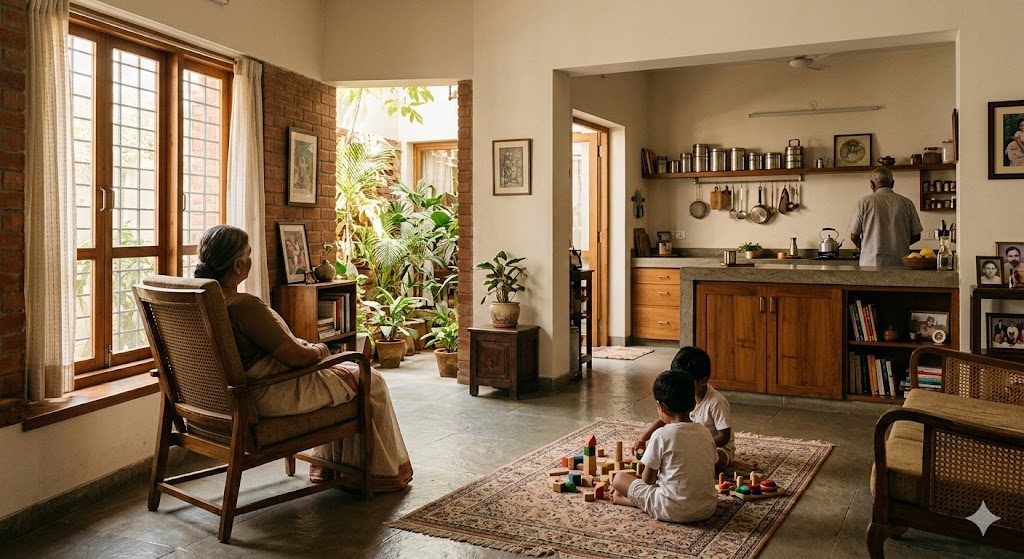
Walk into a home that was truly designed around the people who live in it, and you feel it before you can name it. The kitchen counter sits exactly where your hands fall when you cook; the morning light reaches the dining table at the hour the family actually eats; the doorway is wide enough for a grandmother with a walking stick and a child running the other way to pass without a word. Nothing is grand for its own sake. The switch is where your fingers expect it. The window seat is where you would have chosen to sit anyway. The house seems to know you — because, in a sense, it was built to.
Human-centered design is the philosophy that architecture should begin and end with the real human being who uses it — their needs, their bodies, their habits, their comfort and their dignity — rather than with form, ego, fashion or pure efficiency.
It treats empathy as a design method: you observe how people actually live, define what they truly need, and only then shape walls, light and space to serve it. The measure of a building is not how it photographs, but how it feels to live a real, ordinary, demanding day inside it.
What human-centered design really is
Most architecture quietly serves a master other than the occupant. A form-first building serves an idea — a pure shape, a striking facade, the architect's signature gesture. A developer-first building serves a spreadsheet — the maximum saleable area at the minimum cost, with the human treated as a unit to be stacked. Both can produce competent buildings. Neither starts where human-centered design (HCD) insists you start: with a specific person, doing a specific thing, on a specific ordinary day.
The shift sounds obvious until you notice how often it is skipped. A developer-first kitchen is sized to look generous in a brochure render, yet the cook stands with their back to the family and reaches across a hot hob to a tap two steps away. A form-first staircase sweeps beautifully through a double-height void and is murder to carry a sleeping toddler or a gas cylinder up. Human-centered design refuses to begin with the drawing. It begins with watching — how this family cooks, where they actually gather, who in the household is young or old or tired or carrying something, and what a hard day looks like — and lets those observations generate the plan.
This is why HCD is less a visual style than a way of working. An HCD home can be modern or traditional, minimal or ornate; what unites human-centered buildings is the discipline of designing outward from the body and the life, not inward from the image. It shares deep roots with two of its philosophical neighbours — organic architecture, which grows a building from the inside out and from its site, and biophilic architecture, which centres our innate need for light, air and living systems. Where organic design centres the site and biophilic design centres nature, human-centered design centres the person; in practice the three constantly overlap.
Where it came from
The instinct is ancient. The Roman architect Vitruvius, writing his "Ten Books on Architecture" around 25 BCE, gave the West its oldest design brief: a building must have firmitas, utilitas and venustas — translated by Henry Wotton in 1624 as "firmness, commodity and delight." Buried in that triad is a human-centered claim. "Commodity" means the building must serve human use; "delight" means it must please the human spirit. Architecture, from its earliest theory, was never meant to be only structurally sound — it was meant to fit the people inside it and lift them. Vitruvius even drew the proportions of the human body as the source of architectural order, the idea Leonardo da Vinci later immortalised as Vitruvian Man.
The modern, methodical version grew in the twentieth century along several lines that eventually braided together. The first was the science of fitting things to the body. In Germany, Ernst Neufert published "Bauentwurfslehre" (Architects' Data) in 1936 — a relentless catalogue of human dimensions and the clearances buildings owe them, still on every architect's shelf nearly a century later. In the United States, the industrial designer Henry Dreyfuss put the human figure literally at the centre of design with "Designing for People" (1955) and his anthropometric figures "Joe and Josephine," insisting that the measured human being, not the convenient module, set the dimensions of everything from telephones to tractors. This was ergonomics: design proven against the real body rather than an idealised one.
The second line was a revolt against planning that ignored real life. In 1961 the journalist and activist Jane Jacobs published "The Death and Life of Great American Cities," a furious attack on the top-down urban renewal then bulldozing living neighbourhoods for towers and highways. Jacobs argued that cities work because of the messy human choreography of the sidewalk — "eyes on the street," mixed uses, short blocks, the casual web of everyday encounter — and that planners who designed for the map instead of the person destroyed exactly what made places safe and alive. Her authority was observation.
The third line gave the movement a grammar. The architect and mathematician Christopher Alexander spent the 1960s and 70s identifying the recurring patterns that make places feel deeply right to inhabit. "A Pattern Language" (1977) and its companion "The Timeless Way of Building" (1979) set out 253 patterns — "Light on Two Sides of Every Room," "Window Place," "Six-Foot Balcony" — each a small, testable, human-scale truth about comfort and belonging. Alexander insisted ordinary people could feel the difference between a place that had this "quality without a name" and one that did not, and that the design process should be put back into their hands.
The fourth line carried that humanism into the modern city. The Danish architect Jan Gehl, after watching how Modernist planning emptied public space of people, spent decades studying "life between buildings" — counting how people actually walk, sit, linger and meet. His books "Life Between Buildings" (1971) and "Cities for People" (2010), and his transformation of Copenhagen and later New York streets, made one argument with data: design for people first, then bicycles, then cars — never the reverse.
Finally, in the 1990s and 2000s, the consultancy IDEO and Stanford's d.school turned all of this into a teachable, repeatable method called design thinking: empathise, define, ideate, prototype, test. IDEO's term "human-centered design" became the banner for the whole tradition. Running alongside it, the universal-design movement — crystallised in the seven Principles of Universal Design drafted at North Carolina State University in 1997 under Ronald Mace, himself a wheelchair user — pushed the human at the centre to its most demanding form: design that works for the widest range of bodies and abilities, without special adaptation, as a matter of course.
"First life, then spaces, then buildings — the other way around never works." — Jan Gehl
The defining principles
Human-centered design has no single canon, but the practice rests on a recognisable set of commitments. Each one is a refusal to design from assumption.
| Principle | What it means | The test it must pass |
|---|---|---|
| Empathy & observation | Watch and listen before you draw; design from how people really live, not how you imagine they should | Did you observe a real day before fixing the plan? |
| Ergonomics & anthropometrics | Heights, reaches and clearances fit the measured human body | Can the actual user reach, sit, lift and work without strain? |
| Accessibility & universal design | One design serves child, elder, pregnant woman, wheelchair user and the simply tired | Does it work for the least-able person, with no separate "special" version? |
| Comfort | Thermal, acoustic and visual ease the body barely has to notice | Is it cool, quiet and well-lit on the worst day, not just a mild one? |
| Wayfinding & legibility | You can read the space and find your way intuitively | Could a first-time visitor navigate it without a sign or a guide? |
| Participation & co-design | The people who will live there help shape the design | Did the family help decide, or were they handed a finished plan? |
| Dignity | Even the smallest, cheapest space is given grace, light and respect | Does it treat the occupant as a person, or only as a problem to be housed? |
Two of these deserve special attention because they are the most measurable. Ergonomics is where good intentions meet the tape measure. A kitchen counter at 850 to 900 mm, a comfortable reach of around 600 mm before you have to step, a walkway of 900 to 1,200 mm so two people pass, a chair seat at 400 to 450 mm, a wheelchair turning circle of 1,500 mm — these are not aesthetic choices but the dimensions of the human body, and a plan that ignores them will quietly hurt its occupants for decades. Accessibility, meanwhile, is the principle that exposes whether a designer truly centred the person or only the average person. The ramp that serves a wheelchair also serves a suitcase, a pram and a delivery trolley; the lever handle that helps an arthritic hand also helps a child and someone carrying groceries. Designing for the edge almost always improves the centre.
How it actually gets made
If human-centered design has a workshop method, it is the design-thinking loop borrowed from IDEO and adapted to building: empathise, define, ideate, prototype, test — then go round again.
You begin by empathising — not by surveying tastes, but by observing behaviour. Where does this family gather in the evening? Who cooks, and do they want to face the room or the wall? When relatives visit, where do the extra ten people go? The most useful brief is not "we want a four-bedroom house" but "we are three generations, the grandmother's knees are bad, we host a lot, and the children study at the dining table." You then define the real problem hidden inside the wishes. "We need a bigger living room" often turns out to mean "we never manage to eat together"; the answer might be a re-planned kitchen, not square footage. Defining well stops you solving the wrong thing expensively.
Only then do you ideate — generating several genuinely different plans rather than refining the first sketch that fits the site, because the first idea is rarely the most humane. Next you prototype cheaply: tape the room outlines on the empty slab and walk through a morning; build a quick 3D model and move through it; place cardboard where the wardrobe will go and try to open it. And finally you test against real, hard days — not the showroom day, but the day of a wedding, the day someone is ill, the day the power is out and you need cross-ventilation, the day in twenty years when the owners are old. What you learn feeds the next round. Human-centered design is a loop, not a straight line, and the cheapest place to fix a mistake is on tape on the floor, not in finished concrete.
In the Indian context
India did not import human-centered design; at its best it has practised a profound version of it for centuries, and two giants of modern Indian architecture made it the explicit core of their work.
Charles Correa, perhaps the most influential Indian architect of the twentieth century, reduced his philosophy to a phrase that quietly rebukes a century of imported glass boxes: "form follows climate." Correa understood that in India the human being's first need is to be comfortable in a fierce climate without burning energy to do it, and that life here spills outdoors. His Belapur housing in Navi Mumbai (1983–86) was designed around the way ordinary Indian families actually live — incremental, ground-hugging, clustered around shared courtyards, with space to grow as the family and its income grew. His Kanchanjunga Apartments in Mumbai (1983) pulled the verandah, that supremely human-centered Indian device, up into a high-rise as deep recessed terraces that shade the flats and give every family an outdoor room. For Correa the section of a house was a climate machine and a social diagram at once.
Balkrishna Doshi — who in 2018 became the first Indian to win the Pritzker Prize, architecture's highest honour — built an entire career on humane housing. Having worked with both Le Corbusier and Louis Kahn, Doshi turned away from monument toward the dignity of the ordinary dweller. His Aranya Low-Cost Housing in Indore (1989), planned for around 80,000 people, is the landmark: rather than impose finished flats, Doshi designed a framework of plots, services and a hierarchy of streets and courtyards, and let residents build and extend their own homes incrementally. He understood that dignity is not granted by a polished facade but by giving people agency over their own dwelling — a deeply human-centered, participatory idea. His Life Insurance Corporation (LIC) housing in Ahmedabad and his own studio Sangath show the same warmth: spaces scaled to the body, shaded, layered, never grand for grandeur's sake.
Beneath these named architects lies an older, anonymous Indian human-centered tradition. The courtyard and the verandah are among the most quietly brilliant human-centered devices ever invented. The courtyard cools the house by drawing hot air up and pulling cooler air through, gives women and children a private outdoor room, and becomes the social heart where a joint family eats, sleeps in summer, dries grain, celebrates and mourns. The verandah — the thinnam, the otla, the pol house front — is the gradient between the public street and the private home, a shaded place to sit, to receive a guest you do not quite invite inside, to watch the neighbourhood. These are not decoration; they are answers to how Indians actually live, in heat, in large families, in close relationship with the street. Any human-centered home in India still begins by asking what the courtyard and verandah were always answering: how do we keep cool, gather the family, and stay connected to the street and the sky? These same instincts run through vernacular Indian architecture and the logic of courtyard homes and climate-responsive passive design.
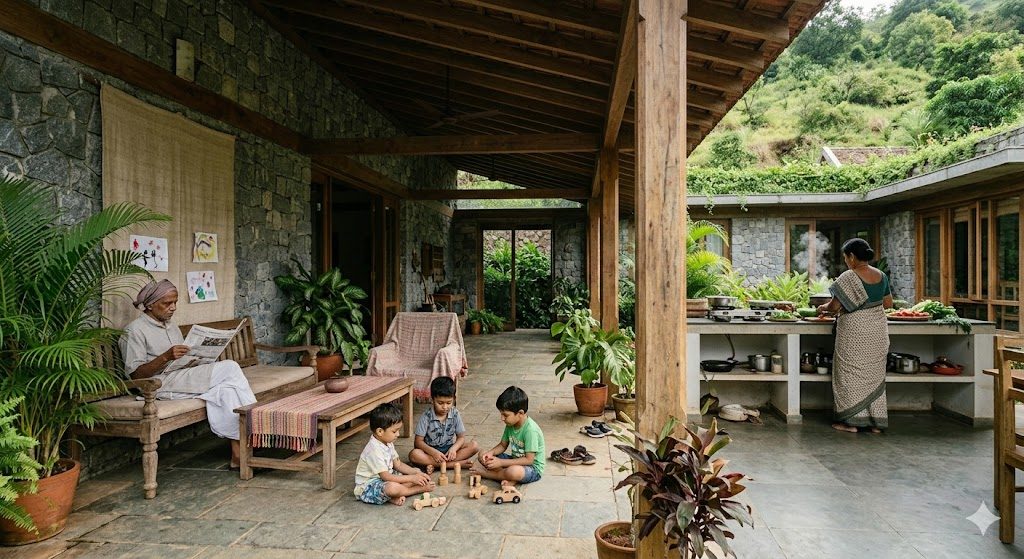
Designing for real Indian life means designing for things a Western template ignores: the joint family that needs both togetherness and privacy; the pooja space; the kitchen as the household's command centre; festival days when fifty guests arrive; the harsh sun and the monsoon; and the street as a living-room extension rather than a thing to wall out. Human-centered design in India is, more than anywhere, climate-centered and family-centered at once. The way good architecture quietly supports the nervous system — explored in architectural psychology and comfortable spaces and in how good architecture reduces stress — is the human-centered tradition stated in the language of wellbeing.
How to bring it into your own home
You do not need to be an architect to design your home around your life. You need to be a careful observer of it.
Start by writing a brief from how you actually live, not from what you have seen in magazines. Spend a week noticing: where does everyone end up in the evening; what is the morning bottleneck; who struggles with stairs or reaching; what happens when guests come; where the noise and the heat are worst. That honest diary is worth more than any mood board, and a structured tool like the Design Brief Generator can help you turn those observations into a clear set of needs.
Then design outward from the body. Check the ergonomics: are counters, switches, shelves and seats at heights your household can actually use, including the oldest and youngest? Build in accessibility before you need it — a step-free entry, a 900 mm or wider main doorway, lever handles, a bathroom that a wheelchair or a recovering knee could turn in. These cost almost nothing at the planning stage and are ruinously expensive to retrofit. Protect comfort actively: orient and shade for the sun, plan for cross-ventilation, soften hard surfaces that bounce noise, and get daylight onto the surfaces where people actually work. Make the home legible, so a guest can find the bathroom and a child can find their way in the dark. And before you commit to a plan, test it: tape it on the floor, or walk it in 3D with a tool like the Layout Planner, and ask whether it survives a wedding, an illness and an old age.
Where it goes wrong
Human-centered design fails in three quiet, common ways. The first is designing for an imaginary average person — a fit adult of average height and ability — and so excluding the child, the elder, the pregnant woman and the disabled, who are not edge cases but everyone, eventually. The second is mistaking what people say for what they do: clients ask for a formal dining room and then eat every meal in the kitchen, and a designer who takes the brief at face value builds a beautiful room nobody uses. Observation outranks survey. The third is sentimentality — assuming "human-centered" means soft, warm and informal as a look. It does not; it is a discipline, not a mood. A rigorous, even austere building can be deeply human-centered if every dimension was tested against a real person's day, and a cosy-looking one can be quietly hostile if it was not.
There is also a tension worth naming. Pure efficiency and pure expression both pull against the person, and human-centered design is the constant, humble work of holding the person at the centre while the budget, the developer's yield and the architect's ego all try to move them. It is less glamorous than a signature gesture. It is also the only reason a building is worth building at all.
Bring it home, in order
1. Keep a one-week diary of how your household actually lives — gatherings, bottlenecks, who struggles, what happens with guests — and turn it into a needs list, not a wish list.
2. Write or generate a real brief from that diary using the Design Brief Generator; name the true needs beneath the wishes.
3. Set the ergonomics: confirm counter, switch, shelf and seat heights work for your oldest and youngest members; fix the kitchen work triangle.
4. Build in accessibility now — step-free entry, a 900 mm-plus main door, lever handles, a turnable bathroom — while it is cheap.
5. Plan comfort actively: shade the sun, route cross-ventilation, soften noise, and get daylight onto work surfaces; lean on India's climate-responsive and courtyard logic.
6. Make it legible: clear arrival, intuitive routes, light where people decide where to go.
7. Prototype before you commit — tape the plan on the floor or walk it in 3D with the Layout Planner.
8. Test it against the hardest days you can imagine — a wedding, an illness, a power cut, your own old age — and revise before you build.
Designing a home around the people who will live in it is patient, observant work, and it rewards a partner who keeps the human at the centre at every step. DesignAI helps you do exactly that — translating how you actually live into plans, light and layouts you can walk through and test before a single wall goes up, so the house you build already knows you.
References
1. Vitruvius, "Ten Books on Architecture" (De architectura), c. 25 BCE — the firmness, commodity and delight triad; trans. Morris Hicky Morgan.
2. Henry Dreyfuss, "Designing for People" (1955) and "The Measure of Man" (1960) — anthropometrics and "Joe and Josephine."
3. Ernst Neufert, "Architects' Data" (Bauentwurfslehre, 1936 onward) — the standard reference of human dimensions and clearances.
4. Jane Jacobs, "The Death and Life of Great American Cities" (1961).
5. Christopher Alexander et al., "A Pattern Language" (1977) and "The Timeless Way of Building" (1979).
6. Jan Gehl, "Life Between Buildings" (1971) and "Cities for People" (2010).
7. Charles Correa, "A Place in the Shade: The New Landscape and Other Essays" (2010); and on Balkrishna Doshi, the 2018 Pritzker Prize jury citation and "Balkrishna Doshi: Architecture for the People."
If this idea moved you, follow it into its philosophical neighbours: read how a building can grow from the inside out in organic architecture, how design reconnects us to living systems in biophilic architecture, and how the same humanism shapes calm, low-stress homes in architectural psychology.
Export this guide
Related Guides — Deep-dive reading
Belapur Incremental Housing: How Charles Correa Gave the Poor a House That Could Grow
In Navi Mumbai, Charles Correa refused the housing block. Instead he gave roughly 550 families a small plot, an open-to-sky courtyard, and — crucially — no shared walls, so each house could be extended by its own occupants over decades. It is India's most quietly radical answer to where affordable housing should go next.
The Future of ArchitectureThe Street, Mathura: How Sanjay Puri Turned a Corridor into a Community
At GLA University near Mathura, Sanjay Puri Architects folded 800 hostel rooms into five snaking, four-storey blocks so that the leftover space between them became a genuine pedestrian street — a low-cost, climate-tuned answer to the question of how young people should live together, drawn from the winding lanes of an old Indian city.
The Future of ArchitectureDesigning Adaptable & Universal-Design Homes
Accessibility, Aging-in-Place, and the Multi-Stage Family — Code, Anthropometrics, and Plan-Stage Discipline for Indian Residential Architects
Room PlanningRelated Tools — Try Free
Cross-Ventilation Analyzer
Estimate airflow and air changes per hour (ACH) from room size, window areas, layout, and local wind — with NBC 2016 Part 8 compliance check.
Ventilation CalculatorAcoustic Privacy (STC) Visualizer
Indian healthcare acoustic visualizer — compare wall assemblies and noise sources, see received SPL after STC attenuation, and check FGI 2018 / IS 1950 / NABH speech-privacy compliance with live dual-canvas waveform.
Acoustic ToolBrise-Soleil Visualizer
Interactive horizontal-louvre cut-off angle calculator — sun altitude, louvre depth, and spacing inputs with a live shadow preview. Computes θ = arctan(spacing/depth) for façade shading, ECBC envelope compliance, hospital daylight design, and tropical sun-control detailing.
Sun Shading Tool