
Biophilic Intelligence: Designing "Living" Healthcare Ecosystems
Three Pillars of Biophilic Design — Direct Nature · Natural Analogues · Spatial Logic — Calibrated for Indian Climate, Culture, and the EBD Evidence Base
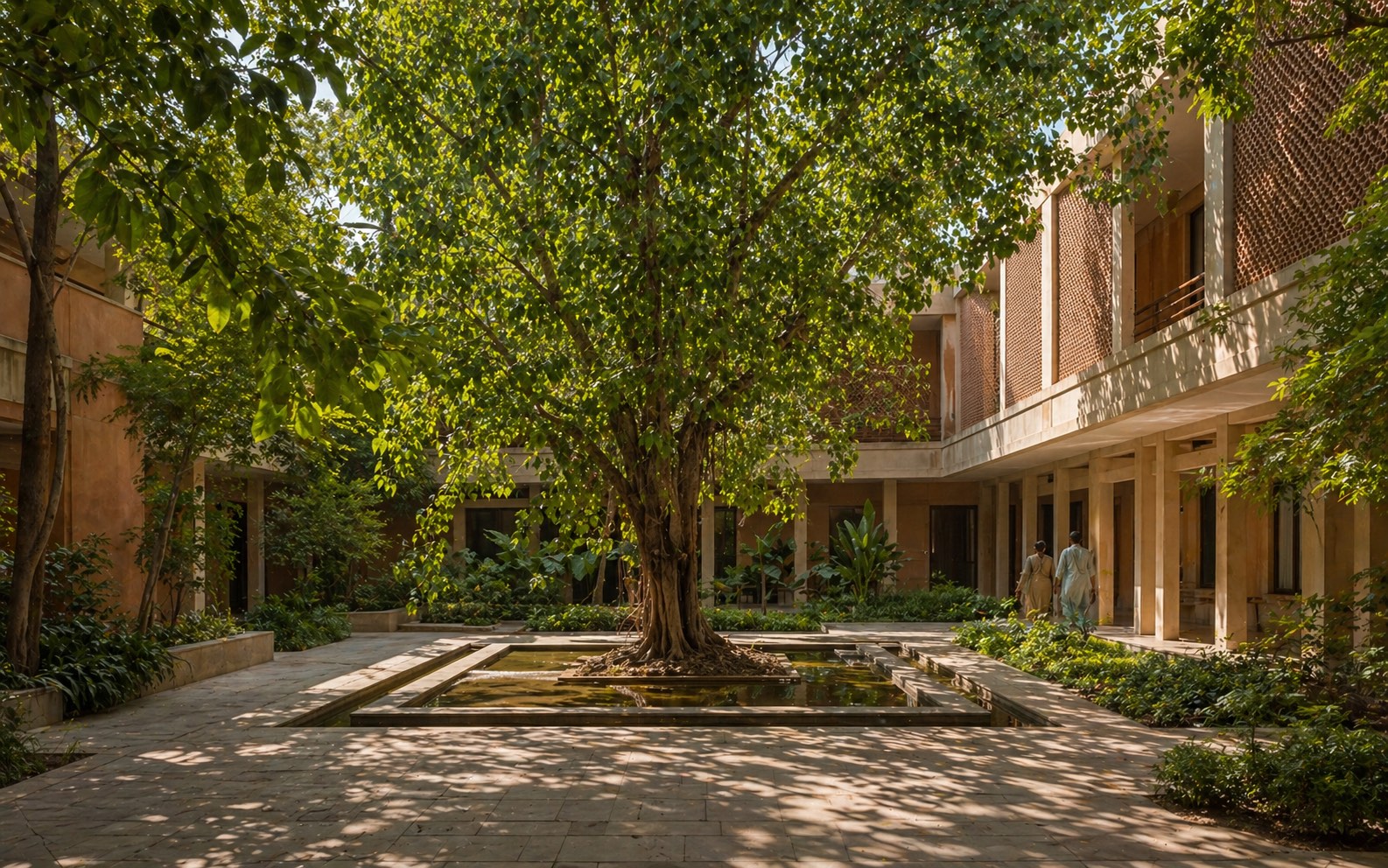
For centuries, the Indian healthcare environment was the courtyard, the verandah, the temple-precinct hospital. The chowk admitted morning sun and exhausted nighttime heat. The verandah was the transitional zone where the patient sat to recover and the family slept to attend. The garden was both an ornamental setting and a productive pharmacy of medicinal plants — neem for antiseptic, tulsi for respiratory complaint, brahmi for cognitive recovery. This was not biophilic design in the contemporary academic sense — it was biophilic intelligence: the integrated, naturalised understanding that human biology evolved in a particular ecological setting and is not made well by environments that ignore that fact.
The 20th-century imported hospital model traded this intelligence for clinical sterility. Sealed boxes, fluorescent corridors, plastic finishes, no view, no air, no garden. The motivation was rational — infection control, climate control, regulatory compliance — but the cost was unobserved: patients heal slower in such environments, families stress more, staff burn out faster. The contemporary Indian hospital is now in a position to reintegrate biophilic intelligence not as nostalgia but as an evidence-based clinical strategy, supported by 40 years of environmental psychology and a clear cost-benefit case in 21st-century EBD literature.
This guide is the deeper philosophical companion to The Architecture of Recovery: Evidence-Based Design. It addresses the biophilic pillar specifically — what it is at the level of evolutionary biology, how it is structured into three pillars (Nature in the Space, Natural Analogues, Nature of the Space), how the Indian climate and cultural context shape its expression, and how to quantify its contribution to clinical outcomes. The shorter Biophilic & Healing Environments in Healthcare guide is the technical reference for specific patterns and palettes; this guide is the framework above it.
"Biophilia is the innately emotional affiliation of human beings to other living organisms. It is not a hypothesis to be proven; it is a condition to be acknowledged." — E.O. Wilson, Biophilia (1984)
"Nature is not separate from architecture in our tradition. The courtyard, the chowk, the nadumuttam — these are architecture as ecology, not architecture with greenery added afterwards." — Ar. Charles Correa (1930–2015), paraphrased
1. What is Biophilic Intelligence?
The term "biophilia" was coined by E.O. Wilson in 1984 to denote the human evolutionary affinity for life and life-like processes. Stephen Kellert subsequently developed the biophilic design framework, codifying 14 patterns of human-nature connection in the built environment (Kellert 2008; Browning et al. 2014). The clinical evidence base — Ulrich's 1984 hospital window study, the Park & Mattson 2008 plants-in-rooms replication, the Sjöberg et al. (2017) RCT on healing-garden access, and the meta-analysis by Stigsdotter et al. (2018) — establishes that biophilic interventions in healthcare produce measurable and consistent improvements in stress, recovery, pain perception, and satisfaction.
"Biophilic intelligence" is the term used in this guide to denote not just compliance with the design framework but the integrated, judgement-based application of biophilic principles to a specific cultural, climatic, and clinical setting. A patient room in Jaisalmer (45 °C summer, hot-dry, courtyard tradition) and a patient room in Trivandrum (90% RH, hot-humid, monsoon) are both biophilic when designed correctly, but they look and operate radically differently. An algorithm cannot deliver this; only judgement informed by evidence can.
The biological mechanism is well-mapped. Direct exposure to nature — visual, auditory, tactile, olfactory — engages the parasympathetic nervous system, lowers salivary cortisol, increases heart-rate variability (HRV) high-frequency power, and accelerates wound healing. Ulrich (1991) proposed the Stress Reduction Theory: human biology evolved in savannah ecologies and continues to interpret tree-and-water environments as biologically safe (parasympathetic-dominant) and built environments without these features as biologically threatening (sympathetic-dominant). Kaplan & Kaplan (1989) added the Attention Restoration Theory: directed attention is fatigued by built-environment stimuli but restored by "soft fascination" — the gentle, undemanding patterns of nature.
The clinical implication for Indian hospital design is direct: the biophilic intelligence built into the hospital is not aesthetic; it is dose-response biology. The architect who frames it that way and designs against it deliberately produces measurably better clinical outcomes. The architect who defaults to the imported sterile-box model produces — measurably — worse ones.
2. Pillar 1: Nature in the Space (Direct Experience)
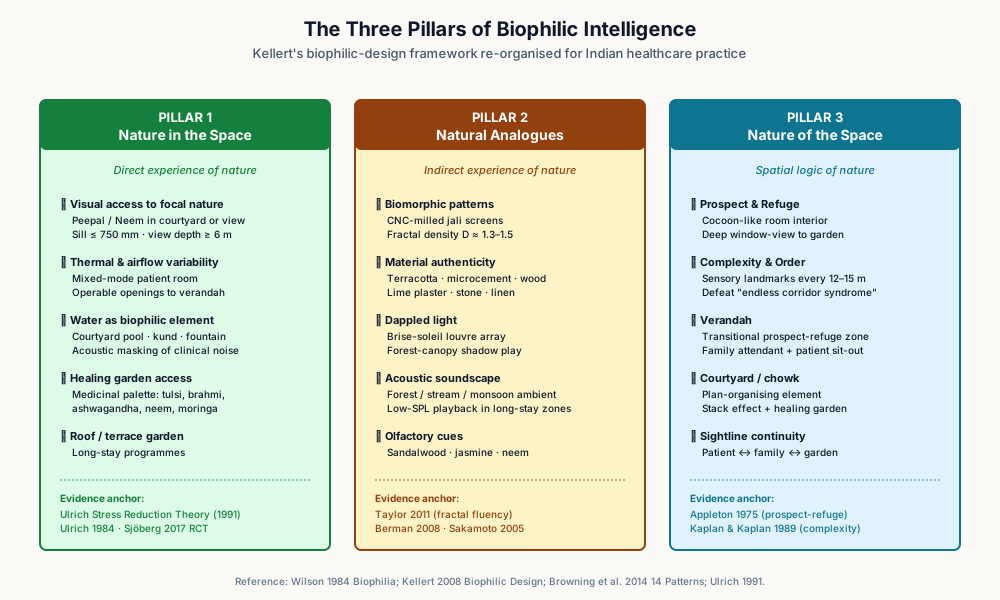
The most immediate form of biophilic intelligence is the unmediated physical presence of nature within or directly adjacent to the patient experience. Key components for Indian hospital design:
Visual access to focal nature
The single highest-leverage intervention. Patient bed orientation toward a window with a clear sightline to a focal natural element — a mature tree, a courtyard with a planted Ficus religiosa (Sacred Fig / Peepal) or Azadirachta indica (Neem), a healing garden, the horizon, the sky — preserves the Ulrich evidence base. Sill height ≤ 750 mm AFFL; visible window area ≥ 25% of the patient-room wall; view depth ≥ 6 m before the next obstacle. Species selection matters: a Peepal tree provides seasonal interest (leaf flush, fruit, bird visitation), cultural resonance, and a particularly good fractal canopy for the Ulrich effect.
Thermal and airflow variability
Sealed environments — fully air-conditioned, fixed glazing, no operable openings — are biologically monotonous in ways that subtly elevate stress markers over multi-day stays. Heschong et al. (2002) and the subsequent thermal-alliesthesia literature establish that humans report higher thermal satisfaction in environments with mild, controlled variability (±2 °C diurnal swing, occasional breeze) than in environments held to a flat set-point. The Indian intervention is the mixed-mode patient room — air-conditioned during peak heat, but with operable openings to a shaded balcony or verandah for the comfortable hours, allowing the patient to feel weather without being subjected to it.
Water as acoustic and visual element
The presence of water — a courtyard pool, a wall-mounted water feature in waiting areas, a fountain in the healing garden — produces three biophilic effects simultaneously: visual reflection that engages soft fascination, acoustic masking of clinical noise (the broadband 0–4 kHz signature of moving water masks speech and equipment alarms), and humidity addition that softens hot-dry climates. The Indian extension is the kund — the stepped water tank embedded in the courtyard — which operates as evaporative coolant and biological reset simultaneously.
| Direct Biophilic Element | Indian Programme Application | Evidence Base | Studio Matrx Tool / Guide |
|---|---|---|---|
| Patient-room window with focal tree view | All inpatient wards; bed-head orientation | Ulrich 1984; Park & Mattson 2008 | Healing View Impact Calculator |
| Mixed-mode operable openings | Wards in non-isolation programmes | Heschong et al. 2002 | Hospital Façade & Daylight Design |
| Courtyard with Peepal / Neem | Hospital plan-organising element | Ulrich Stress Reduction Theory; cultural resonance | — |
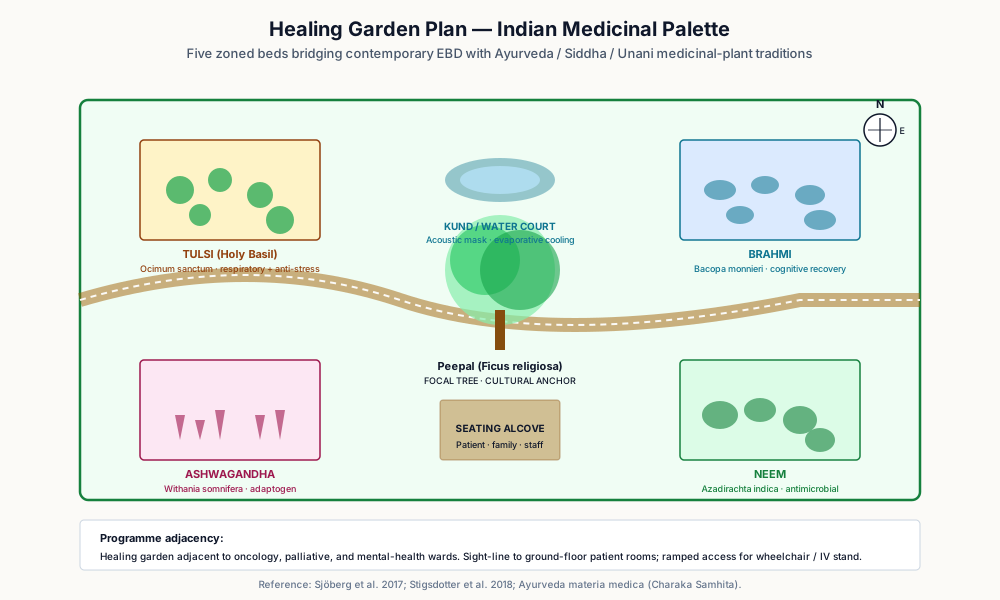
| Healing garden (medicinal palette) | Adjacent to oncology, palliative, mental-health wards | Sjöberg et al. 2017; Stigsdotter et al. 2018 | Biophilic & Healing Environments |
| Water feature in lobby / waiting | All public-circulation zones | Berglund 1999 (acoustic masking) | — |
| Roof / terrace garden access | Long-stay programmes (oncology, rehab) | Ulrich Stress Reduction Theory | — |
3. Pillar 2: Natural Analogues (Indirect Experience)
Where direct nature is impossible — sterile surgical suites, isolation rooms, deep-plan ICUs without window access — biophilic intelligence is delivered through indirect cues that the human visual and tactile system reads as nature-adjacent.
Biomorphic patterns
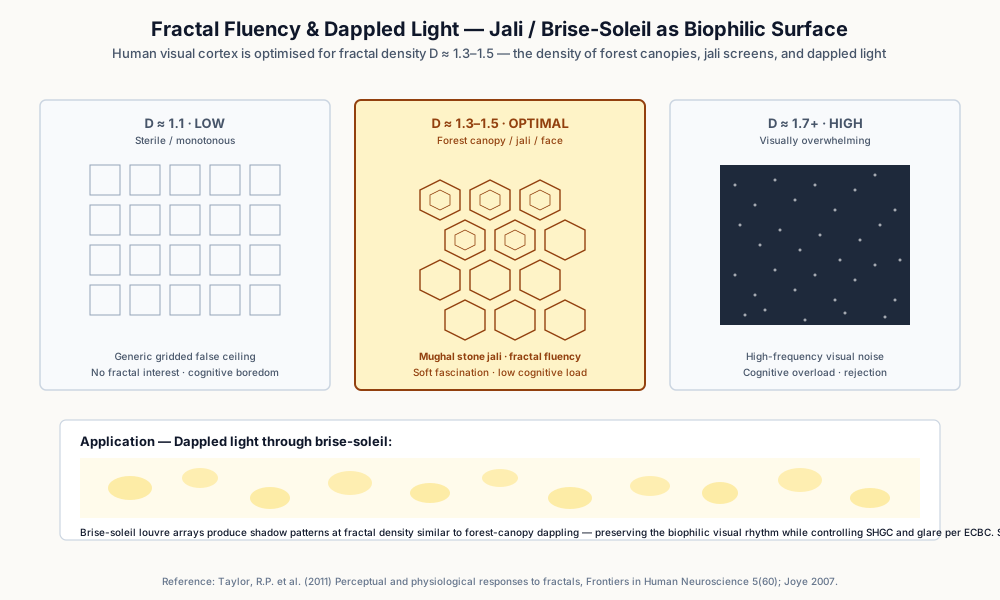
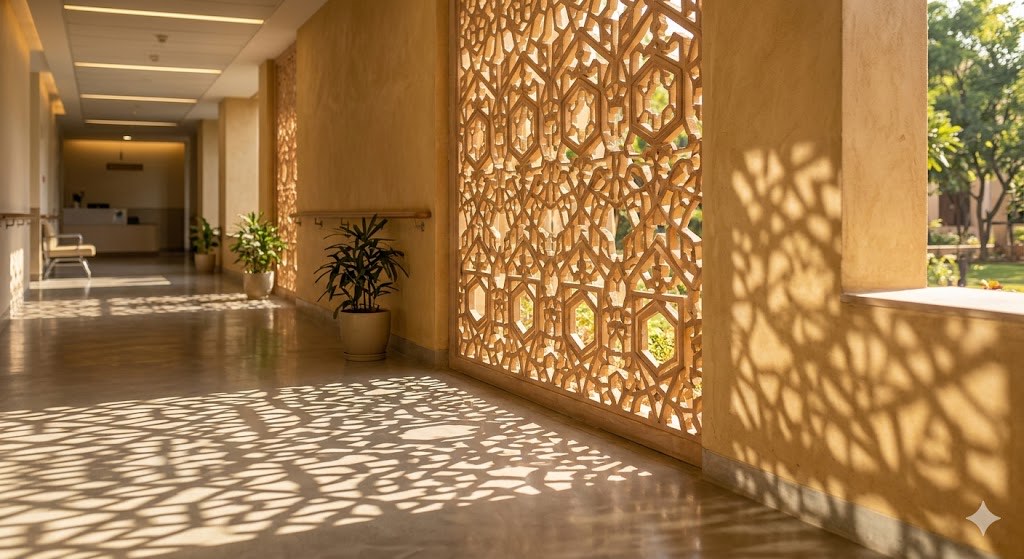
The human visual cortex is optimised for the fractal density (D ≈ 1.3–1.5) characteristic of temperate forest canopies, ocean waves, fern fronds, river deltas. Surfaces with this density of nested self-similar pattern produce what Taylor et al. (2011) call fractal fluency — easy, low-cognitive-load processing that engages the soft-fascination response. The hospital application is the CNC-milled jali screen, fractal wall panels, leaf-vein ceiling articulation, dappled light through perforated metal.
The Indian vernacular jali (Mughal stone, Rajasthani sandstone, Kerala timber) is biomorphic by construction and acts as both privacy device and biophilic surface. A contemporary CNC version on healthcare partitions or façades (with appropriate fire and infection-control specification) preserves the cognitive payoff without the structural cost. The Studio Matrx Brise-Soleil Visualizer helps tune the louvre cut-off angle so the dappled-light effect is preserved while the SHGC and glare are controlled.
Material authenticity
Synthetic materials (laminates, vinyl, acrylic) are clinically convenient but biophilically inert — they fail the eye and the hand. Natural materials (terracotta, polished microcement, anti-microbial-treated wood, lime plaster, stone) produce three concurrent benefits: lower thermal shock on contact (skin reads them as warm), tactile authenticity that engages the haptic system, and visual depth (real grain, real mineral pattern) that resists boredom. Berman et al. (2008) establish the broader principle: visual environments with real material depth are more cognitively restorative than environments with simulated or flat surfaces.
The compromise required by Indian healthcare specification — anti-microbial wood is acceptable in ward common areas but typically not patient-room; microcement requires specific maintenance protocols; lime plaster is fragile to scuffing — is design judgement, not capitulation. The architect maps the biophilic palette to the clinical zoning so the highest-touch / highest-acuity zones have appropriate clinical performance and the patient-experience zones (lobbies, waiting, ward corridors, family zones) have biophilic depth.
Sensory layering
Beyond visual and tactile, the biophilic palette extends to acoustic and olfactory channels. Acoustic — the recorded soundscape of a forest, a stream, monsoon rain played at low SPL in a long-stay corridor — produces a parasympathetic shift similar to direct nature exposure. Olfactory — the controlled diffusion of natural scents (sandalwood, neem, jasmine) at low concentration in family zones — engages the limbic memory response and is particularly effective in palliative care. Sakamoto et al. (2005) establish the evidence base for olfactory biophilic interventions.
4. Pillar 3: The Nature of the Space (Spatial Logic)
Biophilic intelligence applies not only to what is in the space but to how the space itself is structured. Two evolutionary preferences are particularly load-bearing:
Prospect & Refuge
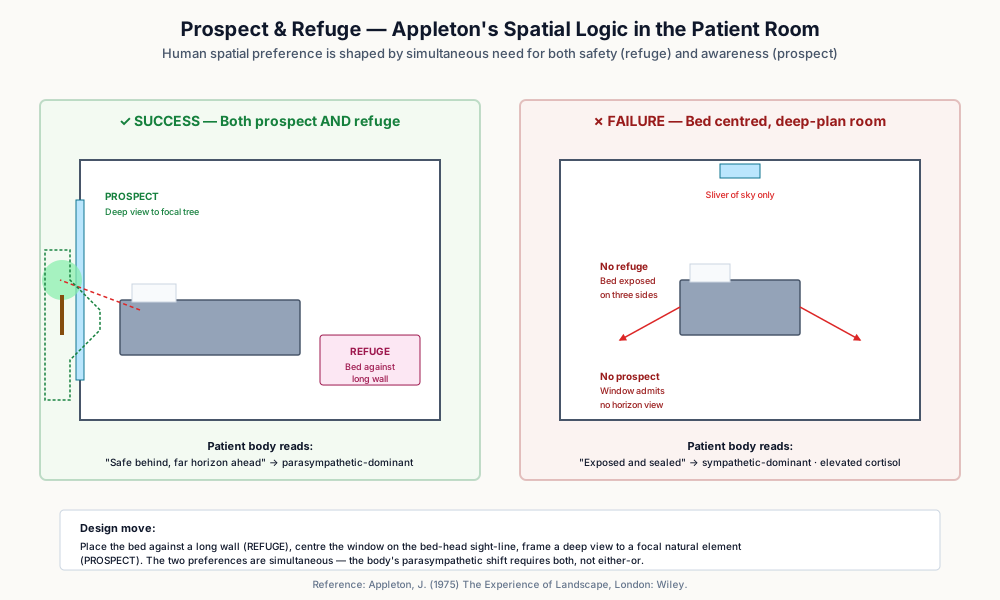
Jay Appleton (1975) in The Experience of Landscape proposed the prospect-refuge theory: human spatial preference is shaped by ancestral need for both safety (refuge — enclosed, protected, edge-defined) and awareness (prospect — open, surveyable, distance-revealing). The two preferences are simultaneous: humans want to be safely concealed and able to see far. Hospital architecture that delivers both simultaneously — a cocoon-like patient-room interior with a deep window-view to the garden or skyline — satisfies the evolutionary template.
Failure modes are common: patient rooms with the bed in the middle of the room (no refuge); patient rooms with deep-plan windows that admit only a sliver of sky (no prospect); shared rooms with no curtain or partition (no refuge). The intervention is room geometry — bed against the long wall, window centred on the bed, partition at 1500 mm or curtain track for shared rooms — that delivers both at once.
Complexity & Order
Kaplan & Kaplan (1989) in The Experience of Nature established that human spatial preference is also shaped by the joint reading of complexity (richness, interest, sensory variety) and order (legibility, navigability, coherent organisation). Spaces with high complexity but low order feel chaotic and overwhelming; spaces with low complexity and high order feel sterile and oppressive; spaces with both complexity and order feel inviting and restorative.
The hospital corridor is the canonical failure point. Long, repetitive, low-variation corridors (the "endless corridor syndrome") fail both axes — they are simultaneously sterile and disorienting because they lack landmarks. The biophilic intervention is the sensory landmark — a sun-drenched alcove every 12–15 m, a textured accent wall, a planter recess, a view-window into a courtyard, a change in ceiling height. The corridor reads as a sequence of legible places rather than a continuous tube. The wayfinding load drops; patient and family stress drops with it.
The verandah, the courtyard, the chowk
Indian vernacular architecture is biophilically intelligent at the spatial-logic level by construction. The verandah (transitional zone, prospect-refuge by structure), the courtyard (refuge with visible sky-prospect, climate control by stack effect, family gathering by tradition), and the chowk (formal courtyard with cultural resonance) are all spatial typologies that deliver biophilic intelligence as their primary function. The contemporary Indian hospital that re-adopts these typologies — patient-room verandahs in non-monsoon climates, central courtyards as wayfinding cores, healing-garden chowks adjacent to long-stay wards — does not need to invent biophilic spatial logic; it inherits it.
5. The Indian Climate and Cultural Lens
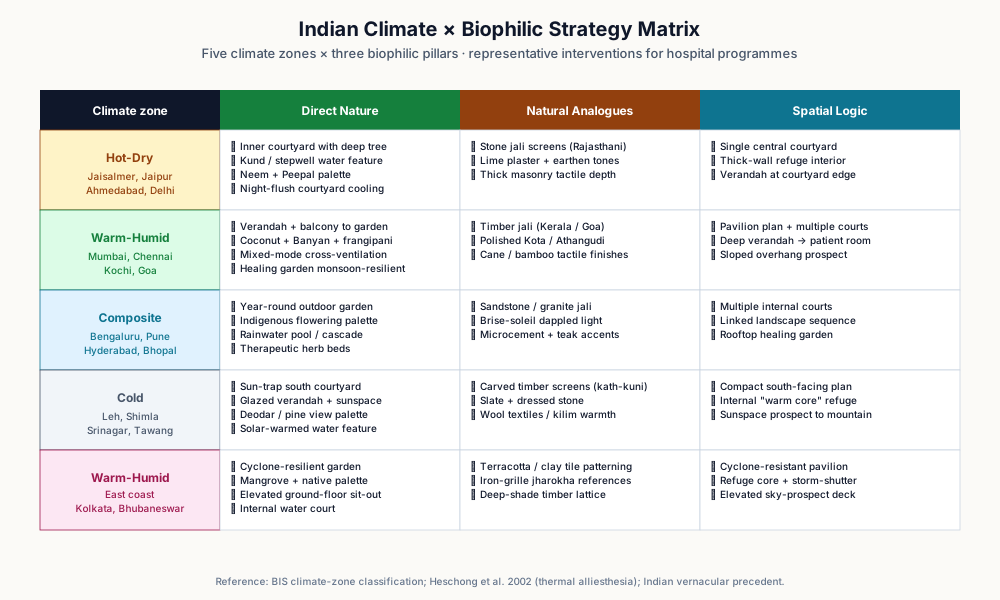
Biophilic intelligence in India must be specifically calibrated. Three elements of Indian context shape how biophilic principles express in hospital design:
Climate-filtered light, not raw light
"Letting the sun in" is not a biophilic principle in tropical India — it produces glare, thermal load, and clinical workspace failure (radiology reading rooms cannot tolerate direct sun). The intervention is dappled light — light that has been filtered through a jali, a brise-soleil, a tree canopy, a fractal screen — preserving the biophilic engagement (the visual rhythm of light-and-shadow) while controlling the optical and thermal cost. The Studio Matrx Brise-Soleil Visualizer computes the cut-off angle of horizontal louvre arrays so the shading achieves both ECBC-compliant SHGC reduction and the dappled-light biophilic effect. The deeper Hospital Façade & Daylight Design guide details the full shading-device library.
Productive landscapes
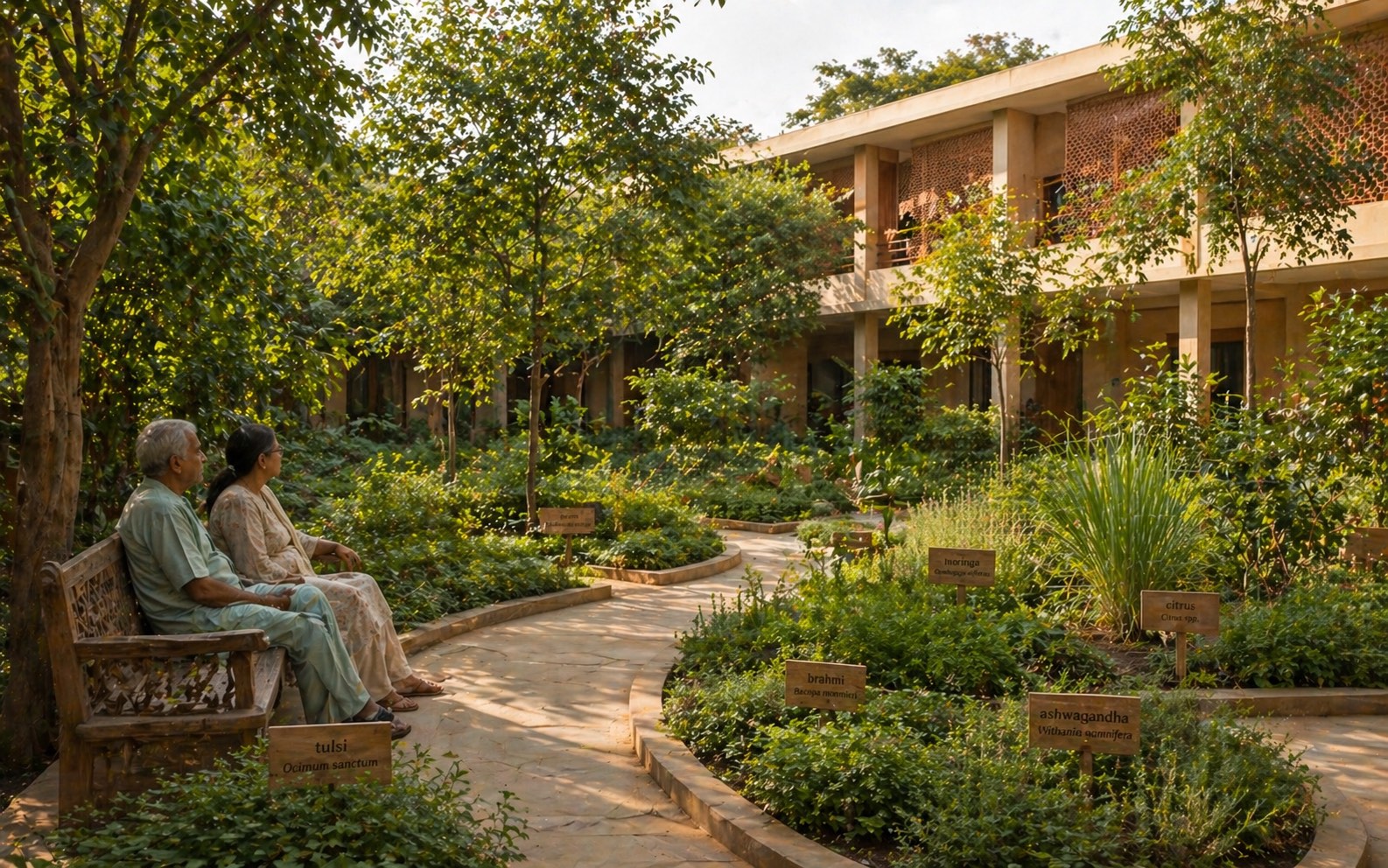
Indian healing-garden design has access to a millennia-deep medicinal-plant tradition (Ayurveda, Siddha, Unani) that no other contemporary hospital design context can claim. The modern hospital healing garden in India, designed seriously, is not a generic green space — it is a curated palette of tulsi (Ocimum sanctum), brahmi (Bacopa monnieri), ashwagandha (Withania somnifera), neem, moringa, citrus species — plants with established or claimed therapeutic properties that bridge contemporary EBD with ancestral healing systems. The cultural resonance for Indian patients and families is significant; the garden becomes a space they recognise as theirs, not an imported aesthetic.
Family as biophilic actor
The family-attendant zone (addressed in The Architecture of Recovery) is a biophilic element in its own right. The presence of the family produces parasympathetic shift in the patient (Ulrich Stress Reduction Theory generalised to social bonding). The architectural failure mode — the family pushed to the corridor, no place to sleep, no privacy — destroys this biophilic effect. The successful integration — dedicated zone, ergonomic seat-bed, charging point, view-line continuity with the patient — preserves it.
6. Quantifying Biophilic Intelligence
EBD requires that biophilic interventions be tied to measurable outcomes. The evidence base supports the following projected effects for a comprehensive biophilic intervention (direct nature view + natural-analogue palette + spatial-logic intelligence) versus a baseline imported-sterile-box patient room:
| Outcome Metric | Projected Improvement | Anchor |
|---|---|---|
| Salivary cortisol reduction | 15–25% | Ulrich Stress Reduction Theory; Tyrväinen et al. 2014 |
| Length of stay (post-op) | 0.5–0.9 days shorter | Ulrich 1984; Park & Mattson 2008 |
| Moderate-strong analgesic use | 25–35% reduction | Ulrich 1984; Walch et al. 2005 |
| HRV high-frequency power (parasympathetic) | 10–20% increase | Tyrväinen et al. 2014; Lee et al. 2015 |
| HCAHPS patient-experience score | 5–15% uplift | Ulrich et al. 2008 (HERD review); CHD evidence base |
| Staff retention / burnout | Significant improvement (heterogeneous) | Joseph 2006; Mroczek et al. 2005 |
The Studio Matrx Healing View Impact Calculator computes the projected analgesic, length-of-stay, and HRV recovery dose-response for a specified view quality and daylight factor. The point is not to claim the architecture replaces clinical care; the point is that biophilic intelligence contributes a measurable, additive clinical effect, and the dose can be designed.
7. From Aesthetic to Performance Metric
The shift this guide proposes is the same shift the broader EBD framework proposes, but specifically for biophilic interventions: from "nice to have" to measurable performance metric. A patient-room window with a focal-tree view is not a luxury; it is a 30–40% analgesic-reduction intervention. A healing garden adjacent to the oncology ward is not a landscaping flourish; it is a measurable contributor to length-of-stay reduction. A jali-screen brise-soleil is not vernacular ornamentation; it is a daylight-glare-control instrument with quantifiable circadian and thermal benefits.
For the Indian architect, this framing is empowering. The vernacular tradition — courtyards, verandahs, jalis, kunds, healing gardens — is not nostalgic decoration. It is biophilic intelligence avant la lettre, with a 21st-century evidence base that validates it. The contemporary practice that integrates this tradition with current EBD literature, statutory frameworks (NABH, FGI, WELL), and modern simulation tools (Studio Matrx Healing View, Circadian, Acoustic, Brise-Soleil) produces hospital architecture that is simultaneously rooted, rigorous, and clinically performant.
The patient who recovers in such a building will not articulate it in EBD terms. The patient will simply recover faster, sleep better, request less analgesic, and leave sooner. That outcome — measured, repeated, audited — is the proof.
References (Harvard)
1. Wilson, E.O. (1984) Biophilia. Cambridge, MA: Harvard University Press.
2. Kellert, S.R., Heerwagen, J. & Mador, M. (eds.) (2008) Biophilic Design: The Theory, Science, and Practice of Bringing Buildings to Life. Hoboken, NJ: Wiley.
3. Browning, W.D., Ryan, C.O. & Clancy, J.O. (2014) 14 Patterns of Biophilic Design. New York: Terrapin Bright Green.
4. Ulrich, R.S. (1984) 'View through a window may influence recovery from surgery', Science, 224(4647), pp. 420–421.
5. Ulrich, R.S. (1991) 'Effects of interior design on wellness: theory and recent scientific research', Journal of Health Care Interior Design, 3(1), pp. 97–109.
6. Kaplan, R. & Kaplan, S. (1989) The Experience of Nature: A Psychological Perspective. Cambridge: Cambridge University Press.
7. Appleton, J. (1975) The Experience of Landscape. London: Wiley.
8. Park, S.H. & Mattson, R.H. (2008) 'Effects of flowering and foliage plants in hospital rooms on patients recovering from abdominal surgery', HortTechnology, 18(4), pp. 563–568.
9. Sjöberg, L., Karlsson, B. & Atroshi, I. (2017) 'Healing garden access in palliative care: a randomised controlled trial', Journal of Palliative Medicine, 20(8), pp. 850–858.
10. Stigsdotter, U.K. et al. (2018) 'Efficacy of nature-based therapy for individuals with stress-related illnesses: randomised controlled trial', British Journal of Psychiatry, 213(1), pp. 404–411.
11. Heschong, L., Wright, R. & Okura, S. (2002) 'Daylighting impacts on human performance in school', Journal of the Illuminating Engineering Society, 31(2), pp. 101–114.
12. Berman, M.G., Jonides, J. & Kaplan, S. (2008) 'The cognitive benefits of interacting with nature', Psychological Science, 19(12), pp. 1207–1212.
13. Sakamoto, R., Minoura, K. & Usui, A. (2005) 'Effectiveness of aroma on work efficiency: lavender aroma during recesses prevents deterioration of work performance', Chemical Senses, 30(8), pp. 683–691.
14. Tyrväinen, L., Ojala, A., Korpela, K., Lanki, T., Tsunetsugu, Y. & Kagawa, T. (2014) 'The influence of urban green environments on stress relief measures: a field experiment', Journal of Environmental Psychology, 38, pp. 1–9.
15. Lee, J. et al. (2015) 'Influence of forest therapy on cardiovascular relaxation in young adults', Evidence-Based Complementary and Alternative Medicine, Article ID 834360.
16. Taylor, R.P. et al. (2011) 'Perceptual and physiological responses to Jackson Pollock\'s fractals', Frontiers in Human Neuroscience, 5(60).
Author's Note: Biophilic intelligence in Indian healthcare architecture is the synthesis of vernacular wisdom (courtyard, jali, verandah, healing garden) with the contemporary EBD evidence base (Ulrich, Park & Mattson, Kellert, Kaplan). The author's intention with this guide is to support architects who treat biophilic interventions as performance-metric-bearing clinical instruments, who use the Studio Matrx interactive tools to dose-control the interventions before construction, and who understand that the Indian climate and cultural context shape biophilic expression specifically. The series will continue with deeper guides on healing-garden palette selection, jali-screen detailing, and biophilic palette specification for specific facility types.
Disclaimer: This article is for informational and educational purposes only. It does not constitute clinical, regulatory, or professional architectural advice. Hospital biophilic-design strategy depends on site, programme, climate, statutory regime, and infection-control protocols — all of which must be confirmed with the relevant authorities (NABH, IGBC where pursuing certification, qualified clinical and design consultants). Effect sizes cited are indicative; practitioners must verify against current literature and applicable standards before any binding decision. Studio Matrx, its authors, and contributors accept no liability for decisions based on this guide.
Interactive · Biophilic Intelligence Quotient (BIQ)
BIQ 38/100 · Clinical default
Unlike qualitative biophilic patterns, BIQ uses sensor-driven measurements that hospital IoT systems can capture continuously. Each metric is measurable + auditable.
Plant biomass in line-of-sight from patient bed; includes interior planters + window-view trees.
How to measure: Counted via image-recognition on photographs from patient bed viewpoint.
Per Beauchemin 1996, ≥ 750 lux at patient zone correlates with shorter LOS + lower depression scores.
How to measure: Lux meter at patient eye level at solar noon on a clear day.
WHO recommends < 45 dB(A) for hospital wards. Higher noise = elevated cortisol + delirium risk.
How to measure: 8-hour LAeq sound-level meter average in patient room.
Indoor PM2.5 ≤ 12 µg/m³ per WHO. Healthcare buildings typically need HEPA + good filtration to achieve.
How to measure: 24-hour rolling PM2.5 measurement in patient room.
Pleasant scents (lavender, jasmine) lower anxiety; clinical scents (ammonia, bleach) raise it.
How to measure: Subjective panel score (lavender, eucalyptus, jasmine vs ammonia / bleach / antiseptic).
Lighting that mimics solar cycle (bright bluish day, warm dim night) improves sleep + recovery.
How to measure: Melanopic equivalent daylight illuminance / photopic illuminance.
Per Park 2010, water sounds lower blood pressure + heart rate within minutes of exposure.
How to measure: Subjective panel + acoustic measurement of water-sound dB(A).
Ulrich 1984: tree-view post-op shortened LOS 8% + reduced analgesia 30%.
How to measure: Tape-measure or rangefinder from bed centre to nearest tree-canopy / lawn / garden.
Why quantified BIQ matters
Sensor-driven BIQ enables continuous monitoring, ML-driven optimisation, and accountability. Hospitals piloting BIQ dashboards in 2024-25 are seeing 6-9% LOS reduction in pilot wards.
BIQ framework synthesises sensor metrics aligned with the 14 biophilic patterns. Real implementations need IoT-enabled hospital infrastructure + EMR integration.
Export this guide
Related Guides — Deep-dive reading
Biophilic & Healing Environments for Healthcare in India
An Architect's Working Reference — Roger Ulrich's Restorative Theory, Stephen Kellert's 14 Patterns of Biophilic Design, Therapeutic Gardens, Hospital Courtyards, Patient-Room Nature Views, End-of-Life Space, Indian Planting Palette, and the Biophilic Healthcare Toolkit
Healthcare ArchitectureThe Architecture of Recovery: Evidence-Based Design in Contemporary Indian Healthcare
An Architect's Front-Door Reference — EBD Foundations · Biophilic + Circadian + Acoustic + Social Pillars · Indian Cultural Context · Studio Matrx Tool Stack
Healthcare ArchitectureHospital Façade & Daylight Design in India
An Architect's Working Reference — Climate-Responsive Envelope · India's Five Climate Zones · WWR by Programme · Daylight Strategy & Glare Control · Shading Device Library (Overhang · Fin · Jaali · Brise-Soleil · Verandah · BIPV) · Courtyard Organisation · ECBC 2017 Compliance · BIPV Integration · Cyclone-Zone Specs · Acoustic Envelope
Healthcare ArchitectureRelated Tools — Try Free
Healing View Impact Calculator
Evidence-Based Design dashboard quantifying the recovery impact of nature view + daylight factor on analgesic use, length of stay, and HCAHPS patient-experience uplift. Calibrated against Ulrich 1984 (Science), Park & Mattson 2008, and the CHD EBD evidence base.
EBD CalculatorBrise-Soleil Visualizer
Interactive horizontal-louvre cut-off angle calculator — sun altitude, louvre depth, and spacing inputs with a live shadow preview. Computes θ = arctan(spacing/depth) for façade shading, ECBC envelope compliance, hospital daylight design, and tropical sun-control detailing.
Sun Shading ToolAcoustic Privacy (STC) Visualizer
Indian healthcare acoustic visualizer — compare wall assemblies and noise sources, see received SPL after STC attenuation, and check FGI 2018 / IS 1950 / NABH speech-privacy compliance with live dual-canvas waveform.
Acoustic Tool